
On this page
Table of Contents

If you want the bigger picture of what the electrical trade teaches beyond technical skills, start here: 🔹 “What the Electrical Trade Teaches You: Discipline, Problem-Solving, and Real-World Growth”
After that, this story will hit deeper.
Don’t try to jump from zero to perfect. Start where the risk of serious injury is highest and the fix is simplest:
- Before you leave home or the shop: hard hat, safety glasses, proper footwear.
- When you arrive on site: notice open edges, temporary power, overhead work.
- Before you start a task: pause for three seconds and scan the area.
You don’t need to hit 100 percent overnight. Removing just a few high-risk situations from your day is already a huge win.
If you walk onto almost any construction site in the U.S. and ask ten people, “Do you think construction site safety is important?”, all ten will say, “Of course.”
But take a slow walk around the jobsite and you’ll see something else: some people treat safety like a checklist, some treat it like background noise, and some quietly think, “We’ve got the gear if we need it, but it’s not that big a deal.”
So whose job is construction site safety, really? And how did it turn into something everybody says they care about, but nobody truly owns?
Construction site safety isn’t as distant as it sounds
Before you roll your eyes and think, “Here we go again, another safety lecture,” pause for a second.
On most jobs, accidents don’t happen because people have never heard of OSHA or never saw a safety manual. They happen because somebody thought, “Today’s probably fine,” or “I’ll just do it this once.”
A lot of folks think wearing a hard hat or high-visibility vest is just for inspectors or company photos. But every rule in your safety plan, every OSHA standard, was written because somebody somewhere paid for it with real pain, lost income, or worse. That’s what construction site safety standards are really built on.
Before we start: 3 key ideas about construction site safety
- Construction site safety isn’t “nothing happened yesterday so we’ll be fine today.” It’s a habit you rebuild every single shift.
- The culture on your crew quietly decides whether people “half-do” safety or actually treat it like part of the work.
- Every small decision—clipping your chin strap, labeling a temp power line, putting a guardrail back—is you deciding whether you get to go home in one piece.
The most dangerous phrase: “It’s just for a second”
You probably see scenes like this every week:
- Hard hat hanging from someone’s hand, ready to go on only if the superintendent walks by.
- Guardrail taken down to move material, never put back because “we’ll come right back to it.”
- Water on the floor in a dark hallway; everyone just steps around it, nobody puts up a sign.
- Extension cords and power strips everywhere, one outlet feeding half the room like an electrical octopus.
Everyone is thinking, “I’ll be careful, nothing will happen.”
But accidents don’t ask if you’re ready. They don’t care that you were planning to fix it in five minutes.
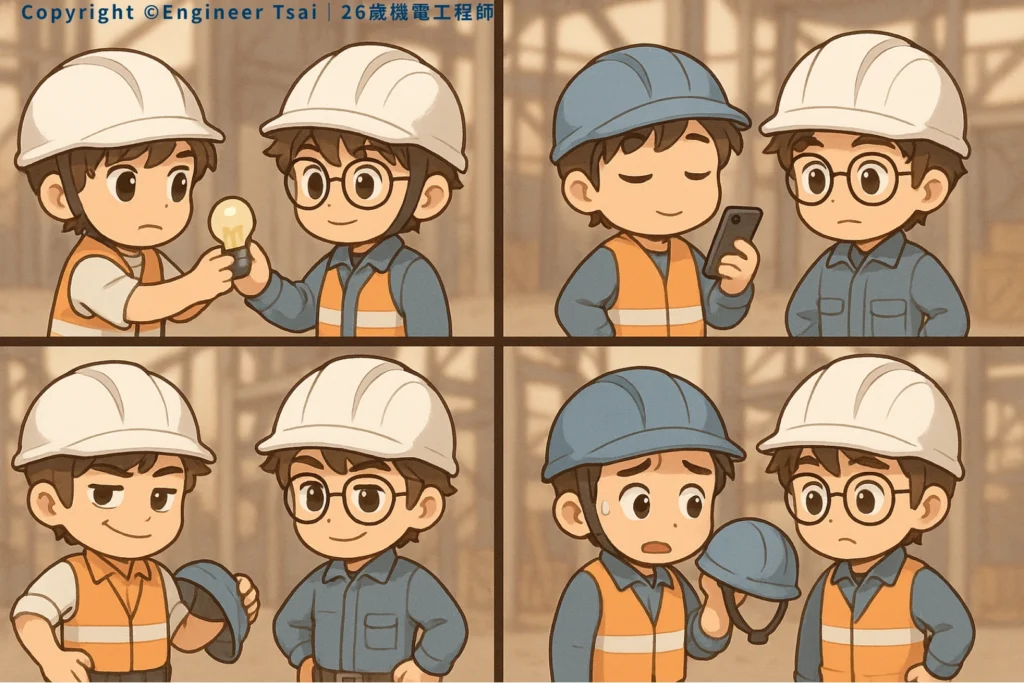
Where jobsite safety culture splits: Which camp are you in?
If you look around your crew, you’ll probably recognize yourself in at least one of these groups.
Together, they make up your jobsite safety culture.
1. The safety-first crew — rules are a life insurance policy
These are the people who actually read the safety plan, wear their PPE correctly, and remind others, “If you don’t have a hard hat on, you’re not really on site.”
They might sound nagging to some, but when something goes wrong, they’re usually the calm ones who know what to do and who to call.
2. The “only when someone is watching” crew
These folks do whatever the supervisor checks for. When inspections are happening, they click into full compliance. As soon as nobody is looking, straps loosen, guards come off, rules soften.
They know the rules—but in their head, safety is paperwork, not habit.
3. The overconfident veterans — experience over rules
You’ve heard this line: “I’ve been doing this twenty years and never had an accident.”
That confidence can be earned—but it can also be blinding. When experience starts to feel more reliable than the fall-protection plan, the risk goes up fast. Sadly, serious accidents often hit this group the hardest.
4. The nervous newbies — afraid of being yelled at, not of getting hurt
Apprentices and new hires don’t want to slow the crew down or look dumb. They see risky behavior, but they’re scared to speak up and just follow whatever seems “normal” on that site.
If they land on a job where nobody models good habits, their whole safety baseline starts way too low.
Your jobsite safety culture is basically a tug-of-war between these four groups.
The side you stand on changes how everyone else thinks about safety.
The 5 small details that cause the most accidents on site
On jobsites I’ve worked on—and from stories across the industry—the same small issues keep showing up. Many people later call it an “accident,” but most of those accidents are really just the result of small details adding up over time.
- Hard hats with loose or unbuckled straps
If you slip or something falls, a loose hard hat won’t stay on your head when you actually need it. - Temporary power run with no plan or labels
Cords knotted together, running across walkways, sharing outlets in ways they were never designed for. Easy to trip on, easy to unplug the wrong thing, easy to overload. - Half-removed guardrails
Railings taken down “just for a minute” to move a pallet and never put back. People forget, lighting changes, somebody backs up without looking. - No warning around active work areas
Wet floors, open edges, floor openings left unmarked. You step around it because you know it’s there; the next person doesn’t. - Working at height with no proper tie-off
“I’m just climbing up for a quick look” turns into a life-changing fall. One moment of rushing can rewrite the rest of your career.
These details are not picky rules. They’re the small decisions that decide whether everyone gets to clock out and drive home.
Why construction site safety turns into “just a suggestion”
If everyone says safety matters, why does it still end up treated like optional fine print?
- Schedules are brutal. Crews get the message that speed matters more than anything else.
- PPE and guardrails feel like they slow people down or “get in the way of real work.”
- Some rules look like they’re only there so the company can say, “We had a policy,” if something goes wrong.
- If the most experienced people ignore the rules, everyone else quietly assumes the rules don’t really count.
But when something serious happens, nobody else can fully absorb what you lose.
Workers’ comp checks can’t replace your knees, your back, or your ability to pick up your kids. There is no make-up exam for a life-changing injury.
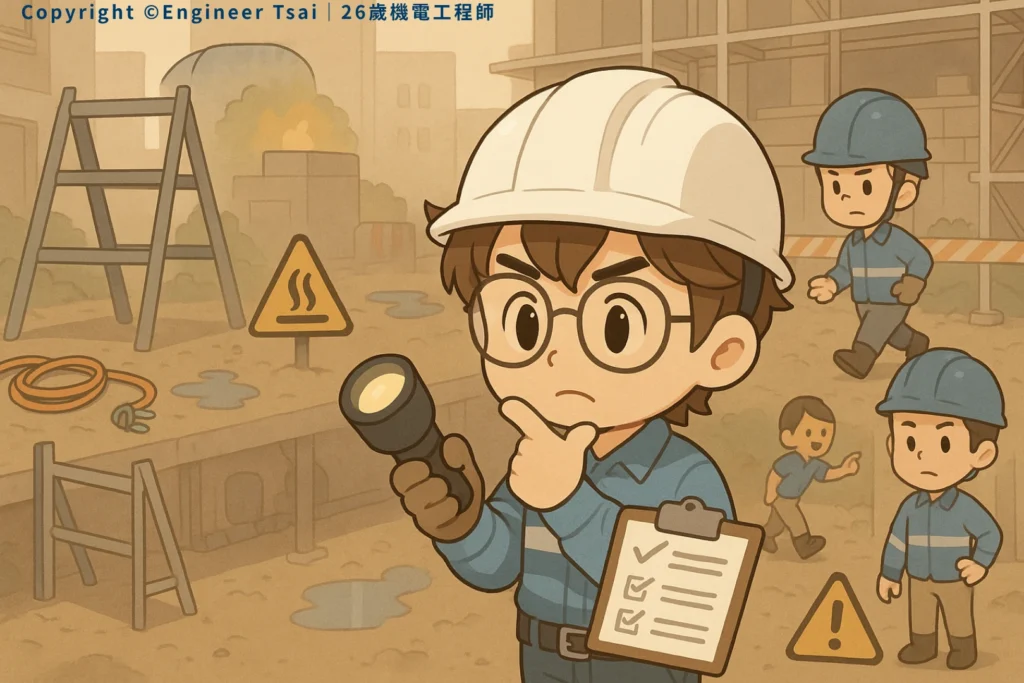
On-site playbook: 3 everyday safety rules
If you want fewer close calls and fewer hospital trips, you don’t need a 200-page manual.
Start with these three simple rules and repeat them until they’re muscle memory.
1. Pause for 3 seconds before you touch anything
Not to drag the job out—just to actually look:
- Look down: cords, holes, rebar, scrap, slick spots.
- Look up: overhead work, suspended loads, unprotected edges.
- Look around: hot work, cutting, grinding, spray, vehicle traffic.
Those three seconds are often the difference between “That was close” and “We need an ambulance.”
2. Use reminders instead of blame
When you see someone doing something risky—no hard hat, no glasses, climbing where they shouldn’t—you don’t always have to bark orders.
Try something like:
- “Hey, there’s overhead work right there—throw your hard hat on so you don’t get nailed.”
- “Let’s tape or tag this cord. I don’t want the next crew tripping over our temporary power.”
Same goal—protecting the crew and the job—but with a tone that says, “We’re in this together,” instead of “I’m better than you.”
That tone decides whether people actually listen.
3. If you don’t understand, ask. If you feel uneasy, speak up.
The most dangerous phrase on any site is, “I figured it was fine.”
If something feels off, that’s your brain waving a red flag.
- Can’t read the drawing or method clearly? Ask.
- Think the proposed shortcut looks sketchy? Ask.
- Feel like the work area is just wrong—too cluttered, too dark, too wet? Stop and talk to someone in charge.
The extra question you ask today might be the reason you and a coworker both walk off that job tomorrow.
External resources: U.S. jobsite safety
If you’d like to go deeper into official U.S. construction safety rules and best practices, these are great starting points:
- OSHA – Construction Industry
Official OSHA hub for construction safety standards, toolbox topics, and training resources in the U.S. - NIOSH – Construction Safety & Health
Research-based guidance from the National Institute for Occupational Safety and Health, focused on preventing injuries and fatalities in construction. - CPWR – The Center for Construction Research and Training
Non-profit organization dedicated to construction safety research, training materials, and practical field tools for contractors and workers.
FAQ: How far do I really need to go with construction site safety?
Q1: I’m just a small subcontractor. Do I really need to care this much about construction site safety?
Yes. When something goes wrong on a jobsite, the first people hurt are the ones actually on the floor or in the bucket—not the people whose names are on the drawings.
GCs, owners, and insurance all matter, but a serious accident hits your body, your income, and your family first.
So safety isn’t just about avoiding fines or keeping the GC happy. It’s about making sure you can keep working and keep providing for the people who rely on you.
Q2: The old-timers on my crew don’t take safety seriously. Am I weird if I follow every rule?
At first, yeah, some people might tease you for being “too careful.”
But if you quietly do your job, wear your PPE, and fix what you can fix without making a scene, people adjust. Pretty soon you’re “the one who always does safety right.”
And when the crew has a close call—or a minor injury—you suddenly become the person people ask, “Hey, can you take a look at this setup?”
Culture shifts start with one or two people willing to behave differently.
Q3: I’m an apprentice. I see dangerous stuff but I don’t know who to tell.
Start with the person directly responsible for you: your foreman, lead tech, or journeyman. Describe what you saw, not what you think of it:
“There’s an open edge on the third floor with no rail,” or “That temp panel has exposed live parts.”
If they agree it’s a problem, ask them to walk with you to the site superintendent or safety manager and report it together. If you believe it’s immediately dangerous—fall hazards with no protection, live conductors exposed where anyone can touch them—stay clear of the area until someone with authority addresses it.
You’re not being dramatic. You’re preventing a much bigger problem.
Q4: There are so many construction site safety rules. Where do I even start?
Don’t try to jump from zero to perfect. Start where the risk of serious injury is highest and the fix is simplest:
Before you leave home or the shop: hard hat, safety glasses, proper footwear.
When you arrive on site: notice open edges, temporary power, overhead work.
Before you start a task: pause for three seconds and scan the area.
You don’t need to hit 100 percent overnight. Removing just a few high-risk situations from your day is already a huge win.
A quote to bring back to the jobsite
“Safety isn’t a rulebook; it’s your ticket home every night. Nobody on your crew wants to be the one everyone remembers from the story that starts with, ‘Next time, we’ll be more careful.’”
Call to action|Build a jobsite safety culture that actually cares
If you like field-tested stories, practical rules, and honest conversations about construction site safety, follow Engineer Tsai.
Let’s learn how to protect ourselves and look out for each other—until safety becomes an unspoken habit on every job, not just a slogan on the wall.
📌 Recommended reading
🔹What Is a Short Circuit and How Do You Prevent It?
Understand how short circuits really happen in everyday electrical work so you can prevent fires and equipment damage before they start.
🔹Conductors vs. Insulators: A Practical Guide to Electrical Safety
Learn how different materials behave around electricity and how to choose the right ones to reduce shock and fire risks.
🔹The Hidden Risks on Your Jobsite: 10 Safety Blind Spots You Might Be Missing(coming soon)
A checklist-style look at the most commonly overlooked hazards and how to spot them before they hurt someone.