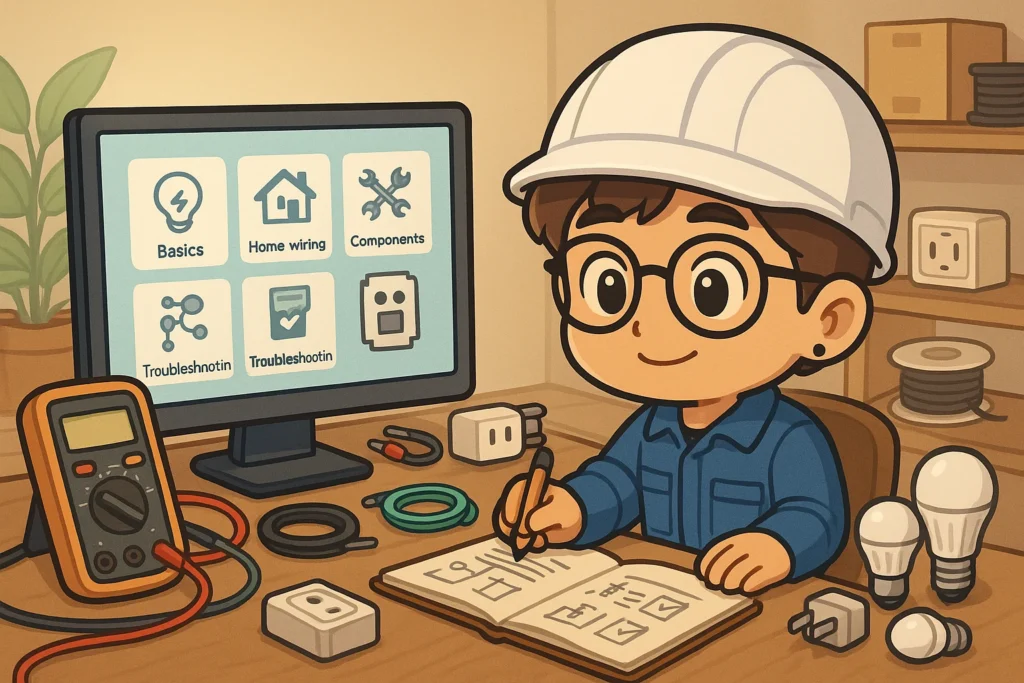
These Electrical Guides turn core electrical concepts into short, field-tested lessons with diagrams and checklists. Start with the basics, then follow a learning path for home wiring, safety, and components. Each Electrical Guide ends with a quick task, a tool list, and a study map so you can practice today and return later with confidence.
First, search a topic. Then, pick one guide and finish a quick task. Afterward, use the checklist to confirm the result. Additionally, each article links to tools and study maps, so you can learn fast and act with confidence.
To start, browse the latest posts. Then, pick one guide and try a single task. Afterward, use the checklist to confirm the result. In addition, each article links to tools and study maps, so you can learn and act with confidence.
All articles
-
Electrical Foreman Communication and Estimating Basics: Pre-Task Briefs, Takeoffs, Labor Hours and Variance, With Worked Examples
For senior apprentices and new journeymen moving toward lead roles: how to run a pre-task brief, do a device and cable takeoff,…
-
Electrical Preventive Maintenance Planning for Apprentices: Asset Lists, Criticality, Intervals and Records, With Worked Examples
How to build a simple electrical preventive maintenance (PM) plan: list the assets, rank criticality, set intervals, assign an owner, and keep…
-
Commercial Electrical Layout and Coordination for Apprentices: Gridlines, Elevations, Conflict Logs and RFIs, With Worked Examples
How a second-year electrical apprentice lays out commercial work from gridlines and finished-floor elevations, transfers plan dimensions, spots conflicts with other trades…
-
Residential Rough-In and Trim for Apprentices: The Sequence, Room Checklists and Inspection Holds, With Worked Examples
A first-year apprentice’s guide to residential electrical rough-in and trim-out: the job sequence, rough-in and trim checklists, the inspection hold before insulation…
-
Electrical Blueprint Symbols and Plan Reading for Apprentices: Legends, Scales, Schedules and Details, With Worked Examples
How a first-year electrical apprentice reads a plan set: sheet order, the symbol legend, common electrical symbols, architectural scales, half-size prints, and…
-
NEC 690 Solar PV and NEC 700 Emergency Systems for Apprentices: What Each Article Covers, With PV Current and Voltage Examples (2026 NEC)
An apprentice guide to NEC Article 690 solar PV and Article 700 emergency systems: how to trace a PV system and an…
-
NEC 430 Motor Circuits for Apprentices: Full-Load Current, Conductor Size, Overloads and Breaker Size, With Worked Examples (2026 NEC)
How to size a motor circuit under NEC Article 430: when to use table full-load current or nameplate current, 125% conductors, overload…
-
NEC 230 and 240 for Apprentices: Services and Overcurrent Protection, With Worked Examples (2026 NEC)
NEC Article 230 services and Article 240 overcurrent protection in plain words: service parts on a one-line, standard breaker sizes, the next-size-up…
-
NEC Article 300 and the Raceway Articles: How to Pick a Raceway and Calculate Conduit Fill, With Worked Examples (2026 NEC)
How apprentices use NEC Article 300 and the Chapter 3 raceway articles: which raceway article to open (EMT, RMC, PVC, FMC, LFMC),…
About this Electrical Guides Library
This page is your index for all electrical guides on Tsai Electro. Moreover, you can search and filter tutorials covering basics, home wiring, components, safety and troubleshooting. Because each guide keeps theory short and focuses on steps, diagrams and checklists, you learn faster. As a result, you can move from reading to doing with less guesswork.
Topics These Electrical Guides Cover
Electrical fundamentals · Ohm’s law · AC/DC basics · Home wiring and outlets · Protective devices and relays · Meters and safe measurement · Components and LED drivers · Troubleshooting common faults and practical fixes.
How to Use These Electrical Guides
- First, use the search box or category pills to find a topic.
- Next, open one guide and complete a single task with the checklist.
- Finally, save the tools and diagrams linked inside each article for later jobs.
FAQ
Where should beginners start?
For beginners, start with Tutorials, then the “Electrical Basics” path; after that, move to wiring and safety.
Are these tutorials safe for DIY?
Yes, but always follow safety notes; if unsure, consult a licensed professional.
What tools do I need?
Typically, a non-contact tester, a multimeter, insulated screwdrivers and proper PPE are enough.
What’s the difference between Articles and Tutorials?
In short, Tutorials are step-by-step lessons, whereas Articles are quick reads for specific topics.
Can I use these guides for my home wiring?
However, codes differ by region; therefore, always follow your local electrical code.
Popular paths: