
On this page
Table of Contents
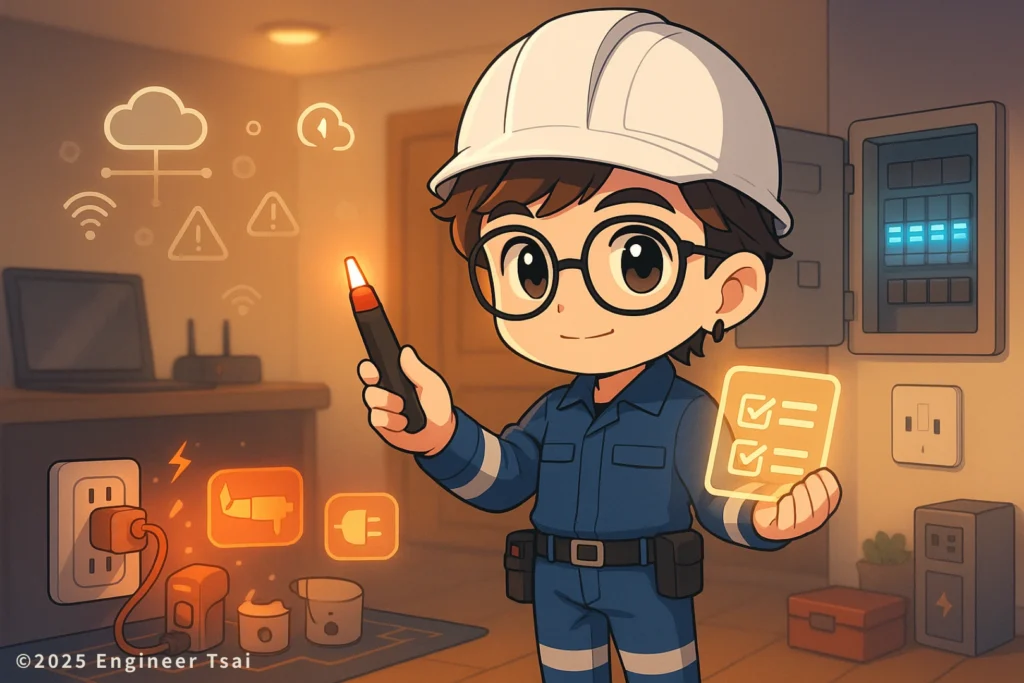
This article is the complete overview for home electrical systems in the U.S. From breakers, grounding, AFCI/GFCI protection, and common failures to basic lighting and outlet circuits, this page builds the full safety map. Every troubleshooting guide and home-wiring tutorial connects back here.
Introduction: Why start with home electrical safety?
Home electrical safety is not just your mom saying “don’t plug too many things into that power strip.”
In a time when AI is changing a lot of office jobs, the real “safety line” you can still hold on to every night is surprisingly old-school: wires, outlets, your breaker panel, and switches.
If you’re thinking about a career change or just want a backup option,
learning to “read electricity” in your own home and keep your family safe is one of the most practical things you can do in your first 0–3 months.
This article pulls together several topics you might have seen scattered across different posts—short circuits, warning signs, old wiring, and power-outage prep—and turns them into a single “home electrical risk map” you can actually use:
- So you know which situations are red flags and need your full attention
- Which things you can check yourself, and when you absolutely need a licensed electrician
- And if you’re serious about moving toward electrical / maintenance work, these are the basic ways of thinking you’ll use every day
If you want to seriously evaluate whether you should treat “electrician” as a backup plan in your first 0–3 months,
you can use this guide as your starting line:
First, learn to keep your own home safe. Then decide whether you want to step out to real job sites.
By the end, you’ll have a personal home electrical safety SOP so you don’t freeze up every time the breaker trips, the lights go out, or you smell something burning.
1. Why does home electrical safety still matter in the age of AI?
Let’s start with the point:
AI can write your code and reports, but it can’t walk into your kitchen and inspect a burned outlet for you.
Your day might look like this:
- At work, you stare at screens all day with ChatGPT open in one tab and meetings in another
- After work, you go home, watch something on your laptop or TV, run the AC, do laundry, cook dinner
- On remote-work days, your home turns into a mini office: extra monitor, router, laptop, chargers everywhere
These all have the same hidden assumption:
As long as the electricity is fine, your work, life, and safety all stand.
When it fails, everything fails at once.
If you’re thinking about a career shift, there’s another layer:
- If you’re considering electrical work, maintenance, HVAC, or facility support
- You’ll be working on systems that are directly tied to other people’s safety and quality of life
So learning to take care of your own home’s electrical safety is not just about your family.
You’re also training yourself to see electricity through risk and systems, the way every good electrician eventually does.
2. A home electrical risk map: see the big picture before diving into details
Before we dive into short circuits, ground faults, old wiring, and outages, it helps to draw the big map first.
For many homes—whether it’s an older apartment, a small single-family home, or a rental—the main home electrical risks can be grouped like this:
- Short circuits / arcing
- Cracked insulation with copper exposed
- Loose outlets and plugs with poor contact
- Wrong plugs, busted power strips, “octopus wiring”
- Overload / overheating
- Too many high-power appliances on one outlet or circuit (space heater, hair dryer, microwave, etc.)
- Thin, cheap extension cords carrying heavy loads for long periods
- Leakage / shock risk (ground faults)
- Bathroom, kitchen, or outdoor outlets without proper GFCI / RCD protection
- Poor or missing grounding
- Old appliances with metal cases that can become live
- Aging or undersized wiring
- Homes 30 years or older that have never been rewired
- Wiring and panel sizing designed for “one TV, one fridge, a few lights” but now serving 2025-level appliance loads
- Outdated breaker panels with too few circuits or undersized breakers
- Power outages / unstable voltage
- Seasonal heavy loads causing fuses to blow or breakers to trip repeatedly
- Area-wide outages putting food in the fridge, computers, or servers at risk
- Voltage surges when power comes back, damaging sensitive electronics
In this article, I’ll guide you through four big themes using this map:
- Short circuits: what they really are and which warning signs you must not ignore
- Abnormal behavior and leakage: six key warning signs + how to think through basic troubleshooting
- Old wiring: when you should seriously consider rewiring
- Outages and your panel: how to prepare, respond, and restore power safely
If you’re busy and just need a quick overview,
start with Section 2’s risk map + Section 4’s six warning signs.
If you’re already thinking about changing careers to electrician,
make sure you read Section 7’s “0–3 month practice project”.
That’s the cheapest practice you can do before stepping onto a job site.
3. What is a short circuit? From “wrong path” to “house fire” in a few seconds
3.1 The essence of a short circuit: electricity takes a fast path it should never take
In plain English, a short circuit is when current suddenly takes a path with very low impedance.
Normally, current flows like this:
- From the power source → through the load (lamp, appliance, etc.) → back to the source
The load consumes energy and turns it into light, heat, or motion.
During a short circuit, something else happens:
The “hot” conductor and the neutral or ground get connected directly
with almost no load between them.
So:
- Current spikes suddenly
- Wires, terminals, plugs, and outlets heat up very quickly
- If protection is poor or fails, they can char, arc, or ignite nearby flammable materials
3.2 Common real-world short-circuit scenarios at home
You may have seen or heard about things like:
- You plug something in, there’s a loud pop, and you see sparks
- You replace a light fixture or outlet, don’t tighten the wire nuts properly, stuff the wires back into the box, and they touch
- An old extension cord has cracked insulation, metal is exposed, and it gets stepped on or pinched
- A child pokes metal objects into an outlet (this one is extremely dangerous)
3.3 Warning signs before and after a short circuit
The instant of a short circuit is fast, but your home usually gives you warning signs before that:
- An outlet or switch feels unusually warm or hot over long periods
- Plugs and outlets show yellowing, browning, black marks, or melted plastic
- There’s a burning smell or even smoke near an outlet or power strip
- A particular extension cord gets hot every time you use it
All of these are your home telling you:
“The electrical system has been putting up with this for a while.”
3.4 Everyday habits that reduce short-circuit risk
You don’t have to become paranoid. A few small habits help a lot:
- Retire any extension cords or outlets that smell odd, discolor, or show burn marks
- Don’t leave an extension cord coiled up while it’s carrying a heavy load
- For simple DIY tasks you’re confident you can handle—like replacing a basic light fixture or outlet—
always shut off the breaker first and verify there’s no voltage before touching wires.
The moment you feel uncertain, stop and call a licensed electrician. - If you have kids or pets, use safety covers on outlets they can access
📌 Extended reading:
“What Is a Short Circuit? Causes, Warning Signs, and How to Prevent Electrical Fires”
⚠️ Safety note (please don’t skip this)
This article mentions some things non-professionals can safely do, such as:
- Organizing extension cords and reducing overload
- Pressing the test button on a GFCI or main residual-current breaker
- Labeling your breaker panel and mapping which circuit serves which room
But once you’re dealing with:
- Running new wiring or opening walls
- Replacing or reconfiguring the main panel
- Wiring in high-risk areas like bathrooms, kitchens, and outdoor locations
Those jobs belong to a licensed electrician.
Regulations and codes are different in every country and state. This article uses common home scenarios as examples, but always follow your local electrical code and work with licensed professionals.
4. Abnormal behavior and leakage: six warning signs + how to think about them
Many people only notice something’s wrong the moment the breaker trips.
In reality, your home has probably been sending signals long before that.
4.1 Six common warning signs your home electrical system is not okay
Treat this like a simple home electrical safety checklist:
- Outlets, switches, or power strips feel noticeably warm or even hot to the touch
- Lights flicker or dim when other appliances (especially large ones) are turned on
- Plug blades or the inside of outlets are yellowed, darkened, or melted
- A particular circuit breaker trips frequently, not just once in a long while
- Outlets near washers, dryers, or sinks are rusty, damp, or smell musty
- You feel tingling or little shocks when touching metal cases of appliances, especially with bare feet on damp floors
If you see two or three of these at the same time, it’s a good idea to:
- Reduce the load on that circuit (unplug and avoid heavy loads)
- Schedule an on-site inspection by a licensed electrician as soon as you can
4.2 What is leakage / a ground fault, and how is it different from a short circuit?
A short circuit is current taking a wrong path way too fast.
Leakage or a ground fault is current quietly escaping into places it should never flow.
For example:
- A damp outlet lets current travel through moisture to ground
- Damaged insulation on an appliance lets its metal case become live
- A person standing on a damp floor touches that case and unknowingly becomes part of the current path
This is why:
- Bathrooms, kitchens, and outdoor outlets need proper grounding plus GFCI or RCD protection
- Many building codes around the world require GFCI-type devices in these locations
4.3 Simple checks a homeowner can safely do
You don’t need to open walls or run new wiring to do a few basic checks:
- Open your panel and look for breakers with a TEST button or labels like “GFCI / RCD / leakage breaker”
- Press the TEST button once a month to confirm the trip mechanism still works, then reset
- In older homes, if outlets in kitchens or bathrooms have no grounding slot and no GFCI,
plan to talk to an electrician about upgrading to grounded, GFCI-protected outlets
📌 Extended reading:
“6 Warning Signs Your Home Electrical System Is Not Okay (and a Simple Troubleshooting SOP)”
5. Old house wiring: do you really need to rewire?
5.1 The reality of “old houses” in modern life
In many cities, a lot of people live in:
- Homes that are 30–40 years old or more
- Older townhouses
- Units that have been “cosmetically renovated” but never had the wiring updated
When those homes were built, the expected load was:
- One TV, one fridge, a couple of fans, a few light fixtures
- Maybe one window-type AC
Now?
- Full HVAC, induction cooktops, dishwashers, dryers, dehumidifiers, instant hot water, gaming consoles…
- Plus computers, chargers, NAS boxes, home servers, and networking gear
If the wiring and panel have never been updated, it’s like:
Trying to run 2025-level appliance loads on a 1980-era electrical skeleton.
5.2 Signs that old wiring needs attention
You can do a quick self-assessment:
- The home is 30+ years old and has never had a major electrical upgrade
- Every summer, when the AC and heavy appliances run together, certain circuits trip often
- There are far too few outlets, so extension cords and “power strip daisy chains” are everywhere
- Outlets and the panel look clearly old: yellowed plastic, cracks, outdated design
- The walls have a history of leaks or water damage, but the wiring was never checked afterward
If you check off three or more of these, it’s worth scheduling a “wiring health check” + “rewire or not” assessment.
5.3 When should you seriously consider rewiring?
There’s no single rule, but you can ask yourself three questions:
- “Will I (or my family) live here for at least 10 more years?”
- If yes, rewiring is more like a long-term safety investment,
not just a resale value question.
- If yes, rewiring is more like a long-term safety investment,
- “Does the current panel have enough circuits and capacity for how we actually live?”
- Many modern homes benefit from dedicated circuits for HVAC, heavy kitchen loads, and bathroom heaters or fans.
- “Am I already planning other big renovations?”
- If you’re opening walls and changing floors anyway,
doing the wiring properly at the same time usually makes the most sense.
- If you’re opening walls and changing floors anyway,
5.4 Common mistakes around old wiring
- Only changing outlets but ignoring the wires behind them
The faceplates look new, but old, brittle wires are still there. The risk hasn’t really changed. - Using more power strips to “create” more outlets
The problem is not the number of receptacles.
The problem is that the entire circuit is already overloaded. - “We’ve used it like this for years and nothing bad happened.”
Electrical systems tend to be “fine until they’re not”—and when they fail, the incident can be serious.
📌 Extended reading:
“Old House Wiring Safety Guide: Aging Wires, Inspections, and When to Rewire”
6. Before, during, and after a power outage: not just “waiting for the lights to come back”
In many areas, outages are “rare but very annoying,” but they’re still a key part of home electrical safety planning.
For a typical household, it’s inconvenient.
For people working remotely, running home servers, or needing medical devices, it can be a real risk.
6.1 Before an outage: draw your home’s “electrical map”
While everything is still working, you can:
- Find your main breaker and all branch breakers
- Create simple labels: which breaker serves which rooms and major loads
- Decide what’s critical vs. optional during an outage:
- Critical: fridge, basic lighting, internet/router
- Optional: AC, laundry, oven, other heavy loads
If you rely heavily on remote work or sensitive equipment, consider:
- A small UPS (uninterruptible power supply) for your router and main work machine
- Portable power, power banks, and backup internet (like mobile hotspots) for short emergencies
6.2 During an outage: check “how big” it is and whether anything is dangerous
When the power goes out, do two things:
- Figure out if it’s just you or the whole area
- Look at hallway lights, outside lights, or neighbors’ windows
- If only your unit is dark, it may be a blown fuse or tripped breaker
- Make sure nothing is in a dangerous state
- Ovens, stoves, or appliances that were running right before the outage
- Elevators are a special case—follow your building’s emergency procedures
This is not the time to keep slamming breakers on and off.
First, turn off or unplug heavy loads like AC units and space heaters, then carefully try to reset breakers.
6.3 After power comes back: restore in the right order
Once power returns, do two more things:
- Don’t turn everything on at once.
Let fridge, basic lighting, and the router come back first.
Wait a few minutes, then bring heavy appliances back one by one. - Watch for any abnormal behavior:
weird noises, burning smells, flickering screens, or odd resets.
If something feels wrong, unplug the device and have it checked.
📌 Extended reading:
“Home Electrical Panel and Power Outage Preparation: Planning, Prevention, Zoning, and Backup”
7. For people considering a career change: turning home electrical safety into a 0–3-month project
If you’re reading this because you want “one more option in the age of AI,”
I strongly recommend treating this guide as a 0–3-month home electrical safety practice project.
Once you complete this three-month cycle,
you’ll have covered the “home electrical safety” part of a 0–3-month electrician roadmap.
Adding tools, hands-on practice, and certifications after that will feel much smoother.
7.1 Month 1: Learn to really see your own home
- Read this article and the related posts on short circuits, warning signs, old wiring, and outages once
- Then walk around your home with your phone and a notebook:
- Where is the panel? Which is the main breaker?
- Where are outlets crowded and power strips chained together?
- Which outlets or appliances have made you think “this feels weird” before?
7.2 Month 2: Make a few small safety upgrades
Depending on your situation, choose a few:
- Retire obviously old, hot, or discolored extension cords
- With help from a licensed electrician, upgrade outlets in key locations to grounded, modern receptacles
- Discuss with your electrician whether bathrooms and kitchens should have GFCI protection added or upgraded
- If it’s an older home, schedule a professional “wiring health check”
7.3 Month 3: Start training your “electrician’s eye”
Even if you’re still in your current job, you can start practicing:
- Every time you enter a new space (coffee shop, office, friend’s home), quietly observe:
Where is the panel? How are outlets arranged? Is there obvious overload or risky behavior? - When you see news about fires or electrical incidents,
try to guess: short circuit? overload? leakage? aging wiring?
These small habits are exactly the kind of mindset you’ll use daily
if you eventually step into electrical work.
8. FAQ: Home electrical safety × career change to electrician
Q1: I have zero electrical background. Is this still useful?
Yes.
Most home electrical safety doesn’t start with advanced theory.
It starts with being willing to look, smell, and feel:
Look at outlets and cords more carefully
Notice any burning smells sooner
Feel whether cords, outlets, and power strips are running too hot
Once you get familiar with these “signals,”
adding theory on top later will be much easier.
Over time, that’s how you build real home electrical safety awareness without needing advanced math.
Q2: What can I do myself, and when do I need an electrician?
Things you can usually do yourself:
Clean up and reorganize extension cords to reduce overload
Unplug or spread out loads on crowded power strips
Press the test button on GFCI outlets or leakage breakers regularly
Label circuits in your panel so you know which breaker controls which rooms and devices
Things that should be left to a licensed electrician:
Replacing or upgrading the main panel
Changing circuit layouts or adding new circuits
Large-scale rewiring
Any work inside walls, ceilings, or in high-risk areas like bathrooms and kitchens
As a rule of thumb:
If it involves new wiring, panel work, or opening walls, don’t DIY it.
Q3: What if I never become an electrician—does learning this still matter?
Absolutely.
Even if you never work as an electrician, you’ll still:
Buy or rent homes
Deal with renovations and contractors
Use tons of appliances and electronics
Experience tripped breakers, outages, and equipment failures
Understanding basic home electrical safety means:
You’re harder to bluff during renovations or repairs
You can make more informed choices about upgrades
You get a lot more peace of mind about the place you and your family live in
9. Where to go from here: from “avoiding disaster” to “I do have a path”
If this “home electrical safety overview” opened something up for you,
here’s what I suggest reading next :
- Short circuits:
“What Is a Short Circuit? Causes, Warning Signs, and How to Prevent Electrical Fires” - Warning signs & checklist:
“6 Warning Signs Your Home Electrical System Is Not Okay (and a Simple Troubleshooting SOP)” - Old wiring:
“Old House Wiring Safety Guide: Aging Wires, Inspections, and When to Rewire” - Panel & outages:
“Home Electrical Panel and Power Outage Preparation: Planning, Prevention, Zoning, and Backup”
If you want to take another step toward the career-change path:
- “Why I Help People Change Careers to Electrician in the Age of AI”
- “3–12-Month Electrician Career Roadmap: From Zero to Your First Real Jobs”
For “official” home electrical safety recommendations, you can also check:
- Your local fire department or building authority’s electrical safety pages (for example, in the U.S. you can refer to the U.S. Fire Administration’s electrical fire safety outreach).
- NFPA – electrical fire statistics and safety resources
- ESFI – home electrical safety guides and checklists
Finally, if you’re willing to share:
How old is your current home, roughly?
And what worries you the most about your home’s electrical safety?
As Engineer Tsai, I’ll keep turning those worries into the next round of practical guides and learning materials.
This is where, in the age of AI,
we learn home electrical safety to protect our homes and train our hands and eyes for a more resilient future.