
Table of contents
Table of contents
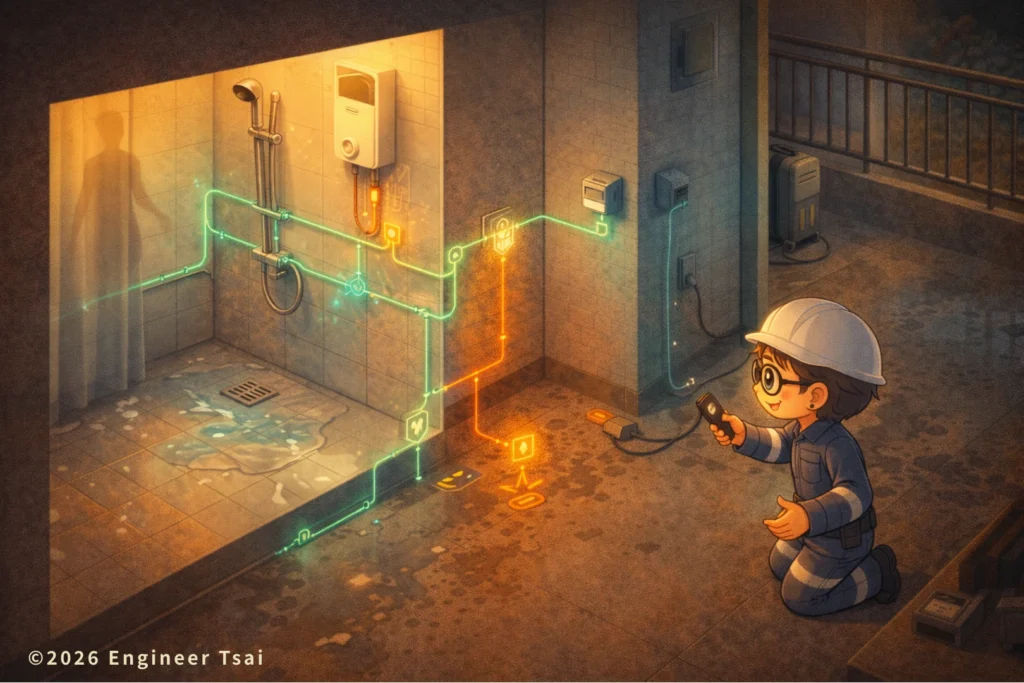
When people think about bathroom safety, most of the time it’s “don’t slip on the floor.” But from an electrical perspective, the real danger is water + metal + electricity. That’s where grounding vs equipotential bonding comes in. If these two are not done well, the exact same bathroom can be completely uneventful for one family… and seriously dangerous for another.
In many U.S. homes, the setup looks like this:
A gas or electric water heater on the other side of the wall, metal piping feeding a showerhead and faucet, a tiled floor that often gets wet, maybe a bathroom exhaust fan or heater, a nearby receptacle, and sometimes someone will even run an extension cord into the bathroom to blow-dry their hair.
This article uses real-world bathrooms and outdoor spaces as a starting point and breaks the ideas down step by step:
- What exactly does grounding protect? How should we think about “where fault current wants to go”?
- What is equipotential bonding, and why does it matter so much in bathrooms and outdoor areas?
- Which layouts and habits make shock risk higher, even if you have a “grounded” outlet?
- As a homeowner or electrician, what are some practical steps you can take to improve safety?
If you still feel shaky on the basics of voltage, current, and how electricity flows, it helps to start with a fundamentals guide first:
🔹 “Electrical Basics Cheat Sheet: From ‘What is electricity?’ to understanding your breaker panel”
Once you’re comfortable with current paths and fault circuits, grounding and equipotential bonding will feel much more intuitive.
▶️ Watch now: one simple diagram to visualize water, metal, and electricity in a bathroom
Start with a quick video overview:
we’ll walk from the water heater on the other side of the wall, through the wiring in the wall, all the way to the showerhead, faucet, and wet floor – and trace the possible paths a fault current might take. Then we’ll compare how proper grounding and equipotential bonding change that picture.
If your first reaction after watching is: “So is my bathroom layout actually safe?” – this article is your deep-dive follow-up, with more time to unpack each concept in plain language.
Chapter 1 — What is grounding? Start with “where does fault current want to go”
Instead of starting with code articles and jargon, let’s first answer one simple question:
If a metal appliance case becomes energized, where do you want that fault current to go so it doesn’t pass through a person?
That’s the heart of grounding: giving fault current a low-impedance path back to the source so protective devices can “see” the problem and trip quickly, instead of letting current wander through random paths – like a person standing on a wet floor touching a metal faucet.
1. What does the grounding conductor actually protect in bathrooms and outdoor areas?
Take a typical U.S. installation with a water heater, laundry area, or outdoor receptacle. The equipment grounding conductor (EGC) is there to protect two things:
- Metal enclosures and cases – If insulation fails or a screw pierces a conductor, the metal case becomes “live.” The grounding conductor pulls that fault current back toward the panel instead of letting it hang around on the case.
- Protective devices – When enough fault current flows, the breaker or GFCI/RCBO detects the abnormal condition and trips, shutting the circuit off.
You can think of it as: “We give electricity a safe, easy path home so it prefers that path over your body.”
2. Why is grounding even more important in bathrooms and outdoor spaces?
The same fault that might just tingle in a dry bedroom can be dangerous in a wet bathroom or on a patio. Why?
- High moisture – Wet tile, damp concrete, and puddles all reduce the resistance between your feet and the earth.
- Lots of exposed metal – Faucets, showerheads, metal frames, railings, racks, and door frames can all become touch points.
- Bare feet or thin footwear – Your body is more directly connected to the floor than when you’re in dry shoes on carpet.
In these environments, if a fault energizes metal parts, your body can easily become part of the current path. Grounding is the first line of defense: pull that current away from you and toward the breaker or GFCI instead.
Chapter 2 — What is equipotential bonding? Why bathrooms and outdoor areas need it most
Grounding is about giving fault current a path. Equipotential bonding starts from a different question:
If something does go wrong, how do we make sure all the metal and surfaces you can touch are at nearly the same voltage so there’s very little difference for current to push through your body?
1. Equipotential bonding basics: tie everything to the same reference point
In a bathroom, the following metal parts are common candidates for bonding:
- Metal hot and cold water lines
- Metal drain pipes or pans
- Reinforcing steel in concrete (where accessible and required by code)
- Metal door frames, rails, or structural supports
- Metal tubs or shower bases and their supports
These parts are connected with bonding conductors to an equipotential bonding bar or directly to the building’s grounding system. The goal is that if any of those items rise in voltage during a fault, all of them rise (and fall) together, so the voltage difference between what your hands and feet touch stays as small as possible.
2. Why grounding alone isn’t enough
Even if grounding is done correctly, there are scenarios where your body still ends up bridging two different voltages. For example:
- You hold a metal showerhead with one hand while standing barefoot on a damp floor whose potential is slightly different.
- You rest one hand on a metal door frame and touch a receptacle cover screw with the other.
If those metal parts are at significantly different voltages, your body becomes the connecting wire between them. Equipotential bonding’s job is to shrink those differences so that even if something fails, the voltage between two simultaneously touched points stays low enough to greatly reduce shock risk.
That’s why places like bathrooms, spas, pools, and outdoor wet locations with lots of metal often have stricter bonding requirements in U.S. codes compared to ordinary dry rooms.
Chapter 3 — Bathroom scenarios: water heater, showerhead, wet floor – where can things go wrong?
Let’s walk through a few common setups and look at where grounding and equipotential bonding make a difference.
1. Water heater, metal piping, and a wet bathroom floor
Imagine this layout:
- An electric or gas water heater supplies hot water through metal piping into the bathroom.
- Somewhere inside the heater, insulation degrades or a screw nicks a conductor and the metal case or piping becomes energized.
- The showerhead, faucet, or exposed metal fittings rise in voltage.
- You’re standing barefoot on a wet tile floor, reaching out to adjust the water temperature.
If there is no effective grounding and equipotential bonding, your body can end up between “energized metal” and “wet floor,” acting as part of the fault path. With proper grounding and bonding:
- The fault current is pulled back via the grounding conductor toward the panel.
- Bonding ties metal parts and structural steel together, reducing voltage differences at the points you touch.
- A breaker or GFCI (called an RCD in many countries) sees the imbalance and trips, clearing the fault.
2. Bathroom receptacles, fans, and metal door frames
Another classic combination looks like this: a bathroom receptacle near the sink, possibly a ceiling heater or fan, and a metal door frame or metal shower enclosure. Over time, wiring or devices can develop faults around mounting screws or cover plates.
If your hand is on the metal frame while the other reaches for the switch or receptacle, any significant voltage difference becomes a shock hazard. Protective measures include:
- Using correctly wired, grounded, and GFCI-protected bathroom receptacles (as required by the NEC in the U.S.).
- Including metal frames and accessible metal piping in the bonding scheme where required.
- Avoiding device locations where they’re directly exposed to splashing or continuous moisture.
From a design standpoint, bathrooms are not just about fixtures and tile; they’re about controlling where current can and can’t flow when something fails.
Chapter 4 — Outdoor outlets and metal structures: balconies, patios, campsites
Now let’s step outside: balconies, decks, patios, gardens, and campsites often share the same risky trio — moisture, metal, and electricity.
1. Outdoor receptacles and metal railings or racks
Picture this: an outdoor GFCI receptacle on the wall, maybe feeding a pressure washer or string lights, right next to metal railings, deck framing, or aluminum door frames. The ground might be wet after rain, and maybe someone has run an extension cord across a puddle.
Good practice in these situations includes:
- Correctly grounded, in-use rated (weather-resistant) GFCI receptacles.
- Bonding of large metal structures and railings where required, especially near pools, spas, or other wet features.
- Minimizing temporary cords across walking paths and standing water.
2. Campgrounds, pool decks, and outdoor showers
These environments add even more people, more water, and more metal. Codes and standards in the U.S. treat them as special cases, with strict requirements for:
- Robust grounding systems and equipotential bonding grids.
- GFCI protection and careful circuit layout, so faults can be isolated by tripping only the affected area.
- Regular inspection and testing of receptacles, equipment, and bonding connections.
Even if you’re “just a user,” it’s worth developing a simple habit: whenever you see electricity + water + metal in the same zone, ask yourself: “Is this equipment grounded and bonded correctly? Is there GFCI protection?” That awareness alone can change how you use the space.
Conclusion — Grounding vs equipotential bonding: look beyond “is there a ground pin?”
A lot of people judge electrical safety with one quick glance: “Does this receptacle have a ground pin?” But after walking through grounding vs equipotential bonding, you probably see a few more layers than that:
- If a metal case or pipe faults, will the grounding path pull enough current to trip the breaker or GFCI quickly?
- In a bathroom or on a patio, are common metal parts likely to be at similar voltages thanks to bonding, or could your body end up between two very different potentials?
- Are we paying attention to the mix of cords, water, and metal – or just assuming “it’s fine because it worked last time”?
Grounding and equipotential bonding aren’t fancy luxury features. They’re quiet, always-on safety systems that do their job every time you shower, do laundry, water plants on the balcony, or plug something in outdoors.
Whether you’re a homeowner, a DIY-oriented renter, or someone on a skilled-trades path into electrical work, I hope this breakdown helps you see bathrooms and outdoor areas with “current paths” in mind – not just fixtures and finishes. When in doubt, that’s usually the moment to bring in a licensed electrician to inspect and upgrade what you can’t see behind the walls.
📌 Further reading
🔹 “Neutral vs ground at the receptacle: what’s the difference?”
If you’re still not clear on what the “ground” slot on a receptacle actually connects to, this article walks through the circuit from the receptacle back to the panel.
🔹 “Home electrical safety overview: short circuits, leakage, old wiring, and outage response”
Grounding and bonding are the “hardware” side. GFCI devices and other protection are your “automatic referees.” Combining them gives you a much stronger safety net.
🔹 “How to read common outlet types in different countries: plug shape is only step one”
If you travel or work internationally, this guide helps you tie together plug shapes, grounding schemes, and voltage/frequency differences.
🔹 Electrical Safety Foundation International: Electrical safety in the bathroom
If you’d like a U.S.-focused checklist for safer bathrooms – GFCIs, lighting, ventilation, and appliance use – this ESFI resource is a solid starting point.
Grounding vs equipotential bonding FAQ
Q1: If my grounding is good, do I really need equipotential bonding too?
A: Yes. Grounding gives fault current a path back to the source so breakers or GFCIs can trip. Equipotential bonding, on the other hand, reduces the voltage differences between metal parts you might touch at the same time. They address different aspects of shock risk. In high-risk locations like bathrooms, pools, and spas, U.S. codes often require both grounding and bonding measures, not just one or the other.
Q2: How can I tell if my bathroom has equipotential bonding?
A: In many cases, you can’t fully confirm it by eye. You might see bonding jumpers attached to metal piping, tubs, or structural steel, or you may find references to bonding bars on as-built drawings. But the only reliable way is to have a licensed electrician inspect and, if needed, test continuity and potential differences between metal parts. If you’re remodeling a bathroom, that’s the perfect time to ask about bonding upgrades.
Q3: Can older homes be upgraded for better grounding and equipotential bonding?
A: In most cases, yes – but it can be more complex and costly than in new construction. Grounding upgrades may involve running new equipment grounding conductors or improving grounding electrodes. Equipotential bonding often makes the most sense during bathroom remodels or when you’re replacing water heaters, tubs, or piping, because walls and floors are already open. A qualified electrician can outline what’s realistic for your specific home.
Q4: I only feel a small tingle sometimes in the shower. Is that really a big deal?
A: Any time you feel a tingle when touching plumbing, fixtures, or appliances, especially in a wet area, you should treat it as a red flag. It could mean leakage current, poor grounding, or missing bonding. Just because it hasn’t caused serious harm yet doesn’t mean it’s safe. The conditions might line up differently next time. Call a licensed electrician and get it checked.
Q5: I’m in the trades and want to master this topic. Where should I start?
A: Think in three layers: (1) Fundamentals – learn about touch voltage, step voltage, fault current paths, and how the human body responds to current. (2) Code and protection – study grounding and bonding articles in the NEC, GFCI requirements, and how breakers/GFCIs detect faults. (3) Field practice – spend time inspecting bathrooms, pools, and outdoor installations, tracing how grounding and bonding were actually done. Over time, these three layers connect, and grounding vs equipotential bonding becomes one of your strongest specialties.
—
Have you ever felt even a small “zap” or tingle in the shower, or on a damp balcony when you touched a metal railing and an appliance at the same time?
Are you more worried about your water heater, bathroom receptacles, or kids running around wet and barefoot near outlets and metal fixtures?
Share your questions or real-world stories in the comments. And if you know someone who’s remodeling a bathroom or building an outdoor deck, feel free to send them this guide so they can make better, safer electrical decisions.
If this breakdown of grounding vs equipotential bonding helps you see your bathroom or outdoor space differently, bookmark it. When you later read about GFCIs, breaker sizing, or wiring methods, you can come back and connect those pieces to the bigger picture of how current flows – and how we keep it from flowing through you.