
On this page
Table of contents
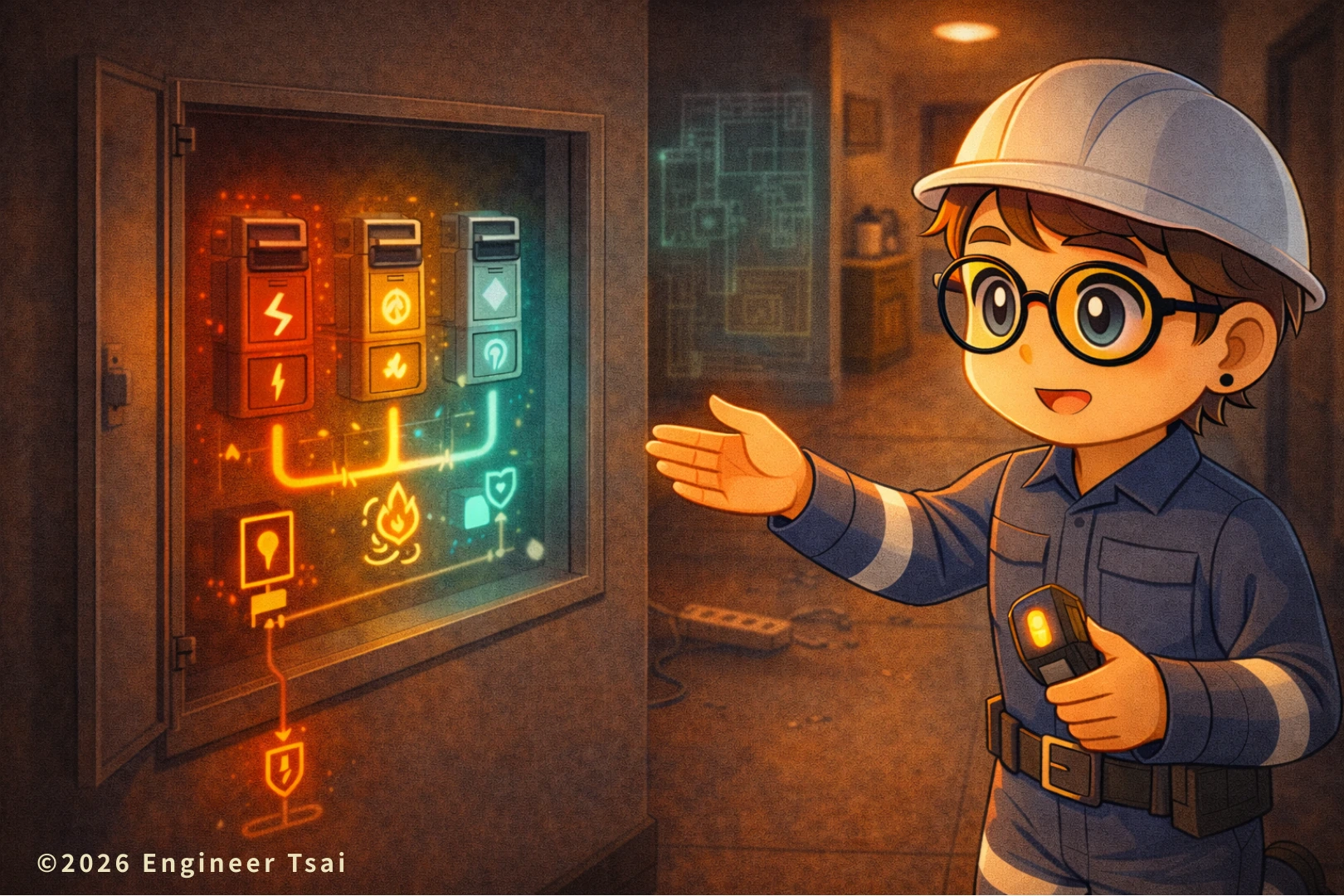
Short circuit vs overload vs ground fault—the difference usually shows up in the exact moment your breaker trips: does it trip instantly, after a few minutes, or more often when things are damp? This article gives you one quick chart + a safe, real-world SOP so you can stop guessing (and stop “upgrading” breakers) and narrow down the most likely cause fast. If you remember one phrase from this page, make it short circuit vs overload vs ground fault—it’s the fastest way to think clearly when you’re standing in front of a panel.
▶️ Watch now: 90 seconds to tell short circuit / overload / ground fault apart
Watch the video first to get the full picture: what a breaker is actually protecting you from, what the three fault patterns look like in a panel, and what your very first step should be so you don’t make the situation worse. Think of it as your fast primer on short circuit vs overload vs ground fault before you use the chart.
Chapter 1|Before you blame the breaker: tripping is often protection doing its job
Have you seen this at home? You turn on the hair dryer, the microwave is already running, the AC kicks on… and bam—the room goes dark. You walk to the breaker panel and the same breaker is tripped again. Your first thought is usually: “Is the breaker bad? Should I replace it?”
Pause for a second. Most breaker trips aren’t “a broken breaker”—they’re the protection doing its job. The problem is we only see “it tripped,” but we don’t know what it’s trying to protect us from. That’s why learning short circuit vs overload vs ground fault matters: the “why” tells you what to do next.
In this guide, I’ll explain short circuit vs overload vs ground fault in plain English so you can decide what’s most likely: what you can safely rule out yourself—and what’s a “stop now and call a licensed electrician” situation. Once you can label the pattern as short circuit vs overload vs ground fault, you’ll stop making random guesses and start making safer decisions.
(Safety note: this is about diagnosis logic + a safe SOP. If you smell burning, see smoke, feel heat at an outlet, or the breaker trips immediately the moment you reset it, stop using that circuit and call a licensed electrician.)
Chapter 2|Quick chart: short circuit vs overload vs ground fault
| Type | What you’ll notice | Most common cause | Risk level | What you can do first |
|---|---|---|---|---|
| Short circuit | Trips instantly; sometimes you hear a “pop” | Damaged insulation, a loose connection touching where it shouldn’t, internal fault inside a plug/outlet/appliance | ★★★★★ (high) | Stop, unplug the suspected device, don’t keep resetting |
| Overload | Trips after a while; more likely as things heat up | Too many loads on one circuit (space heater + microwave + hair dryer, etc.) | ★★★☆☆ (medium) | Reduce simultaneous loads, spread devices to other circuits, estimate total watts |
| Ground fault (leakage) | Intermittent trips; worse with moisture/humidity | Moisture + aging insulation, leakage to metal casing/ground, failing appliance | ★★★★☆ (med-high) | Stop using it; bathrooms/garage/outdoor circuits are higher risk; get it tested if unsure |
A simple way to remember it: a short circuit is “conductors touching directly,” an overload is “too much current for too long,” and a ground fault is “current leaking where it shouldn’t go.” Save this as your short circuit vs overload vs ground fault cheat sheet for the next time your breaker trips.
Chapter 3|Overload: it trips after a while (usually too much on one circuit)
Overload is the classic pattern: it doesn’t trip the moment you turn something on. It trips after the circuit has been running for a bit. Common examples: a space heater in winter, a dehumidifier, a microwave + toaster oven combo, or a hair dryer while something else is already pulling power. In short circuit vs overload vs ground fault terms, overload is the “slow trip” pattern.
Quick reminder: a lot of people misread overload as “the breaker is faulty” and then try to swap in a higher-amp breaker. That can be dangerous. The breaker rating is matched to the wire and the circuit design—not your convenience.
Why does it trip later? Because overload protection is time-based: slightly over the limit may take longer; far over the limit trips faster. It’s designed to tolerate normal inrush (like a compressor starting) but still prevent overheating over time.
So when the pattern is “runs for a while, then trips,” your first question shouldn’t be “is the breaker bad?” It should be: “Did I stack too much load on one circuit?” That’s the overload side of short circuit vs overload vs ground fault.
If you want a deeper breakdown of “why the same circuit keeps tripping” with common scenarios and an easy wattage mindset, here’s the related article on my site: Same Breaker Keeps Tripping? 7 Real Reasons (Wattage, Inrush, Loose Connections)。
Want an actual number instead of a guess? Engineer Tsai’s free Circuit Breaker Size Calculator estimates the minimum breaker capacity and standard size for your actual load, so you can check whether “too much on one circuit” is really what’s happening — instead of just swapping in a bigger breaker.
Chapter 4|Short circuit: it trips instantly (sometimes with a pop)
Short circuits tend to be obvious: the moment you flip a switch or plug something in, it trips instantly. Sometimes you’ll hear a sharp “pop,” or you might even see a spark.
A short circuit usually means two conductors that shouldn’t touch are touching—inside an appliance, inside an outlet, in a damaged cord, or from a wiring fault.
The risk is that short-circuit current can be extremely high, which is why the breaker trips immediately to prevent rapid overheating and fire. Don’t keep resetting a breaker that trips instantly. Every “pop” is another risky moment. In the short circuit vs overload vs ground fault comparison, short circuit is the “instant trip” that you treat as urgent.
If you want a more detailed checklist of causes and warning signs, this internal guide goes deeper: What Is a Short Circuit? 7 Things Every Homeowner Should Know。
Chapter 5|Ground fault (leakage): “wet / old / intermittent” trips are a red flag
A ground fault isn’t “too much power.” It’s “power going where it shouldn’t.” A common real-world cause is aging insulation plus moisture: current leaks through dampness, dust, or damaged insulation—toward metal housings, building materials, or any path to ground (including you).
In the U.S., this is exactly what GFCI protection is designed for (GFCI outlets or GFCI breakers)—especially in bathrooms, kitchens, garages, basements, laundry areas, and outdoors. In short circuit vs overload vs ground fault terms, ground fault is the pattern that most often correlates with moisture and “sometimes it trips, sometimes it doesn’t.”
If you want a more visual, “why bathrooms/outdoors are special” explanation, this related post uses a very intuitive scenario: Grounding vs Equipotential Bonding: 5 Bathroom and Outdoor Safety Rules。
Ground faults are tricky because they don’t always trip every time. You might notice “it trips more on humid days,” “it trips when I use the bathroom heater,” or “a device feels slightly tingly.” Treat those as warning signs.
If you suspect a ground fault, especially near water, put safety first: don’t keep resetting, and don’t use your body as a tester. A pro can test insulation resistance and leakage current with proper instruments and procedures.
Chapter 6|Safe DIY SOP: the same breaker keeps tripping—what to do first
Here’s a low-risk sequence that keeps you from escalating the problem. Just follow the order. This SOP is built around short circuit vs overload vs ground fault so you can match what you see to the safest next step.
Step 1|Turn off / unplug all high-power devices on that circuit
Don’t rush to reset the breaker. Unplug the hair dryer, space heater, microwave, dehumidifier—anything that draws serious power.
Step 2|Reset once, and watch what happens
If it trips instantly again: that points toward a short circuit or serious ground fault—stop here.
If it stays on: go to Step 3.
Step 3|Plug devices back in one by one
Wait a moment after each one. If one device makes the breaker trip, that device (or its cord/outlet) is your prime suspect—stop using it.
Step 4|If it trips after a while, think overload
Reduce simultaneous loads, and try spreading devices across different circuits (different outlets may still be the same circuit—so verify).
Step 5|If moisture is involved, treat it like a ground fault
Bathrooms, garages, outdoors, laundry areas—if it trips more when damp, stop using the circuit/device and consider professional testing.
If you want a longer “do this, then this” version (including how to decide when to call a pro), here’s the internal step-by-step guide: What to Do When Your Breaker Keeps Tripping at Home。
Chapter 7|3 common mistakes that make the risk worse
Mistake 1|“It keeps tripping, so I’ll just install a bigger breaker”
This is one of the most dangerous moves. A breaker tripping means the circuit is telling you it’s not safe. Upsizing the breaker can remove protection and put the wiring at risk. If this article taught you anything about short circuit vs overload vs ground fault, it’s that “bigger” is not a fix.
Mistake 2|You smell burning, but you keep resetting anyway
If you smell burning, feel heat at an outlet, or see dark marks, stop using it. That’s rarely “nothing.”
Mistake 3|Testing for a ground fault by touching things to see if it “tingles”
Please don’t. You’re not a meter. Ground-fault diagnosis should be done with proper instruments and safety procedures.
FAQ: short circuit vs overload vs ground fault
Q1: The same breaker keeps tripping—does that mean I must replace the breaker?
A: Not necessarily. Many trips are overload-related, or caused by one appliance with an internal short/ground fault. Use the SOP in this article to narrow it down before you replace anything.
Q2: It trips sometimes, but not every time—what does that usually mean?
A: That pattern often points to a ground fault (moisture/aging insulation) or a poor connection that heats up intermittently. If it correlates with humidity or wet areas, treat it as a ground-fault risk—this is the “ground fault” side of short circuit vs overload vs ground fault.
Q3: What’s the fastest way to tell a short circuit from an overload?
A: Timing. Trips instantly (right when you turn it on) is more like a short circuit. Trips after running for a while is more like an overload.
Q4: If it’s a ground fault, will it always trip a GFCI?
A: In an ideal setup, yes—but real homes vary (device condition, moisture level, protection type, wiring). If you suspect a ground fault, prioritize safety and don’t keep resetting.
📌 Recommended reading
🔹What to do when your power goes out: a safe, step-by-step self-check SOP
If you’re in the moment and you’re not sure what to do first, this guide is designed to be followed without panic.
🔹Why one circuit keeps tripping: common scenarios + the protection logic behind it
If your pattern looks like overload, this one helps you think in “total load” and reduce repeat trips safely.
🔹Short circuit 101: causes, warning signs, and how to prevent repeat trips
If it trips instantly with a pop, don’t keep resetting—use this as a quick checklist for what’s most likely going on.
🔹How to read breaker markings (amps, trip curves, interrupt rating) in plain English
Understanding the labels helps you avoid the dangerous “just swap a bigger breaker” mistake.
🔹Grounding vs bonding: the bathroom/outdoor safety concepts most people mix up
If your trips correlate with wet areas, this gives you a more visual intuition for the risk path.
🔹Home electrical safety master guide: short circuits, ground faults, older wiring, outage response
A “save this” overview if you want to strengthen your whole home safety baseline.
External references
- U.S. Consumer Product Safety Commission (CPSC)|Electrical safety guide
- NFPA|Electrical safety in the home (fire prevention basics)
- Electrical Safety Foundation International (ESFI)|Home electrical safety
- OSHA|Electrical hazards and basic guidance
If you want, tell me which pattern you’re seeing: “trips instantly,” “trips after a while,” or “trips more when things are damp.” I can help you map it to short circuit vs overload vs ground fault and suggest the safest next step.