
On this page
Table of Contents
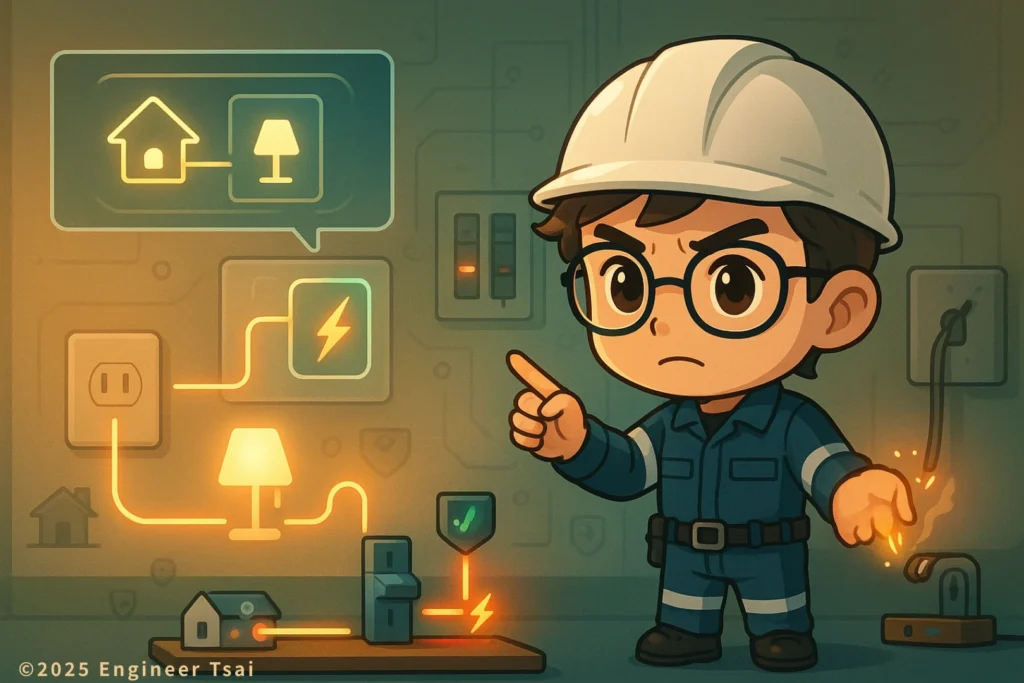
If you want a full understanding of how home electrical systems work, start with the safety overview: 🔹 “Home Electrical Safety Guide: Panels, Breakers, Grounding, AFCI/GFCI, and Common Faults”
Once you know the big picture, this article becomes much easier to follow.
Watch this first: see how a short circuit really behaves (60 seconds)
In a typical home, that little pop, a sudden burnt-plastic smell, or a spark at the outlet often points to the same culprit: a short circuit.
This 60-second short video gives you a quick visual of what a short circuit is, what happens to the current, and what your circuit breakers are actually protecting.
If you’ve ever wondered what is a short circuit and why it can be so dangerous, this video gives you a feel for it before we dive into the details below.
Once you’ve seen it in action, the explanations below will be much easier to connect in your head.
What is a short circuit? The one-sentence answer
So, when people ask what is a short circuit in simple terms, here’s the idea.
A short circuit happens when electric current stops following its intended path through the load and instead finds an accidental, very low-impedance shortcut, causing the current to spike and the circuit to overheat.
More down-to-earth:
- Under normal conditions, current flows through the switch, through the load (light bulb, appliance, motor), along the conductors, and back to the source.
- When insulation fails, a loose wire touches metal, or two conductors that should be separated touch each other, the current suddenly discovers a “shortcut” with almost no resistance.
- The current shoots up, conductors and connections heat up, arcing can occur, and in a worst-case scenario you get melted components or an electrical fire.
That’s why in electrical design and wiring, a short circuit is not “an occasional glitch.” It’s a predictable risk that needs to be designed for, protected against, and managed.
What does a short circuit look like in everyday life?
You don’t need to imagine a high-voltage substation. In a typical North American home or small business, short circuits show up in very familiar ways:
- A discolored, cracked outlet
You plug something in, see a noticeable spark, or smell something burning. - Overloaded power strip or extension cord
You run a space heater, hairdryer, and another high-wattage appliance on the same strip. The plug is hot to the touch, and eventually you hear a click as the breaker trips.
Overloaded power strip or extension cord - You run a space heater, hairdryer, and another high-wattage appliance on the same strip. The plug is hot to the touch, and eventually you hear a click as the breaker trips. That’s usually an overload, but if the insulation or plug is damaged, it can turn into a short circuit later.
- Damp locations like kitchens, bathrooms, basements, or outdoor outlets
Moisture creeps into the receptacle or junction box, insulation breaks down, and a short forms between hot and neutral or hot and ground. - DIY wiring and “temporary fixes”
Wires without proper junction boxes, connections only wrapped in tape, or cables pinched under furniture can all end up with exposed conductors touching each other.
The common pattern here is simple:
Conductors that shouldn’t touch, end up touching — or insulation that should protect them has failed.
When that happens, current takes the direct shortcut.
What actually happens to current during a short circuit?
A few key ideas make this much clearer:
- Current always prefers the path of lowest impedance. In a short circuit, that path often bypasses the load entirely.
- At the same supply voltage, lower impedance means much higher current, which quickly turns into heat.
- If there’s no properly sized breaker or fuse to open the circuit fast enough, conductors, terminals, or busbars can overheat, arc, and melt.
So the big idea is:
A short circuit is not “suddenly higher voltage.”
It’s the same voltage driving a much larger current through a path that was never meant to carry it.
The destructive power comes from that overcurrent and heat, not from the voltage magically increasing.
How does a short circuit happen? Common causes
If the relationship “lower resistance → higher current” still feels fuzzy, it’s worth reviewing Ohm’s law and basic resistance first. That’s the foundation for understanding why short circuits are so violent.
In typical homes, stores, and job sites, short circuits usually fall into a few big categories.
1. Conductors that should be separated touch each other
- Inside an outlet, a loose connection lets the hot conductor touch neutral or ground.
- In a panel, messy wiring and exposed copper end up touching.
- At an equipment terminal, a stray strand of wire slips out from under the screw and presses against a metal enclosure or neighboring terminal.
2. Insulation damage or moisture
- Old wiring where insulation has hardened, cracked, or flaked off.
- Wiring or devices in damp environments (bathrooms, basements, outdoor receptacles) where insulation resistance drops and leakage paths form.
- Conduit or junction boxes that have taken on water — the moisture itself becomes a conductive path.
3. Overload and voltage surges that lead to short circuits
- Long-term overload → conductors run hot → insulation softens, carbonizes, or breaks down → eventually you have a short circuit.
- Lightning strikes or severe surges → components inside an appliance or power supply burn and collapse internally → the damaged part becomes a short.
In other words, short circuits are rarely “random events from nowhere.”
They’re often the final stage of problems that have been brewing for a long time — aging, moisture, overloading, and poor workmanship.
What can a short circuit actually do? From nuisance trips to fires
The damage from a short circuit roughly falls into three levels.
1. Equipment damage and downtime
- Household appliances: burned power supplies, blown fuses, charred circuit boards.
- Industrial equipment: burned motors, carbonized control panels, relay contacts welded together. Downtime often costs far more than the part.
2. Personal safety risks
Short circuits can create electric arcs with extremely high temperatures and molten metal spray. If there’s no proper enclosure or if someone is working too close during a fault, that can lead to:
- Arc-flash burns
- Shrapnel-like metal fragments
- Secondary injuries from being startled or knocked back
3. Electrical fires and wider outages
- If there are combustible materials nearby (wood framing, plastic, stored goods), the heat and sparks from a short can ignite them.
- A short inside a panel can darken an entire floor, building, or even trip upstream protective devices, widening the outage.
That’s why short-circuit protection isn’t optional — it’s a core part of any electrical system, whether at home or in a data center.
If you want to go deeper on home electrical safety, these resources are also helpful:
- Electrical Safety Foundation International (ESFI) – home electrical safety tips
- NFPA – electrical fires and prevention basics
Types of short circuits in practice
1. DC short circuits vs AC short circuits
- DC short circuits
- Current flows in one direction.
- Once the short is established, the current can stay very high and continuous until something opens the circuit.
- Typical sources: car batteries, solar PV DC strings, battery packs, DC power supplies.
- AC short circuits
- Current alternates direction.
- Fault current often has a very high instantaneous peak at the first half-cycle or two.
- Typical sources: 120/240 V branch circuits, industrial distribution, motor feeders.
2. Partial short circuits vs solid (bolted) short circuits
- Partial short circuits
- Only part of the current is diverted through an unintended path.
- Symptoms are vague: equipment runs “strange,” breakers trip sometimes, temperatures run higher than expected.
- Solid or bolted short circuits
- Almost all the current is pulled into the fault path.
- Breakers trip instantly, or if there’s no protection, you see intense arcing and possibly an explosion.
3. Momentary vs sustained short circuits
- Momentary short circuits
- Think of a plug wiggling as you insert it, with a brief flash.
- A little arcing during plug-in is normal, especially with capacitive loads — but frequent or large flashes are not.
- Sustained short circuits
- Conductors remain in contact, or a failed component stays shorted.
- Without proper breakers or fuses, these quickly escalate into serious damage.
How to tell if you might have a short circuit: early warning signs
Most circuits “cry for help” before they actually burn. Watch for:
- Burning or melting smells
A hot, sharp plastic or rubber smell near outlets, panels, or equipment — especially when load increases. - Local hot spots
Outlet faces, plugs, or breakers that are hot to the touch.
Extension cords that are warm or soft along their length. - Frequent breaker trips or blown fuses
If a specific branch circuit trips as soon as you turn a particular device on, that could be a short or severe overload. - Flickering lights or unstable voltage
If you’ve ruled out utility issues, inconsistent voltage inside the building wiring is worth checking.
Big picture:
Smell, heat, and frequent protective device operations are not random. They’re the circuit asking you to pay attention.
How to test and troubleshoot a suspected short circuit (safely)
⚠️ Important:
If you suspect a short circuit in your home and you’re not familiar with electrical work, turn off the main breaker and call a licensed electrician.
Safety first, always.
Common tools for short-circuit detection
- Multimeter
- In resistance or continuity mode, it helps you see whether two points are unintentionally connected.
- Example: hot and neutral in a branch circuit should not show near-zero ohms when completely disconnected from any loads.
- Infrared (thermal) camera
- Scans panels, cable trays, and boards to find abnormally hot spots that may indicate loose connections or faults.
- Specialized short-circuit and insulation testers
- More common in industrial and utility environments, used for complex distribution systems and busbars.
Basic steps to narrow down a short circuit
- De-energize first
- Open the main breaker or the specific branch breaker.
- In industrial settings, follow a proper lockout/tagout (LOTO) procedure before touching anything inside.
- Divide and isolate
- Unplug all loads from the suspect circuit and test the empty branch first.
- In panels, disconnect sections of a circuit to see when the short disappears — this helps you pinpoint which cable run or device is involved.
- Inspect connections and insulation
- Look for cracked, discolored, or melted insulation.
- Check for loose terminations and exposed copper strands.
- Pay special attention to areas with moisture, corrosive chemicals, or mechanical damage.
Again: if you’re not fully comfortable and qualified, this is the point where you hand it off to a pro.
Preventing short circuits: from design to daily habits
1. Good circuit design and layout
- Use properly rated conductors and insulation
- Match wire size to load current and ambient temperature.
- Use cable types rated for wet locations, outdoor use, or high temperatures where needed.
- Separate circuits sensibly
- High-wattage loads such as electric water heaters, dryers, ovens, and EV chargers should have their own dedicated circuits.
- Avoid running “the whole house” off a single branch circuit.
- Keep wiring neat and well-documented
- In panels, keep conductors organized, labeled, and properly terminated.
- Clear labeling makes future maintenance and troubleshooting safer.
2. Use the right protection devices
- Fuses and circuit breakers
- They are designed to sacrifice themselves under fault conditions to protect the wiring and equipment.
- Never “upsize the breaker” just to stop nuisance trips. Fix the real problem.
- GFCI / RCD / ground-fault protection
- Required for bathrooms, kitchens, outdoor receptacles, basements, garages, and other damp locations.
- They primarily protect people from shock, but also help catch dangerous leakage currents that can lead to heating and faults.
- AFCI (Arc-Fault Circuit Interrupter)
- Detects arcing patterns that standard breakers may not catch.
- Increasingly required by code in many areas of the home to reduce electrical fire risk.
- Surge protective devices (SPDs)
- Provide an extra layer of protection for sensitive electronics during lightning or switching surges, reducing the chance that a surge destroys equipment and causes internal shorts.
3. Regular inspection and maintenance (especially in older buildings)
- Evaluate older wiring
- Homes that are several decades old may have undersized conductors, too few circuits, or wiring methods that no longer meet modern safety expectations.
- A whole-house electrical inspection by a licensed electrician is often money well spent.
- Replace aging outlets, switches, and extension cords
- Discolored, cracked, loose, or wiggly devices are all red flags.
- Stiff or brittle cords, or cords with damaged jackets, should be replaced.
- Keep electrical equipment clean and dry
- Prevent water intrusion around panels and outlets.
- Clean dust and debris around electrical enclosures and equipment — contamination can become a leakage path.
4. Everyday user habits and education
- Don’t treat power strips as “infinite outlets”
- Avoid plugging multiple high-wattage devices (heaters, hairdryers, microwaves) into the same strip or extension cord.
- Avoid “creative” DIY splices
- No twisted-together wires left in open air with a bit of tape.
- Always use proper junction boxes, connectors, and covers.
- Protect children and pets
- Use outlet covers where small children can reach receptacles.
- Route cords where pets can’t chew or constantly pull on them.
- Use cord covers or raceways where needed.
Good habits don’t eliminate risk completely — but they dramatically reduce the chances that a minor issue evolves into a dangerous short.
Modern short-circuit solutions: smart breakers and smart grids
If you work in engineering, facility management, or data centers, short-circuit protection is moving far beyond simple mechanical breakers.
Smart breakers and real-time monitoring
- Smart circuit breakers can measure current, voltage, and temperature, and trip based on configurable thresholds.
- Monitoring systems pull data from breakers and sensors to spot abnormal heating, harmonic distortion, or repeated near-fault events before something fails.
- Typical applications: data centers, semiconductor fabs, industrial plants, and smart buildings.
New insulation and fire-resistant materials
- Advanced insulation systems improve performance in high-temperature, high-voltage, or chemically harsh environments.
- Fire-resistant cables and enclosures help prevent a fault from turning into a spreading fire, and reduce toxic smoke if something does burn.
Short-circuit management in smart grids
- Protection schemes are designed so that only the smallest necessary part of the system trips when a fault occurs.
- With reclosers and remote control, utilities can clear temporary faults and restore power quickly, while isolating persistent faults to a small area.
FAQs: short circuits, overloads, and everyday questions
Q1. What is a short circuit, and what’s the difference between a short circuit and an overload?
A short circuit is when current takes an unintended, very low-impedance path, usually bypassing the load. Current spikes extremely fast and breakers trip quickly, often with sparks or noise.
An overload happens when current is still flowing along the correct path, but the amount of current is too high for too long — conductors run hot, insulation ages, and eventually you may get a short or fire.
A simple way to remember:
Short circuit: the path is wrong.
Overload: the path is right, but there’s too much traffic.
Q2. If my breaker keeps tripping, does that mean there’s a short circuit?
Not always.
If it trips instantly every time you turn on a device, and you see or smell signs of trouble, it might be a short or severe overload.
If it trips only when many devices are running together, it’s more likely a plain overload or a circuit that’s doing too much.
Either way, resist the urge to “solve” it by installing a bigger breaker. That can turn a warning into a serious hazard. Investigate the cause or call an electrician.
Q3. If I see a spark at the outlet, is that always a short circuit?
A small, brief spark when plugging in certain devices can be normal, especially with electronics that have internal capacitors.
But if you see large, frequent sparks, hear crackling or popping sounds, smell burning, or notice the outlet face turning brown, that’s a warning sign. The device, outlet, or wiring may be loose, worn out, or internally shorted and should be checked or replaced.
Q4. Are extension cords more likely to short-circuit? How can I use them safely?
Extension cords themselves aren’t automatically dangerous. The real risk is:
Running too many high-wattage loads through a cord that’s too small, or
Using cheap cords that don’t meet safety standards, or
Damaging the cord by pinching, crushing, or running it under rugs.
Safer practices:
Plug heavy loads (space heaters, microwaves, portable AC units) directly into a wall outlet when possible.
Avoid “daisy-chaining” multiple power strips and cords together.
Replace cords that are stiff, cracked, or warm in normal use.
Q5. If I suspect a short circuit at home, can I fix it myself?
You can safely:
Unplug any appliance that’s clearly behaving badly.
Replace a damaged extension cord with a new, properly rated one.
But if it involves:
Opening the breaker panel,
Replacing breakers,
Rewiring outlets or lighting circuits,
you should call a licensed electrician. Short circuits are, by definition, high-risk events — mistakes can make the situation worse or put you in danger.
Q6. How can I reduce the risk of short circuits in an older home?
Older homes often have undersized wiring, too few circuits, and aged insulation. To reduce risk:
Have a licensed electrician perform a whole-house electrical inspection.
Prioritize upgrades to kitchens, bathrooms, laundry circuits, and HVAC loads.
Ensure that GFCI and (where required) AFCI protection are installed in the right locations.
It’s an investment, but compared to the potential damage from an electrical fire, it’s usually more than worth it.
Q7. What should I watch out for if I have kids or pets at home?
Pay extra attention to:
Loose cords on the floor that pets can chew or children can pull on, damaging insulation.
Low-mounted outlets without any protection. Curious kids love to poke things into holes.
Helpful measures:
Outlet covers or tamper-resistant receptacles.
Cord organizers or raceways to keep cables neat and out of reach.
Avoid placing portable high-wattage heaters where kids or pets play.
Conclusion: short circuits are not “just occasional trips” — they’re a risk to manage
If you remember only three things about short circuits, make it these:
- When someone asks what is a short circuit, the short version is: it’s current taking an accidental, very low-impedance shortcut, which makes current skyrocket and generates intense heat and arcing.
- Behind most short circuits you’ll find long-term issues: aging insulation, moisture, overloading, messy wiring, or poor habits.
- Good design, the right protection devices, and better everyday habits can push short-circuit risk down to a very low level.
Once you can clearly explain:
- What a short circuit is and how it differs from an overload,
- What breakers, fuses, GFCIs, and AFCIs each protect you from, and
- Where your own home or facility might be vulnerable,
you’re already far ahead of most people on electrical safety.
If you’ve recently experienced frequent trips, burning smells, or other strange behavior, feel free to share your situation in the comments. Real-world examples make these concepts much easier to understand.
💡 Moving into a new place or living in an older home?
You can start with my free “30-Minute Whole-Home Electrical Quick-Scan” checklist to do a basic safety review of your 120/240 V home, then come back to this article to interpret what you find or ask questions in the comments.