On this page
目錄
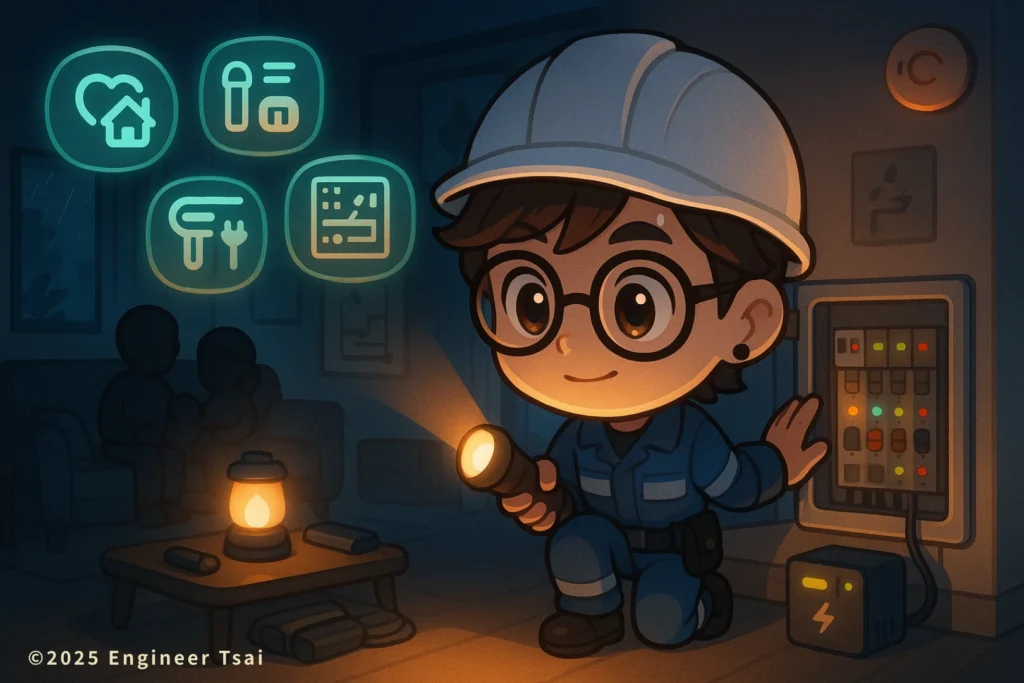
If you want a full understanding of how home electrical systems work, start with the safety overview: 🔹 “Home Electrical Safety Guide: Panels, Breakers, Grounding, AFCI/GFCI, and Common Faults”
Once you know the big picture, this article becomes much easier to follow.
Home electrical safety and power outage preparedness sound like big, technical topics, but they start from very real moments in everyday life.
You know that feeling when the power suddenly goes out in the middle of the night and everyone’s walking around the house in the dark, using their phones as flashlights?
Or when a storm knocks out the power for hours, everything in the fridge starts to thaw, and you’re standing there doing the mental math of how much money is melting away?
Or maybe you’ve seen a news story about a house fire or gas leak that forced an entire apartment building to evacuate and thought:
“If something like that happened here… would my home actually be ready?”
Whether you live in a New York apartment, a townhome in Texas, or a single-family house in the suburbs, extreme weather, power outages, and electrical issues are part of modern life in the U.S. In other words, home electrical safety and power outage preparedness isn’t just for “doomsday preppers” — it’s for regular households.
As an engineer who spends a lot of time around electrical rooms and equipment rooms, I’ve seen the same pattern over and over:
When something goes wrong, the people who prepared a little bit ahead of time suffer way less.
That’s really what home electrical safety and power outage preparedness means in everyday life: doing a few small things now so a bad night doesn’t turn into a full-blown crisis.
In this guide, I’ll walk you through practical home electrical safety and power outage preparedness from a field perspective:
- UPS (battery backup) and portable power banks
- Emergency lights and flashlights
- Labeling and splitting circuits at your electrical panel
- Smart cameras, locks, and detectors
- Simple family emergency plans you can actually follow
Think of this as a 10-minute read that gets you 50% of the way to a safer, more prepared home.
If you want to go deeper after this guide, you can also check official resources like Ready.gov’s power outage preparedness checklist and the U.S. Fire Administration’s home electrical fire safety tips. Think of them as long-form companions to your own home electrical safety and power outage preparedness plan.
1. Power outage preparedness: get your home ready before the lights go out
1.1 UPS (battery backup) and portable power banks are worth it
In a lot of parts of the U.S., it’s not unusual to lose power because of:
- summer heat waves that push the grid to the limit
- thunderstorms, hurricanes, or winter storms
- car accidents that take down utility poles in the neighborhood
A lot of people shrug and think, “It’s just a blackout, I’ll wait it out.”
But when the power actually goes out, it’s not just about the lights:
- The fridge and freezer stop, and you can easily lose hundreds of dollars in food.
- Phones and tablets die, so it’s harder to contact family or check updates.
- If you work from home, your modem, router, and laptop are all dead weight.
- If someone in your home uses medical equipment (like a CPAP machine), power is not optional.
- Aquariums, terrariums, or pet heating pads can become a real problem very fast.
That’s why UPS units (battery backups) aren’t just for server rooms or office IT racks anymore. They’re incredibly useful for regular households too.
You don’t need to put your entire house on backup power.
Start by protecting the devices where a power outage hurts you the most.
Good first candidates:
- The refrigerator or freezer
- Your modem and Wi-Fi router
- Essential medical equipment
- Aquarium filters or circulation pumps for sensitive pets
A small UPS can usually carry you through the first hour or two of an outage. That’s often enough time to:
- finish saving work
- coordinate with family
- decide whether you need to relocate food, medicine, or a person
On top of that, portable power banks are the simplest backup you can own:
- Keep a couple of high-capacity power banks fully charged.
- During an outage, they can keep phones, tablets, and even some laptops going.
- That means you still have maps, news, messaging, and a way to call for help.
A quick personal story: the night a UPS saved our fridge
One stormy night, the power went out while everyone was asleep.
By the time we realized what was happening, the fridge was off, phones were almost dead, and we were trying to decide which food to save first.
I happened to have a small UPS in my room, originally set up for a computer. We quickly moved it over to the fridge and managed to keep it running for almost two hours.
We didn’t save everything, but:
- the milk
- the meat
- a few things that would’ve gone bad fast
all survived.
After that night, we made a simple rule at home:
The fridge, internet gear, and one or two critical devices always get a UPS.
That’s our baseline for how we prepare our home for power outages and electrical issues.
1.2 Emergency lighting and flashlights you can actually find in the dark
When the power goes out, your first real risk isn’t “no Wi-Fi” — it’s tripping, falling, or running into things in the dark.
So you want light sources that are:
- easy to find
- easy to use
- already in the right spots
Practical ideas:
- One flashlight or headlamp per floor of your home, especially near:
- hallways
- staircases
- exits
- Plug-in emergency lights that double as night lights:
- They stay plugged in and charge when the power is on.
- When the power goes out, they turn on automatically.
- Put them in hallways, at the top and bottom of stairs, and near the front door.
- If you live with older adults or kids, consider a small flashlight by the bed for each person. They shouldn’t have to walk across the room in the dark just to find a light.
Real-life example: when every phone became a flashlight (and then died)
I’ve seen this play out more than once:
The power goes out.
Everyone immediately turns on their phone flashlights and starts walking around, texting, and checking social media or news.
Thirty minutes later:
- all the phones are down to single-digit battery
- it’s still dark
- and there’s no backup light source
In one case, the family ended up digging out old camping headlamps just to get through the night.
It only took that one experience for them to do the obvious:
They put a flashlight and/or emergency light on every floor, in the hallway, and near the main doors.
Now, they don’t have to sacrifice phone battery just to see where they’re going.

1.3 Labeling and circuit separation at your electrical panel
In older homes and rentals, it’s very common to see this:
You open the electrical panel, and it’s just:
- a row (or several rows) of breakers
- no labels, or handwritten notes like “bedroom?” or “misc”
When something trips, you’re guessing.
From a safety and practicality point of view, clear labeling and thoughtful circuit separation are a big deal.
Here’s what you can do:
- Label every breaker clearly, for example:
- “Kitchen small appliances”
- “Main bedroom outlets”
- “Living room A/C”
- “Fridge only”
- Whenever possible, have separate circuits for:
- the refrigerator
- internet equipment
- major appliances (microwave, dishwasher, washer/dryer, etc.)
- Avoid putting high-load appliances and critical devices on the same circuit.
Field story: one overload, and the fridge + A/C died together
A homeowner once called about a “mystery outage.”
The whole house hadn’t lost power, but the fridge and the living-room A/C both stopped working at the same time.
When we checked the panel and the wiring, here’s what we found:
- The fridge, living-room A/C, and several kitchen outlets were all on the same circuit.
- One busy day, they had the A/C on, were cooking with multiple appliances, and the fridge was running hard.
- The circuit overloaded, the breaker tripped, and the food and the A/C both lost power.
By the time they noticed, they had:
- lost a lot of food
- paid for fridge and A/C checks
- and were very frustrated
If the fridge had its own circuit and the panel was clearly labeled, that whole chain of problems would’ve been easily avoided.
2. Smart security: keeping your home safe even when you’re away
2.1 Smart cameras and electronic door locks
Once you’ve covered the basics of home electrical safety and power outage preparedness, the next layer is how your home protects you when you’re not there.
More and more homes in the U.S. now use:
- Wi-Fi cameras (indoor and outdoor)
- video doorbells
- smart locks on the front door or garage entry
They look high-tech, but the real question is:
When something goes wrong, do these tools actually help you respond better and faster?
If you’re investing in smart security, here’s what matters:
- Choose systems that offer remote viewing and instant alerts:
- motion detection
- person/vehicle detection (if available)
- cloud or local recording that you can access later
- For smart locks, always:
- check battery levels regularly
- keep a physical key or backup method
- have a plan for what happens during a power or Wi-Fi outage
The goal: even if you’re at work, traveling, or just out for the evening, you can:
- see what’s happening
- save footage if needed
- give someone temporary access (or lock things down) when necessary
2.2 Smoke, gas, and carbon monoxide detectors aren’t “install and forget”
In many homes, smoke alarms and carbon monoxide (CO) detectors are treated like checkboxes:
- installed once
- never tested
- batteries never replaced
That’s dangerous.
Safer practice:
- Make sure detectors are placed in practical locations, such as:
- outside bedrooms and along escape routes
- on every level of the home
- near gas appliances, water heaters, or furnaces (for CO)
- If you use gas appliances (stoves, dryers, furnaces, water heaters), a CO detector is not optional.
- Test your detectors at least twice a year:
- press the test button
- replace batteries as recommended by the manufacturer
- replace old units entirely when they reach the end of their service life
A detector that has dead batteries, is covered in dust, or is hidden in a cabinet is almost as bad as not having one at all.
If you want more detailed placement rules beyond this overview of home electrical safety and power outage preparedness, resources like the National Fire Protection Association’s smoke alarm guidelines are worth bookmarking.
2.3 Emergency contacts and a simple family plan
In real emergencies—fire, gas leak, major storm—families often get stuck not because of equipment, but because no one knows what to do next.
You don’t need a 20-page manual. You just need a simple, shared plan.
Things to decide and write down:
- A primary escape route for everyone at home
- A backup meeting point outside the house or building
- Where you keep:
- a basic first-aid kit
- flashlights or headlamps
- a little cash
- copies of important documents (IDs, insurance info, etc.)
- A short emergency contact list, including:
- family members
- a trusted neighbor or friend
- your property manager or HOA (if applicable)
- nearby urgent care or hospital
Put this info somewhere visible and boring:
- taped inside a kitchen cabinet
- on the side of the fridge
- near the main entry door
The goal is simple:
In a stressful moment, no one has to think from zero.
The next steps are already written down.
3. From the field: common electrical mistakes to fix today
Over and over again on real jobs, I see the same simple issues quietly weaken a home’s overall electrical safety and resilience during outages. The next few sections highlight the ones you can start fixing today.
3.1 Daisy-chained power strips and overloaded outlets
A huge number of electrical fires start with overloaded outlets and power strips.
It’s especially common in:
- older homes with too few outlets
- rental apartments where tenants don’t want to ask for electrical upgrades
- “temporary” setups that quietly become permanent
You’ve probably seen it:
- one outlet → power strip → another power strip → multiple adapters → a tangle of cords
That’s a problem.
Safer habits:
- High-power appliances (space heaters, microwaves, hair dryers, window A/C units, etc.) should have their own outlets.
- Avoid plugging multiple high-load devices into the same power strip.
- If a cord or strip feels hot, discolored, or brittle, replace it.
- Don’t run cords under rugs or mats where you can’t see damage.
Power strips and extension cords are meant for temporary use, not as permanent wiring.
3.2 “We installed it once, so we’re done” is the real risk
On paper, some homes look great:
- smoke detectors installed
- a couple of fire extinguishers
- one UPS in the corner
But the real danger hides in one sentence:
“Yeah, we have that… I’m just not sure when we last checked it.”
Common failure points:
- UPS batteries that are so old they only last a few minutes
- flashlights with leaking or dead batteries
- panel labels that fell off or faded
- detectors that chirp for low batteries, then get taken down and never put back
Home electrical safety isn’t just about owning the right gear.
It’s about spending a few minutes a couple of times a year to make sure it still works.
3.3 Saving a few dollars on unsafe devices
From an engineering perspective, some of the scariest devices in a home are:
- ultra-cheap power strips
- no-name adapters and chargers
- counterfeit or uncertified breakers, outlets, and switches
They often skip safety testing and use poor-quality materials, which can lead to:
- overheating
- arcing
- fire
Safer choices:
- Look for products that are listed by recognized testing labs, such as UL (Underwriters Laboratories) or ETL.
- For critical safety devices (smoke alarms, CO detectors, UPS units), avoid brands with no track record or support.
- Be careful when buying from third-party sellers online; check reviews, packaging, and certifications.
Sometimes the difference in price between a properly listed product and a suspicious one is just a few dollars.
For something that’s handling electricity inside your home,
that extra few dollars is worth it.
If you’d like a deeper dive into electrical fire risks, the U.S. Fire Administration’s electrical safety resources are a solid companion to your own home electrical safety and power outage preparedness checklist.

FAQ: Home electrical safety & power-outage preparedness
Q1: Do small households really need a UPS (battery backup)?
If any of these apply to your home, a small UPS is worth serious consideration:
You keep expensive food, breast milk, or temperature-sensitive medicine in the fridge or freezer.
Someone relies on medical equipment at home (e.g., CPAP, suction, certain pumps).
You work from home and need internet and a computer to stay online.
You have fish tanks, reptiles, or other animals that depend on stable water circulation or heat.
You don’t have to back up the whole house.
Pick the 1–3 devices where a power outage would cause real pain (food loss, health risk, income disruption) and give those a UPS.
Treat it as a small “home electrical safety investment” rather than a luxury.
Q2: I rent. Is it still worth doing home electrical safety upgrades?
Yes—and you can do a lot without touching the building’s wiring.
For renters, simple wins include:
1–2 big power banks + one headlamp or flashlight per person
→ solves basic lighting and phone charging during outages.
Plug-in emergency lights that turn on when the power goes out + a stand-alone smoke alarm if you’re not sure the existing ones work.
Ask your landlord or property manager where the electrical panel is and which breakers correspond to your unit. Take a photo so you don’t forget.
Your goal as a renter isn’t to rebuild the electrical system.
It’s to make sure that inside your unit, you have:
light
basic communication
working alarms
even when something outside your control goes wrong.
Q3: Where should I install smoke and carbon monoxide detectors?
Exact code requirements vary by state and local rules, but as general principles:
Smoke alarms should be on every level of your home and near sleeping areas and escape routes.
Carbon monoxide detectors should be near:
gas furnaces
gas water heaters
gas stoves or ovens
attached garages or other places where exhaust can build up
Some quick “don’ts”:
Don’t hide detectors inside cabinets, behind curtains, or in “nice looking” spots where they can’t sense smoke or gas properly.
Don’t ignore low-battery chirps. Replace the batteries or the detector itself.
A good rule of thumb:
Test alarms at least twice a year and replace units according to the manufacturer’s recommended lifespan.
Q4: My house is older and the wiring might be outdated. Where should I start?
If your home is a few decades old (or older), it’s smart to start with a basic safety check, especially if you notice:
frequent breaker trips
outlets that feel hot, loose, or discolored
flickering lights when multiple appliances run
Practical first steps:
Have a licensed electrician inspect:
the main panel
major circuits
any obviously overloaded or suspicious areas
Check heavily used outlets (kitchen, bathrooms, living room) for:
burn marks
cracking
“wiggly” plugs that don’t sit firmly
Make sure outlets in wet areas (bathrooms, kitchens, garages, outdoors) are GFCI-protected where required.
If your electrical system shows signs of overload or age, this isn’t just a “future project.”
It can be a real safety issue—and it’s worth planning a proper upgrade with a professional.
4. Final thoughts: electrical safety is one of the best insurance policies you can buy
Life is busy. After a long day, it’s normal to just want to relax and not think about breakers, detectors, or backup power.
But if you spend even a little bit of time on a few basics:
- a UPS for your most critical devices
- flashlights and emergency lights in the right places
- a labeled panel
- working smoke and CO detectors
- a simple, shared family plan
then when something does go wrong—a storm, a fire alarm, a gas leak—you’re not starting from zero.
Your family’s safety often depends on decisions made long before anything happens.
It’s much better to say “I’m glad we set this up” than “I wish we had done this earlier.”
Recommended next reads (for U.S. readers)
- “Home Electrical Safety Checklist: A Room-by-Room Walkthrough” (coming soon)
A simple checklist you can print and walk through your home with, so you’re not guessing about what to fix first. - “Smart Home Safety on a Budget: Affordable Devices That Actually Help in an Emergency” (coming soon)
A practical look at smart plugs, cameras, and sensors that make your home safer—not just more complicated. - “Smart Power Management: How to Use Your Home’s Electricity More Safely and Efficiently”
Not just about saving energy bills—this one’s about balancing loads, avoiding overloads, and taking care of your system so it stays reliable.
If you’ve lived through a big outage, a close call with an electrical fire, or you’ve got questions about home electrical safety, share it in the comments.
I’ll do my best to answer from an engineer’s point of view—and help you turn “I hope nothing happens” into “If something happens, we’re ready.”