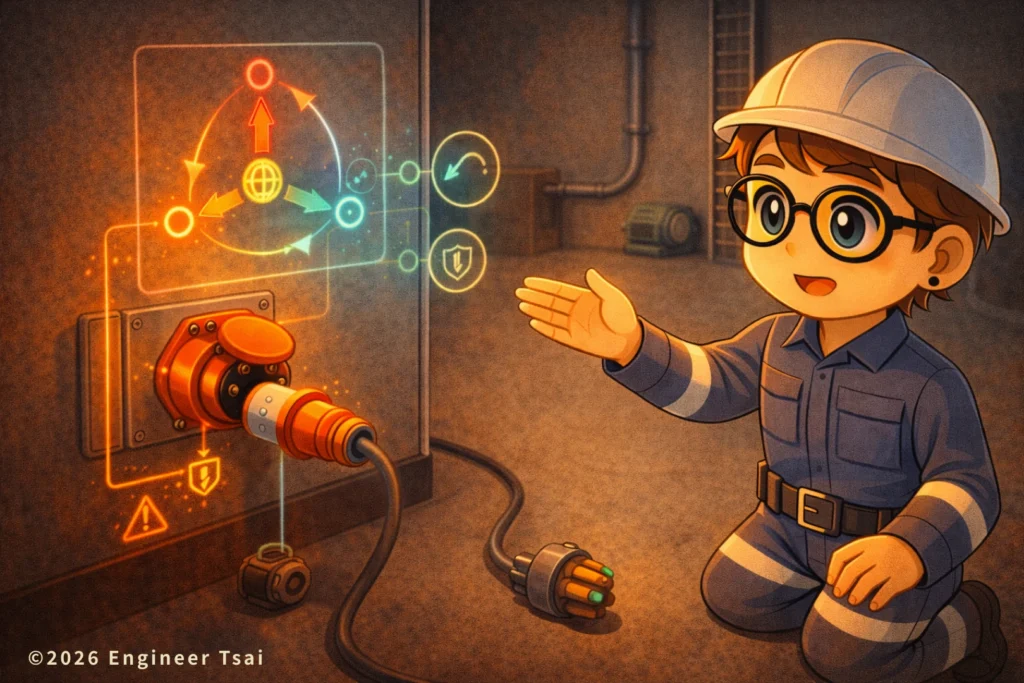
Three-Phase Outlet 101: How to Read 3P+E and 3P+N+E Safely
If you’re still trying to get a feel for how electricity actually works—especially when you start seeing heavy-duty connectors like […]
This category is where we break down electrical theory in plain language, from true beginner level to more advanced concepts.
Voltage, current, resistance, power, power factor, inductors, transformers, motors, generators, semiconductors—if it’s core electrical theory, Electrical basics & advanced concepts lives here.
Examples are based on everyday U.S. situations (120/240-V residential power, common appliances, basic HVAC, small motors), so you’re not just memorizing formulas—you’re connecting them to what you actually see at home or on the job.
If you’re still trying to get a feel for how electricity actually works—especially when you start seeing heavy-duty connectors like […]

This article is the main entry point for all electrical fundamentals. If you want a clear, beginner-friendly explanation of voltage,

Outlet hot neutral ground—if you’ve ever stared at a U.S. wall outlet and wondered “which slot is neutral, which is

If you’re still sorting out the basics of voltage, current, and power, I recommend starting with this big-picture guide first:🔹

If you’re still getting comfortable with the basics of electricity (voltage/current/resistance), start here first: 🔹 “Electricity Basics for Beginners: A

Electromagnetic interference (EMI) is the invisible “noise” that makes electronics act weird: your audio buzzes, your display glitches, your MCU

Decibels dB dBm dBi explained — if you’ve ever stared at Wi-Fi signal bars, router antenna specs, or “+43 dBm”

Superconductors explained in plain English: if you’re still piecing together how electricity actually works, I strongly recommend starting here first:🔹

Magnetic fields are invisible, but your devices “feel” them constantly: your phone knows which way it’s pointing, a PC fan

Antenna basics answers a super real—and honestly brutal—question: why does wireless sometimes “die” after just one wall, even when your