On this page
Table of Contents
If you want the bigger picture of what the electrical trade teaches beyond technical skills, start here: 🔹 “What the Electrical Trade Teaches You: Discipline, Problem-Solving, and Real-World Growth”
After that, this story will hit deeper.
When you walk onto a jobsite, what annoys you the most?
Hard hats hanging off people’s elbows?
Coffee cups and food containers everywhere?
Extension cords twisted into a knot across the floor?
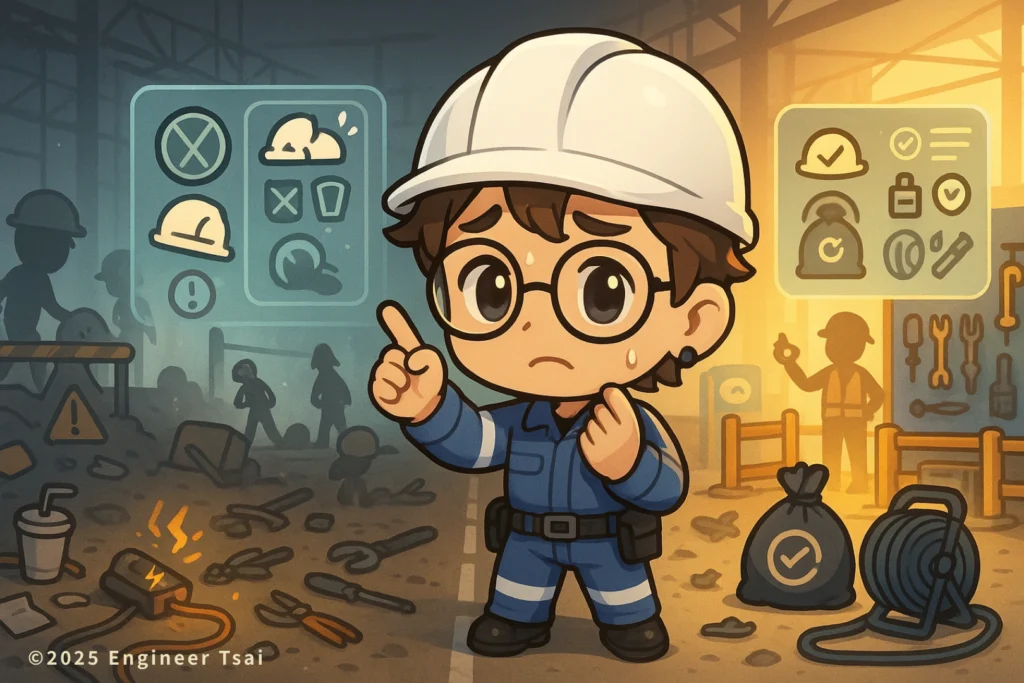
All of those look like “small things,” but behind them are very real risks to safety, quality, and trust.
As someone who’s spent years on active jobsites as an MEP engineer, I’ve seen my fair share of “what on earth are we doing” moments. In this article, I want to break down 10 common construction site safety mistakes and jobsite bad habits that quietly become landmines – and, more importantly, show you the small daily shifts that can actually fix them.
You don’t need a brand-new safety manual.
You just need the crew to move one small step at a time in the same direction.
1. Wearing the hard hat everywhere… except on your head
One of the most common sights on a jobsite:
- Hard hat in hand
- Hard hat hanging off the back of a harness
- Hard hat just resting on the head with the chin strap loose
The logic is always the same:
“I’m just moving a few materials.”
“I’m only walking over there for a second.”
And that’s exactly when accidents happen.
On one job, we were moving materials in a high-bay area. An electrician decided to “save time” and left his hard hat on the ground. A piece of metal pipe slipped from the floor above and sliced right past his shoulder. If it had come down a few centimeters to the side, the story would have ended very differently.
The scariest mindset on any site is:
“I’ve been doing this for 20 years. Nothing’s ever happened to me.”
Experienced workers are actually at higher risk, because habit makes it easy to ignore danger.
👉 Small fix:
Create a simple rule for yourself and your crew:
“Inside the work zone = hard hat on, chin strap fastened.”
No exceptions for “just a minute.” And if you see a coworker with their hard hat loose, a quick:
“Hey, strap that in for me, will you?”
isn’t nagging – it’s how pros take care of each other.
2. Jobsite trash everywhere – and nobody wants to be the one who cleans it up
Coffee cups, energy drink cans, fast-food bags, plastic wrap, cigarette butts…
We all know the picture.
Most trades on a jobsite are under schedule pressure. People unwrap materials, grab a quick drink, and tell themselves:
“I’ll deal with the trash later.”
“Later” rarely comes.
On one site I was on, a carpenter finally lost it and yelled:
“Whose trash is this? You guys finish your work and disappear. I’m the one sweeping all this up!”
Of course, everyone agreed that in theory “everyone should clean up their own mess.”
In reality, nothing changed – until the final inspection came up, and the entire crew was pulled into an all-hands cleanup day. No one got to leave early. This kind of housekeeping problem is one of the simplest construction site safety mistakes to fix, but it shows up on almost every jobsite.
👉 Small fix:
- Set up clear trash stations on each floor or in each zone.
- Rotate responsibility by trade or crew for hauling bags to the dumpster.
- Make it normal that: “When you open it or drink it, you walk it to the trash point.”
At the end of the job, you want to be dealing with a few full bags, not a full-scale landfill.

3. Extension cords and temporary power turned into a spider web
For the sake of convenience, many crews:
- Chain multiple extension cords together
- Throw cable bundles across walkways
- Plug three tools into one overworked outlet
If nothing goes wrong, no one thinks twice.
But on a busy jobsite with high load, this setup is an invitation to:
- Overheating
- Tripped breakers
- In the worst case, electrical fires
I once watched an evening shift where several crews were “fighting for outlets.” There were cords wrapped around scaffolding, Y-splitters everywhere. Then suddenly: pop. The main breaker tripped, and the whole floor went dark. When we traced it back, a cheap extension cord had been overloaded and literally burned at the plug.
👉 Small fix:
- Use rated, heavy-duty extension cords with clear current capacity labels.
- No daisy-chaining if you can avoid it; no cords running through wet areas.
- At the end of every shift, schedule one quick “power walk”:
- Remove temporary connections that aren’t needed
- Coil and hang cords off the floor
- Check outlets that have multiple loads
You’re not just protecting your own tools – you’re protecting everybody’s safety and the GC’s warranty.
4. Treating safety measures as “suggestions” instead of life support
Loose guardrails, safety netting tied “just enough,” missing warning signs on open stairwells – these are classic construction site safety mistakes that people shrug off with:
“I’m just walking through.”
“No one’s working here right now anyway.”
That’s how people trip, fall, and get hurt.
On one project, a new guy walked too close to an edge where the guardrail was “temporarily” secured with thin rope. It looked fine from a distance. When he leaned slightly, the line sagged and he almost lost his balance. A senior tech grabbed him just in time.
Safety gear is not decoration for inspectors. It’s there so that a moment’s distraction doesn’t become a life-changing incident.
👉 Small fix:
Before work starts each day, give yourself three minutes to walk your area and check:
- Edge protection
- Floor openings and covers
- Stairways and ladders
- Warning signage
If something looks sketchy and you can fix it, fix it. If you can’t, report it.
The goal is to make “fix safety first” a shared habit – not just something you do when you hear “OSHA is coming.”
If you want a formal checklist to compare against, you can look at OSHA’s Construction Industry safety overview and NIOSH’s guidance on safety culture . They’re written for U.S. jobsites, but the core ideas apply on almost every project anywhere in the world.
5. “Not my problem” attitude – until everyone has to stay late
One of the worst jobsite habits isn’t physical – it’s cultural:
“I just do my part. If something goes wrong, it’s on someone else.”
No handover notes.
No labels.
No explanation for the next trade.
Imagine this: conduit layout is half done, but nothing is marked. Walls get closed up. Later, someone realizes a run is in the wrong place. Electricians blame the plumber, plumber blames the drywall crew, drywall crew blames the drawings.
And in the end?
Everyone stays late. Everyone tears things down. Everyone is angry.
All because one person didn’t take 3 minutes to label their work.
👉 Small fix:
- Before you call your task “done,” take photos.
- Label conduits, boxes, penetrations, and critical dimensions with markers or tags.
- Spend three minutes walking the next crew through what you did.
That tiny bit of “ownership” is often the difference between a smooth turnover and a multi-day rework nightmare.
6. Tools never going back where they belong
On most jobsites, tools are technically “shared.” In real life, that often means:
- Screwdrivers disappear
- Wrenches are “borrowed” and never returned
- That one good drill goes missing right when you’re under the gun
I’ve seen crews lose an hour just hunting for a drill that ended up buried under packaging in a random corner. Everyone’s on edge, tempers rise, and the schedule slips.
From the user’s point of view, it’s “I just needed it for a second.”
From the team’s point of view, it’s “We’re burning time looking for ghosts.”
👉 Small fix:
- Set up a clearly marked tool zone or tool cart for each crew.
- Make it standard to say: “I’m grabbing the impact for five minutes.”
- And just as important: make “put it back where it lives” a visible expectation.
It’s a small discipline, but over weeks and months, it literally adds days of work time back to the schedule – and makes the crew look a lot more professional to the GC and the owner.
7. Underestimating communication – until it becomes a PR disaster
Sometimes the issue isn’t skills or tools; it’s that nobody talks.
A carpenter lines up openings based on one set of assumptions.
The electrician shows up later and cuts in boxes based on a different assumption.
The owner walks the job and sees outlets in the wrong place, crooked lines, or boxes that don’t match the plan.
On one project, carpenters and electricians never synced up over outlet heights and positions. By the time someone raised a concern, dozens of openings had to be patched and recut. The owner was frustrated, the GC was angry, and every trade involved got dragged into rework.
👉 Small fix:
- At the start of the day, take five minutes with the key trades in your area:
- Review the latest floor plan
- Confirm locations and heights of important elements
- Call out any special owner requests
Turn “I thought…” and “I heard…” into clear, shared agreements on paper.
Those five minutes can easily save three days later.
8. Working from memory instead of current drawings
“I’ve done this layout a hundred times. I know it by heart.”
That’s a very familiar line from experienced trades.
But projects change. Owners change their minds. Architects revise details. If you show up without current drawings or specs, your “memory” might actually be two versions out of date.
I once watched a very experienced electrician rough in an entire run from memory. Halfway through, we realized the design had been revised. He spent almost twice the time tearing things out and redoing the installation.
Experience is valuable – but only when it’s anchored to the latest information. Ignoring revisions and working from memory is one of those construction site safety mistakes that also turn into expensive rework.
👉 Small fix:
- Always bring the latest drawings into the field – printed, on a tablet, or on your phone.
- Double-check revision dates before starting work.
- If something in the field doesn’t match the drawing, stop and confirm.
Make the shift from:
“I remember it like this.”
to:
“Here’s what this version of the drawing actually says.”
That’s how pros operate.

9. Rushing the work and skipping the last 5% of quality checks
Rushing through the final checks is another common construction site safety mistake that doesn’t look dangerous in the moment, but quietly destroys quality and trust.
On a tight schedule, it’s tempting to think:
“Let’s just get it done; we’ll worry about punch list later.”
The problem is, “later” often means “with the owner watching.”
Examples you’ve probably seen:
- Paint looks fine from a distance, but under real lighting there’s a long scratch on the wall.
- Light fixtures are installed, but no one bothered to flip every switch and test every lamp.
- Plates, covers, or trims are “mostly fine,” but don’t align when you look straight at them.
None of these are giant technical failures.
But they destroy trust very quickly.
👉 Small fix:
Before you call it a day, walk a personal punch list loop:
- Start at the entry
- Check switches, receptacles, and visible fixtures
- Look at surfaces from the owner’s eye level
Fix what you can right then.
You want the owner’s first impression to be:
“These people care about details.”
Not:
“How did they miss that?”
10. The most dangerous phrase on site: “It’s just a small thing”
Many serious construction site safety mistakes start with some version of:
“It’s no big deal.”
“It can’t cause any real harm.”
For example:
- A panel door that doesn’t latch properly, so it keeps swinging open, letting dust and moisture in until corrosion and faults show up months later.
- A device cover that’s left off “just for now,” and later a small animal or debris ends up inside, causing a stuck switch or a tripping breaker at hand-over.
- A floor drain left uncapped in a wet area, then buried under topping or tile, only to be discovered when water has nowhere to go.
Individually, each decision feels tiny. Together, they become expensive, reputation-damaging failures.
👉 Small fix:
Build a habit of “one last loop” before you leave:
- Check panels, cover plates, temporary openings
- Close what needs to be closed
- Cap what needs to be capped
Your job as a professional isn’t just to finish tasks.
It’s to make sure today’s work doesn’t become tomorrow’s problem.
FAQ: Construction Site Safety Mistakes and Jobsite Culture
Q1: Are these construction site safety mistakes really that serious? Aren’t they just “little habits”?
Most accidents start as “little habits.”
A loose hard hat, a temporary cable mess, a bit of trash on the floor – none of these cause an explosion on their own. The danger is that risk on a jobsite is cumulative:
One trip hazard here
One missing cover there
One overloaded extension cord in the corner
On the wrong day, those “little things” combine into a big incident.
These bad habits don’t just affect safety. Over time they also:
Shorten equipment life
Increase maintenance and repair costs
Delay inspections and hand-over
Damage your personal and company reputation
A truly professional jobsite culture isn’t “nothing bad happened today.”
It’s “we actively removed risk before something happened.”
Q2: I’m a newer apprentice. Where should I start if I want to break these bad habits?
You don’t have to fix the entire jobsite alone. Start with three simple practices you can control today:
Three things when you walk in:
Hard hat on
Proper footwear
Quick scan for obvious hazards in your work area
Use it? Put it back:
Tools, extension cords, cover plates – if your hands touch it, leave it in a state where the next person understands instantly what’s going on.
Ask instead of guessing:
If you don’t understand a drawing, a dimension, or a routing path, ask.
“I’m not sure, can we check this?” saves far more time than “I assumed.”
You don’t have to lecture anyone. Just being one less source of risk already makes the whole site better.
Q3: How do I bring up safety issues with a coworker without sounding like I’m lecturing them?
On a jobsite, nobody likes being “preached at,” but most people accept mutual reminders if the tone is right.
You can try:
Start with concern, not blame:
“Hey, that spot looks a little sketchy. I noticed the guardrail is loose over there.”
Use real examples instead of orders:
“On a previous job, someone’s hard hat wasn’t strapped, and something fell from above. It was a really close call.”
Share the responsibility:
“If something happens in this area, they’re going to ask all of us what happened. Let’s just tighten this up together.”
If the person clearly doesn’t care, it’s better to loop in the foreman, superintendent, or safety lead. Let the system, not just your personal frustration, handle the risk.
Q4: As a foreman or site engineer, how can I build a healthier safety culture on my jobsite?
Instead of just “catching mistakes and writing people up,” focus on building the idea that safety:
“exists to protect you and your crew,”
not just to satisfy OSHA or the GC.
Practically, that can look like:
A 5-minute huddle before work:
Call out the day’s main risk areas
Highlight special tasks or congested zones
Make good habits visible:
When someone cleans up without being asked, secures a guardrail, or labels their work, call it out and thank them in front of the crew.
When something goes wrong, fix the process, not just the person:
Ask: “What broke in our process that allowed this to happen?”
Change checklists, walk patterns, or communication – not just the name on a write-up.
When “watch your back” becomes “we all watch out for each other,” those dangerous jobsite bad habits start to fade on their own.
Conclusion: What jobsite habits drive you crazy?
A lot of these construction site safety mistakes look like “small habits.”
But when you add them together day after day, they become the biggest landmines on a project:
- People get hurt
- Schedules slip
- Punch lists explode
- And trust between trades, GC, and owner slowly disappears
No one on a jobsite is perfect. But if each person improves just one small habit – putting the hard hat on, coiling the cord, labeling their work – the entire project becomes:
- Safer
- Smoother
- And a lot more respectful to work on
What about you?
- Which jobsite bad habits make you roll your eyes?
- What’s the worst “I can’t believe we did that” story you’ve seen?
Drop your story in the comments – those real-world examples are exactly what help the next generation of electricians, techs, and site engineers avoid the same mistakes.
And if you like content that mixes field stories, practical electrical knowledge, and real jobsite culture, stick around and follow Engineer Tsai.
Let’s build safer, smarter, more human jobsites together.
📌 Further reading:
🔹 “What Is a Short Circuit? And How Do You Prevent One?”
Even a tiny wiring mistake or rushed connection can hide a short-circuit risk inside the walls. This guide walks through what a short circuit actually is, common causes on real jobs, and simple habits that keep your projects safer.
🔹 “5 Must-Have Home Electrical Tools for Everyday Fixes”
The right basic tools turn small electrical issues from “call someone” into “I’ve got this.” This article breaks down five essentials every homeowner or new electrician should keep in their kit, and when it’s still smarter to call a pro.
🔹 “What Is Electrical Resistance? The Quiet Workhorse in Every Circuit”
Resistors look small, but they quietly protect equipment, shape voltage, and keep circuits stable. Here you’ll get a clear, beginner-friendly explanation of resistance, why it matters for safety, and how it shows up in real projects.
If you enjoy this mix of real jobsite stories, practical electrical tips, and honest talk about construction culture, stick around and follow Engineer Tsai.
Let’s build safer, smarter, more human jobsites together.
Read next in this topic
- Your First Major Electrical Failure – Do You Remember How It Felt?
- Why “It’s Easy, Right?” Makes Every Engineer Cringe
- Smart Warehouse Automation: The Complete 2025 Guide for Decision-Makers
- What Construction Work Teaches About Patience, Progress, and Personal Growth
- 10 Construction Site Safety Mistakes That Drive Every Pro Crazy (and How to Fix Them)
- Smart Warehouse Field Engineering Made Easy: 2025 Guide for Engineers
- How to Spot (and Stop) Unsafe Behaviors on Your Crew
- Field-Proven Tips for Successful MEP Integration—From Planning to Inspection
- New Engineer Afraid of Making Mistakes? How to Turn Jobsite Anxiety into Growth
- Top Material Handling Mistakes And How To Fix Them On The Jobsite
- Why Great Employees Fail in the Wrong Roles—NBA-Style Insights
- The Truth About Blueprints: Field Fixes Every Pro Should Know