Three quantities
Voltage (V, in volts) is the push. Current (I, in amps) is the flow. Resistance (R, in ohms) is what holds the flow back.
Choose yearly membership for US$99 a year and get the Texas First-Year Electrical Apprentice Kit at no extra charge with your first eligible yearly payment.
The kit includes a PDF with a pre-start checklist and questions for your employer, plus two editable CSV spreadsheets for your tool budget and inventory.
Annual members get the kit included.
Yearly membership renews at US$99 a year until you cancel. Any applicable tax is shown at checkout. Cancel future renewal using the existing billing controls in your account.
Once your eligible payment is confirmed, sign in to the same account and open Downloads. No separate purchase or coupon is needed.
Canceling future renewal or letting your membership expire does not remove your kit. Membership access still ends according to your paid membership period. You can keep the files you have downloaded.
If the qualifying yearly payment is fully refunded, future downloads granted by this offer end. We do not deduct the kit's price from your membership refund. Your existing refund rights still apply. A separate purchase of the kit keeps its own download rights.
One kit per account. Yearly renewals do not qualify. If you already own the kit, this offer does not provide a second copy, credit, cash alternative or substitute.
Monthly membership keeps its existing 7-day free trial and does not include this bonus. A free trial alone does not qualify. If you currently pay monthly, confirm your billing before changing plans so you avoid overlapping subscriptions.
Your hours are self-recorded, not official verification.
US$14.99 per month with a 7 day free trial, or US$99 per year. Cancel any time.
Texas electrician path: free account and ET Member
Try the complete first-skill preview, compare the free account with ET Member, and see the activities available today. Start with your Texas entry checklist if you are still deciding how to enter the trade.
Choose what you need
Your free account keeps your starting plan and latest first-skill practice. ET Member adds the full foundation path and its saved review tools.
| What you want to do | Free account | ET Member |
|---|---|---|
| Plan your first Texas steps | Save your three preparation checks and return to the next unfinished step. | Everything in the free account. |
| Try the foundation lessons | Complete the public first-skill preview below. No account is needed. | Work through all seven foundation skills, their checks and practice activities in your account. |
| Keep and review foundation results | Read feedback without an account. A free account saves your latest first-skill answers, scores and review list. | Save your foundation results, return to up to three checks needing review, and download current foundation progress as CSV. |
| Apply what you learned | Use the public guides and the first-skill preview. | Work through the two guided scenarios and the Texas job-search pack. |
| Review exam practice history | See your total practice count and five recent entries. | See up to 200 saved entries and your best score for each exam. |
Your basic hours ledger and career-planning tools are already included in your free account.
See the activities available now · See ET Member pricing and trial terms
A complete first-skill preview
Learn the ideas, check your understanding, then solve five paper calculations. Read the explanations and try again until you can explain your answers.
Your outcome: calculate amps, ohms and watts, compare series and parallel circuits, and explain how current changes resistive heating.
Paper calculations only. You do not need equipment or live measurements. A free account can save this practice result. It stays separate from your paid skill progress.
Voltage (V, in volts) is the push. Current (I, in amps) is the flow. Resistance (R, in ohms) is what holds the flow back.
V = I × R. Turn it around when you need another value: I = V ÷ R and R = V ÷ I.
Power (P, in watts) is how fast energy is used. P = V × I. Put Ohm's law into it and you also get P = I² × R and P = V² ÷ R.
One path. The same current flows through every part, and the resistances add up.
Separate paths. Every branch has the same voltage, the branch currents add up, and the total resistance is lower than the smallest branch.
Heat in a wire or a connection grows with current squared (I² × R). That is why an overloaded circuit or a loose connection runs hot.
For these resistive examples, use V = I × R and P = V × I. When using AC values here, treat the stated voltage and current as RMS values.
Sources: OpenStax 9.4 Ohm's Law · OpenStax 9.5 Electrical Energy and Power · OpenStax 10.2 Resistors in Series and Parallel
Your free account saves your latest answers and scores for this first skill. It does not unlock the other paid foundation activities.
Keep your starting checklist and latest first-skill result with a free account. ET Member continues the other foundation activities, guided scenarios and saved review tools.
Keep my starting checklist free See the full first-stage path See ET Member pricing
Available in ET Member today
Start with the preview, then work through these seven skills. Each skill includes a lesson, an understanding check and applied practice. Your member activities save your results so you can return to what needs work.
Calculate amps, ohms and watts on paper, and compare series and parallel circuits.
Open the free skill previewUse a program tool list to decide what to confirm before buying.
Use a drawing legend, follow circuit tags and read a drawing scale.
Recognize common hazards and identify when to stop and ask.
Explain basic AC and 120/240 V relationships with paper examples.
Interpret supplied readings and distinguish practice from supervised field tasks.
Put rough-in, inspection and trim stages in order in a scenario.
A guided scenario with 9 steps to work through.
A guided scenario with 10 steps to work through.
Use the Texas job-search pack alongside the learning activities when you are preparing applications.
Continue through the remaining skills and both scenarios, retry checks that need review, and use the job-search pack. You can revisit these activities and your saved review tools while your plan is active. This is the current first-stage library; choose a plan based on the activities listed here.
These activities build online foundation knowledge and practice. They do not award a trade licence or a job qualification.
Built around your next action
01
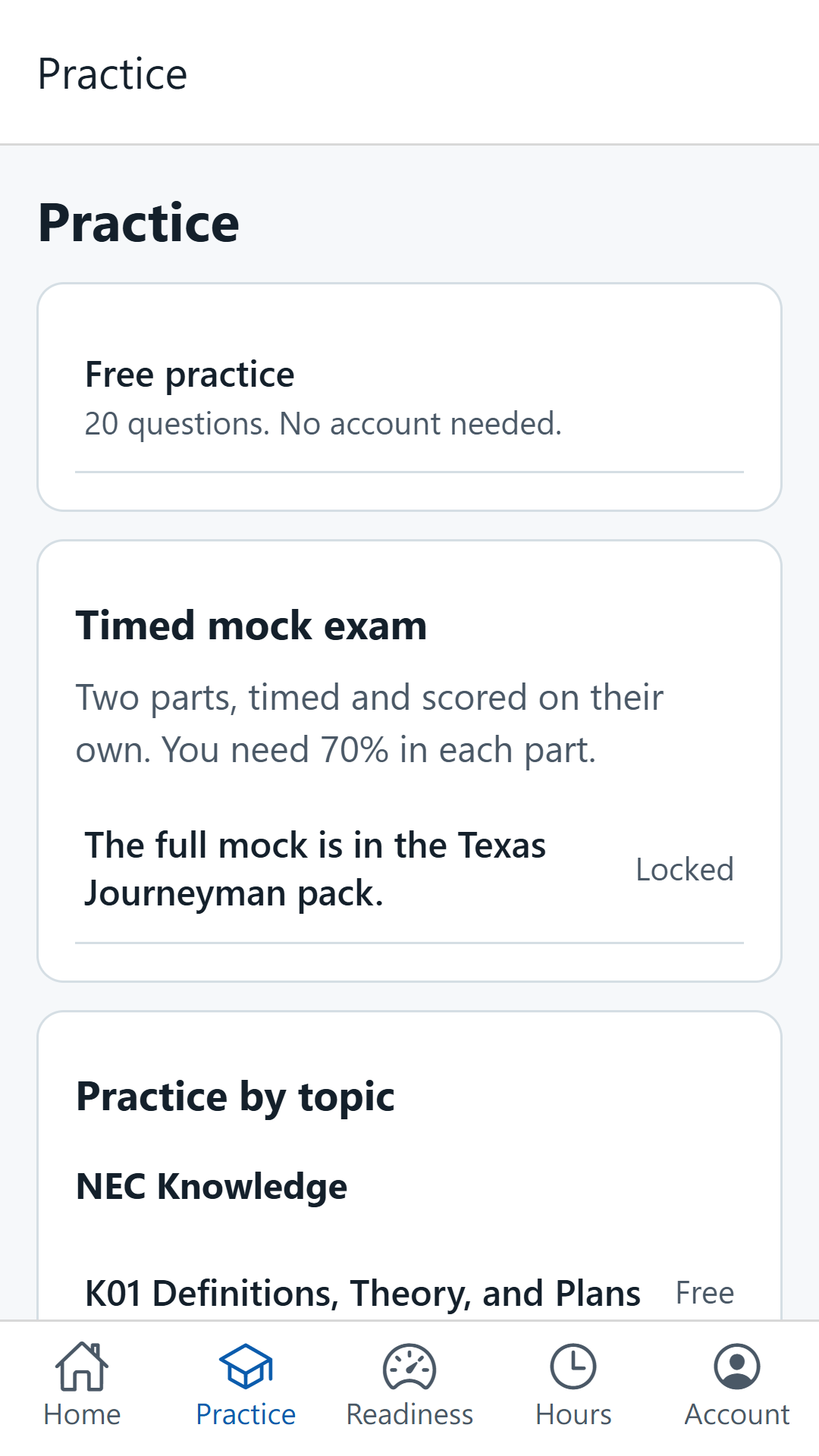
Your free learning record shows your total practice count and five recent entries. ET Member adds the longer history and review features in the comparison above.
02
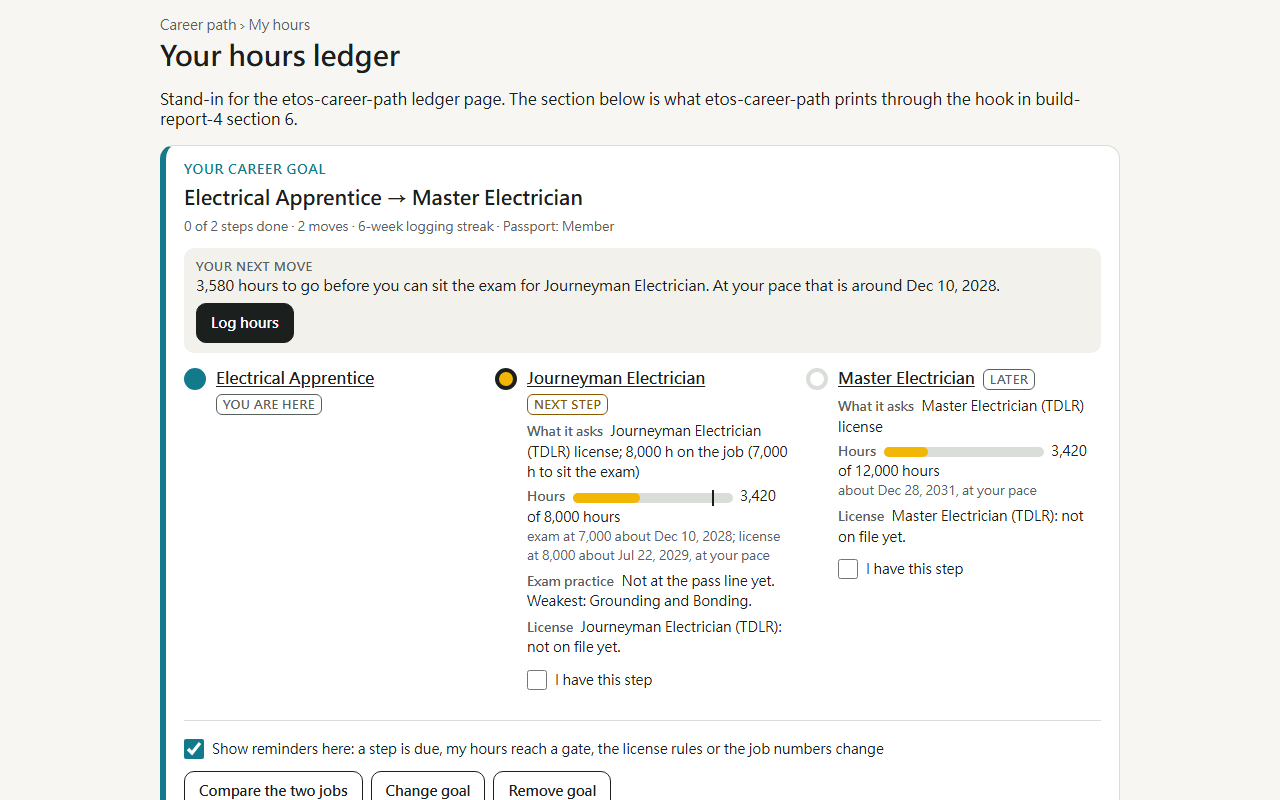
Use the hours ledger already included in your free account to organize your own entries by employer and supervisor.
03
Keep your own target dates and next steps together with the free planning tools.
04
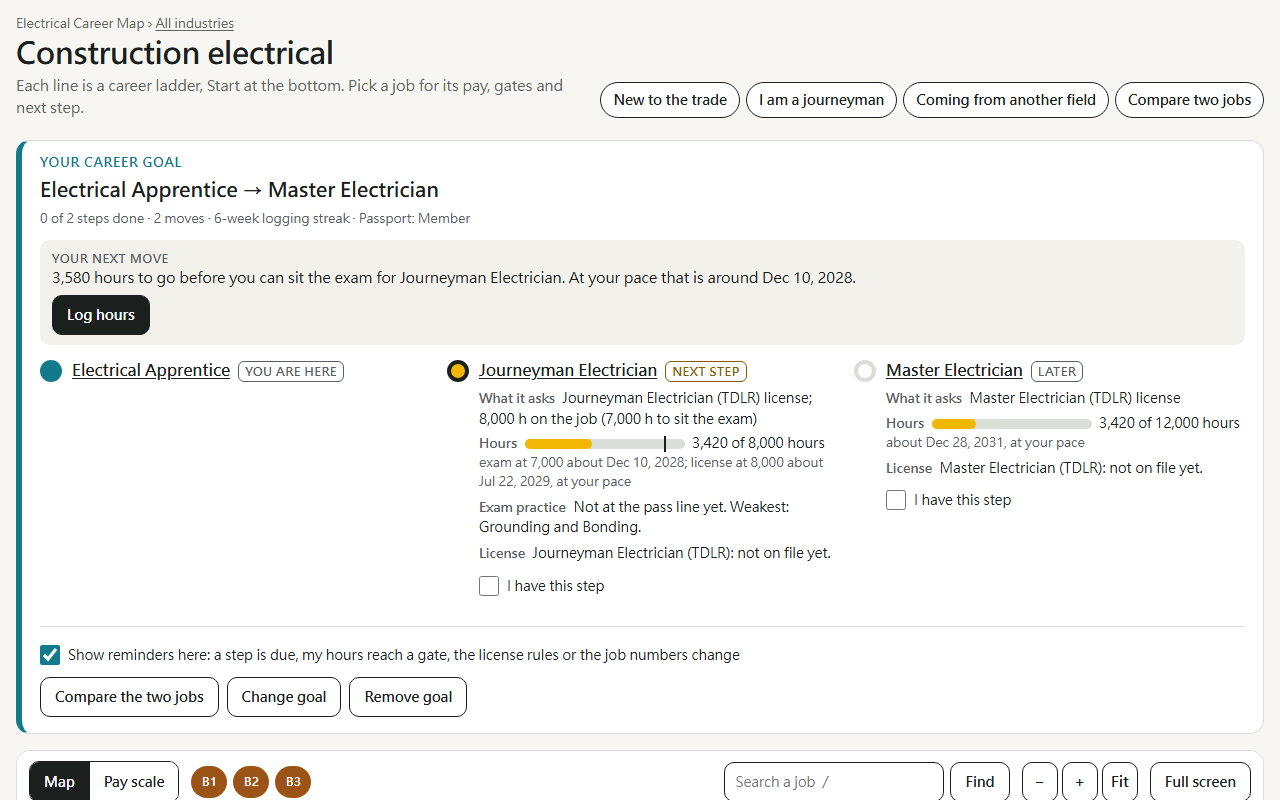
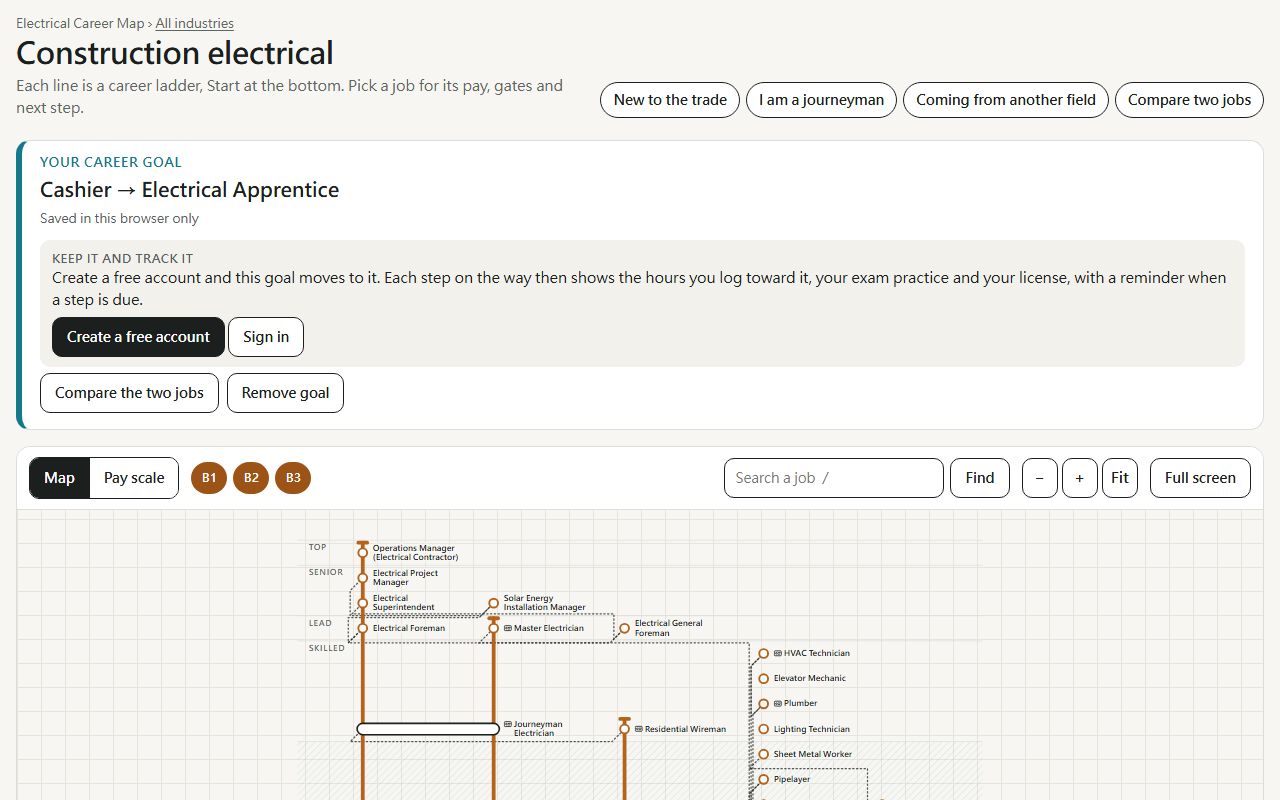
Explore electrical roles and save the career target you are working toward.
No setup maze
Compare Texas entry routes and choose one place to contact.
Create an account and select Texas and your current stage.
Save your preparation checks and continue when you sign in again.
The practical details
Yes. Save your Texas starting checklist and use the basic learning record and planning tools in your free account. ET Member adds the foundation activities and the extended review features listed in the comparison above.
The preview gives feedback without an account. Its sample answers are not saved. Your free account saves your preparation checklist; ET Member activities save your foundation results.
Yes. The account pages fit phone and desktop screens, so you can study or log hours wherever you are.
Track practice progress, focus topics, your exam date, supervised hours, license milestones and career goals.
If you have not entered the trade, start with the three preparation guides above. If you are already working, use your account to keep supervised hours and practice results.
Save your Texas starting checklist with a free account, then return to the next preparation step.
Not affiliated with TDLR or PSI.
The paid plan
Build your first steps toward becoming a Texas electrician.
Follow a structured learning path, practice the basics, work through job search resources, and keep your learning progress in one place.
How to cancel: sign in and open Manage or cancel your plan. It opens your billing page at Creem, our payment partner, where you press Cancel. Your plan stays on until the end of the period you paid for.
If you cancel, your free account and everything in it stay.
Things you can do in your first 7 days as a member. Each one is switched on today.
What each option lists on its own public page. A feature is in the table when every option here states it.
| Feature | ET Member | Electrician U | Journeyman Practice | Zero to Journeyman |
|---|---|---|---|---|
| Price | US$14.99 a month or US$99 a year 1 | US$25 a month or US$270 a year 2 | US$29.99 a month, US$99 a year, or US$199 once 3 | Free, no account 4 |
| How you pay | Subscription, 7-day free trial, cancel anytime 1 | Subscription, 14-day free trial 2 | Subscription or one lifetime payment; a free plan too 3 | Free; affiliate links pay for the site 5 |
| Personal hours log | Yes, an apprentice hours log in your account 1 | Not listed on the individual plan page 2 | Not listed on the pricing page 3 | No hours tool; the Texas page advises writing down every supervised hour 6 |
Checked October 16, 2026. Prices and features can change; see each source.
