On this page
On this page

If you want the bigger picture of what the electrical trade teaches beyond technical skills, start here: 🔹 “What the Electrical Trade Teaches You: Discipline, Problem-Solving, and Real-World Growth”
After that, this story will hit deeper.
Have you noticed this pattern?
The MEP coordination drawings look perfect in the conference room — clean layers, no clashes, everything lined up. But once you walk the jobsite, it’s landmines everywhere.
You’re not alone. In MEP coordination projects, the gap between MEP coordination drawings and real field conditions is something almost every engineer, designer, inspector, and even owner has tripped over.
In fact, the gap between drawings and field conditions is the daily reality of most MEP coordination work.
A lot of what starts as “small issues” — conduits hitting beams, condensate drains with nowhere to go, low-voltage and fire protection fighting for the same path — can snowball into overtime, blown schedules, and failed inspections.
And the most common line you hear on site is still:
“But that’s not how it looks on the drawings…”
🧩 MEP coordination drawings are a rehearsal for the real jobsite
It’s easy to treat MEP drawings as “just reference”:
“We’ll just build to the drawings and fix it in the field if anything comes up.”
But in reality, if you want good MEP coordination between drawings and field, most of the outcome is already decided during the coordination and drawing stage.
The catch? The drawings will never see every field variable in advance.
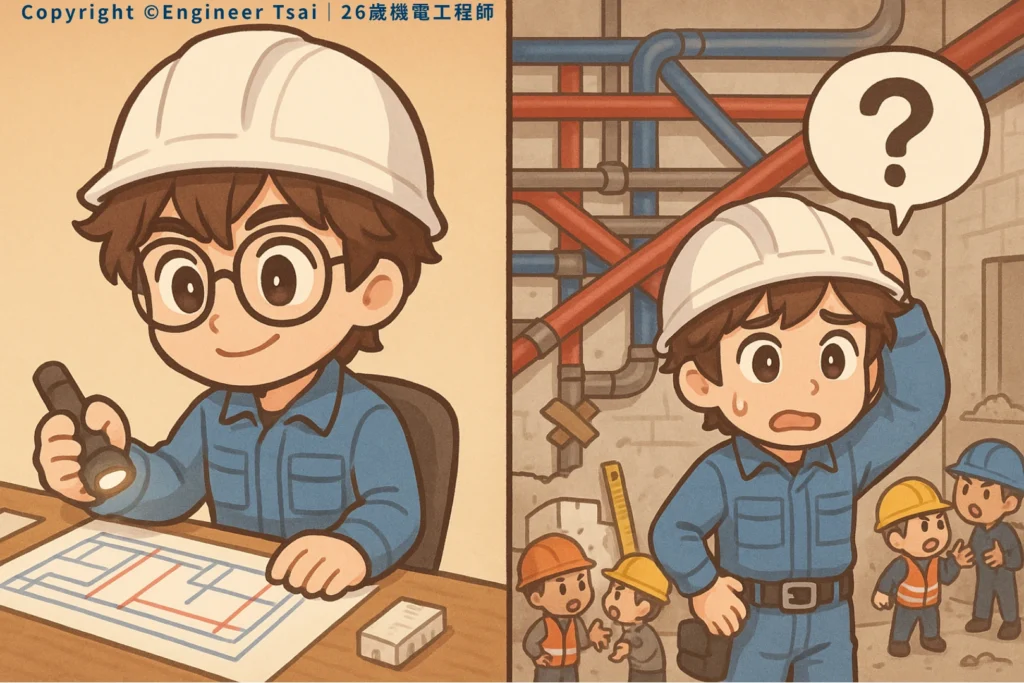
Here’s a typical example: on the MEP coordination drawings, you see three parallel runs, plenty of clear height, everything looks clean. Out in the field, one piece of rebar, an embed, or a misplaced sleeve is off by half an inch — and the entire run is blocked.
Or the MEP coordination drawings show a nice smooth series of bends, but once ceilings drop, equipment shifts, or interiors change, the beautiful route is no longer buildable.
Anyone who’s been through real projects knows this: success isn’t just about drawings. It’s about “drawings + field conditions + communication” moving together.
👷 Three common MEP coordination pain points when drawings hit the field
1. From paper to concrete: embeds vs real field conditions
The first problem is usually poured in long before you see it.
- On paper, all conduit runs look smooth and continuous. On site, you discover a shaft, a duct riser, or a concrete beam exactly where your path was supposed to be — and nothing fits.
- Real-world example: before the reinforced concrete (RC) slab was poured, nobody double-checked sleeve locations, embeds, and actual rebar shop drawings against the MEP coordination drawings. Once the slab is placed, heights are off and penetrations don’t line up. Now you’re forced to run surface conduits, and both your schedule and aesthetics take a hit.
- Field insight: never assume “the drawings must be right.” Before any RC pour, a field engineer needs to physically walk the area, measure critical points, and mark locations on the structure. Skipping this step is how rework gets started.
2. Trade clashes: electrical, HVAC, and fire protection fighting for space
The second pain point usually lives above the ceiling.
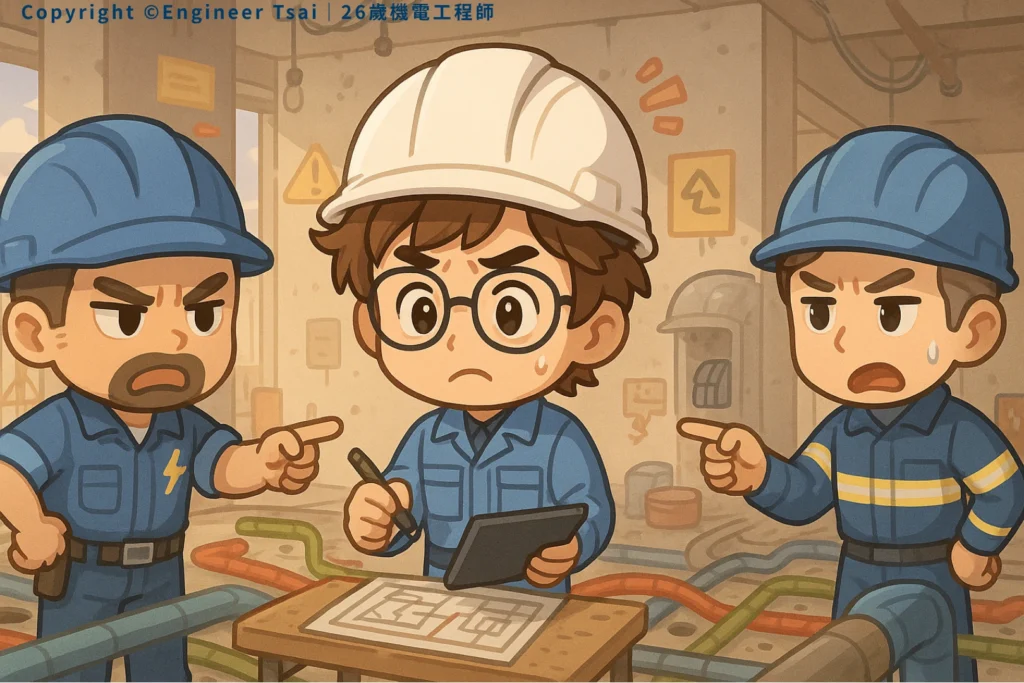
- On the MEP coordination drawings, electrical, HVAC, plumbing, and fire protection have their own neat routes. On site, they’re all fighting for the same corridor, the same soffit, the same shaft — and somebody’s system is going to lose.
- Example: in coordination meetings, I’ve watched electricians and fire protection foremen argue over a single opening for half an hour. Eventually either the field bends and forces things in, or the design team has to revise the MEP coordination drawings on the fly.
- Practical approach: during the MEP coordination drawing phase, clearly mark priority systems (life safety first, etc.) and reserved zones. And in coordination meetings, don’t just bring flat 2D plans. Bring simple 3D views, clash screenshots, or even quick hand sketches and field photos. A shared visual is worth more than 30 minutes of arguing.
3. Spec changes and “temporary substitutions” that become permanent problems
The third headache usually shows up the day materials arrive on site.
- The MEP coordination drawings and submittals show Manufacturer A. What shows up on the truck is Manufacturer B — or a “temporary equivalent” that’s supposed to be “basically the same,” except the dimensions, connections, and sometimes the performance all differ.
- Example: we once got a last-minute notice that a piece of equipment was being substituted. The new gear didn’t match the MEP coordination drawings. Conduit heights, connection points, and clearances were all wrong. The result: tear-down and reinstall for an entire run of equipment.
- Field rule of thumb: when materials arrive, always run a “see + ask + record” checklist:
– See: visually confirm that size, model, and connections match the drawings and approved submittals.
– Ask: did anyone change the model, manufacturer, or voltage? Who approved it?
– Record: take photos and keep a simple log. If performance issues pop up later, you’ll have a paper trail.
📋 MEP coordination checklist: helping drawings actually match the field
If you constantly feel that your MEP coordination drawings and field conditions are out of sync, you can use this simple checklist as a baseline for every project.
- Verify in the field before you order
- No matter how clean the drawings look, walk every embed, opening, and critical height yourself — especially at beams, shafts, and equipment rooms.
- Bring drawings and field photos to every coordination meeting
- Don’t walk into the room with just a floor plan. Use field photos, simple 3D views, or quick sketches so everyone is literally looking at the same problem.
- When clashes happen, get all three parties on the same page fast
- If electrical, HVAC, and fire protection are all stuck at one choke point and the field team can’t resolve it, pull in the designer, GC, or owner rep. Solve it with the same set of drawings and the same field photo in front of everyone.
- When materials arrive, always “look, ask, and log”
- Look: does the actual gear match the approved shop drawings and MEP coordination drawings?
Ask: has anyone changed the model, manufacturer, or specs?
Log: take photos and make a short note so future disputes don’t rely on someone’s memory.
- Look: does the actual gear match the approved shop drawings and MEP coordination drawings?
- Document every significant change
- Field changes, quick “let’s just move this over here” decisions, verbal approvals — don’t let them live only in a group chat. A simple field log, RFI, or change note can save you multiple fights at the end of the job.
🔍 One-line takeaway: drawings decide 80%, the field decides the last 20%
“Drawings set 80% of the direction. The last 20% is carried by field decisions, coordination, and documentation.”
When you start seeing MEP coordination drawings and field conditions as one integrated system, you stop asking only “How do I route this row of conduits?” and start asking bigger questions like:
— Will anyone be able to see and reach this for maintenance later?
— Am I boxing in another trade or blocking future expansion?
— If the owner calls someone back in two years, will they be able to trace this system without tearing half the ceiling down?
💡 Field-proven habits that keep MEP drawings from becoming landmines
- Give yourself more tolerance than the minimum
→ If you can leave 4 inches of clearance, don’t draw only 2. Design with the “worst case” in mind so the field still has room to maneuver. - Talk to field people and suppliers early
→ Set up regular check-ins between designers, field engineers, and key vendors. When in doubt, mock it up in the field instead of guessing on the plan. - Protect inspection points and maintenance access
→ During design, think about how someone will inspect, test, and replace gear later. Don’t erase access panels or shrink maintenance clearances just to make a drawing look clean. - Build a “solve one problem per day” habit
→ When you see a mismatch between drawings and field, try to get at least one concrete decision recorded that same day. The earlier you surface and log issues, the cheaper they are to fix.
🎤 Jobsite FAQ: MEP coordination between drawings and field
Q1: Why do we still have so many issues when everyone “built to the drawings”?
A: Because the drawings are just a snapshot of conditions at one moment in time. The field changes every day — structure tolerances, interior changes, material substitutions, trade sequencing. If those changes never make it back into your MEP coordination drawings, the field will pay the price sooner or later.
Q2: What’s the scariest part about major field changes?
A: When everyone thinks they agreed, but nothing is documented. At punch list or closeout, the team is suddenly scrolling through months of chat messages and random photos, and no one has the same understanding. That’s why any critical change in MEP coordination between drawings and field needs at least one simple record and sign-off.
Q3: Is there any practical way to noticeably reduce rework?
A: Three key moves:
① Don’t let one person be the only eyes on the drawings — involve design, field, and key vendors in MEP coordination reviews.
② For high-risk areas (shafts, equipment rooms, congested ceilings), use 3D, mock-ups, or detailed sections instead of relying only on floor plans.
③ When the field spots a mismatch, report it and document it immediately, instead of waiting until half the work in that area is already installed.
Q4: How can junior engineers build better “field instincts” from MEP coordination drawings?
A: The simplest habit is this: bring the drawings to the field. Look at the MEP coordination drawings first, then look up and compare them with what’s actually installed. Track each run and each piece of equipment with your own eyes. Over time, you’ll start spotting “this height seems off” or “no one will ever be able to service that valve” much earlier.
🎯 Your next step: becoming a field-smart MEP professional
Have you ever been burned by a gap between MEP coordination drawings and field conditions?
Which type of mismatch shows up most often on your projects — embeds that don’t line up, trades fighting for the same space, or spec changes that hit late? And when it happens, how do you handle it?
📌 Recommended next reads
🔹 “Current vs. Voltage for DIYers: Unlocking the Basics”
Many jobsite mistakes are rooted in confusion between current and voltage. Get the fundamentals straight so your troubleshooting and testing aren’t built on guesswork.
🔹 “How Transformers Change Voltage: Principles, Types, and Real-World Uses”
From theory to field examples, learn how to choose the right transformer and protection strategy so each segment of your distribution stays safe and reliable.
🔹 “OSHA Electrical Safety – Construction Overview”
Official OSHA guidance on electrical hazards in the construction industry, including shock, arc flash, and lockout/tagout basics that directly affect everyday MEP work on U.S. jobsites.
🔹 “National Electrical Code (NEC): An Overview”
A quick primer on the NEC, the core electrical safety and installation standard that underpins most U.S. MEP design and inspection requirements.
🔹 “Field Safety Playbook: 5 Non-Negotiables Every MEP Professional Should Know” (in progress)
It’s not just about drawings and installation quality — your own safety has to come first. We’ll walk through high voltage, fault risks, and daily habits that keep you going home in one piece.
Feel free to share your experiences in the comments, or pass this checklist to teammates who are constantly stuck between drawings and field conditions.
If you want more content that connects MEP coordination drawings with real-world field lessons, follow along — in the next articles we’ll keep unpacking the hidden patterns behind everyday jobsite chaos. 🔧
Read next in this topic
- Your First Major Electrical Failure – Do You Remember How It Felt?
- Why “It’s Easy, Right?” Makes Every Engineer Cringe
- Smart Warehouse Automation: The Complete 2025 Guide for Decision-Makers
- What Construction Work Teaches About Patience, Progress, and Personal Growth
- 10 Construction Site Safety Mistakes That Drive Every Pro Crazy (and How to Fix Them)
- Smart Warehouse Field Engineering Made Easy: 2025 Guide for Engineers
- How to Spot (and Stop) Unsafe Behaviors on Your Crew
- Field-Proven Tips for Successful MEP Integration—From Planning to Inspection
- New Engineer Afraid of Making Mistakes? How to Turn Jobsite Anxiety into Growth
- Top Material Handling Mistakes And How To Fix Them On The Jobsite
- Why Great Employees Fail in the Wrong Roles—NBA-Style Insights
- The Truth About Blueprints: Field Fixes Every Pro Should Know