
On this page
Table of contents
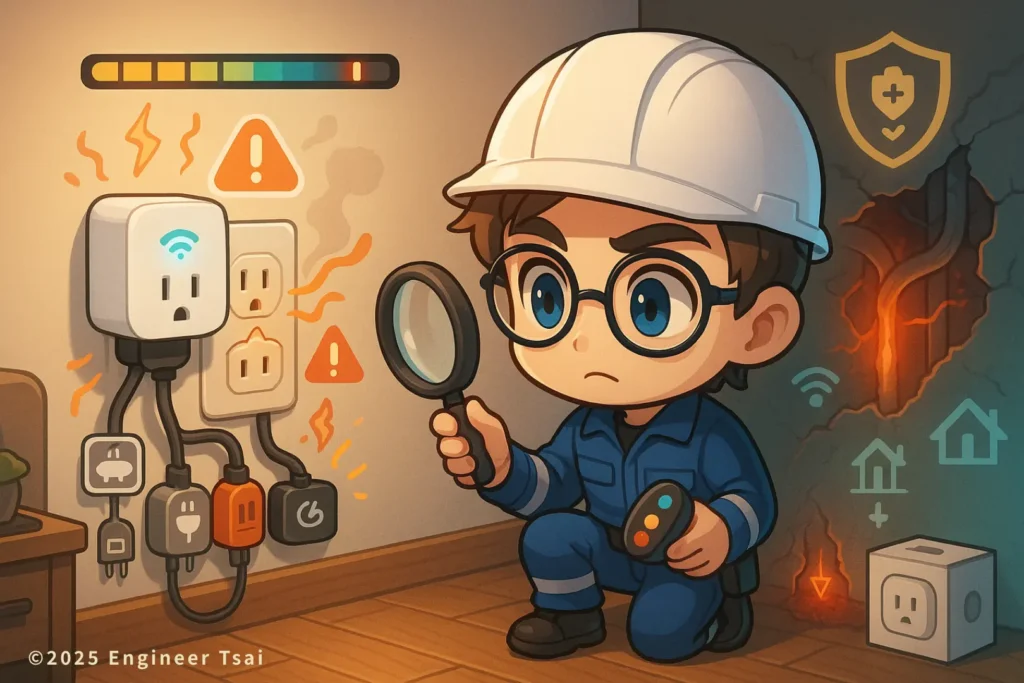
If you want a full understanding of how home electrical systems work, start with the safety overview: 🔹 “Home Electrical Safety Guide: Panels, Breakers, Grounding, AFCI/GFCI, and Common Faults”
Once you know the big picture, this article becomes much easier to follow.
Ever looked at all the smart plugs on the market and thought: “If I install a few of these, I can control everything from my phone and finally have a smart home”?
This guide walks you through smart plug safety from an engineer’s point of view, so you understand the basics of electricity first, then decide how to upgrade without stressing your wiring or your nerves.
You have probably seen horror stories online: “It burned out after a week,” “It trips the breaker every time I cook,” “The power strip melted with everything plugged in.”
Most of these disasters are not because smart plugs are evil tech. They happen because people trust marketing more than basic electrical safety and smart plug safety principles.
“Tech can be clever, but if you never learned the basics of electricity, every smart plug is a little gamble on your home’s wiring.”
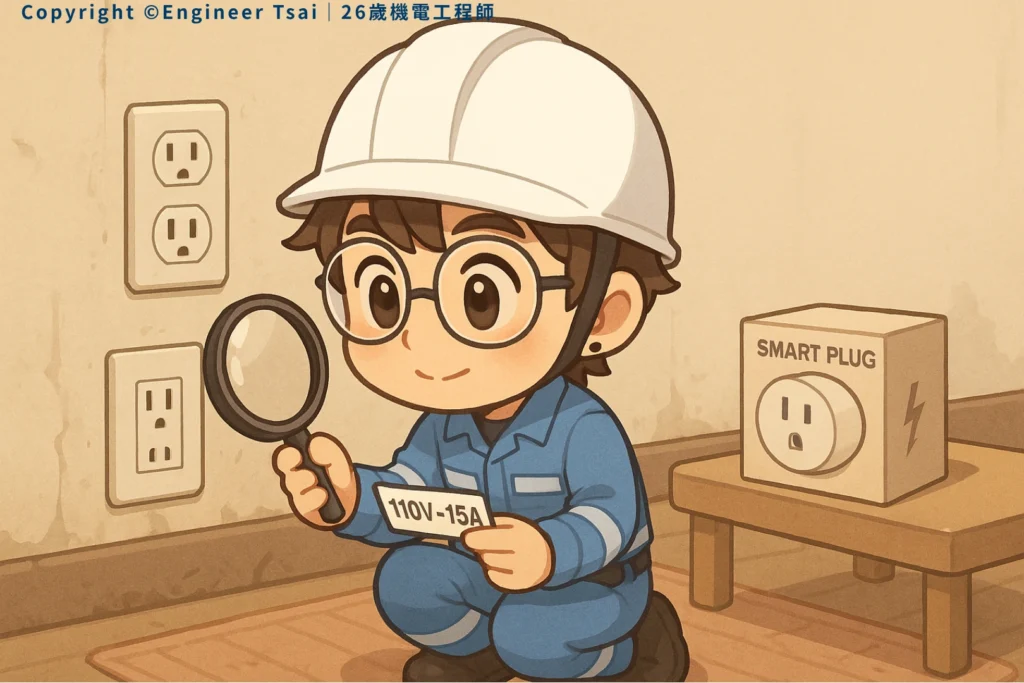
1. Is your home wiring ready for smart plug safety?
In many older homes and apartments, the wiring and outlets were never designed with today’s “always on, always charging” lifestyle in mind. Before you think about smart plug automation, you need to think about smart plug safety on the circuit behind the wall.
Every wire, every outlet, and every smart plug has limits — rated current and rated voltage.
Key takeaways
- The circuit’s amp rating is like the maximum traffic a road can handle. Push more current through it for too long and the “road” (your wiring and outlet) overheats and can literally burn.
- When a smart plug is labeled 15A or 16A, that number is its absolute upper limit, not a daily goal. For smart plug safety, aim for about 80% of that rating or less for continuous loads.
- Most U.S. homes use 120V branch circuits. If you import a 220–240V-only smart plug or plug the device into the wrong type of circuit, the chance of damaging the smart plug or starting a fire goes way up.
→ Before installing any smart plug, take a quick look at the labels on the outlet, breaker, or power strip. If you are not sure what the numbers mean, ask a licensed electrician instead of assuming “it’s probably fine.” That simple step is the foundation of smart plug safety.
2. Smart plug safety: overload protection is not a magic shield
Many people buy a power strip or smart plug and only check whether it says “overload protection” on the box. It feels safer, like there is an invisible shield protecting the whole circuit. In reality:
Overload protection is the last line of defense. Just like a seatbelt in a car, you still want to avoid the crash in the first place.
Real-life scenario
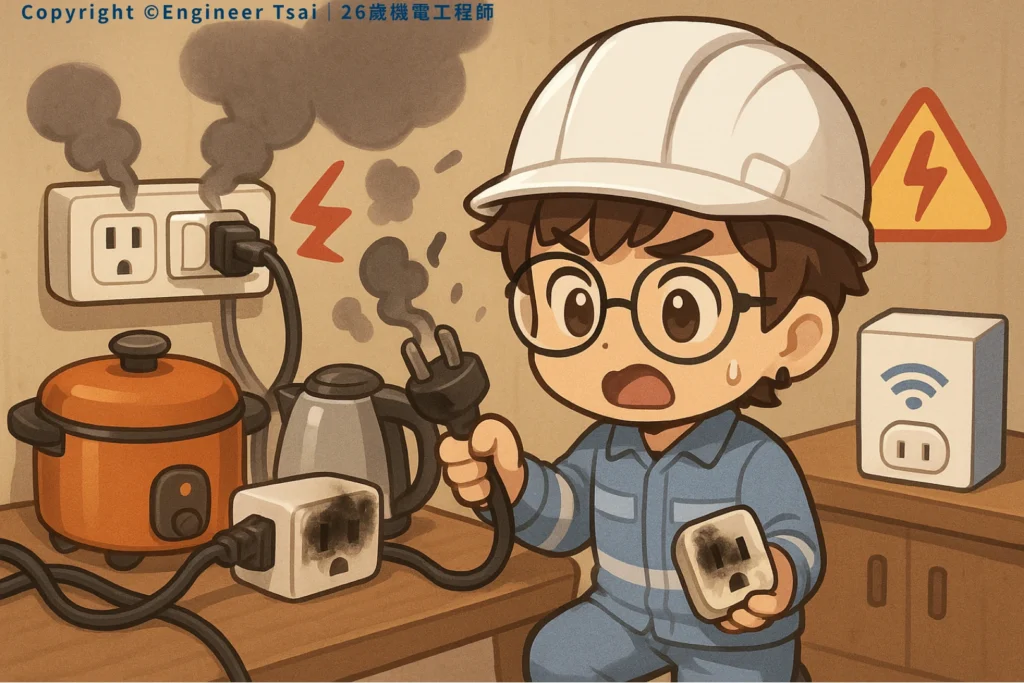
- A reader once told me: “We plugged a rice cooker, an induction cooktop, and an electric kettle into the same power strip. It tripped the breaker and the strip started to smoke.”
- Some products advertise overload protection, but if you run them close to the limit for a long time, the protection may react too late to prevent damage.
“Electrical safety is not about hoping the smart plug will save you. Smart plug safety is about knowing the total load before you plug everything in.”
Action tip:
→ Add up the wattage (W) of everything you want to plug into that smart plug or power strip. If you are anywhere near the rating on the device or the circuit, spread the load across multiple outlets or even different circuits. Smart plug safety often just means not asking one outlet to do the job of three.
3. Grounding and smart plug safety: does your home actually have a ground?
High-end smart plugs often highlight features like “three-prong grounded outlets” and “built-in leak or fault protection.” Those are great features — if your home’s wiring actually includes a proper ground and the breaker panel is up to date.
Reality check
- In many older buildings, two-prong outlets are still common. Some people “upgrade” to a three-prong outlet but cheat by tying the ground to the neutral or to random metal nearby. That kind of fake ground can make shocks and fires more likely, not less.
- If the grounding system and any GFCI protection are not installed correctly, the extra icons and features on your smart plug are mostly decoration. Smart plug safety still depends on the wiring in the wall and the breaker box.
“Safety doesn’t come from icons on the packaging. It comes from every wire, every outlet, and every smart plug being installed to spec.”
Tool tip:
→ A simple outlet tester (usually under US$15) can tell you whether your outlet is wired correctly and has a ground. You can find them at hardware stores or online. It is one of the easiest ways to verify basic smart plug safety at home before you start upgrading outlets.
4. Field story: don’t test old wiring with new smart plugs
On job sites and in customers’ homes, I have seen many “I thought it would be fine” smart plug installs go wrong. In one home, the owner installed a smart plug to control a new dryer and was excited to run it from their phone. A month later, the outlet faceplate was discolored, and a long run of wire behind the wall had overheated and needed to be replaced.
Learning from failures
- Typical DIY mistakes include: mis-wiring the outlet, leaving terminal screws loose, or ignoring the ground wire entirely.
- Many “imported” smart plugs are not certified for U.S. standards or are designed for very different electrical systems. From a smart plug safety perspective, using them on U.S. wiring can mean anything from nuisance tripping to real fire risk.
“Don’t use a fancy new feature to stress-test wiring that was installed twenty or thirty years ago.”
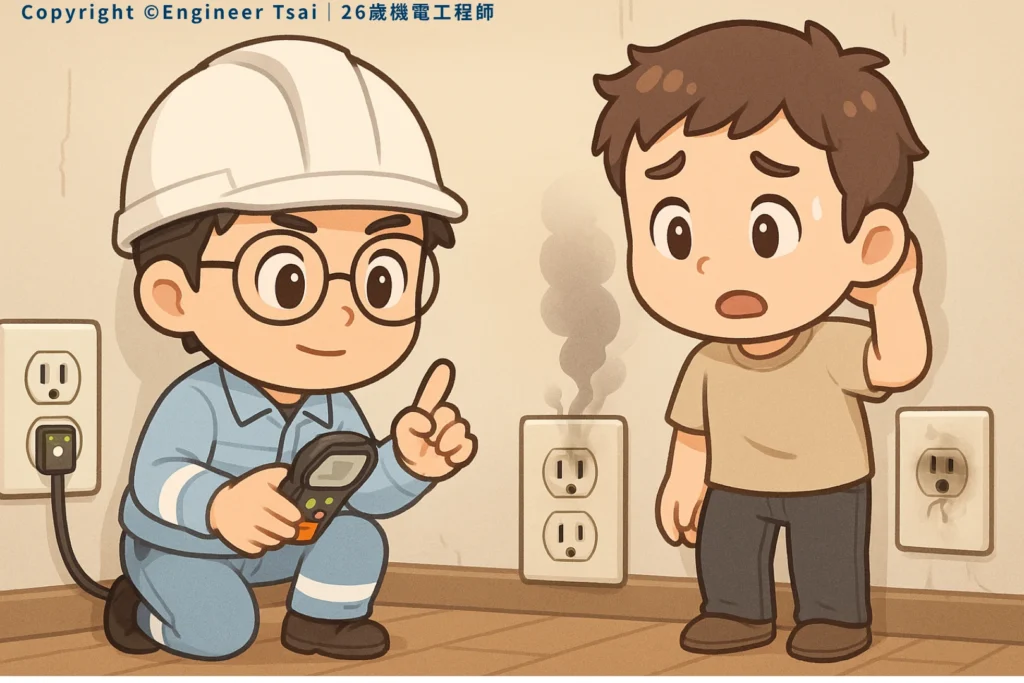
5. Three smart plug safety rules before you buy
- Check the specs – Don’t just scan for features. Look at rated current and rated voltage on the smart plug, outlet, and circuit. Smart plug safety starts with knowing whether your wiring can handle the load.
- Calculate the total power – Add up the wattage of everything you plan to run through that smart plug. Stay comfortably under the rating. If in doubt, split the load across outlets or circuits.
- Ask a pro – If you see brittle wires, discolored outlets, frequent tripping, or you are adding several high-power appliances, bring in a licensed electrician. A small service call is cheap compared to repairing fire damage.
“If you want peace of mind, read the specs first. If smart plug safety is an afterthought, even the smartest outlet can cause trouble.”
Conclusion | Your smart home starts with smart plug safety
Don’t let marketing copy make decisions for your electrical system. A little bit of electrical knowledge and smart plug safety awareness goes a very long way.
The next time you are tempted to drop a smart plug into your cart, pause for a moment: check the wiring, check the specs, and make a plan that keeps both your family and your circuits safe – that’s the heart of smart plug safety.
Smart plug safety FAQ
Q1: Can I install smart plugs in an older apartment or house?
It is not a great idea to just swap in smart plugs and hope for the best. Many older homes have undersized wiring, few circuits, or several outlets chained on the same run. For smart plug safety, have a licensed electrician check the circuit capacity, outlet condition, and grounding before you decide which locations are suitable for smart plugs.
Q2: How many high-power appliances can one smart plug handle safely?
The issue is not how many devices, but the total wattage. On a typical 120V, 15A branch circuit, the absolute maximum is 1800W, but in practice smart plug safety means staying closer to 1400–1500W or less. Large appliances like space heaters, microwaves, or toaster ovens should usually be on separate outlets or even separate circuits, not all stacked on one smart plug.
Q3: What if my outlet has no ground – can I still use a grounded smart plug?
You can physically plug it in, but most of the extra safety features will not work as intended. If there is no proper ground, you lose one of the key layers of smart plug safety. Use an outlet tester or hire an electrician to check whether the circuit can be upgraded with a ground or protected with GFCI or other devices, instead of trusting one smart plug to fix everything.
Q4: When should I call an electrician instead of DIY smart plug installation?
Replacing a like-for-like outlet on a healthy circuit is sometimes manageable for experienced DIYers who understand basic electrical safety, lockout, and testing. But if you see signs of overheating, discoloration, brittle insulation, frequent breaker trips, or if you plan to add several high-power loads at once, that is no longer a basic swap. For real smart plug safety and long-term reliability, let a licensed electrician inspect and update the wiring first.
Have you ever had a smart plug fail, overheat, or a DIY outlet swap go wrong? Share your experience in the comments, or send this guide to someone who is about to upgrade their home so they can think about smart plug safety before they start plugging things in.
📌 Recommended next reads
If you are trying to make your home safer and more efficient, or you are just curious about practical electricity, smart plug safety, and future electrical tech, these are great next steps:
🔹How to use a multimeter: beginner-friendly voltage and current checks
Learning to use a multimeter gives you a simple way to check outlets, appliances, and circuits, so you are not guessing about what is happening behind your smart plugs.
🔹What is a short circuit and how do you prevent it?
Many household electrical emergencies start with a small short circuit. This article walks through common causes, prevention, and what to do if something goes wrong.
🔹Power strip and extension cord load guide (coming soon)
A plain-language walkthrough of how much you can safely plug into one strip or outlet, and how that connects back to smart plug safety in real homes.
🔹For a broader U.S.-based overview of home electrical safety, you can also read this home electrical safety checklist from a U.S. energy provider. It summarizes key data from national safety organizations and gives more context on overloaded outlets, extension cords, and smart plug safety.
Read next in this topic
- What Is a Short Circuit? 7 Things Every Homeowner Should Know
- Smart Home Energy Management: A Simple Starter Guide for Safer, Cheaper Power at Home
- What Is Electrical Grounding? A Simple Guide to Safer Power at Home
- How to Choose Home Lighting: A Practical Guide from an Engineer Who Learned the Hard Way
- Home Electrical Safety: Turning Off Your Main Breaker Made Simple
- Home Electrical Safety and Power Outage Preparedness: A Practical Guide for U.S. Households
- What to Do When Your Breaker Keeps Tripping at Home
- How to Avoid Electrical Fires When Using Smart Outlets at Home
- From Power Outages to Food Shortages: Hurricane Prep Made Simple
- 6 Common Signs of Electrical Problems in Your Home (And What to Do First)
- Loose Electrical Outlet? Here’s How to Repair It Safely
- Top Mistakes in Home Electrical Setup (and How to Fix Them)
- Do Home Wires Really Wear Out? The Truth About Old House Wiring In The U.S.
- How to Weatherproof Your Home: Windows and Doors Made Easy
- Static Shock in Winter? 5 Causes + 5 Fixes (Home + Clothes)
- Electric Meter Reading Explained (5-Step Guide): What kWh Really Means on Your Bill
- Home Electrical Safety in the AI Era: From Short Circuits to Old Wiring (and Your First 0–3 Months as an Electrician)
- How to Choose an Extension Cord Safely: 5 Rules to Prevent Overheating
- Home Electrical Panel and Outlet Guide: How to Plan Safer Circuits for Your Home
- Same Breaker Keeps Tripping? 7 Real Reasons (Wattage, Inrush, Loose Connections)

