On this page
Table of Contents
If you’re still building your foundation in basic electricity, start with this beginner-friendly overview: 🔹 “Electricity 101: The Complete Beginner’s Guide to How Power Really Works”
After reading it, the concepts in this article will make a lot more sense.
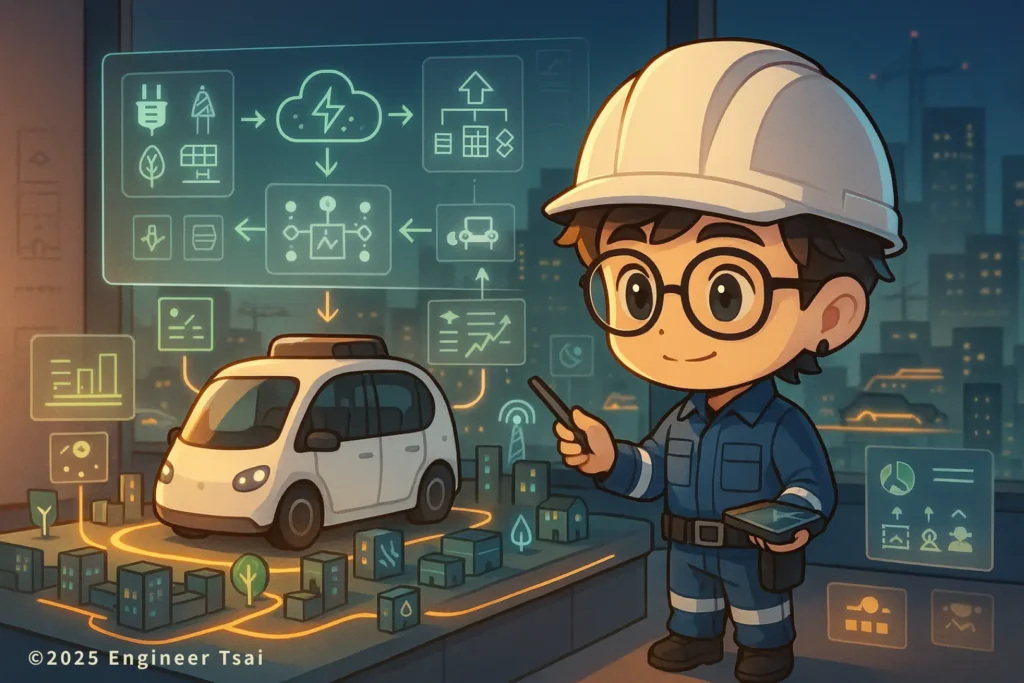
Tesla Robotaxi engineering impact is the core question behind this article: how self-driving taxi fleets will reshape power systems, networks, and real engineering jobs in U.S. cities.
🔗 Tesla Robotaxi news source recap
Let’s first pull out the key facts from this Tesla Robotaxi story, then look at what they really mean for engineers, construction teams, and anyone working on city infrastructure in the U.S.
- Tesla has announced plans to launch the Tesla Robotaxi autonomous taxi service in Austin, Texas in August 2025, moving from demo into real-world operations.
- According to internal reports, the vehicle design removes the steering wheel and pedals entirely, using a minimalist closed cabin built specifically for self-driving rides.
- Elon Musk describes this as a “revolution in transportation efficiency,” built around Full Self-Driving (FSD) and a shared autonomous fleet model.
🚗 Let’s be blunt: Think this has nothing to do with you?
It’s actually about whether your skills still pay the bills.
When you see headlines about Tesla Robotaxis hitting the streets, it’s easy to think, “Wow, that looks cool,” and move on.
But if you work in construction, MEP, low-voltage systems, BIM, or any kind of systems integration, a different question should pop into your head:
Self-driving cars aren’t just a tech story anymore — they’re starting to lean hard on power grids, networks, and the physical city we build every day.
Most people treat this as “just another Tesla hype cycle.” If you have an engineering background, the better questions are:
✔️ How does the Tesla Robotaxi system actually work end-to-end?
✔️ Are our city power, telecom, and roads ready to support a self-driving taxi fleet?
✔️ Will your current skills be replaced — or upgraded — as Robotaxis roll out?
🔍 Tesla Robotaxi engineering impact: What problem is it really trying to solve?
On the surface, Robotaxi sounds like “we just removed the human driver.” In engineering terms, it’s closer to rebuilding an entire urban transportation system from scratch.
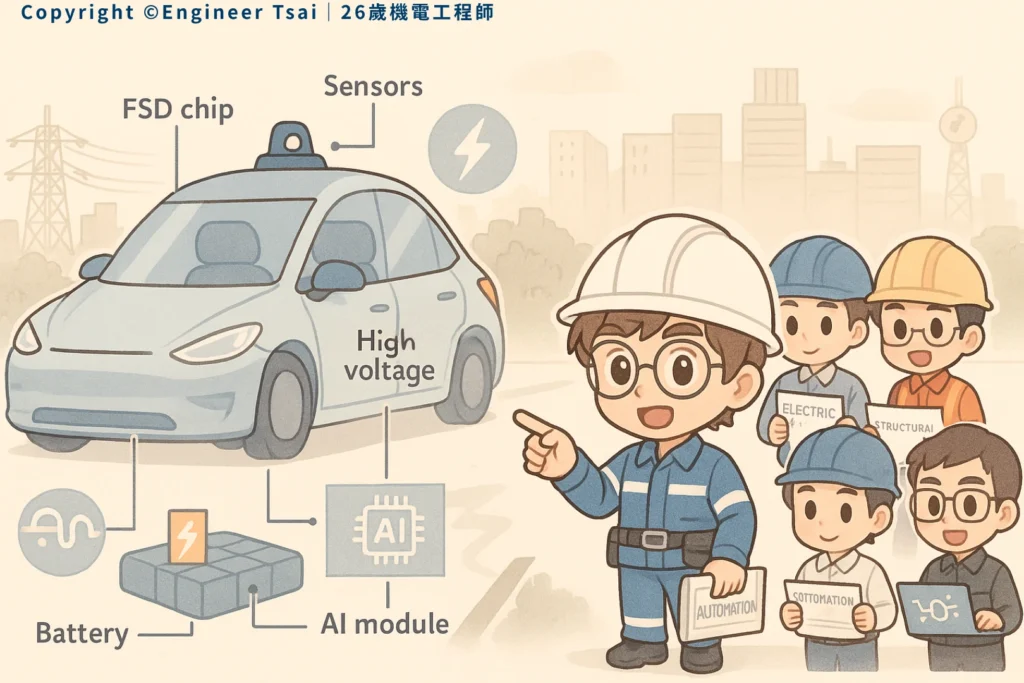
Behind every Tesla Robotaxi there are several stacked layers:
- FSD self-driving algorithms – Heavy use of pure vision and deep learning instead of the classic radar-first stack.
- AI decision-making and real-time traffic prediction – It’s not just “see the red light and stop,” it’s forecasting what pedestrians, bikes, and cars will do in the next second.
- Fleet management and dispatch – Think Uber, but the cars drive themselves. The backend optimizes routes, uptime, and charging schedules.
- Modular cabin design – Today it’s a robotaxi. Tomorrow it could be reconfigured as a delivery pod, mobile office, or mini medical unit.
📌 Jobsite analogy: Why “it sees the lane, so it drives” is way too simple
Think about a good site superintendent. They don’t just read today’s drawing — they can tell you where concrete, rebar, and crews will get jammed three days from now. Tesla Robotaxi is similar: it’s not “see lane, go straight,” it’s “predict what’s about to happen every second” and react safely. That takes algorithms, sensors, cloud services, and network infrastructure all working together.
🏙️ Can our cities keep up? This is the real engineering bottleneck.
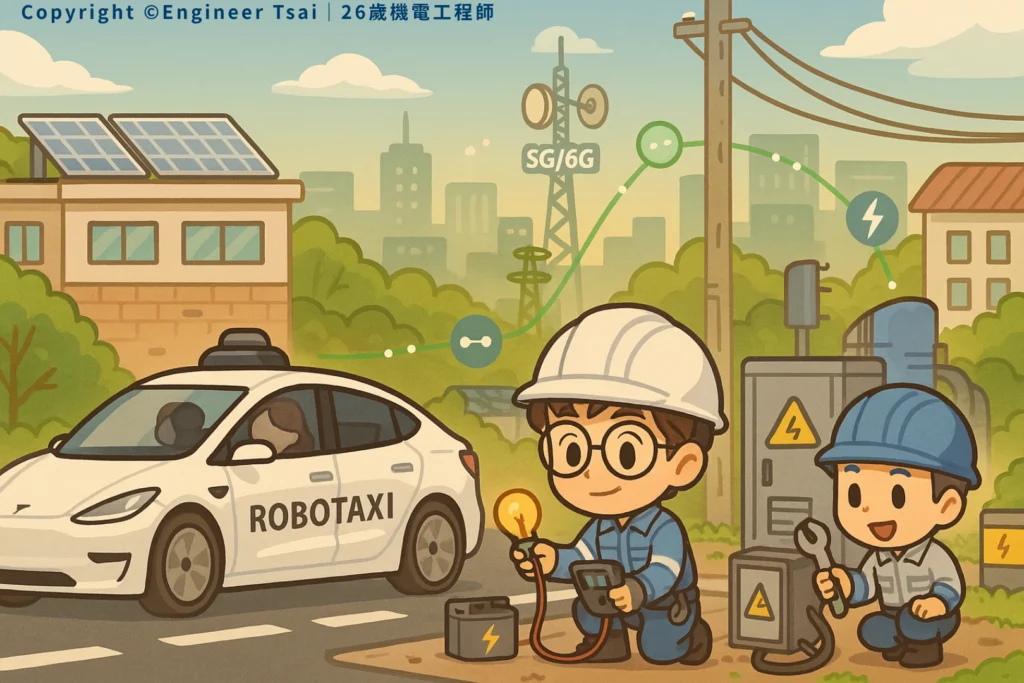
Whether a Robotaxi fleet can run reliably in a U.S. city isn’t just a Tesla problem. It’s a city infrastructure problem.
From a U.S. perspective, we’re staring at questions like:
🔌 Power supply and fast-charging layout
A large self-driving fleet means a huge increase in fast-charging demand. That forces us to rethink substation locations, feeder capacity, protection coordination, and how we distribute high-power chargers across neighborhoods and highways.
📶 Network quality and coverage
FSD is very sensitive to latency and connection drops. 5G — and eventually 6G — coverage outdoors and inside parking structures directly affects how safely and smoothly Robotaxis can operate in downtown streets, tunnels, and garages.
🛣️ Roadway and lane marking maintenance
If lane markings, reflectors, and signs are faded, misaligned, or repainted badly, it makes computer vision much more error-prone. Potholes, standing water, and temporary construction barriers all add extra risk for autonomous taxis.
📌 A takeaway you can actually use
Robotaxi is basically a stress test for the “smart city” idea. From electrical work and telecom to signals and roadway maintenance, every “boring” project you work on today could face a new question tomorrow: will this design still be safe when self-driving taxis are part of the traffic mix?
🧠 From a career lens: Which skills does Tesla Robotaxi amplify?
If your background is in electrical, computer engineering, mechanical, controls, telecom, BIM, or MEP integration, this wave is not far away from you at all.
Here are a few technical areas that will only get more valuable as Robotaxis and other autonomous vehicles scale:
📌 Power and energy system design
High-power DC fast charging, battery management systems (BMS), high-voltage distribution, protection coordination, and grounding — all of these show up again and again when you design infrastructure for self-driving EV fleets.
📌 Automation and systems integration
We’re shifting from “one PLC, one machine” to city-scale multi-vehicle coordination. Control engineers now have to understand cloud services, edge computing, and OT/IT integration, not just panel wiring.
📌 Mechanical design and thermal management
High-power electronics, battery enclosures, crash structures, cooling, and maintainability — all of these are mechanical design challenges that grow as fleets scale up and duty cycles get harsher.
This isn’t just “a new car model.” It’s a rewrite of how cities move people and energy — and that means a different kind of demand for engineering talent.
📣 Final takeaway: This isn’t just “tech news” — it’s a jobsite-level revolution.
When you think about the Tesla Robotaxi engineering impact, you’re really thinking about how self-driving fleets change what gets drawn, calculated, and inspected on real projects.
You don’t have to write FSD algorithms to be relevant. But if you work in the U.S. on power systems, mechanical design, telecom, construction, or BIM, the rise of Tesla Robotaxi and other autonomous fleets will show up in your project requirements, standards, and inspections.
🛠️ Whether you’re doing electrical work, piping, low-voltage, building design, BIM coordination, or full MEP packages — if you touch city infrastructure, self-driving taxis will eventually appear on your drawings, RFIs, or project briefings.
One-line summary
This isn’t just cars evolving — it’s cities upgrading. And you’re very likely to be one of the people helping that upgrade happen.
💬 What do you think — are U.S. cities actually ready to let Tesla Robotaxis roam safely? Which part of your field do you feel will get hit first: power, networks, traffic systems, or something else?
Drop a comment and share where you’re working now. In the next deep dive, we’ll unpack where self-driving cars might clash with construction sites and how to design around those conflicts.
If you’re still wondering how all of this translates into real projects, this FAQ walks through the most common questions I get about Tesla Robotaxi engineering impact on U.S. jobsites and everyday engineering work.
❓ Tesla Robotaxi × U.S. jobsite FAQ
Q1: What exactly is Tesla Robotaxi, and how is it different from a regular self-driving car?
You can think of Tesla Robotaxi as a dedicated self-driving version of the Tesla fleet, built specifically for ride-hailing. It’s not just “Autopilot plus a human backup.” In the long-term concept, it removes the steering wheel and pedals and is designed so passengers just get in, pick a destination, and let the car handle the whole trip. Behind the scenes, it combines FSD algorithms, a fleet management platform, and city infrastructure — it’s a transportation service, not just a car.
Q2: Will Tesla Robotaxis really spread that fast? Do we in the U.S. need to worry right now?
At scale, Robotaxi rollouts will still hit roadblocks: regulations, liability, insurance, and uneven infrastructure. But for engineers and technical workers, now is the right time to understand what self-driving fleets need to operate safely. When you design power, networking, roads, garages, or charging stations with autonomous vehicles in mind, you’re ahead of the curve by the time clients start asking for it explicitly.
Q3: Will self-driving taxis reduce or increase job opportunities on the ground?
In the short term, it’s less about losing jobs and more about jobs leveling up. You’ll see new project types: fast-charging hubs, smart roadside equipment, fleet operations centers, data rooms, and resilient telecom networks. For people in electrical, MEP, telecom, low-voltage, and BIM, if you’re willing to learn these new requirements, you can become one of the rare specialists who actually understand what autonomous fleets need.
Q4: If I’m in electrical contracting or MEP design, how can I start aligning my skills with the Robotaxi trend?
You can start from three directions:
① Strengthen your power and distribution fundamentals: high-voltage distribution, transformers, switchgear, panelboards, grounding, and protection coordination are all core to fast-charging and fleet depots.
② Get comfortable with telecom and low-voltage systems: 5G deployment, fiber, wired and wireless networking, and surveillance systems all play a role in smart transportation projects.
③ Build “system thinking” habits: stop looking only at individual devices. Train yourself to think in terms of “vehicle + road + cloud + control center” as one integrated system.
Q5: If I’m still in school or just switching careers, is it too early to care about Tesla Robotaxi?
It’s actually a great time. You don’t need to jump straight into FSD algorithm research, but you can use self-driving cars as a learning radar: notice which sensors, networks, power systems, and control concepts they rely on, then lean into those areas in your coursework or early jobs. By the time U.S. cities start building more complete self-driving infrastructure, your resume will already show relevant skills instead of starting from zero.
📌 Recommended next reads
🔹 “What Is an Electric Motor? From Electricity to Motion”
Understand how motors turn electrical energy into mechanical motion — core to propulsion, steering, and actuation in self-driving EVs.
🔹 “How Inductors Shape Power Circuits: Basics and Real-World Applications”
Dig deeper into how inductors affect fast charging, power smoothing, and vehicle control modules in modern EV and Robotaxi systems.
🔹 “Beginner’s Guide: Using a Multimeter to Measure Voltage and Current”
Start building hands-on electrical intuition from simple measurements, so when you later deal with EVs and smart-city hardware, the numbers on the meter actually mean something.
👉 If you enjoy looking at big tech trends from an on-the-ground engineering perspective — like the real Tesla Robotaxi engineering impact on power, networks, and jobsites — feel free to follow my blog and channel. Let’s keep sharpening your skills now so you have more and better options in the next decade. 🔧