
On this page
Table of Contents

If you’re still building your foundation in basic electricity, start with this beginner-friendly overview: 🔹 “Electricity 101: The Complete Beginner’s Guide to How Power Really Works”
After reading it, the concepts in this article will make a lot more sense.
▶️ Watch now: What is a waveform? Sine, square, and sawtooth in 60 seconds
Quick answer: a waveform is a graph of how a signal’s voltage or current changes over time. A sine wave rises and falls smoothly (standard AC power); a square wave switches instantly between two levels (digital signals); a sawtooth ramps up steadily then drops sharply (used in some timing and display circuits). The shape tells you how the electricity actually behaves, not just its peak value.
Want to check how solid your grasp of concepts like this really is? Try the free Electricity Fundamentals Mock Exam — a self-practice quiz, not an official certification exam.
Did you know the chips inside your phone, laptop, and headphones are constantly reading waveforms? Most people only understand numbers like volts and amps, and have no idea what that squiggly line on the screen is trying to say — or even how to answer the basic question, “what is a waveform?”
You’ve probably seen waveforms before without calling them that: the jumping line on an ECG heart monitor, or the audio track in your video-editing software. Those moving lines are just waveforms — a visual way to show how a signal changes over time.
Waveforms aren’t only for engineers. They quietly shape almost everything around you. From the way your AC unit draws power, to how your headphones play music, to how the motor in your washing machine is controlled, different systems “talk” to each other using different waveforms.
In this guide, we’ll walk through what a waveform is in electronics, and how sine waves, square waves, and sawtooth waves are different — plus how they show up in real devices you actually care about.
👉 In short: after reading, you’ll not only be able to answer “what is a waveform?”, you’ll also be able to look at a basic oscilloscope screen and roughly tell what kind of waveform you’re seeing and what it’s trying to do.
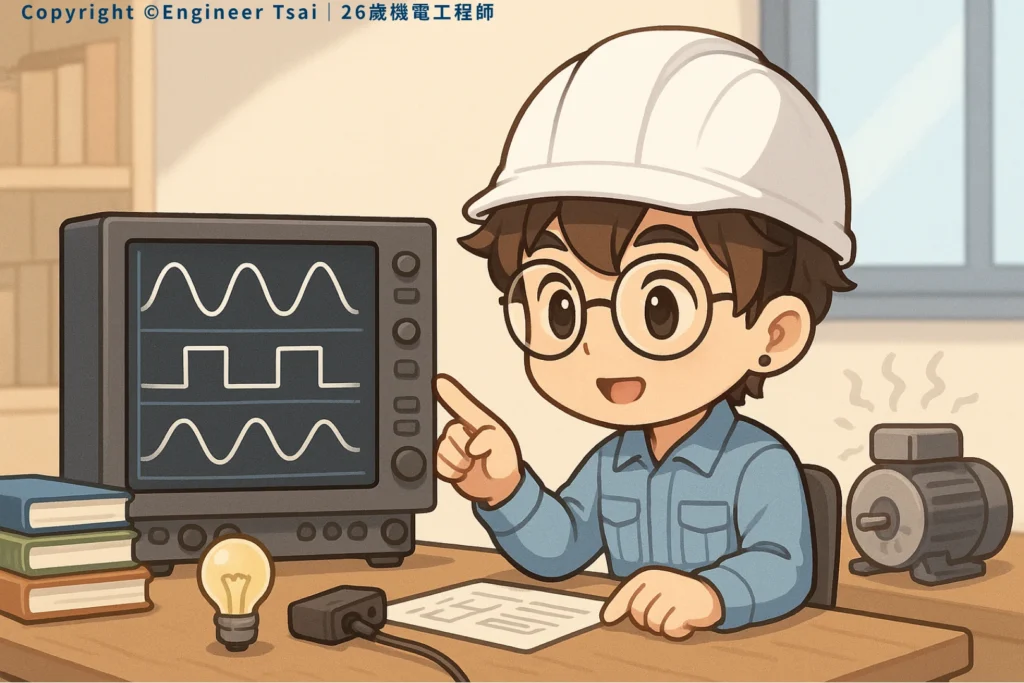
Chapter 1|What is a waveform and what is it used for?
In simple terms, if someone asks “what is a waveform in electronics?”, the short answer is: a waveform is how voltage or current changes over time. That’s the practical way to explain “what is a waveform” to someone who’s just getting started. You can think of it as:
- the “mood curve” of electricity
- the “command signal” a controller sends to a motor
- the “shape of sound” inside your audio system
A perfectly flat line means “nothing is changing” — the voltage is steady. A line that rises and falls means the signal is actively doing something. Those changes affect how smoothly a motor spins, how a power supply behaves, how a sound feels to your ears, and even whether a device stays cool or slowly cooks itself to death.
If you’re just starting out, you don’t have to begin with formulas. It’s more helpful to learn to “tell a story” from the picture. When you see a waveform, can you roughly tell whether it’s:
- delivering smooth, steady power
- giving a sharp on/off command
- doing a repeating “ramp up then reset” motion
If you can do that, you’re already ahead of many people who only glance at numbers on a multimeter.
Quick answer: 3 common types of waveform covered in this guide
- Sine wave — smooth, continuous rise and fall with no sharp corners; the shape of AC power at home.
- Square wave — jumps straight between high and low with almost no in-between; used for digital on/off signals.
- Sawtooth wave — ramps up steadily then resets suddenly, repeating; used in synth sound design and scanning circuits.
These three are not the only waveform shapes out there, but they are the ones every beginner should recognize first. For how waveforms connect to voltage and current, start with electricity basics for beginners.
Chapter 2|Sine wave: the smooth and gentle workhorse
The sine wave is the “mother” of many waveforms. It’s also the classic shape of AC power used in homes and buildings around the world.
- What it looks like: a smooth, flowing S-shaped curve, rising and falling like an ocean wave.
- Main feature: it changes smoothly with no sudden jumps or sharp corners.
- Where you see it: AC outlets, HVAC compressor motors, transformers, medical devices, many analog audio systems.
Why is the sine waveform so important? Because it produces fewer unwanted harmonics and noise, and it keeps motors and transformers running more efficiently and gently. You can imagine it as a calm, steady river: always moving, but never crashing into the riverbank.
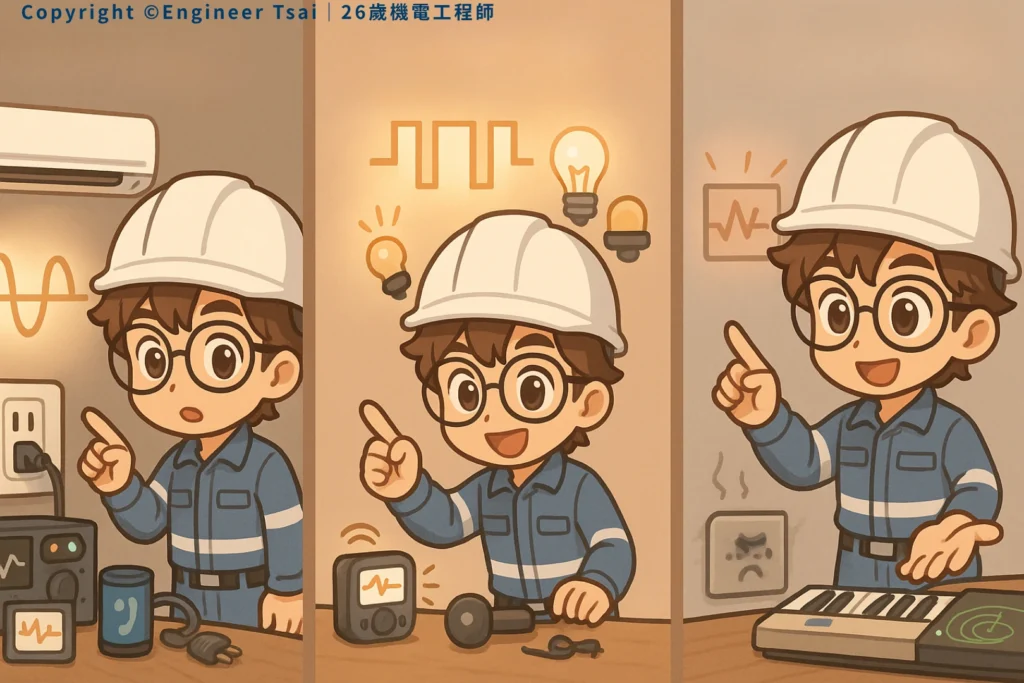
Chapter 3|Square wave: the most decisive on/off command
The square wave has a completely different personality.
- What it looks like: the voltage jumps straight up and straight down, with almost no slope — like a switch being flipped on and off.
- Main feature: it’s either high or low, on or off. There’s almost nothing in between.
- Where you see it: digital logic signals (0s and 1s), simple motor on/off control, buzzers, LED blinking circuits.
The big advantage of square waveforms is that they’re simple, fast, and cheap. Anytime you only need a “yes/no” or “on/off” instruction, a square wave is perfect.
But those sharp edges come with downsides:
- They generate more electrical noise and interference for nearby circuits.
- If you use a square wave as a “fake sine wave” power source for motors or coils, the extra harmonics can cause more heating and stress over time.
You can think of a square wave as a very impatient boss:
“I don’t care if you’re ready or not — do it NOW. Stop NOW.”
Great for fast digital control. Not so great if you’re trying to keep analog hardware comfortable for the long term.
Chapter 4|Sawtooth wave: the repeating ramp and reset
The sawtooth wave looks exactly like its name: a row of evenly spaced saw teeth.
- What it looks like: the voltage ramps up slowly, then suddenly drops back to the start, then ramps up again.
- Main feature: it has a clear direction and pattern, but it’s not smooth like a sine wave – it feels like a series of “run up, reset, run up, reset” cycles.
- Where you see it: synth sound design, scanning circuits, old CRT TV scan lines, radar displays, and control circuits that need a repeating “sweep” motion.
The sawtooth waveform is useful because its behavior is predictable and repeatable. It’s great for simulating vibrations, ramps, or periodic scanning motions. However, because it isn’t as gentle as a sine wave, it’s more often used inside specific control or signal circuits — not as a general-purpose power waveform.
You can imagine it like a timer that keeps ramping up and then suddenly snapping back to zero, over and over again.
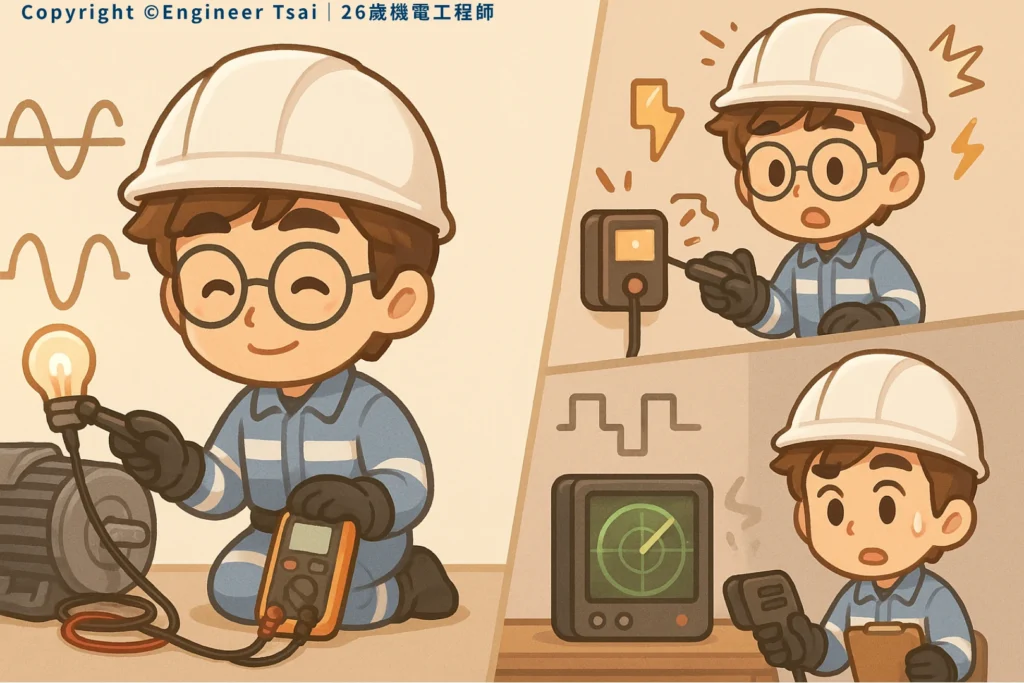
Chapter 5|What’s the difference between sine, square, and sawtooth waveforms?
Different waveforms are like different tones of voice:
- A sine wave is like a calm, steady explanation.
- A square wave is like a direct command: “yes or no, now.”
- A sawtooth wave is like a repeating reminder: ramp up, reset, ramp up, reset.
In control systems and power electronics, these differences directly affect things like:
- whether a motor spins smoothly or feels jerky
- whether a power supply stays stable or runs noisy and hot
- whether components stay comfortably within their limits or get overloaded
- whether audio sounds warm and pleasant or harsh and tiring
So choosing the wrong waveform isn’t a tiny detail. It can be the difference between a system that runs reliably for years and one that overheats, fails early, or interferes with everything around it. Understanding what a waveform is and choosing the right one is basically learning to use the right “tone of voice” when you talk to your hardware.
Conclusion|Waveforms are the real language of electricity
When people first learn about electricity, they usually focus on the numbers: how many volts, how many amps. But in real systems, the waveform is the language that actually matters. Once you can clearly answer “what is a waveform” in your own words, the rest of power and signal concepts become much easier to learn.
You’re not only sending “how big” a signal is — you’re sending how it changes. The waveform is the rhythm and timing of that change.
So next time you look at an oscilloscope trace or a waveform diagram, don’t just ask “how high is it?” Try asking yourself:
“What is this waveform trying to make the device do?”
Once that question becomes a habit, every waveform you see will start to feel more like a sentence you can read, instead of just a mystery squiggle on the screen.
🎤 Waveform FAQ
If you’re still not fully confident answering “what is a waveform?” or if oscilloscope screens still look a bit confusing, these common questions are a good place to continue.
Q1: What is the relationship between a waveform, frequency, and period?
A: The waveform tells you the shape of the signal. Frequency is how many times that shape repeats per second, and period is how long one full cycle takes. Even with the same sine waveform, changing the frequency changes what you feel or hear — for example, motor speed or the pitch of a sound.
Q2: Why do household outlets use sine waves instead of square waves?
A: Sine wave AC power is much kinder to motors, transformers, and other equipment. It produces less noise and heat for the same amount of useful power. If we used square waves as the main power waveform, a lot of devices would run louder, hotter, and reach the end of their life much sooner.
Q3: Are square waves really harder on equipment?
A: Square waves are perfectly fine for simple on/off control signals. The problem comes when you try to use a square wave as a substitute for a smooth power waveform. The sharp edges bring extra harmonics and noise, which can mean more heating and stress in coils, motors, and transformers — especially in cheap or poorly designed systems.
Q4: When I see a messy waveform on the oscilloscope, what should I look at first?
A: Start with three things:
1) Overall shape: is it mostly like a sine, square, or sawtooth?
2) Frequency range: is it slow, medium, or very fast for your system?
3) Edges and noise: do you see sharp spikes or fuzzy edges? These three checks already tell you whether the signal looks like “normal operation” or “a device calling for help.”
Q5: As a beginner, what’s the best way to practice reading waveforms?
A: Start simple. Compare a battery and LED, your wall outlet, and a basic square wave signal on the scope. Build a mental library of “when I connect it like this, the waveform looks roughly like that.” Once you have these reference pictures in your head, strange waveforms on real projects will feel much less mysterious.
📌 Further reading
🔹Voltage Basics: How Voltage Drives Current
Voltage is the “push” behind many waveforms. Once you understand it, waveform diagrams stop being just pictures and start to feel like real control signals.
🔹How Inductors Affect AC Circuits
What happens when your waveform passes through an inductor? This article dives into why some waveforms tend to “lag,” “ring,” or get pulled into different shapes.
🔹What Is an Electric Motor? From Electricity to Motion
Many motors behave very differently depending on what waveform you feed them. This article connects waveforms back to something tangible: how your choice of signal turns into real, physical motion.
—
Is there a particular type of waveform that sticks in your mind — maybe from a noisy power supply or a strange scope trace on a project? Drop a comment and share your story. Let’s turn those “invisible” electrical patterns into something you can actually read and control with confidence, so the next time someone asks you “what is a waveform?”, you’ll have a real story to answer with.