On this page
Table of contents
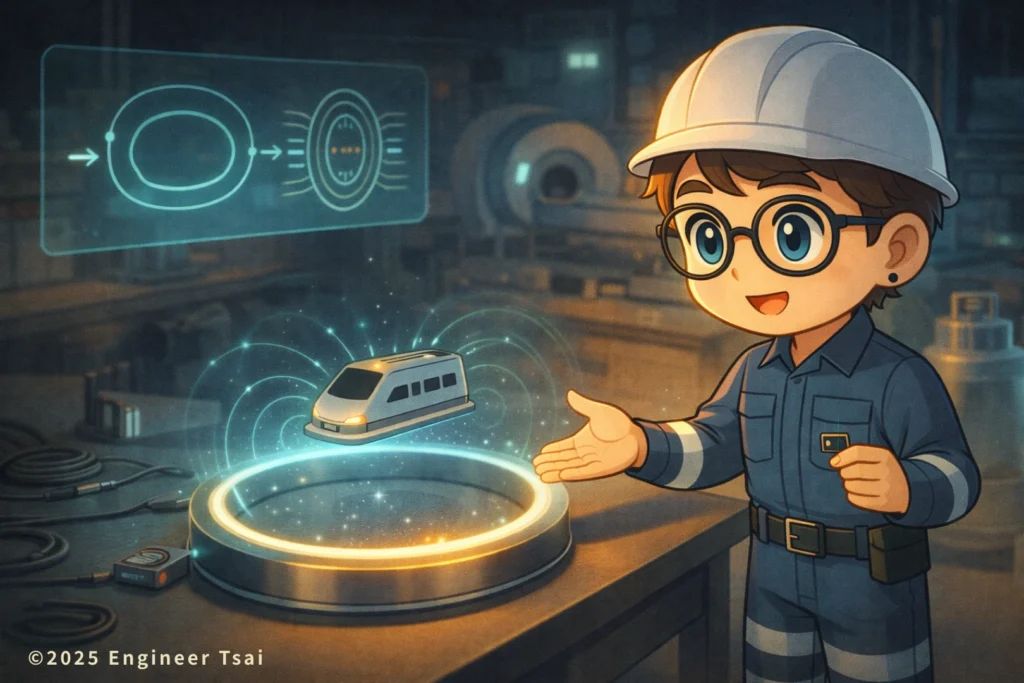
Superconductors explained in plain English: if you’re still piecing together how electricity actually works, I strongly recommend starting here first:
🔹 “Electrical Basics Starter Pack: from ‘What is electricity?’ to understanding your home breaker panel”
Once voltage, current, and resistance feel solid, it’s much easier to make sense of what a superconductor is and what people mean by a “world with no resistance” – without getting lost in clickbait headlines.
When most people first hear about superconductors, the images that come to mind are things like: “a magnet floating in mid-air,” “current going around a loop forever without stopping,” or “if we get room-temperature superconductors, will electricity basically be free?”
In short, this is superconductors explained in one sentence:
Below a certain critical temperature, a material’s electrical resistance suddenly drops to essentially zero, while it also expels magnetic field lines from its interior.
Those two key behaviors are what we call “zero resistance” and “perfect diamagnetism” (the Meissner effect).
So what’s really going on inside a superconductor? Why can the same idea of “a coil of wire with current” sometimes heat up and waste power, and other times behave like the current can flow with almost no loss at all? And when the media scream “room-temperature superconductor,” is that a real breakthrough or just headline hype?
In this article, we’ll use everyday, U.S.-friendly examples to walk through superconductors and the idea of a “world with no resistance”—starting from pictures you can easily imagine, then moving into the basic conditions for superconductivity, and finally looking at real applications like MRI scanners, maglev trains, power systems, and quantum computers. At the end, we’ll talk about how to read all those “room-temperature superconductor” news stories in a more grounded way.
▶️ Watch first: one diagram to understand superconductors and zero-resistance current
Forget the math and quantum mechanics for a moment. Let’s start with a simple picture that compares a normal wire loop and a superconducting loop: same shape, same idea of “a coil with current,” but with completely different behavior. In one case the wire heats up and the current fades away; in the other, once it’s cold enough, the current seems to be “trapped” in the loop and just keeps circulating.
This short video uses two intuitive images—water in a rough vs. ultra-smooth pipe, and magnetic field lines being pushed out of a material—to show how an ordinary metal behaves as you cool it down, and what changes the moment it drops into the superconducting state. You’ll walk away with a gut feeling for what people really mean when they talk about a “world with no resistance”: not “free electricity,” but a state where energy loss is extremely small and magnetic fields are highly controllable.
If you finish the video and find yourself asking, “How ‘zero’ is zero resistance, really? Why does it require such low temperatures? And what exactly is happening when a magnet hovers over a cold, smoking disk?”—then you’re exactly who this extended explainer is written for.
We’ll break this superconductors explained guide into four chunks: start with visual, real-world images; introduce what superconductivity actually is; look at concrete applications; and finally, talk about the “room-temperature superconductor” headlines that keep popping up.
Chapter 1|What does a superconductor look like? Visualizing a “zero resistance” world
To understand what a superconductor is, it’s often better not to start with formulas. Instead, imagine how your everyday world would look if electric current really did move with almost no resistance.
Here are a few familiar scenes you can use to picture it, whether you’re in the U.S. or anywhere else with modern infrastructure:
- Wires that don’t “cook” themselves: In the real world, if a conductor is undersized or overloaded, it heats up. You might even smell something burning in a worst-case scenario. In an ideal superconducting wire, once it’s in the superconducting state, resistance is essentially zero. The same current flows with negligible losses, and the wire barely warms up at all.
- A magnet “locked” in mid-air: You’ve probably seen those viral clips where a small magnet floats above a frosty white puck and can glide around a track like a tiny maglev train. That happens because the superconductor expels magnetic field lines, effectively pinning the magnet in an invisible magnetic track.
- The giant magnet inside an MRI scanner: If you’ve ever had an MRI at a hospital, that big tube you slide into is basically wrapped with superconducting coils. Those coils generate an incredibly strong, stable magnetic field that lets the scanner build a detailed picture of the inside of your body.
- Futuristic maglev trains: You might have seen footage of high-speed maglev trains in Japan or China. The cars float a small distance above the track, with almost no mechanical contact. If you combine this with superconductors, the system can maintain strong, stable magnetic fields and levitation with far less energy than conventional electromagnets.
Looking at these pictures, the two main selling points of superconductors jump out:
- Current flows with almost no energy loss (zero resistance)
- You can create very strong, very stable magnetic fields (perfect diamagnetism)
So for now, you can store the superconductors concept in your head as one simple sentence:
Under the right conditions, you can make current flow as if it were in a “zero-friction pipe,” while also keeping magnetic fields extremely well-organized.
Chapter 2|What is superconductivity? Start with zero resistance and perfect diamagnetism
Now let’s move a bit closer to the physics—still keeping it intuitive—and spell out the key conditions for superconductivity.
For a material to be called a superconductor, it needs at least two core features:
- Zero resistance: Below a certain temperature, the measured resistance suddenly drops to a value so small it’s practically unmeasurable. Current can flow around a closed loop for a very long time.
- Perfect diamagnetism (the Meissner effect): The material expels magnetic field lines from its interior, creating a state where magnetic fields “don’t really want to pass through.”
1|Zero resistance: not “a bit smaller,” but “dropping off a cliff”
For an ordinary metal, if you cool it down, its resistance gradually decreases. That’s easy to understand: lower temperature means atoms vibrate less, so electrons bump into them less often.
But the resistance curve of a superconductor doesn’t gently slope downward. Instead, as temperature drops to a specific critical temperature (Tc), the resistance suddenly falls off a cliff—straight down toward “essentially zero.”
You can picture it like this:
- Normal metal: water flowing through a rough pipe. There’s always friction, heat, and pressure drop.
- Superconductor (below Tc): the water suddenly enters an ultra-smooth, almost frictionless pipe. Once it’s flowing, it doesn’t need constant “pushing” to keep moving.
In experiments, if you send current around a superconducting loop and keep it below Tc, the current can circulate for an extremely long time with almost no decay. That’s the most literal picture of a “world with no resistance” you can have.
2|Perfect diamagnetism: why does a magnet float above a superconductor?
The second hallmark is perfect diamagnetism (the Meissner effect), which explains why magnets can hover over superconductors.
When a material enters the superconducting state, it tries to expel magnetic field from its interior—as if it’s saying, “Sorry, magnetic field lines aren’t welcome here.”
The result looks like this:
- Electric currents appear on the surface of the superconductor that cancel the applied magnetic field inside.
- Magnetic field lines bend around the superconductor, creating a very unusual field distribution.
- When you place a magnet near it, the magnet can get “locked” into this field pattern, so it levitates and can even stay rigidly in place.
That’s what you’re seeing in all those demo videos: a cold, misty superconducting puck with a magnet above it that seems to sit on invisible rails, hovering steadily in mid-air.
3|Low temperature, critical temperature, and what “room-temperature superconductors” really mean
Here’s the critical reality check: most superconductors only become superconducting at very low temperatures.
- Early metallic superconductors (like lead or certain alloys) needed temperatures of just a few kelvins—very close to absolute zero—cooled with liquid helium.
- Later we found “high-temperature” superconductors (still extremely cold in everyday terms), such as certain copper-oxide ceramics. They can become superconducting at liquid nitrogen temperatures (around −196°C / −321°F), which is much cheaper and easier than liquid helium.
When people talk about a “room-temperature superconductor”, they usually mean:
a material that shows superconductivity at or near room temperature and at normal atmospheric pressure. That would slash cooling costs and could, in principle, transform power transmission, transportation, and computing.
But as of now, most “room-temperature superconductor” stories look like this: a small research group publishes a result, but other labs struggle to reproduce it reliably, or it requires extreme high pressure or other exotic conditions. For a general reader, the healthiest stance is to treat these as interesting research updates, not “next year your power bill goes to zero.”
If you’d like the more formal, academic definitions, you can check the Wikipedia entry on superconductivity.
Chapter 3|How do we use superconductors in the real world? Medicine, transport, power, and quantum computing
At this point, a fair question is: “If superconductors are so hard to make and keep cold, how much are they actually used today? Are they mostly just lab toys?”
In practice, superconducting technology has already quietly slipped into our lives. It’s just hidden inside large pieces of equipment that don’t have a big label saying “there’s a superconductor in here.”
1|MRI scanners: the superconducting magnet you’ve probably already met
In most major hospitals in the U.S. and around the world, if you’ve ever had an MRI scan, you’ve already benefited from superconductors.
To run MRI, you need an extremely strong, extremely stable magnetic field. Building that with ordinary copper coils would waste huge amounts of energy and generate too much heat. So MRI machines typically rely on superconducting coils plus low-temperature cooling:
- Superconducting wire is wound into a large magnet and cooled below its critical temperature.
- Once the current is established, it can sustain a multi-tesla magnetic field for a long time.
- The patient lies inside the bore of this magnet, and the machine uses nuclear magnetic resonance, RF pulses, and signal processing to map internal structures.
So if anyone tells you “superconductors are just a lab curiosity,” you can confidently answer: no—they already work quietly inside MRI scanners and other big machines we depend on.
2|Maglev trains and transportation: imagining ultra-low-friction travel
Another classic example is maglev (magnetic levitation) trains. While the U.S. doesn’t have a commercial maglev network yet, Japan and China already operate or test such systems.
The core idea is simple:
- Magnetic forces between the train and the track are used to levitate the train, eliminating mechanical contact and drastically reducing friction.
- By controlling magnetic fields and propulsion, you can reach very high speeds with smooth, quiet motion.
- If you use superconducting magnets in the track or onboard, you can maintain strong, stable fields and levitation with much lower energy losses.
Turning superconducting maglev into a large-scale, everyday transportation system still means solving lots of engineering challenges—cooling, maintenance, safety, cost—but it nicely shows how a “low-loss, high-field” world could reshape mobility.
3|Power transmission and energy storage: low-loss cables and superconducting magnetic storage
In power systems, some of the most talked-about superconductor applications include:
- Superconducting power cables: Cables made of superconducting material can, in principle, carry large currents with almost no line losses when kept cold enough. They’re attractive for dense urban grids or special facilities.
- Superconducting magnetic energy storage (SMES): A superconducting coil stores energy in its magnetic field. It can charge and discharge very quickly and deliver large currents, making it useful for grid stabilization and backup.
- Fault current limiters and protection devices: Because superconductors can abruptly regain resistance when current exceeds a critical value, they can act as smart limiters that protect equipment from short-circuit surges.
For a country like the U.S., rolling out superconducting cables or SMES systems at scale would still run into real-world constraints: cost, cooling infrastructure, grid integration, and long-term reliability. In the near term, you’re more likely to see them appear at a few critical nodes or pilot projects than suddenly replacing all transmission lines.
4|Quantum computing and basic science: where superconductors fit in
In the world of quantum computing, a major family of platforms relies on superconducting qubits.
Very roughly:
- Superconducting circuits plus Josephson junctions are designed so that, at extremely low temperatures, parts of the circuit behave quantum mechanically.
- Microwave pulses are used to control these quantum states and perform computations.
- All of this depends on ultra-stable cryogenic systems, careful shielding, and precise control electronics.
Even if you don’t plan to work in quantum information, it’s useful to know that superconductors are central to some of the most cutting-edge computing architectures. It gives you a better map when you read tech news or sit through conference keynotes.
Chapter 4|How should you read “room-temperature superconductor” headlines? The gap from lab to real life
In recent years you’ve probably seen headlines like these more than once:
“Scientists discover possible room-temperature superconductor” / “If confirmed, this could slash electricity costs” / “Is a new energy revolution coming?”
As a reader, how do you stay calm and realistic when you see this kind of superconductor news? Here’s a simple mental checklist you can run through whenever the next big claim pops up.
1|Is this just the first paper, or already replicated by multiple teams?
Scientific progress usually starts with one group publishing a result. But the real test comes later: can independent labs reproduce it?
- If the news only says “Team X claims…” with no mention of independent replication, you should treat it as “interesting but unconfirmed.”
- If multiple independent groups, using different methods, confirm similar behavior, the result starts to look genuinely solid.
2|Are the conditions really “room temperature and ambient pressure,” or extreme and exotic?
Some studies observe superconducting-like behavior only under extremely high pressure, for example by squeezing a sample between diamond anvils to hundreds of gigapascals.
Those results are scientifically important, but from an engineering point of view they’re still very far from “let’s replace the neighborhood distribution lines with this material.” To keep it straight, you can roughly categorize things as:
- Room temperature + ambient pressure: if this ever becomes robust and reproducible, it would be the most disruptive for real-world applications.
- Room temperature + extreme pressure or exotic conditions: huge scientific value, but in practice you’ve just swapped cooling costs for pressure and complexity.
3|How far is “we can make it in the lab” from “we can mass-produce it”?
Even if we eventually find a stable room-temperature superconductor, turning it into something that lives inside your home wiring, substations, or factory busbars will still require crossing several major gaps:
- Materials cost and manufacturing: Can it be produced at scale? Is it brittle, toxic, or difficult to shape and join?
- Long-term reliability: How does it behave over years of use, in the humidity, temperature swings, and mechanical stress of real environments?
- System integration: Grid codes, protection schemes, installation techniques, and standards all have to be updated to handle the new material.
So when you see phrases like “a world with no resistance” or “electricity bills will plummet,” take a breath and ask yourself three quick questions:
Has it been independently replicated? Are the conditions really room temperature and ambient pressure? And how close is it to scalable engineering, not just a lab demo?
With that mindset, you’ll be less likely to swing between hype and disappointment every time “superconductors” trend, and more able to follow it as a long-term science-and-engineering story.
Conclusion|Superconductors aren’t magic – they’re quantum physics and materials engineering inside a wire
When people first hear about superconductors and a “world with no resistance”, it can sound like pure science fiction. But once you unpack it, you’ll see familiar ideas from electrical engineering and materials science, just pushed into a more extreme regime:
- Electrons move through a material with almost no scattering (zero resistance).
- The material strongly expels magnetic fields, letting us shape magnetic field lines in very precise ways (perfect diamagnetism).
- All of this only happens under specific temperature, field, and current limits (critical conditions).
The difference is that these principles have been packaged into real equipment—MRI scanners, particle accelerators, experimental maglev systems, quantum computers—then combined with cryogenics, power-system engineering, and cost modeling. Superconductors are no longer just textbook vocabulary; they’re tools that already shape modern medicine, research, and (slowly) power and transport.
Whether you’re a curious reader, a tech news junkie following “room-temperature” claims, or a student in EE/physics wondering what field to step into, I hope this superconductors explained guide helps you see more than just “zero resistance sounds awesome.” Ideally you’re now holding a more complete mental map: Where are superconductors used today? What are their limits? How might they enter everyday systems in the future?
If one day we really do get a stable, mass-producible room-temperature superconductor, it will be an incredible milestone for both science and engineering. But even before that day comes, you can prepare the “knowledge groundwork” now—so that when the next big superconductor headline hits, you can judge it for yourself instead of being pulled around by the hype.
📌 Recommended next reads:
🔹“Electrical Basics Starter Pack: from ‘What is electricity?’ to understanding your home breaker panel”
Get comfortable with voltage, current, resistance, and power first. Then when you hear “the resistance suddenly vanishes in a superconductor,” you’ll have a much clearer sense of how extreme that is.
🔹“How current affects battery life”
In our everyday, non-superconducting world, resistance makes wires and batteries heat up and age. Read this, and then imagine “what if resistance suddenly became almost zero”—the contrast will feel much more real.
🔹“What is an electric motor? From electricity to motion”
The way magnetic fields, coils, and current interact inside motors has a lot in common with how superconducting magnets work. Understanding standard motors makes it easier to appreciate why superconducting magnets and maglev systems are such a big deal.
Superconductors explained FAQ
Q1: If we have superconductors, can electricity bills really go near zero?
A: Superconductors’ “zero resistance” can drastically reduce energy losses inside cables and coils themselves. But in the real world, there are many other costs: running the cooling system, building and maintaining the hardware, and redesigning the overall grid or equipment. So even if we deploy better superconducting cables, that doesn’t mean “electricity becomes free.” A more realistic expectation is higher efficiency and lower losses in specific use cases—like dense urban underground transmission, data centers, or specialized industry—not everybody’s utility bill dropping to zero overnight.
Q2: Do true room-temperature superconductors exist yet?
A: Based on public information so far, we do not yet have a material that shows reproducible superconductivity at room temperature and ambient pressure across many independent labs. From time to time, individual research groups publish claims of room-temperature superconductivity, but if other teams can’t reliably reproduce the results—or if the effect only appears under extreme pressures—it’s hard to treat those materials as ready for engineering use. For most readers, the safest approach is to treat such news as “interesting research in progress,” not a sign that mass deployment is right around the corner.
Q3: Are superconductors only in labs, not in everyday life?
A: No. MRI scanners in hospitals, certain particle accelerators, and large research magnets already make heavy use of superconducting coils. They’re just hidden inside big machines, so you rarely see the superconducting wire itself. In the future, as power and transportation systems adopt more superconducting tech, it’ll get even closer to everyday life—but even now, superconductors are quietly at work behind the scenes.
Q4: Why do most superconductors need such low temperatures?
A: At room temperature, atoms in a solid vibrate intensely. Electrons moving through the material get scattered by these vibrations, which shows up as electrical resistance. Superconductivity involves quantum-mechanical, collective behavior of electrons—often described in terms of electron pairing, like Cooper pairs in BCS theory—that only becomes stable when thermal agitation is low enough. “High-temperature” superconductors are only high relative to older materials; in absolute terms they are still extremely cold. If we ever discover a robust room-temperature superconductor, it will mean we’ve found a material where these quantum states survive all the way up to everyday temperatures—which is exactly why the world is so excited about the possibility.
Q5: If I have an EE/physics background, what should I study next to really understand superconductors?
A: You can think of it in layers: (1) Strengthen your foundations in electromagnetics and circuits so that resistance, induction, magnetic fields, and energy transfer are rock solid. (2) Study introductory quantum mechanics and solid-state physics, especially band theory and how electrons behave in a crystal lattice. (3) Move into dedicated courses or texts on superconductivity and low-temperature physics—BCS theory, high-temperature superconductors, and experimental signatures. (4) If you’re more application-focused, dive into case studies of MRI magnets, superconducting cables, SMES systems, and maglev designs. It’s usually much easier to start from solid EE basics and build up, rather than jumping straight into dense, theoretical papers.
—
Have you ever watched a maglev demo clip or had an MRI without realizing superconductors were involved? If truly practical room-temperature superconductors arrive one day, what would you most want them to transform first—power transmission, transportation, or computing?
Feel free to share your thoughts or questions in the comments. And if you have friends who follow tech news, you can send them this “Superconductors explained: a world with almost no resistance” guide so you can all talk about the topic with something more solid than just hype and headlines.