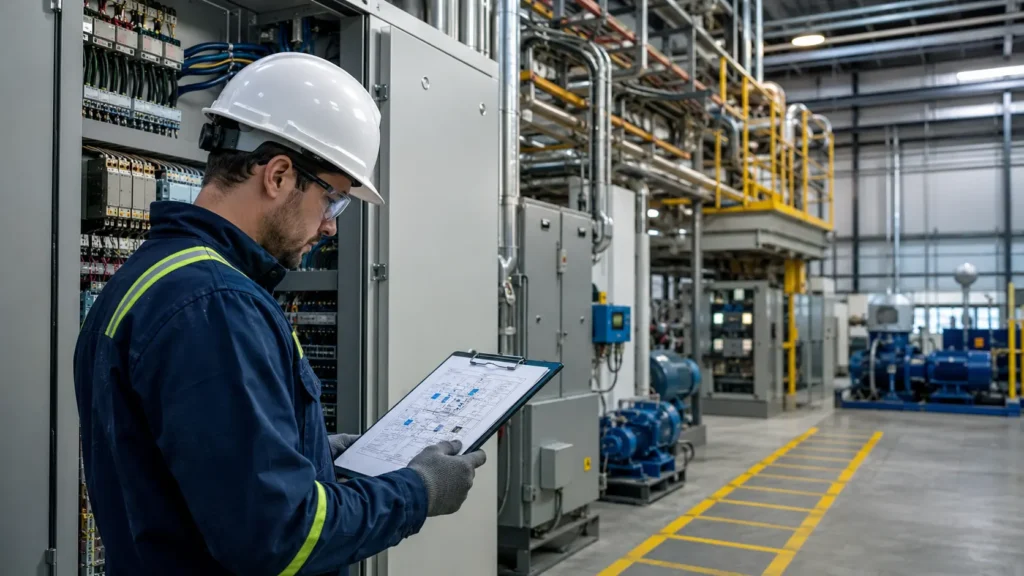
Industrial electrician careers in the United States focus on maintaining production equipment, motors, controls, sensors, and facility power systems inside plants and factories. This career roadmap helps U.S. career changers compare apprenticeships, maintenance roles, technical school, licensing differences, and a realistic first year.
This industrial electrician career roadmap is for U.S. adults comparing plant, factory, and facility electrical paths.
Quick answer: Most people enter through a registered apprenticeship, a helper or maintenance role that may lead into formal training, or technical schooling followed by employer-sponsored training. Rules vary by state, city, sponsor, and employer, so verify local requirements before paying tuition or assuming a title transfers. Official U.S. career information from the Bureau of Labor Statistics notes that electricians commonly learn through apprenticeship, while some start with technical school. Registered programs are listed on Apprenticeship.gov.
According to the U.S. Bureau of Labor Statistics Occupational Outlook Handbook, electricians commonly learn through apprenticeship, while some begin with technical school.
Table of Contents
What an industrial electrician does
Industrial electricians install, maintain, and troubleshoot electrical systems that keep production and facility equipment running. Day-to-day work often includes motor circuits, control panels, sensors, conveyors, and plant power distribution under employer procedures and applicable codes.
Exact duties depend on the employer, process, and local rules. A food plant, automotive line, warehouse, and wastewater facility can share core electrical concepts while differing in equipment, permits, and supervision requirements.
Industrial vs residential and commercial electrical work
Residential and commercial work often focuses on branch circuits, lighting, receptacles, and service equipment in occupied buildings. An industrial electrician career usually emphasizes production uptime, motor control, and facility systems inside plants or process environments.
| Question | Route A | Route B |
|---|---|---|
| Primary work setting | Plants, factories, industrial facilities, and process environments | Homes, apartments, stores, and light commercial spaces |
| Common systems | Motors, motor controls, sensors, panels, and production equipment support | Branch circuits, lighting, receptacles, and service equipment |
| Entry signals to verify | Registered apprenticeship, helper/maintenance roles, or technical training accepted by local sponsors | Registered apprenticeship, helper roles, or trade-school pathways accepted locally |
| What varies by jurisdiction | License titles, supervision rules, and facility-specific employer requirements | License titles, permit rules, and local inspection practices |
If you are still comparing entry paths broadly, start with the published guide How to Become an Electrician in the United States, then use this roadmap to evaluate industrial-specific tradeoffs.
3 Main Entry Routes for an Industrial Electrician
Three entry patterns appear repeatedly in official U.S. career information:
- Registered apprenticeship — paid, supervised work plus related instruction under a registered program.
- Helper, laborer, or maintenance support roles — employer classifications that may build experience but are not automatically the same as registered apprenticeship.
- Technical or trade school — classroom or pre-apprenticeship training that may help applications, depending on local sponsor recognition.
Apprenticeship, helper, maintenance, and technical school options
Registered Apprenticeship is a specific status under federal or state registration. Federal standards in 29 CFR Part 29 describe organized work processes, related instruction, progressive wages, supervision, and a completion credential. Search Apprenticeship.gov for programs near you, then verify sponsor terms directly.
Helper and maintenance titles vary by employer. Some roles provide useful exposure to plant equipment; others stay limited. Ask what tasks you will perform, who supervises you, whether hours count toward a registered program, and what advancement requires.
Technical school can be useful when it connects to real employers or registered programs. Before paying tuition, confirm recognition, credit transfer, placement relationships, and whether the program matches the industrial settings you want.
Search current registered programs through the Apprenticeship.gov career seeker portal, then verify the sponsor’s terms directly.
Core skills and tools
Employers commonly look for safety discipline, print-reading basics, reliable measurement habits, documentation, and the ability to follow lockout/tagout and site procedures. Tool lists vary, but the pattern is consistent: learn to work methodically under supervision rather than improvising on energized equipment.
This article does not provide energized-work instructions. Treat every plant procedure, permit, and supervision rule as local and employer-specific.
Motors, controls, sensors, and troubleshooting
Industrial environments often expose electricians to motors, motor starters, sensors, and control circuits that support production equipment. Troubleshooting is usually a supervised process: gather symptoms, isolate energy sources according to procedure, inspect, test only as authorized, document findings, and restore equipment only when cleared.
Controls exposure does not mean every industrial electrician is a PLC programmer on day one. Many first-year roles focus on safe support work, basic diagnostics under supervision, and learning how the facility’s systems are documented.
Licensing and jurisdiction differences
There is no single nationwide electrician license path in the United States. License titles, trainee rules, supervision requirements, and facility-specific credentials can differ by state, city, county, and employer. Use official state or local licensing pages for any jurisdiction example, and treat examples as illustrations of how the rules differ.
When a program or employer mentions a license, ask which authority issues it, what work it authorizes, whether industrial maintenance work is covered, and what happens if you move across jurisdictions.
Federal registration standards are described in 29 CFR Part 29.
Industrial Electrician Roadmap for the First 12 Months
| Stage | Main goal | Skills to build | Evidence to collect |
|---|---|---|---|
| Months 0–3 | Confirm local entry rules and apply to credible programs | Safety awareness, tool familiarity, basic electrical concepts | Program terms, eligibility rules, application windows |
| Months 3–6 | Enter paid training or supervised helper/maintenance work | Lockout/tagout awareness, print reading basics, jobsite habits | Training hours log, supervisor feedback, safety orientation records |
| Months 6–12 | Build reliability on motors/controls exposure under supervision | Troubleshooting process, documentation, communication | Task list completed under supervision, skills checklist, next-step plan |
Your timeline depends on local openings, sponsor selectivity, prior experience, and whether you enter through apprenticeship, helper work, or school. The useful first-year outcome is not a title upgrade on paper; it is verified hours, safe habits, and a clear next application target.
Pay data and what it does not mean
The U.S. Bureau of Labor Statistics publishes national and occupational wage and outlook data for electricians. Those figures are useful for orientation, but they are not a promise of apprentice pay, overtime, shift premiums, or local industrial rates. Always separate journey-level occupational data from entry-level offers and local collective-bargaining or employer schedules.
Physical demands and safety
Industrial electrical work can involve standing, climbing, confined spaces, noisy environments, and strict energy-control procedures. OSHA standards and employer programs set expectations for hazard recognition, personal protective equipment, and lockout/tagout. This guide does not replace site-specific training.
For an official overview, see OSHA’s Control of Hazardous Energy—Lockout/Tagout guidance.
How to decide whether the path fits
- Do you want plant/facility environments more than residential service calls?
- Are you willing to follow formal energy-control and documentation procedures?
- Can you verify a local registered program or employer pathway before paying for school?
- Are you comparing industrial work against residential/commercial paths with real local openings?
Considering an apprenticeship as your route into industrial work? Check each program’s entry steps. If yours uses an aptitude test or an interview, you can prepare for both. The Electrical Apprenticeship Aptitude & Interview Kit (U.S. Edition) has 6 timed aptitude simulations based on the published test format, 20 interview questions with a weak and a strong answer each, and an 8-question timed mock interview with a scoring sheet. US$39, one payment, full refund within 30 days if not downloaded, and the files are yours to keep.
Application checklist
- Read the broader entry guide: How to Become an Electrician in the United States.
- Search registered programs on Apprenticeship.gov and note industrial or maintenance sponsors near you.
- Verify license and trainee rules with the official authority for your target jurisdiction.
- Ask employers what “industrial electrician,” “maintenance electrician,” and “helper” mean on that site.
- Collect evidence: applications submitted, program terms, safety orientation, and supervised task logs.
Frequently asked questions
Do I need a degree? Many entry routes emphasize apprenticeship or employer training rather than a four-year degree. Individual sponsors set eligibility rules.
Is industrial work always higher pay? Not automatically. Shift work, overtime, location, union status, and employer schedules all matter. Use official wage data as context, not a personal offer.
Can I switch from residential to industrial later? Some skills transfer, but employers may still require local credentials, site-specific training, and proof you can work under plant procedures.
Sources and limitations
Primary references for this draft include the U.S. Bureau of Labor Statistics Occupational Outlook Handbook for electricians, Apprenticeship.gov career-seeker information, federal apprenticeship standards in 29 CFR Part 29, and OSHA safety-topic materials. Jurisdiction examples must be checked on official state or local pages before action.
Your license status, program admission and permitted work are decided by the controlling authority and your employer, so confirm each with them.
About the author
Tsai Electro holds Taiwan’s national Class B Indoor Wiring Technician certificate and works as an MEP and site engineer on major builds. He explains U.S. career-entry pathways from official sources and verified practitioner accounts.
Next-step internal links
Continue with the broader entry overview: How to Become an Electrician in the United States. For site navigation and related career-guide material, see Tsai Electro.
Planning to work as an electrician in Texas?
Texas licenses electricians through TDLR, one step at a time from apprentice to master. See every step, the hours and the exams in one place.
See the Texas license ladder How to become an electrician in Texas Or try 70 free Texas Journeyman practice questions in rounds of 20, no sign-up