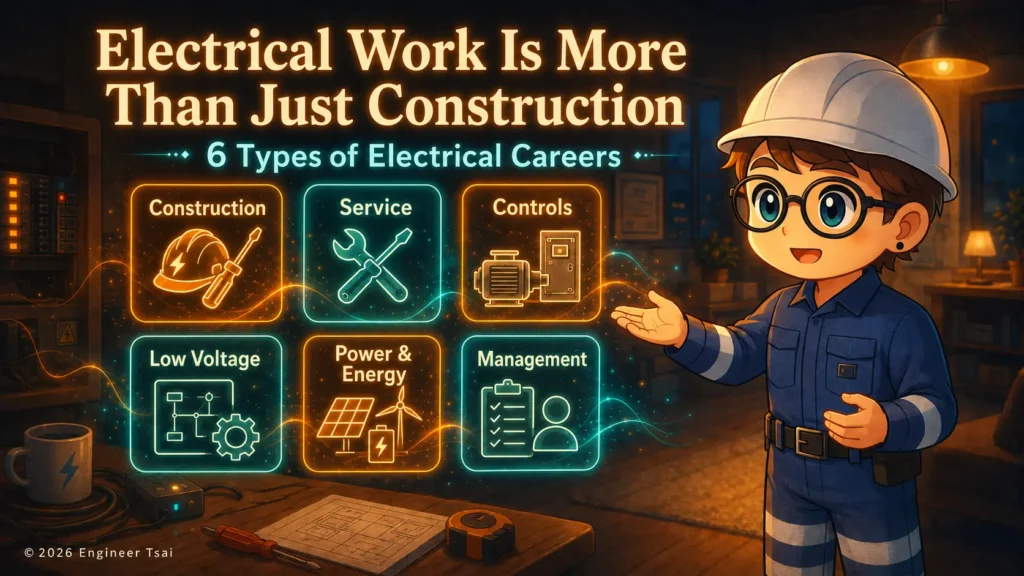
Quick answer: Six practical electrical career paths are construction, service, industrial equipment, low-voltage systems, power and energy, and project coordination. Compare the work setting, common problems, physical demands, and entry route before choosing where to start.
Related: Read how to become an electrician in Texas and Texas training routes.
Table of Contents
Types of electrical careers: more than one apprenticeship track
Types of electrical careers extend far beyond new-construction wiring. In the United States, an electrician apprenticeship is the most common entry route into licensed construction electrical work, but the broader field also includes service, facilities maintenance, industrial equipment, controls, low-voltage systems, power and energy, estimating, and project coordination.
When comparing types of electrical careers, the real question is not simply, “Should I become an electrician apprentice?” It is: What type of work environment do I want, what problems do I want to solve, and which fundamentals am I willing to practice during my first year?
The six paths in this article are a career-navigation framework created by Tsai Electro. They are not an official U.S. occupational classification. A real position may combine two or three paths. For example, a facilities electrician may handle service, equipment, and building systems, while a solar project may combine construction, energy, commissioning, and project management.
▶️ Watch the video: 6 types of electrical careers beyond construction
The video gives you the big picture. This article expands the comparison with U.S. job titles, apprenticeship options, licensing questions, first-year skills, work-environment differences, and interview questions. For a separate timeline-based guide, see Electrician Career Paths in the AI Era: 5 Routes and a 0 to 12 Month Roadmap.
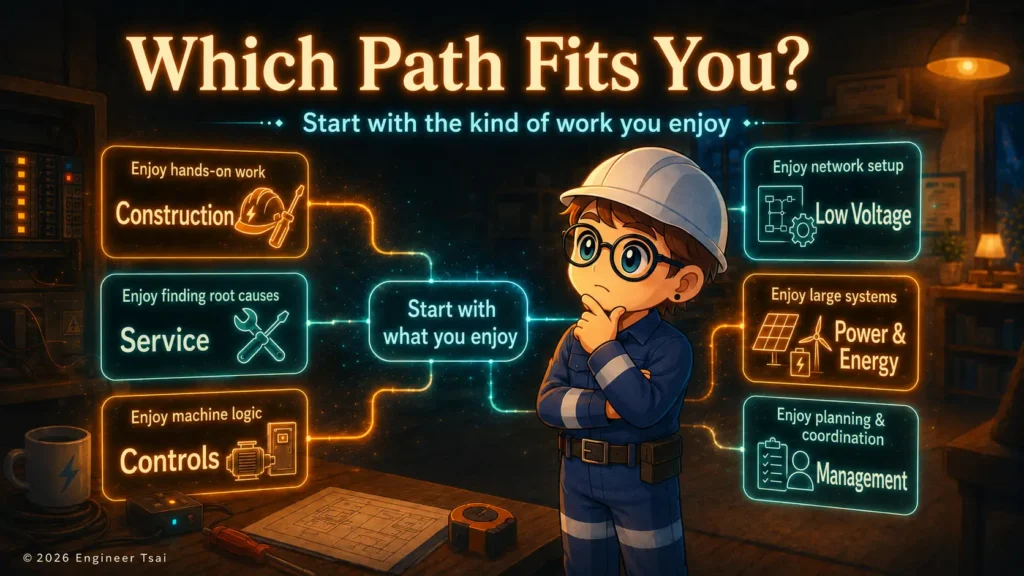
Types of electrical careers: compare these six paths
| Path | Common Work Settings | Core Question | Good Fit If You… | First-Year Priorities | U.S. Job-Search Keywords |
|---|---|---|---|---|---|
| Construction Electrical | New construction, tenant improvements, homes, commercial buildings, industrial projects | How do we turn plans and specifications into a safe, working installation? | Hands-on, comfortable with jobsites, enjoys visible progress | Tools and materials, blueprint basics, raceways, circuits, sequence, safety | Electrician apprentice, inside wireman apprentice, electrical helper, commercial electrician apprentice |
| Service & Maintenance | Homes, stores, offices, hospitals, campuses, facilities | Where is the fault, and how can the problem be narrowed down safely? | Patient, analytical, comfortable asking questions and testing assumptions | System understanding, safe test practices, troubleshooting sequence, documentation | Service electrician apprentice, maintenance electrician, facilities technician, building maintenance technician |
| Industrial Equipment & Controls | Factories, production lines, warehouses, utilities, plants | Why did the machine stop, and which operating condition is missing? | Interested in machines, logic, sensors, motors, and production systems | Motors, relays, contactors, controls, protective devices, reading schematics | Industrial electrician apprentice, controls technician, maintenance technician, electromechanical technician |
| Low-Voltage & Building Systems | Security, access control, structured cabling, fire alarm, CCTV, building automation | Is the problem power, cabling, communication, addressing, or configuration? | Comfortable with computers, networks, organization, and detail | Cable types, terminations, testing, PoE, IP basics, topology | Low-voltage technician, security systems installer, fire alarm helper, structured cabling technician |
| Power & Energy | Solar, battery storage, substations, utilities, power distribution, generation | How is power generated, converted, distributed, protected, and restored? | Willing to study theory, follow procedures, and work with larger systems | Electrical fundamentals, three-phase power, one-line diagrams, metering, protection | Solar installer, substation technician trainee, utility apprentice, electrical power technician |
| Project Coordination & Management | Electrical contractors, construction offices, project sites, estimating departments | How do drawings, materials, labor, schedule, safety, and changes stay coordinated? | Organized, communicative, detail-oriented, willing to learn field operations | Plans, takeoffs, material knowledge, sequencing, documentation, coordination | Electrical project coordinator, assistant project manager, estimator trainee, field technician |
These types of electrical careers can differ dramatically in physical demands, technical depth, schedule, travel, and licensing requirements, even when two employers use the same title. A “maintenance technician” may replace lamps and filters at one facility, troubleshoot motor controls at another, or coordinate contractors at a third. Always verify the actual work.
Why do so many people equate learning the trade with becoming a construction electrician?
Construction electrical work is the most visible path. People see electricians installing conduit, pulling conductors, setting panels, wiring receptacles, and connecting lighting on homes and commercial projects. Apprenticeships are also a well-established route into the trade, so “become an apprentice” is often the first advice a beginner hears.
That advice is not wrong, but it is incomplete. The U.S. Bureau of Labor Statistics describes electricians as workers who install, maintain, and repair power, communications, lighting, and control systems in homes, businesses, and factories. That single occupation already includes both installation and maintenance, and the wider electrical ecosystem includes several adjacent occupations as well.
Before choosing a program or accepting the first offer, ask:
- Do I want to build new installations, diagnose existing systems, work on machines, connect building systems, support the power system, or coordinate the whole project?
- What schedule, travel, physical demands, and work environment can I realistically accept?
- Which first-year fundamentals am I willing to practice until they become reliable habits?
Path 1: Construction Electrical: Turn Drawings Into a Working Installation
Construction electrical work includes residential, commercial, and industrial installation. You may work on new buildings, renovations, tenant improvements, warehouses, factories, schools, hospitals, or infrastructure projects. The work can include raceways, boxes, cable systems, branch circuits, feeders, panels, lighting, controls, grounding and bonding, and equipment connections.
The satisfaction is visible: an empty structure gradually becomes a functioning electrical system. But the job also requires physical stamina, sequencing, coordination with other trades, and the discipline to follow drawings, specifications, code requirements, and site safety procedures.
What problems does construction electrical work solve?
The core job is not merely “connecting wires.” It is translating plans and requirements into a safe installation that can be inspected, operated, and maintained. Questions include:
- What load or equipment will this circuit serve?
- How should the raceway or cable route avoid conflicts with structural, plumbing, HVAC, and fire-protection work?
- What must be installed before walls or ceilings are closed?
- How should field conditions that differ from the drawings be documented and resolved?
- Will the installation remain accessible and understandable for future service?
Who may be a good fit for construction electrical work?
This path may fit you if you enjoy hands-on work, visible progress, tools, materials, and team-based jobsites. You should also evaluate whether you can accept early starts, commuting between projects, noise, dust, heat or cold, ladders, lifts, cramped spaces, schedule pressure, and periods of repetitive physical work.
What should you learn in your first year?
Focus on tool and material identification, jobsite communication, print reading, basic circuit relationships, raceway and cable methods, installation sequence, housekeeping, and safe work practices. Speed matters later. At the beginning, accuracy, consistency, and the ability to follow instructions safely matter more.
Common U.S. search terms: electrician apprentice, inside wireman apprentice, residential wireman apprentice, commercial electrician apprentice, electrical helper, electrical trainee.
Path 2: Service and Maintenance: Diagnose Before You Replace
Service and maintenance work begins after something is already operating, or has stopped operating. A customer or operator may report that a breaker trips, a receptacle has no power, lights flicker, a motor will not start, or part of a building has lost a function. Those reports describe symptoms, not causes.
A strong service technician gathers information, defines the affected area, understands the system, follows the applicable safety procedure, forms a reasonable hypothesis, and tests it in a controlled sequence. Replacing parts without diagnosis may hide the real problem, waste money, or create another hazard.
The biggest difference between construction and service work
Construction usually starts with a defined result: install the system shown on the plans. Service starts with uncertainty: determine what changed and where the failure is located. The same symptom may come from a load, connection, conductor, control device, protective device, upstream supply, or an entirely different system.
Who may be a good fit for service and maintenance?
This path may fit you if you like solving problems, asking detailed questions, keeping notes, and resisting the urge to guess. Communication matters because users often provide incomplete information. You need to ask when the issue occurs, what else was operating, whether it is intermittent, and what changed before the failure.
For a career change from facilities work, read the facilities maintenance to Texas electrician guide.
What should you learn in your first year?
Build system awareness, safe test practices, a repeatable troubleshooting sequence, basic meter literacy under qualified supervision, and clear documentation. Electrical testing and energized work must follow employer procedures, training requirements, and applicable OSHA rules. Online content is not a substitute for qualification, supervision, or an energy-control program.
Common U.S. search terms: service electrician apprentice, maintenance electrician, facilities maintenance technician, building maintenance technician, electrical maintenance technician, field service technician.
Path 3: Industrial Equipment and Controls: Understand Why Machines Run or Stop
Industrial electrical work is common in factories, process plants, distribution centers, utilities, water facilities, and automated production environments. When a machine will not start, the question is often bigger than “Is power present?” A safety interlock may be open, a sensor may be missing, an overload may have operated, a contactor may not energize, a drive may be faulted, or the control sequence may be waiting for another condition.
What do you learn on the industrial equipment path?
Industrial work connects electrical fundamentals with machines, controls, mechanics, and production. Over time, you learn to understand:
- The relationship between motors, drives, mechanical loads, and production equipment
- Relays, contactors, motor starters, overloads, and control circuits
- Sensors, limit switches, safety devices, and permissive conditions
- How electrical drawings represent power and control logic
- How downtime affects production, quality, and maintenance priorities
Do you need to learn advanced PLC programming first?
Usually, no. PLC knowledge is valuable, but it becomes much more useful when you first understand motors, relays, contactors, field devices, protective devices, and basic control logic. Otherwise, the program remains abstract and you may not understand what the machine is physically waiting for.
Who may be a good fit for industrial equipment and controls?
This path may fit you if machines make you curious, you enjoy logic, and you want to understand how conditions interact. Be honest about schedule expectations: many industrial jobs include shifts, on-call rotations, planned shutdowns, emergency repairs, production pressure, or work around moving equipment and multiple energy sources.
Common U.S. search terms: industrial electrician apprentice, industrial maintenance technician, controls technician, electromechanical technician, automation technician, plant electrician.
Path 4: Low-Voltage and Building Systems: Power, Signals, Networks, and Configuration
Low-voltage and building-systems work may include structured cabling, access control, security, CCTV, intercom, fire alarm, audio/visual systems, building automation, sensors, controllers, switches, PoE devices, and network-connected equipment.
A device can have power and still fail because the cable is damaged, the termination is incorrect, the network path is incomplete, the address is wrong, a credential is missing, or the configuration changed. The technician must think across physical wiring and digital settings.
The four layers of a typical systems problem
- Is power available and appropriate for the device?
- Are the cable, connector, termination, and physical path intact?
- Is communication or network connectivity established?
- Are addresses, permissions, software settings, and device parameters correct?
Who may be a good fit for low-voltage systems?
This path may fit you if you are comfortable with computers and networks, enjoy organized cabling, and have the patience to compare device states and settings. “Low voltage” does not mean “low complexity.” Fire alarm, life-safety, security, and communications work may have specific licensing, permitting, testing, and documentation requirements.
What should you learn in your first year?
Learn common cable types, labeling, pathways, termination quality, cable testing, RJ45 fundamentals, PoE, IP addressing basics, device topology, and documentation. Confirm the requirements for your state, locality, and system type before assuming a low-voltage job is unregulated.
Common U.S. search terms: low-voltage technician, structured cabling technician, security systems installer, access control technician, fire alarm helper, building automation technician.
Path 5: Power and Energy: See the System Beyond the Receptacle
Power and energy work looks at a larger part of the electrical chain. How is power generated, transformed, distributed, protected, monitored, and restored? How does a solar array connect to an inverter and the utility system? How does battery storage charge, discharge, and isolate? How do substations, feeders, relays, and protective devices limit the impact of a fault?
This path can include solar photovoltaic systems, battery storage, utility distribution, linework, substations, power generation, commissioning, electrical testing, and maintenance of larger power systems. These are related fields, but they are not all the same occupation and may use different apprenticeships, employers, safety standards, and credentials.
What skills matter in power and energy work?
This path places greater weight on electrical theory, power, three-phase systems, one-line diagrams, metering, grounding, protection, equipment ratings, procedures, and documentation. You are not only looking at a branch circuit; you are learning how different parts of the power system interact.
Who may be a good fit for power and energy?
This path may fit you if you are willing to study theory, follow detailed procedures, and think in larger systems. Some positions involve outdoor work, travel, climbing, high-energy equipment, remote sites, storm response, or regulated qualifications. Confirm the employer’s training program, job scope, and safety expectations.
What should you learn in your first year?
Build a foundation in voltage, current, resistance, power, power factor, single-phase and three-phase systems, transformers, one-line diagrams, meters, equipment identification, and protective concepts. Then specialize according to the actual path: solar, storage, utilities, substations, generation, testing, or commissioning.
Common U.S. search terms: solar installer, PV installer, electrical power technician, utility apprentice, substation technician trainee, relay technician trainee, commissioning technician.
Path 6: Electrical Project Coordination and Management: Keep the Work Moving
Projects do not fail only because someone cannot make a connection. Drawings change. Equipment has long lead times. A wall is about to close. Another trade needs the same space. A submittal is late. The owner requests a change. Labor, inspections, safety, budget, schedule, and documentation all affect whether electrical work can proceed.
What does electrical project coordination involve?
- Comparing drawings, specifications, submittals, and field conditions
- Tracking material quantities, approvals, procurement, and delivery dates
- Understanding activity dependencies and installation sequence
- Coordinating with the general contractor, other trades, inspectors, designers, and the owner
- Documenting RFIs, changes, progress, inspections, deficiencies, and closeout information
- Helping labor, equipment, access, and safety requirements arrive at the right time
Can you manage electrical work without understanding the field?
Not effectively. A coordinator or manager may not install conduit every day, but must understand materials, methods, sequence, access, testing, and the consequences of a change. Field experience creates credibility, but beginners may also enter through assistant project manager, project coordinator, estimating, BIM/VDC, or field-technician roles and build field knowledge deliberately.
Who may be a good fit for project coordination and management?
This path may fit you if you enjoy organizing information, reading drawings, tracking details, communicating across groups, and solving schedule conflicts. The first year should emphasize plans, specifications, material recognition, takeoffs, construction sequence, documentation, meeting follow-up, and field observation.
Common U.S. search terms: electrical project coordinator, assistant project manager, electrical estimator trainee, field technician, project coordinator, electrical BIM technician.
These six paths are connected: common career transitions
Your first job does not permanently define your career. Common transitions include:
- Construction electrical work to residential, commercial, or facilities service
- Construction experience to estimating, field coordination, foreman work, or project management
- Facilities maintenance to industrial equipment or plant electrical work
- Industrial maintenance to controls, automation, commissioning, or reliability work
- Low-voltage installation to systems integration, service, programming, or project management
- Construction or maintenance to solar, storage, testing, substations, or utility-related work after additional training
- Project coordination to estimating, assistant project management, project management, or preconstruction
The important question is not whether your first title is perfect. It is whether the job helps you build transferable skills: safety, drawings, installation methods, troubleshooting, documentation, system understanding, and communication.
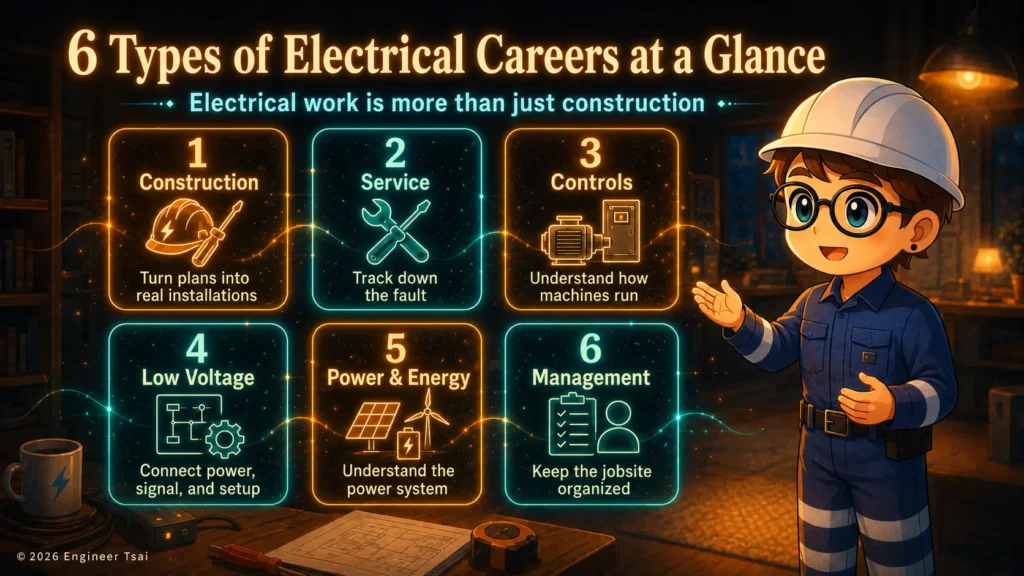
Which of these types of electrical careers fits you? Ask five questions
1. Do I prefer building something or finding the cause of a problem?
If you enjoy creating a visible installation from plans, start by studying construction roles. If you enjoy tracing symptoms to a cause, study service and maintenance. If machines and operating conditions hold your attention, look closely at industrial equipment and controls.
2. What scale of system do I want to work on?
A room, building, or branch circuit often points toward construction or service. A machine points toward industrial equipment. Connected devices point toward low-voltage and building systems. Generation, transformation, distribution, and protection point toward power and energy. Labor, materials, drawings, and schedule point toward management.
3. What work environment can I realistically accept?
Consider jobsites, weather, noise, dust, ladders, lifts, confined areas, travel, long commutes, shifts, on-call duty, shutdowns, customer interaction, and emergency response. A career can sound exciting in a video while the daily schedule is a poor fit for your life.
4. Which fundamentals am I willing to practice repeatedly?
Some people are willing to practice layout, conduit, and installation quality. Others prefer control diagrams, network settings, troubleshooting records, or estimating takeoffs. The skill you can practice consistently is usually more important than the specialty that sounds impressive for one week.
5. What problem do I want to solve independently in three years?
Write the goal as a capability rather than a title. For example:
- Read plans and complete a small electrical installation under the applicable rules
- Follow a safe sequence to diagnose common circuit or equipment problems
- Understand the basic control sequence of a machine
- Install and troubleshoot a small access-control, CCTV, or structured-cabling system
- Read a one-line diagram and explain the basic power-distribution path
- Coordinate the drawings, materials, schedule, and field needs of a small electrical project
Do not judge your first electrical job by the title alone
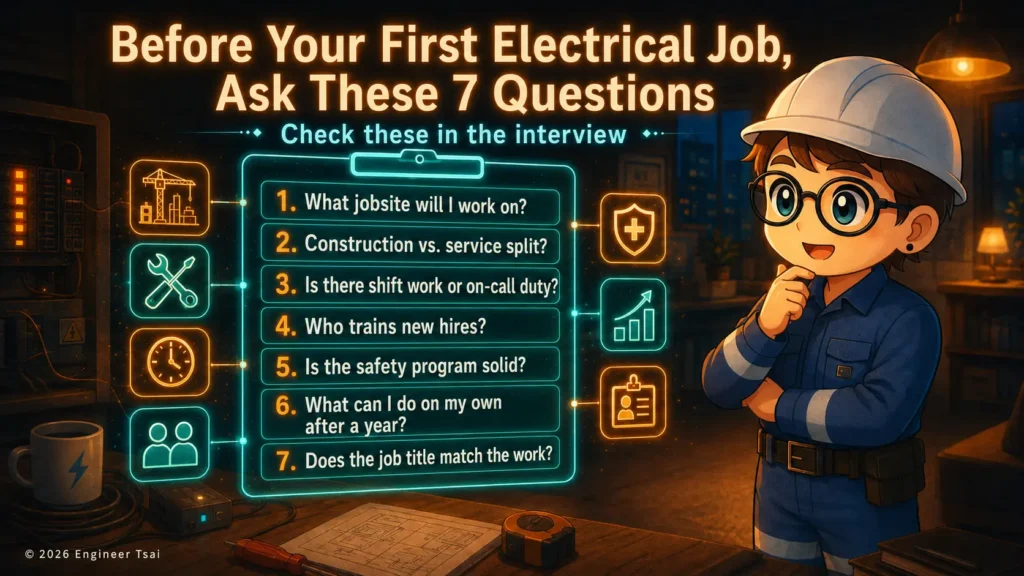
An employer may use “electrical technician,” “maintenance electrician,” “field technician,” or “project coordinator” for very different jobs. During the interview, ask:
- Where does the work usually take place?
- What percentage is new construction, service, preventive maintenance, controls, travel, paperwork, or customer support?
- Does the position include shifts, on-call duty, overtime, travel, heights, or outdoor work?
- Who trains new employees, and what should I learn during the first 90 days?
- What energy-control, lockout/tagout, testing, PPE, and permit procedures does the company use?
- What should a successful employee be able to do independently after one year?
- Does the job title match the actual work and the experience that will count toward licensing or advancement?
For a beginner, the learning structure may matter as much as the starting title. A job with qualified supervision, real core work, clear safety procedures, and progressive responsibility may build a stronger career than a better-sounding title that offers only repetitive support tasks.
Education, apprenticeships, licensing, and entry routes in the United States
Can you enter the electrical field without an electrical engineering degree?
Yes. Electricians are skilled tradespeople, and electrical engineering is a separate professional path. The U.S. Bureau of Labor Statistics lists a high school diploma or equivalent as the typical entry-level education for electricians and identifies apprenticeship as the typical on-the-job training route. Some people begin through technical school, community college, military training, employer training, helper positions, or adjacent technician roles.
Different paths have different requirements. A licensed construction electrician, a low-voltage installer, a solar installer, a utility lineworker, an industrial controls technician, and an electrical engineer may all work around electricity, but they are not interchangeable occupations.
Because the licensing ladder differs from the broader types of electrical careers comparison, use Electrician Career Path USA: 0 to 12 Month Roadmap for Career Changers to map helper, apprentice, journeyman, and contractor stages in more detail.
Common entry routes include:
- Applying to a union, contractor, utility, or employer-sponsored apprenticeship
- Using Apprenticeship.gov to search Registered Apprenticeship opportunities and sponsors
- Completing a technical-school or community-college electrical, industrial maintenance, controls, or electronics program
- Starting as an electrical helper, facilities technician, low-voltage technician, installer, or project assistant
- Entering through military training or another skilled trade and transferring related experience
- Pursuing an electrical engineering degree for a separate professional path
How does a Registered Apprenticeship fit into the picture?
A U.S. Department of Labor Registered Apprenticeship is a paid job pathway that combines structured on-the-job learning, mentorship, related classroom instruction, progressive wage increases, and an industry-recognized credential. It can be an excellent route when the program matches the work you want and is recognized by the licensing authority or industry you plan to enter.
Do not assume every job labeled “apprentice” provides the same value. Ask who sponsors the program, how classroom instruction is delivered, how wages progress, whether hours count toward a state or local license, what completion credential is issued, and what type of electrical work you will actually perform.
How should you think about electrician licenses and certifications?
Most states require electricians to be licensed, but the level of government, license names, experience hours, examinations, continuing education, and scope of work vary. Some jurisdictions regulate electricians at the state level; others rely heavily on cities, counties, or specialty classifications. Low-voltage, fire alarm, solar, utility, and contractor licenses may follow different rules.
Use this order before spending money on training or a credential:
- Choose the work environment and specialty you want to enter.
- Review 10 to 20 real job postings in your target area.
- Check the state licensing board, local authority having jurisdiction, apprenticeship agency, or utility requirements.
- Confirm whether the program or job hours count toward the credential you need.
- Then decide whether you need an apprenticeship, trade school, degree, license, industry certification, or employer-specific training.
A certificate may prove that you completed a course or passed an exam, but it does not automatically make you qualified for every electrical task. Field scope, supervision, employer authorization, jurisdictional rules, and safety training still matter.
Five fundamentals every electrical beginner needs
1. Electrical safety and energy control
Knowing when not to touch something is more important than knowing many wiring methods. OSHA rules require appropriate work practices for electrical hazards. Deenergized conductors that have not been properly locked or tagged must be treated as energized, and verification of the deenergized condition must be performed by a qualified person using appropriate test equipment. Employers are responsible for procedures and training.
2. Electrical fundamentals
Build a working understanding of voltage, current, resistance, power, series and parallel relationships, AC and DC, single-phase and three-phase systems, grounding and bonding concepts, and the purpose of protective devices. You do not need to master every formula before starting, but you need a foundation that grows with the work.
3. Drawings, diagrams, and system relationships
Construction plans, one-line diagrams, ladder diagrams, control schematics, network topologies, panel schedules, submittals, and bills of material look different, but they serve the same purpose: turning a complex system into information that people can build, test, communicate, and maintain.
4. Documentation and troubleshooting
Memory is not a troubleshooting system. Record the symptom, operating condition, affected area, test result, change made, and final cause. Good records prevent repeated mistakes and help the next person understand the system.
5. Communication and verification
Electrical work is rarely a solo activity. You may communicate with a journey-level electrician, operator, customer, maintenance team, general contractor, inspector, project designer, utility, or another trade. Restating the problem, confirming boundaries, reporting hazards, and documenting changes are technical skills.
Planning to work as an electrician in Texas?
Texas licenses electricians through TDLR, one step at a time from apprentice to master. See every step, the hours and the exams in one place.
See the Texas license ladder How to become an electrician in Texas Or try 70 free Texas Journeyman practice questions in rounds of 20, no sign-upStill applying to a Texas apprenticeship? The Texas Electrical Apprenticeship Entry Kit has 1,366 math and 288 reading practice questions with worked answers, 8 timed aptitude simulations, 20 interview questions with a weak and a strong answer each and an 8-question mock interview. Launch price US$49 through November 30, 2026.
Log your Texas Journeyman hours free. A free Tsai Electro account keeps your supervised hours, your online practice scores and your exam date in one place. Start with a five-question check to see which topic to practice next.
FAQ: Types of electrical careers and getting started
Q1: Do I have to start as an electrician apprentice?
No. An apprenticeship is the most common route into licensed construction electrical work, but the broader electrical field also includes facilities maintenance, industrial controls, low-voltage systems, solar and energy work, estimating, and project coordination. The best entry route depends on the work you want to do and the rules in your state or locality.
Q2: Are these six paths official U.S. occupational classifications?
No. This is a career-navigation framework created by Tsai Electro to help beginners compare work environments, problems, and first-year skills. A real job may overlap several paths, and government occupational classifications or employer titles may use different names.
Q3: Which path is best for someone with no experience?
There is no single best path. Construction may fit people who enjoy hands-on work. Service fits people who like diagnosis. Industrial work fits people interested in machines and controls. Low-voltage systems fit people comfortable with networks and configuration. Energy fits people willing to study larger power systems. Project coordination fits people who enjoy plans, details, and communication.
Q4: Can I become an electrician without an electrical engineering degree?
Yes. Electricians are skilled tradespeople, and most learn through an apprenticeship rather than a four-year engineering degree. However, education, apprenticeship, examination, and licensing requirements vary by state and local jurisdiction. Electrical engineering is a different professional path.
Q5: Do I need trade school before applying for an apprenticeship?
Not always. Some people enter directly through an apprenticeship, while others attend a technical school or community college first. A good program should connect the coursework to real employer demand, apprenticeship credit, or a clear entry-level job path.
Q6: Which electrical jobs are less physically demanding?
Some low-voltage, estimating, design-assistance, controls, and project-coordination roles may involve less heavy physical work than construction. However, many still require site visits, ladders, cable work, equipment handling, travel, or long periods on your feet. Judge the specific job, not only the category.
Q7: What is the difference between service work and industrial equipment work?
Service describes the type of task: diagnosing and repairing an existing system. Industrial equipment describes the system being worked on: motors, machines, controls, and production equipment. An industrial maintenance electrician may do both at the same time.
Q8: Is low-voltage work considered electrical work?
Broadly, yes, but it is often regulated differently from line-voltage electrical construction. Low-voltage technicians may work on communications, security, fire alarm, access control, CCTV, structured cabling, and building automation. Licensing and permit requirements vary by state, locality, and system type.
Q9: Should I learn PLC programming before applying for industrial work?
PLC knowledge can help, but beginners usually benefit from learning motors, relays, contactors, sensors, electrical drawings, safety, and control logic first. PLC programs are easier to understand when you can connect the software to the actual machine and field devices.
Q10: Can I start in construction and later move into management or energy?
Yes. Construction experience can build strong knowledge of materials, sequencing, drawings, codes, and field conditions. Moving into management usually requires communication and planning skills. Moving into power and energy usually requires additional knowledge of three-phase systems, one-line diagrams, protection, utility practices, and the relevant credentials.
Q11: What matters most in a first electrical job?
Pay matters, but beginners should also ask who will train them, whether they will perform core work, how safety is managed, and what they should be able to do independently after a year. A title that sounds impressive is not useful if the job offers no structured learning or safe supervision.
Q12: How do I know which path actually fits me?
Compare real job postings before making a decision. Review 10 to 20 postings in each path and track the repeated duties, schedule, travel, physical demands, tools, and qualifications. Then talk to workers, visit a training program, or seek a job shadow or entry-level opportunity that lets you test the environment.
What are the main career paths for electricians?
A useful comparison is construction, service, industrial equipment, low-voltage systems, power and energy, and project coordination. These are navigation categories, so real jobs may combine more than one path.
Conclusion: You are choosing a work environment, not just a job title
Construction turns drawings into a working installation.
Service and maintenance find the cause of a problem.
Industrial equipment and controls explain why machines run or stop.
Low-voltage systems connect power, cabling, communication, and configuration.
Power and energy explain how electricity is generated, converted, distributed, and protected.
Project coordination and management keep drawings, materials, labor, safety, and schedule aligned.
You do not need to decide your entire career today. You do need to understand that the types of electrical careers described here involve different systems, environments, and responsibilities, and that an apprenticeship is a route into a specific kind of work, not a complete description of every electrical career.
Choose a work environment you can accept, then build the first-year fundamentals for that path. After you have worked, observed, documented, and solved real problems, your next move will be much clearer.
If you are considering an electrical career, which path do you want to understand next: construction, service, industrial controls, low-voltage systems, power and energy, or project management?
Further reading
- Electrician Learning Path: 5 Routes for Career Change and Home Safety
- Electrician Career Roadmap: Your First 0 to 12 Months
- Electrician Career Change Roadmap: A Realistic 3 to 12 Month Plan
- What Is Electricity? A Beginner-Friendly Foundation
Sources and safety note
- Tsai Electro YouTube video: 6 Electrical Career Paths Beyond Construction
- U.S. Bureau of Labor Statistics: Electricians
- Apprenticeship.gov: Registered Apprenticeship Program
- Apprenticeship.gov: Apprenticeship Job Finder
- CareerOneStop: Licensed Occupations and License Finder
- OSHA 29 CFR 1910.333: Selection and Use of Work Practices
- OSHA: Control of Hazardous Energy (Lockout/Tagout)
- U.S. Bureau of Labor Statistics: Electrical and Electronics Installers and Repairers
- U.S. Bureau of Labor Statistics: Solar Photovoltaic Installers
- U.S. Bureau of Labor Statistics: Construction Managers
Safety note: This article provides career-navigation and educational information. It does not replace employer training, a qualified person, an apprenticeship standard, a written energy-control procedure, site-specific rules, licensing requirements, or professional supervision. Do not use this article as instructions for energized electrical work, testing, repair, or any high-risk task.
Thinking about an electrical apprenticeship?
Most union apprenticeships start with an aptitude test in algebra and reading, then an interview. The Electrical Apprenticeship Aptitude & Interview Kit (US$39, one payment) has 1,300 math and 216 reading practice questions, 6 timed simulations in the published format, 20 interview answers with a mock interview, and a guide to which test 49 JATCs use. Check your JATC's application page first, because some programs use the GAN test instead.