Table of Contents
The short answer: the light responds fast, but individual electrons do not
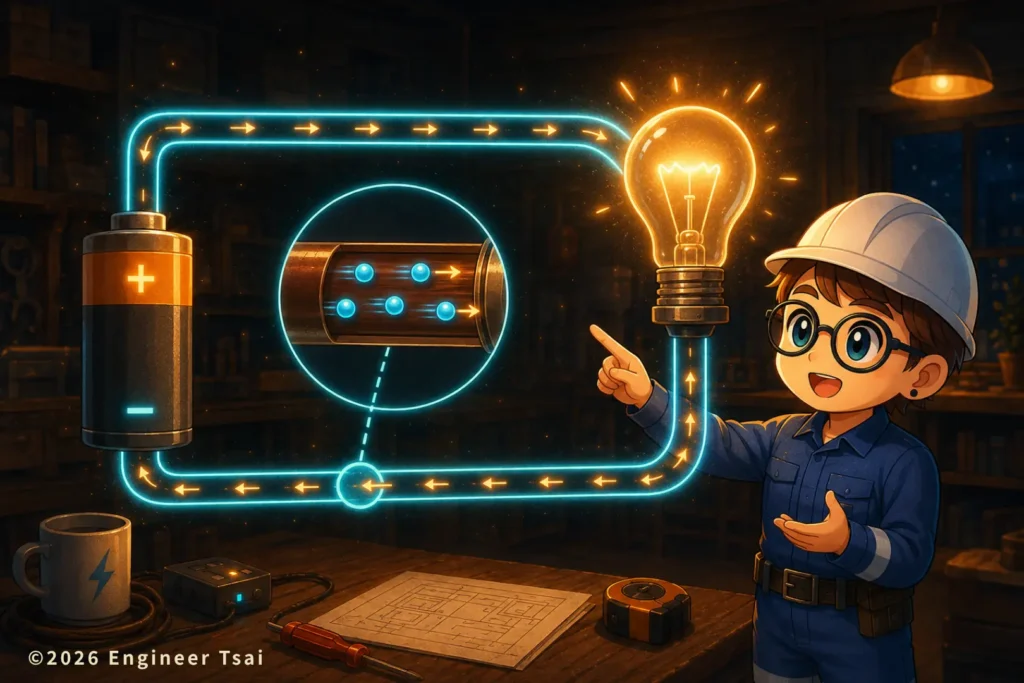
Why does a light turn on instantly? When you close the wall switch, the lighting branch circuit changes from an open path to a closed path. The electric field throughout the circuit changes rapidly, causing the free electrons already inside the conductors to develop a small average drift. Current flows through the light fixture, and the fixture converts electrical energy into light and heat.
The fast part is not one electron racing from the switch to the bulb. Copper wiring already contains an enormous number of mobile electrons, and their average drift velocity is surprisingly small. The room appears to light up immediately because the electrical and electromagnetic conditions in the circuit change far faster than any individual electron drifts through the wire.
30-second takeaway: The breaker panel feeds the branch circuit, the hot conductor carries voltage to the switch and fixture, the switch controls whether the path is complete, the fixture acts as the load, and the neutral provides the normal return path.
▶️ Watch: Why does the light turn on almost instantly?
The video begins with electron speed, then follows the circuit through the switch, fixture, neutral, branch circuit, and breaker panel. This extended guide adds U.S. terminology, the limits of common analogies, common failure modes, and OSHA-based safety context.
The big picture: 5 stops from the wall switch to the breaker panel
| Stop | What happens | Common misunderstanding |
|---|---|---|
| 1. Field response | Closing the switch rapidly changes the electrical conditions throughout the circuit | The circuit does not wait for one electron to travel the entire wire |
| 2. Complete circuit | The hot conductor, load, and return path form a continuous loop | Current cannot operate normally with only a one-way path |
| 3. Wall switch | The switch opens or closes the hot-conductor path | A switch does not generate or store electricity |
| 4. Light fixture | The load converts electrical energy into light, heat, or electronic operation | Current does not disappear inside the fixture |
| 5. Lighting branch circuit | The panelboard, conductors, switch, fixture, and neutral form one branch circuit | The breaker panel is the article’s boundary—not the original source of electrical energy |
Stop 1 | Electrons drift slowly—so why does the light respond immediately?
Metal conductors already contain mobile electrons. Without an applied electric field, those electrons move in many random directions because of thermal motion, so there is no useful average flow in one direction.
When a voltage source establishes an electric field, the electrons gain a very small average drift on top of that random motion. The drift velocity depends on current, conductor cross-sectional area, material, and charge-carrier density. It is not a single universal speed—and it is usually extremely slow compared with the circuit’s visible response.
The water-filled-pipe analogy: the effect arrives before the same particle does
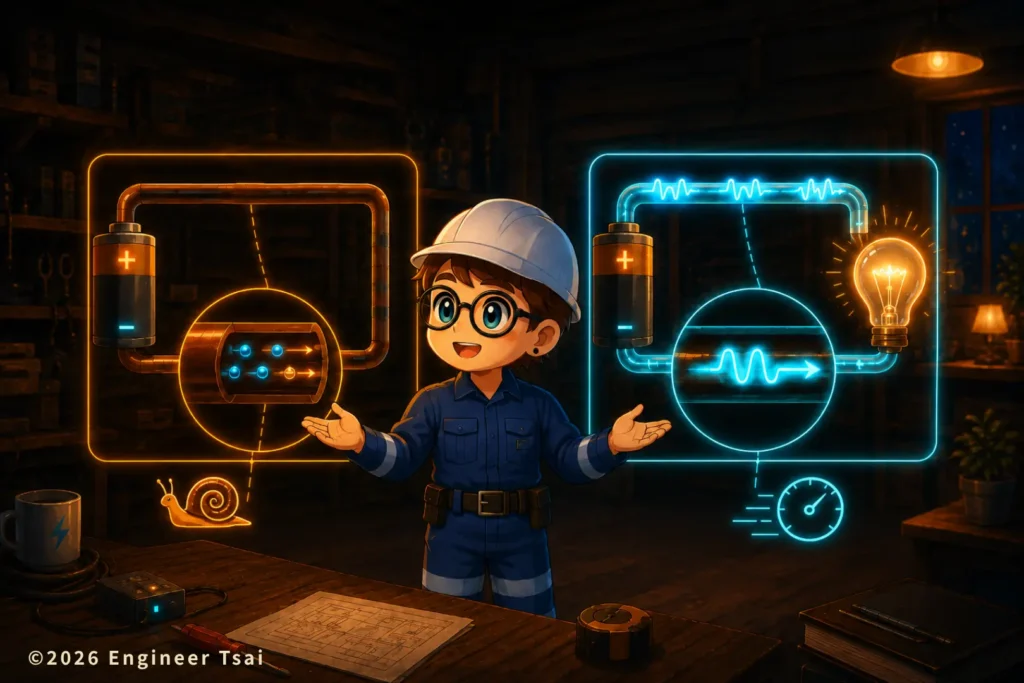
Imagine a pipe that is already full of water. If you push a small amount of water into one end, water at the far end begins moving quickly—even though the water leaving the pipe is not the same drop you just pushed in.
That analogy helps explain two ideas: the conductor already contains mobile charge, and a change at the switch can produce a response at the fixture without waiting for one electron to cross the entire branch circuit.
The analogy is incomplete, however. A real circuit also depends on electric and magnetic fields, the geometry of the outgoing and return conductors, insulation, resistance, inductance, and capacitance. A more accurate picture is that electrical energy and information are carried by electromagnetic fields associated with the circuit.
On 60 Hz AC, electrons move back and forth near their original positions
The North American grid operates at approximately 60 hertz. That means the AC waveform completes 60 full cycles each second, and the direction of the electron drift reverses every half-cycle.
The electrons in a residential branch circuit are therefore not making a one-way trip from the utility, through your panel, and into the lamp. They move back and forth over very small average distances while the circuit continuously transfers energy to the load.
A slight bulb delay does not mean electricity traveled slowly
An incandescent filament must heat to a high temperature before it glows visibly. Some LED fixtures also have a brief delay while a driver circuit charges or starts operating, and dimmer compatibility can add more delay.
Those delays occur inside the load. They do not mean the electrical effect took a long time to reach the fixture.
Stop 2 | A light needs a complete circuit
Delivering a hot conductor to a fixture is not enough. Normal current needs a continuous outgoing path and a continuous return path. If either path is open, the intended operating current cannot continue.
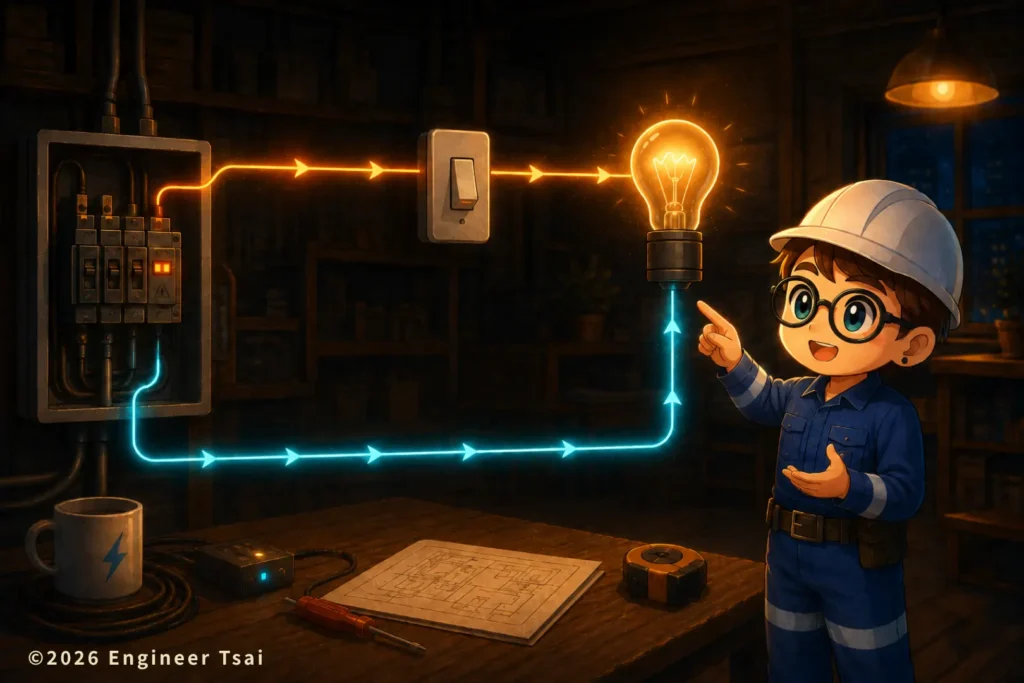
In the simplified branch circuit used here, trace the path as: breaker panel → hot conductor → single-pole switch → light fixture → neutral conductor → breaker panel. This is the basic skeleton. Three-way switching, smart switches, relays, occupancy sensors, and multiwire branch circuits add complexity later.
What do the hot, neutral, and equipment grounding conductors do?
- Hot conductor: The ungrounded conductor supplies voltage to the switch and load.
- Neutral conductor: The grounded circuit conductor provides the normal return path in this simplified 120-volt circuit. It is a current-carrying conductor and should not be treated as harmless.
- Equipment grounding conductor: It normally carries no operating current. Its purpose is to provide a low-impedance fault path if metal parts become unintentionally energized.
This article uses conventional current direction when tracing the circuit. In a metal conductor, the average drift direction of electrons is opposite conventional current. With AC, both directions reverse periodically.
Open circuit vs. closed circuit: one break stops the normal current path
An open circuit contains a break: an open switch, failed lamp filament, loose splice, disconnected neutral, or broken conductor. A closed circuit has a continuous conductive path that allows current to flow through the load.
This model is useful when a light flickers because an intermittent connection may repeatedly open and close the circuit. But flicker has many possible causes, so the symptom alone does not identify the failed component.
Stop 3 | The switch does not create electricity—it opens or closes the path
A standard single-pole wall switch is not a power source. It simply creates or removes electrical contact in one conductor.
When the switch contacts separate, the intended circuit is open and the light turns off. When the contacts close, the hot-conductor path is continuous and the fixture can operate.
In properly wired U.S. systems, the switch is intended to interrupt the ungrounded hot conductor, not merely the neutral. That reduces the chance of leaving internal fixture parts energized while the light appears off. Existing wiring can be incorrect, altered, or damaged, so wire color and switch position are never substitutes for deenergizing and testing.
For a deeper look at common switching arrangements, see 7 Types of Light Switches and Their Uses.
Stop 4 | The light fixture is the load
In this branch circuit, the light fixture is the load. A load does not consume electrons. It converts electrical energy into another form.
- Incandescent lamp: The filament becomes hot enough to glow, with much of the energy becoming heat.
- LED fixture: A driver circuit conditions the incoming power, and semiconductor junctions produce light.
- Other loads: Motors convert electrical energy into motion, heaters convert it into heat, and speakers convert it into sound.
Current continues through the return conductor after passing through the load. The fixture transforms energy; it does not permanently trap the charge carriers.
For the broader circuit model—source, conductors, and load—read Basic Parts of an Electric Circuit.
Stop 5 | How the lighting branch circuit returns to the breaker panel
A home is divided into multiple branch circuits rather than using one conductor for every light and receptacle. A lighting branch circuit supplies one or more lighting outlets and may be protected by a breaker in the panelboard.
The branch circuit includes more than the hot conductor. It includes the outgoing and return conductors, splices, boxes, switching devices, fixture, equipment grounding path, and overcurrent protection.
The breaker panel is the boundary of this explanation, not the original source of electricity. Upstream are the service conductors, meter, utility transformer, distribution system, and power generation.
Readers building a broader foundation can continue with Electricity Basics for Beginners.
Common misconceptions: what sounds right but is not
| Common statement | What is wrong with it | More accurate model |
|---|---|---|
| The switch sends electricity into the bulb | The switch does not generate energy | It only opens or closes the conductive path |
| Electrons race from the breaker to the light | Electron drift is slow and reverses on AC | The circuit’s electromagnetic conditions change rapidly |
| The bulb uses up the current | Charge does not disappear inside the load | The load converts electrical energy while current completes the circuit |
| The switch is off, so the fixture is safe | The wrong conductor may be switched, the circuit may be misidentified, or wiring may still be energized | Deenergize, control reenergization, and verify at the point of work |
| The light is dark, so the wire has no voltage | A failed lamp or open neutral can leave the hot conductor energized | A dark fixture only proves the light is not operating normally |
What can a complete-circuit model tell you about a dead or flickering light?
Once you understand the complete path, troubleshooting becomes less like replacing random parts and more like identifying which section of the circuit failed. The table below is conceptual only; it is not a DIY live-testing procedure.
| Symptom | Possible circuit area | Conclusion you cannot safely make |
|---|---|---|
| Light is completely dead | Lamp, fixture, switch, splice, hot supply, neutral return, or upstream protection | You cannot assume the lamp is the only problem or that the wiring is deenergized |
| Light flickers intermittently | LED driver, lamp, switch, connection, dimmer, or supply voltage | You cannot identify one loose wire from flicker alone |
| LED glows faintly while off | Driver design, capacitive coupling, illuminated switch, smart-switch circuitry, or wiring configuration | You cannot determine shock risk from faint glow alone |
| A new lamp still does not work | The failure may be elsewhere in the circuit | It does not make it safe to open the switch box or touch exposed conductors |
U.S. safety case: a light being off does not mean the circuit is deenergized
A NIOSH FACE investigation documented the electrocution of a newly hired lighting technician who was replacing fixtures during a night shift in a large retail store. The crew was working with lighting circuits energized and assumed the store used the expected lighting voltage and disconnect arrangement.
The foreman identified a panel that served only accent lighting, while the main store lighting was supplied from a different, previously uninspected panel. The worker contacted energized parts at a fixture that did not have the expected quick disconnect.
The lesson applies far beyond that one incident: a dark fixture, an open wall switch, or the panel you believe is correct does not prove that the conductors at the work point are deenergized. OSHA requires exposed live parts to be deenergized when applicable, protected against reenergization, and verified with test equipment by a qualified person.
A separate fault can also energize a metal enclosure. If a person touches that metal while connected to ground, current may follow an unintended path through the body.
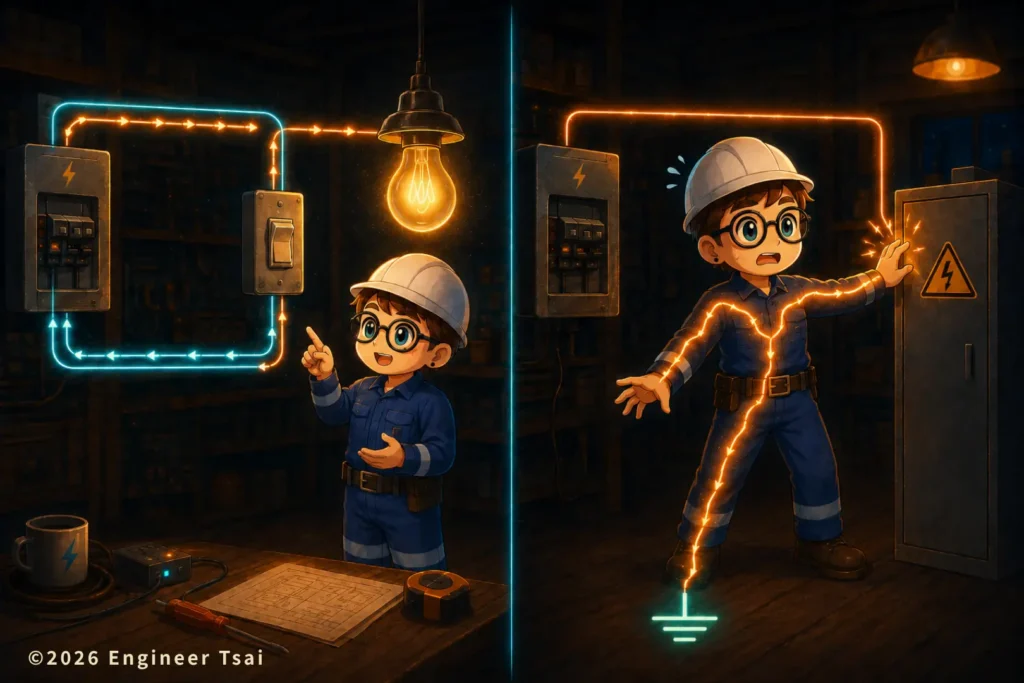
A light being off only tells you that the fixture is not operating normally. It does not prove the conductors are deenergized, and it does not replace lockout/tagout and verification.
The entire lighting circuit in one table
| Component or concept | Role in the lighting circuit | One-line memory cue |
|---|---|---|
| Electric-field change | Rapidly changes the forces acting on charge throughout the circuit | The response is fast; one electron’s trip is not |
| Hot conductor | Supplies voltage to the control device and load | The switch normally interrupts the hot |
| Wall switch | Opens or closes the intended path | It controls the path—it does not make power |
| Light fixture | Converts electrical energy into light, heat, or electronic operation | The fixture is the load |
| Neutral conductor | Provides the normal return path in a 120-volt branch circuit | Current needs an outgoing and return path |
| Equipment grounding conductor | Provides a fault-current path for safety | Not the normal operating-current path |
| Lighting branch circuit | Connects the panel, conductors, switch, fixture, and protection | The whole branch is the useful unit |
| Breaker panel | Distributes and protects branch circuits | The article ends here; the utility system continues upstream |
FAQ: switches, electrons, hot wires, neutrals, and lighting circuits
Q1: Why does a light turn on instantly when you flip the switch?
Closing the switch completes the lighting branch circuit. The electric field in the circuit changes rapidly, causing free electrons throughout the conductors to develop a small average drift. Current then flows through the light fixture, which converts electrical energy into light and heat.
Q2: Does one electron travel from the breaker panel all the way to the bulb?
No. Copper conductors already contain an enormous number of mobile electrons. The circuit responds because the electromagnetic conditions change throughout the wiring; it does not wait for one specific electron to travel from the panel to the fixture.
Q3: How slowly do electrons drift through a wire?
Drift velocity depends on current, conductor size, material, and charge-carrier density. In ordinary copper conductors it can be extremely small—often far below the speed at which the electrical effect propagates through the circuit.
Q4: Is the water-pipe analogy a perfect model of electricity?
No. It is useful for showing that the conductor already contains charge and that a push at one end can produce a response elsewhere. Real circuits also involve electric and magnetic fields, conductor geometry, insulation, resistance, inductance, and capacitance.
Q5: What is the difference between the hot and neutral conductors?
In a typical U.S. 120-volt lighting branch circuit, the ungrounded or hot conductor delivers voltage to the switch and fixture. The grounded or neutral conductor provides the normal return path. The neutral still carries current and should never be treated as harmless.
Q6: Does the equipment grounding conductor normally carry the light’s operating current?
No. Under normal conditions, the equipment grounding conductor should not carry the fixture’s operating current. It provides a low-impedance fault path so protective devices can operate when metal parts become unintentionally energized.
Q7: Why should a wall switch interrupt the hot conductor?
Interrupting the ungrounded hot conductor reduces the chance that accessible parts inside the fixture remain energized when the switch is off. Existing wiring may be incorrect or modified, so a switch position and wire color are not substitutes for deenergizing and verifying the circuit.
Q8: Where does the current go after the fixture uses the electricity?
Current does not stop inside the fixture. The fixture converts electrical energy into light, heat, or electronic operation, while charge continues through the return conductor to complete the circuit.
Q9: Does a flickering light always mean the incoming power is unstable?
No. Flicker can result from a failing LED driver, a loose connection, a worn switch, a failing lamp, dimmer incompatibility, or a supply-voltage problem. Burning odor, buzzing, discoloration, sparks, or abnormal heat require prompt professional inspection.
Q10: If the light is off, does that mean the circuit has no voltage?
No. A failed lamp, an open neutral, a removed switch, or the wrong circuit being switched off can leave parts of the wiring energized. OSHA does not treat a circuit as deenergized merely because a wall switch is off.
Q11: Is the breaker panel the original source of the electricity?
No. The breaker panel is the starting point of the branch circuit in this explanation. Upstream are the service conductors, meter, utility transformer, distribution system, and generating sources.
Q12: Can a homeowner remove a switch or light fixture to identify the hot wire?
This article is not a DIY wiring procedure. Exposed electrical parts should be deenergized, protected against reenergization, and verified with appropriate test equipment by a qualified person. Turning a wall switch off is not enough.
Conclusion: what actually happens when you flip the switch?
Flipping the switch does not launch a new group of electrons toward the fixture. It closes an electrical path. The circuit’s electric field changes rapidly, and the free electrons already present in the conductors develop a small average drift, creating current.
The hot conductor carries voltage from the breaker panel to the switch and fixture. The fixture converts electrical energy into light and heat. The neutral provides the normal return path, completing the lighting branch circuit.
The same model leads to the most important safety point in the article: a dark light does not prove a dead circuit. If an energized conductor remains connected to the source and another conductive path is available, dangerous current can still flow.
The next time you flip a switch, you are not just turning on a bulb—you are completing an entire branch circuit.
Further reading
- Electricity Basics for Beginners: Your 0–3 Month Starter Kit
- Basic Parts of an Electric Circuit: Power, Conductors, and Loads
- 7 Types of Light Switches and Their Uses
- Electrician Learning Map: Paths and Full Article Index
Sources and safety notice
- Tsai Electro YouTube: Why Does the Light Turn On Almost Instantly?
- OpenStax University Physics Volume 2: Model of Conduction in Metals
- U.S. Energy Information Administration: U.S. Grid Frequency and the Hourly Electric Grid Monitor
- OSHA 29 CFR 1910.333: Selection and Use of Work Practices
- OSHA Interpretation: A Light Switch Is Not Sufficient to Establish a Deenergized Condition
- NIOSH FACE Report 18OR040: Lighting Technician Electrocuted While Working on Energized Lighting
- OSHA Electrical Glossary: Hot, Neutral, Grounding, and Energized Metal Surfaces
Safety notice: This article explains circuit concepts and is not a wiring or repair procedure. Before switches, fixtures, or conductors are serviced, exposed parts must be properly deenergized, protected against reenergization, and verified with appropriate test equipment by a qualified person. Do not use a dark lamp, an open wall switch, or conductor color as proof that a circuit is safe.