
On this page
Table of Contents
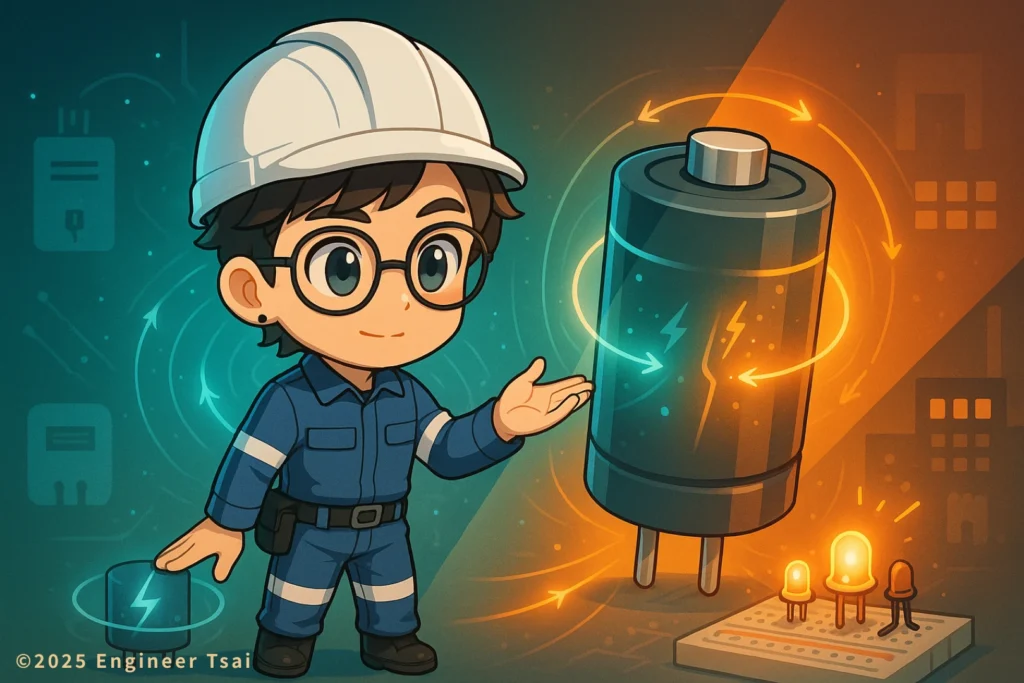
If you’re still building your foundation in basic electricity, start with this beginner-friendly overview: 🔹 “Electricity 101: The Complete Beginner’s Guide to How Power Really Works”
After reading it, the concepts in this article will make a lot more sense.
A capacitor behaves very differently on AC and DC, so it helps to know the difference between AC and DC first.
Watch first: how capacitors store and release energy
Quick answer: a capacitor stores energy as an electric field between two conductive plates, then releases it almost instantly when the circuit calls for it — that’s why capacitors show up wherever a circuit needs a quick burst of power (camera flashes, motor starters) or a steady, filtered voltage (power supplies), unlike a battery, which stores energy chemically and releases it slowly.
Want to check how solid your grasp of concepts like this really is? Try the free Electricity Fundamentals Mock Exam — a self-practice quiz, not an official certification exam.
In this short video, we start with a simple hands-on demo so you can see what a capacitor does.
You’ll watch a capacitor first “store” energy, then “dump” it in a quick burst.
From a tiny LED blinking on and off, all the way to EVs and renewable-energy systems handling fast charge and discharge, capacitors are not just textbook terms. They are real-world electronic components working around you every day, and understanding practical capacitor uses makes those circuits much less mysterious.
What is a capacitor? A plain-English picture first
If we had to introduce it in one sentence:
A capacitor is a small “temporary energy bucket” that charges up first and then releases that energy when the circuit needs a quick boost.
In English we call it a capacitor.
You’ll find capacitors in places like:
- The outdoor unit of your air conditioner
- TVs and Wi-Fi routers
- Laptop chargers and phone chargers
- Motor control panels and power-factor correction banks in commercial buildings
They come in all sorts of shapes, colors, and capacitance values. Every one of those is a real-world example of capacitor uses:
- Smoothing out voltage “ripples” so your devices don’t crash as easily
- Helping motors start and run, and improving power factor so the utility and your equipment both run more efficiently
- Providing a quick burst of current when the load suddenly demands more, so the voltage doesn’t sag too much in that instant
In this article, we’ll walk through:
- What a capacitor is
- How a capacitor stores and releases energy
- The most common capacitor uses
- Where you actually see them in homes, EVs, and industrial sites
- A simple, safe LED experiment that makes the formulas show up right in front of your eyes
Capacitor basics
Inside a capacitor: two conductors plus an insulating layer
Structurally, a capacitor is a passive component that stores energy in an electric field. The simplest way to picture it is:
- Two conductive plates (metal foil or a conductive layer) – think of them as two “buckets for charge”
- A dielectric (insulating material) in between – plastic film, ceramic, paper, mica, and so on
When you apply a voltage across the plates, one plate ends up with extra electrons (negative charge) and the other plate is short of electrons (positive charge). An electric field forms in the dielectric between them, and the energy is stored in that field. All the different capacitor uses you see later come from this same basic structure.
Key parameters you’ll see on a capacitor:
- Capacitance (C)
How much charge the capacitor can store per volt. Unit: farad (F).
In practice you mostly see μF, nF, and pF. - Rated voltage
The maximum continuous voltage the capacitor can safely handle.
Go past that and the dielectric can break down — sometimes violently. - Stored energy
Given by the classic formula:
E = ½ · C · V² You can see directly that the larger the capacitance C and the higher the voltage V, the more energy the capacitor can store.
When you’re picking a capacitor, or reading the markings on a circuit board, the most obvious info will usually be:
“How many μF” + “how many volts”
Those two numbers already tell you a lot about where that capacitor can be used and which capacitor uses it’s suitable for.
How does a capacitor work? What “charging” and “discharging” really mean
The working principle of a capacitor is basically switching between two states:
- Charging (storing energy)
- Discharging (releasing energy)
- Charging When you connect a capacitor to a battery or DC source, electrons are “pushed” onto one plate, and pulled off the other plate.
An electric field builds up in the dielectric between the plates, and energy is stored in that field. Over time, the voltage across the capacitor approaches the supply voltage. - Discharging When you then provide a path between the two plates (through an external circuit), the separated charges finally “meet” again.
The current that flows through that path is the stored energy being released, until the voltage across the capacitor falls toward zero.
Because a capacitor can charge and discharge in a very short time, it’s perfect for jobs like:
- Holding up the voltage during brief spikes in current demand
- Sending high-frequency noise to ground so the main circuit sees a cleaner supply
- Working with resistors and inductors to build delay circuits, filters, and oscillators
Once you really understand this charge–discharge behavior, you stop seeing a capacitor as “some random part on the schematic” and start seeing the job it’s doing for the circuit and which capacitor uses it’s supporting.
Main capacitor uses (and why they matter)
Use #1: Short-term energy storage and quick release
When people talk about capacitor uses, the first thing that usually comes up is this: capacitors are great at storing energy for a short time and dumping it quickly.
Typical scenarios:
- Fast energy release
Camera flash circuits are a classic example. The capacitor charges up first, then releases its stored energy in a single instant to fire a bright flash. - Bridging brief interruptions
In UPS units and industrial control gear, capacitors often work alongside batteries to bridge hundreds of milliseconds to a few seconds during switching events, preventing the voltage from collapsing and shutting everything down.
If you like analogies:
- A battery is like your main bank balance – it can power things for a long time.
- A capacitor is like a small stack of loose cash you keep handy to handle sudden spikes in spending.
The capacitor doesn’t replace the battery, but it keeps the system stable when demand suddenly jumps. This is one of the most important everyday capacitor uses.
Use #2: Filtering and noise reduction in circuits
If you open power supplies, audio equipment, or communication devices, you’ll notice a lot of capacitors labeled “10 μF”, “100 μF”, “0.1 μF”, and so on. Many of these are doing filtering and de-noising:
- Smoothing DC voltage
In phone chargers and laptop adapters, large electrolytic capacitors smooth the rectified DC, turning a “sawtooth-like” voltage into something much more stable. That way your ICs are less likely to crash or reboot whenever the line or load fluctuates. - Bypass capacitors (noise reduction)
The tiny ceramic capacitors right next to IC power pins are there to bypass high-frequency noise to ground. They improve signal integrity and reduce hum, hiss, and RF interference in your audio or communication circuits.
In short, capacitors help your electronics “see” a cleaner, more stable power supply than reality actually provides – one of the most common and important capacitor uses on any PCB.
Use #3: Voltage regulation and stability
In voltage-regulation and power-conversion circuits, capacitors act like buffers and timing elements:
- Stabilizing output voltage
Working with linear regulators or DC-DC converters, capacitors absorb sudden changes in current or voltage, smoothing out spikes that could otherwise stress sensitive components. - Filters and oscillators
In LC filters and oscillators, capacitors and inductors work together to select or reject specific frequency ranges – for example, tuning a radio station or shaping the spectrum of a communication signal.
You can think of capacitors here as the “shock absorbers” and “rhythm keepers” of the circuit: sometimes they absorb the jolts, sometimes they help set the tempo. Many beginner-friendly capacitor uses in power electronics live in this category.
Use #4: Timing and delay functions
Ever seen a bathroom or hallway light that stays on for a few seconds after you flip the switch off, and then gradually fades out?
A lot of that “stay-on-for-a-bit” behavior is done with capacitors.
- Timer circuits
In classic ICs like the 555 timer, the charging and discharging time of a capacitor directly sets the delay or pulse width. - Simple RC delays
With just one resistor and one capacitor, you can create a basic delay circuit. Turn something off, and the capacitor discharges slowly through the resistor, so the output voltage falls gradually instead of instantly.
For many beginners, the first time they build a small RC circuit and see “I can control time in my circuit”, it’s a very satisfying moment and one of the most memorable hands-on capacitor uses.
Use #5: Power-factor correction in electrical systems
Walk into an industrial plant or a commercial building’s electrical room, and you’ll often see an entire cabinet full of capacitors. Those aren’t decorations – they’re there for power-factor correction.
- Improving power factor
Large motors and transformers are inductive loads that pull down the power factor, creating extra current that doesn’t actually do useful work.
Adding properly sized capacitors helps cancel part of this reactive power and raises the power factor back up. - Reducing line losses
When power factor is low, current is higher for the same real power. That means more I²R losses in cables and equipment. With capacitor banks correcting power factor, you get less heating, better system efficiency, and longer equipment life.
In many markets (including the U.S.), large commercial and industrial users can be penalized for poor power factor.
Good capacitor banks can literally make your utility bill look better. This is a “big-iron” example of capacitor uses far beyond tiny PCBs.
Real-world capacitor applications: from smartphones to factory floors
Capacitors in consumer electronics
If you open up a smartphone, laptop, or TV mainboard, you’ll see capacitors everywhere. Here you can clearly see some key capacitor uses tied to power quality and user experience:
- Smartphones and laptops
On the mainboard, capacitors smooth the supply rails for CPUs, GPUs, memory, and other critical components. Their job is to keep these devices from crashing or randomly rebooting when load suddenly ramps up. - Capacitive touchscreens
Capacitive touchscreens work by measuring tiny changes in capacitance when your finger approaches or touches the glass surface. That’s literally a real-world application of capacitors as sensors.
Every time you scroll, tap, or play a game, you’re interacting with a whole cluster of capacitor uses behind the scenes.
Capacitors in EVs and clean-energy systems
As EVs, home battery systems, and renewable energy grow, capacitor uses are taking on bigger roles in how we move and store energy:
- Supercapacitor energy storage
In some electric vehicles and buses, supercapacitors are used for regenerative braking and quick acceleration, swallowing and releasing very large currents in a short period. - Smoothing renewable-energy output
Solar and wind power output naturally fluctuates. Capacitors help smooth those voltage variations and reduce electrical noise so inverters and the grid can handle the power more reliably.
A lot of people only think of batteries when they hear “energy storage”. But for fast charging, braking energy recovery, and short-term high-current events, capacitors can be more suitable than batteries. These are high-power, high-speed capacitor uses that are becoming more common every year.
Capacitors in industrial and building equipment
In factories, data centers, and large HVAC systems, capacitors are everywhere – you can see some of the most important capacitor uses keeping equipment running smoothly:
- Motor start and run capacitors
Single-phase motors – like those in AC compressors, well pumps, and air compressors – often rely on start or run capacitors to provide the right phase shift so the motor can start smoothly and deliver stable torque. - Voltage stability and system protection
In industrial switchboards, capacitor banks not only correct power factor but also help reduce voltage swings and support protection devices in doing their job.
Wherever you have large amounts of power and a need for stable supply, chances are capacitors are part of the solution – another major cluster of real-world capacitor uses.
Future trends: new materials, miniaturization, and supercapacitors
New dielectric materials and higher energy density
- Dielectric innovation As materials science advances, more high-k ceramics and advanced polymers are being used in capacitors.
For engineers, that means you can pack a larger capacitance C into the same volume. For product designers, that means the same function in a much smaller footprint. - Miniaturization and higher energy density
- In ultra-compact devices like smartphones, smartwatches, and wireless earbuds, miniaturized capacitors are absolutely essential.
- New structures and materials allow some capacitors to reach relatively high energy density while still charging and discharging quickly, making them attractive for high-performance electronics.
Supercapacitors: sitting between “capacitor” and “battery”
- Characteristics and applications – supercapacitors (electrochemical double-layer capacitors) are often described as sitting between traditional capacitors and batteries. Their key features:
- Extremely fast charge and discharge – ideal for large, short-duration current pulses
- Very long cycle life – often hundreds of thousands of cycles
- Many designs use relatively eco-friendly materials compared to some battery chemistries
- Future application ideas
- Fast-charging systems
Combining supercapacitors with batteries opens up the possibility of “charge for tens of seconds to a few minutes into the supercapacitor, then gradually transfer that energy into the battery,” which can help extend battery life. - High-power, high-frequency environments
Anywhere there’s a lot of kinetic energy being converted back and forth – EV braking, port cranes, metro systems – supercapacitors have a natural role to play.
- Fast-charging systems
If you’re considering a career in electrical or electronics work, understanding capacitors is no longer just about passing a test. It’s part of the basic language used in EVs, renewable energy, and modern power systems – and many of the most in-demand capacitor uses sit in these fields.
Hands-on: see a capacitor store and release energy with an LED
We’ve talked a lot about theory. To really lock it in, it helps to see a capacitor charge up and then discharge slowly.
This small experiment is safe if you stick to low voltages, and it works well in a classroom or at home.
What you’ll need
- One capacitor (for example, 10 μF–100 μF, rated at 16 V or higher)
- One LED (any color)
- One low-voltage source (such as a 9 V battery or a 5 V bench supply)
- One resistor (around 330 Ω–1 kΩ as a current-limiting resistor)
- A few jumper wires and a breadboard
Safety note:
Do not connect a loose capacitor directly to 120 V / 240 V mains outlets. That’s a serious shock and explosion hazard.
Stick to safe low-voltage sources like batteries or lab supplies for experiments.
Step-by-step instructions
- Build the charging circuit
- Use the resistor to connect the battery to the capacitor so the capacitor charges up gradually.
- Wait a few seconds until the capacitor voltage is close to the battery voltage, then disconnect the battery side.
- Watch the discharge with the LED
- Re-wire the capacitor into a loop: capacitor → resistor → LED → back to the capacitor.
- Make sure the LED polarity is correct.
- You’ll see the LED light up, then slowly get dimmer and finally turn off.
That entire period is the capacitor releasing the energy it stored earlier.
- Experiment with different values
- Swap in a larger capacitor and see how much longer the LED stays lit.
- Change the resistor value and observe how the discharge gets faster or slower.
What this experiment is really showing you
- A larger capacitance C at the same voltage means more stored energy, so the LED stays on noticeably longer.
- A larger resistance R means a smaller current, so the LED fades more slowly.
- The textbook formula E = ½ · C · V² suddenly turns into something you can see: “longer or shorter LED brightness.”
Once you’ve done this with your own hands, later topics like RC time constants and capacitor-based timing circuits will feel much less abstract – and you’ll have a concrete feel for some basic capacitor uses.
FAQ: common beginner questions about capacitors
Q1. How does a capacitor actually “store” energy?
A capacitor stores energy in the electric field between its plates, not in chemical reactions like a battery.
When you apply a voltage across the capacitor, one plate accumulates extra electrons and the other plate becomes electron-deficient. An electric field forms in the dielectric between them. The stored energy is described by:
E = ½ · C · V²
Give that capacitor a discharge path later, and the energy flows out as current in the external circuit.
Q2. What’s the difference between a capacitor and a battery?
In short:
A battery stores energy in chemical form. It can hold a lot of energy and power things for a long time, but it charges and discharges relatively slowly and has a limited cycle life.
A capacitor stores energy in an electric field. It can charge and discharge extremely quickly, making it great for short-term, high-current events, but its energy density is much lower than a battery’s.
In many designs, you actually use both: the battery handles long-term energy, the capacitor handles short-term spikes and stabilization.
Q3. Where are the capacitors in a typical home?
Pretty much everywhere electricity and electronics show up:
Motor start/run capacitors in AC compressors, well pumps, and other single-phase motors
Filter capacitors in the power supplies of TVs, streaming boxes, and Wi-Fi routers
Electrolytic and ceramic capacitors inside laptop and phone chargers
Capacitive touchscreens, which read changes in surface capacitance when your finger touches the glass
If there’s a circuit board, there’s a very good chance there are capacitors on it.
Q4. What happens if I wire a capacitor backwards or pick the wrong rating?
Common risks include:
Reversing the polarity of an electrolytic capacitor
This can cause leakage, bulging, or in worst cases, rupture or explosion, especially at higher voltages.
Using too low a voltage rating
Running a capacitor continuously at or above its rated voltage shortens its life dramatically and can be unsafe.
Choosing a very different capacitance value
If it’s too small, your filtering or regulation may be ineffective.
If it’s too large, you may affect startup behavior or cause large inrush currents.
In practice you should always check: capacitance, voltage rating, temperature rating, and the intended use (for example: start capacitor, safety capacitor, etc.).
Q5. As a beginner, what are the minimum specs I should check when choosing a capacitor?
If you’re just starting to source parts or do basic repairs, make a habit of checking at least these three:
Capacitance C (μF, nF, pF)
Match the original design value or get as close as reasonably possible.
Rated voltage
It’s usually safe to choose a capacitor with a higher voltage rating than the original, but not lower.
Type and application
Electrolytic vs ceramic vs film vs safety capacitors (X/Y caps) are not freely interchangeable. Each type has environments it’s designed for.
Once you’re comfortable with those, you can start paying attention to leakage current, ESR, temperature characteristics, and so on, to make even better choices.
Summary and next steps
Why it’s worth getting comfortable with capacitors
Capacitors may look tiny, but the capacitor uses we’ve just walked through – energy storage and release, filtering and voltage stability, timing, and power-factor correction – literally support a huge part of modern electronics and power systems.
From the charger on your desk to the motors in HVAC systems, to EV drivetrains and grid-scale storage, wherever there’s electricity, you’re likely to find capacitors doing important work.
If you’re planning to build a solid foundation in electrical basics and eventually move into electrical, electronics, or HVAC work, then:
Knowing how to use capacitors – and understanding what they’re doing in a circuit – is one of the core skills you’ll rely on again and again.
Further reading
📌 Recommended next steps
- “What Is Electricity? The Beginner’s Guide”
Get clear on what “electricity” actually is, so you understand what a capacitor is storing in the first place, and why voltage changes affect current. - “How Voltage Drives Current: Basic Concepts Explained”
Voltage, current, and resistance form the basic language you need before RC charge/discharge curves and timing circuits start to feel intuitive. - “Capacitor” – Wikipedia overview
If you want a more formal reference on theory and terminology, this article complements the practical capacitor uses we’ve focused on here. - “Supercapacitors vs Lithium-Ion Batteries” (coming soon)
A side-by-side comparison of when batteries are better, when supercapacitors shine, and how future EVs and energy-storage systems might combine the two.
We’d also love to hear from you:
What’s the most memorable “capacitor incident” you’ve seen so far?
A failed AC start capacitor? A power-factor penalty on a utility bill? A lab experiment where someone wired a cap backward?
Share your story in the comments – your experience might be exactly what another learner needs.
And if this guide helped you understand what a capacitor does and how real-world capacitor uses show up around you, feel free to subscribe to the Engineer Tsai blog or YouTube channel.
We’ll keep breaking down electrical basics, home wiring, and beginner-friendly electrical skills in clear, plain English.