On this page
Table of Contents
If you’re still building your foundation in basic electricity, start with this beginner-friendly overview: 🔹 “Electricity 101: The Complete Beginner’s Guide to How Power Really Works”
After reading it, the concepts in this article will make a lot more sense.
▶️ Watch this first: Why does current make electronics hot? Meet the Joule heating effect
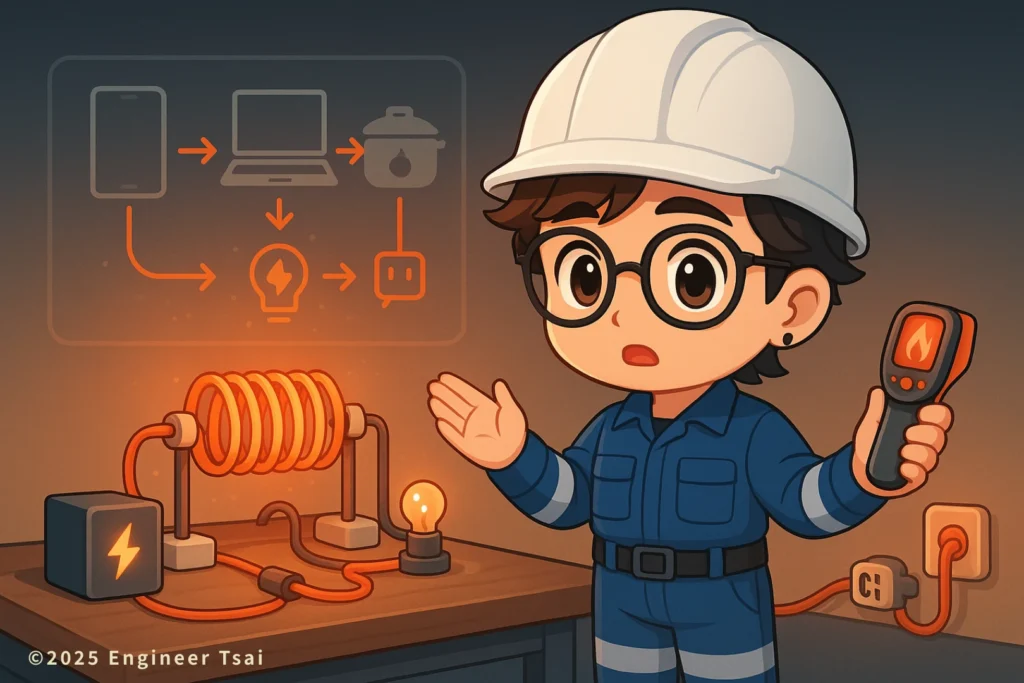
You’ve probably noticed at least one of these:
- Your phone gets hot when you use fast charging.
- Your laptop keyboard feels warm after a long day of work.
- An electric cooktop or rice cooker can bring water to a boil in just a few minutes.
All of those are powered by the same main character:
the Joule heating effect – also called the electrical heating effect.
Quick takeaway: what is the Joule heating (electrical heating) effect?
If you’re busy, remember this first:
- Joule heating (the electrical heating effect) means:
whenever electric current flows through something that has resistance,
some of that electrical energy is turned into heat, so the material warms up. - In physics, this follows Joule’s law:
Q = I² × R × t
Where:
- The bigger the current (I),
- the higher the resistance (R),
- and the longer you keep it on (t),
👉 the more heat (Q) you get.
We intentionally use this effect in things like space heaters, electric kettles and electric blankets.
But inside electronics, wiring and power lines, the same effect becomes waste and risk:
it wastes energy, ages components, and in the worst case, can start a fire.
Let’s unpack it step by step.
Introduction: “It’s just current… so why does everything heat up?”
When people first learn basic electricity, they often have this question:
“If current is just electrons moving through a wire,
why do my phone, laptop or charger get so warm… or even hot?”
In everyday life you’ve seen things like:
- Using your phone while fast-charging → both the phone and the charger feel hot
- Playing games or editing video on a laptop → fans get loud, the palm rest gets toasty
- Plugging a space heater + microwave + rice cooker into the same power strip →
the strip or cord feels suspiciously warm
None of this is “bad luck.”
It’s simply Joule heating working very hard in the background.
In this article we’ll look at:
- What this “current goes in, heat comes out” phenomenon actually is
- Which kinds of heating are normal, and which ones are warning signs
- How to read Q = I² × R × t in plain language
- Where we intentionally use Joule heating, and where it becomes a problem
- A super simple low-voltage experiment you can do to see “current → heat” with your own hands
- A practical FAQ about overheating, phone chargers, wires and safety
Chapter 1 – What exactly is Joule heating?
First let’s put down the slightly textbook-sounding but important definition:
Joule heating, also called the electrical heating effect, means:
when electric current flows through a conductor that has resistance,
part of the electrical energy is lost as heat inside that conductor.
This relationship was studied by the English physicist
James Prescott Joule, so the equation is called Joule’s law:
Q = I² × R × t
- Q – heat energy produced (in joules, J)
- I – current (amperes, A)
- R – resistance of the conductor (ohms, Ω)
- t – time the current flows (seconds, s)
Three key intuitions drop out of this:
- As long as you have current I flowing through something with resistance R,
for some amount of time t, 👉 you will generate heat Q. - Current appears as I squared:
if you double the current, the heat doesn’t just double – it becomes four times as much. - Higher resistance or longer time both make the total heat build up,
so temperature keeps climbing if you can’t get the heat out.
So as long as your wires, traces or components are not “zero resistance”,
current flowing through them will always create heat.
The only question is: how much, and do we let it sit there or remove it?
Chapter 2 – Why do devices get hot? Everyday Joule heating examples
Let’s put the textbook aside and look at real-world cases.
Phone charging and fast charging
When you use a 20 W, 30 W or higher fast charger on your phone:
- The charger’s switch-mode power supply is working hard
- Inside the phone, the charging ICs, power path and the battery are all handling current
That current flows through:
- Copper traces on the PCB
- MOSFETs, inductors, capacitors and other components
- The internal structure of the lithium-ion battery
All of those parts have resistance →
energy is “rubbed” into heat → temperature rises.
That’s why you feel the charger, the cable, and the phone body getting warm,
sometimes even pretty hot, during heavy charging.
A little warmth is normal Joule heating.
If it’s painfully hot, smells weird or the phone keeps crashing,
that’s no longer “just physics” – that’s a warning sign (we’ll talk about this in the FAQ).
Laptops and desktops: why are CPU / GPU so hard to cool?
Inside a CPU or GPU, billions of transistors are switching at high speed.
Every time a transistor turns on or off, a burst of current flows through a very tiny path.
- The metal lines are extremely thin → their effective resistance isn’t low
- The currents are large and the switching is constant → I²R losses become huge
So we need:
- Heat spreaders and heat sinks
- Thermal paste
- Heat pipes and fans
All of that cooling gear is there to move the Joule heat away from the chip.
If the heat can’t escape, the chip temperature spikes → it throttles, crashes,
or in extreme cases, gets permanently damaged.
Hair dryers, space heaters, rice cookers: when heating is the main feature
Some appliances just embrace this “current makes things hot” effect:
- Hair dryers and space heaters
- Electric blankets and heating pads
- Electric kettles, rice cookers, toasters, toaster ovens
Inside, they intentionally use:
- High-resistance heating elements (often nickel-chromium alloy)
- When current flows, a lot of energy is converted to heat in that resistor
→ the heat is transferred to air, water or the metal pot.
Here, Joule heating isn’t a side effect – it’s the whole point of the product.
Chapter 3 – Three levers that control how much heat you get: I, R and t
Back to Joule’s law:
Q = I² × R × t
Heat = current squared × resistance × time
Let’s break it down.
1️⃣ Current (I)
The bigger the current, the more heat you get – but not just linearly.
- If current goes from 5 A to 10 A → current is 2×
- But I² goes from 25 to 100 → heat becomes 4×
That’s why:
- Plugging several high-power appliances into the same power strip
makes the strip or cord get very hot - A circuit that was “barely OK” with yesterday’s loads
suddenly becomes dangerous when you add one more big appliance
2️⃣ Resistance (R)
For the same current, higher resistance means more heating.
- Heating elements intentionally use high-resistance material
(like nickel-chromium) to generate a lot of heat - Wiring, on the other hand, should use low-resistance material
(good copper, thicker wire gauge) to keep heating low
Quick intuition:
- Long, thin wires → higher resistance → easier to heat up
- Short, thick wires → lower resistance → much less heating for the same current
This is also why electricians care so much about proper wire gauge
for circuits like ovens, dryers or EV chargers.
3️⃣ Time (t)
Even if the current isn’t huge and the resistance isn’t crazy high,
keeping it on for a long time lets heat build up.
Think of:
- Motors and transformers running close to full load for hours
- Equipment that stays on 24/7 in a closet or tight cabinet
If the heat can’t escape, the temperature slowly creeps up.
Over time, that can:
- Age insulation
- Dry out or crack plastic
- Fatigue solder joints
So it’s not only about “how big the current is right now” –
it’s also about how long you keep it flowing.
Chapter 4 – A powerful tool… and a real source of trouble
The “good” side: where we intentionally use Joule heating
- Heating appliances
- Induction cooktops, electric kettles, rice cookers, electric blankets, ovens, toasters…
- We use high-resistance elements to convert electrical energy into heat
and send it into water, air or metal cookware.
- Fuses and protective devices
- Fuses and some types of thermal links depend on Joule heating:
when current is too high, a thin metal part heats up and melts,
cutting off the circuit before the wiring can catch fire.
- Fuses and some types of thermal links depend on Joule heating:
- Sensors and simple protection parts
- Some sensors and protection parts use temperature change
to infer current or environmental conditions,
like thermistors or certain resettable over-current protectors.
- Some sensors and protection parts use temperature change
In these cases, Joule heating is designed, calculated and controlled on purpose.
The “bad” side: where you really don’t want things to heat up
- Energy loss and lower efficiency
- In transmission lines, transformers and circuit boards,
Joule heating is usually pure loss. - From the power plant, through the grid, into your home wiring,
there are always I²R losses stealing part of the energy as heat.
- In transmission lines, transformers and circuit boards,
- Component aging and shorter lifespan Excess heat speeds up:
- Plastic housings turning brittle or discoloredPCB solder joints expanding and shrinking, eventually crackingInsulation materials aging and losing their voltage withstand rating
and a higher chance of shorts or breakdowns. - Safety hazards: overheated cords and electrical fires Risky scenarios include:
- One power strip feeding a space heater + microwave + air fryer
- An old apartment circuit trying to run modern high-power appliances
- Loose or corroded outlets and plugs, where bad contact
creates tiny high-resistance spots that get extremely hot
When the wire temperature climbs beyond what the insulation can handle:
- Insulation hardens, cracks or carbonizes
- Leakage current and arcing become more likely
- If there’s something flammable nearby (curtains, cardboard boxes, wood),
you have the ingredients for a fire
In the U.S., overloaded circuits and overheated wiring are a known cause of home fires,
which is why electrical codes and safety campaigns keep warning people
not to overload outlets or bypass breakers.
Because of that, modern products add a lot of protection:
- Aluminum heat sinks, fans, thermal pads and heat pipes
- Temperature sensors and over-temperature protection ICs
- Over-current protection, thermal fuses and thermal cut-off switches
The goal is always the same:
Keep the “useful heat” where it belongs,
and get rid of the extra heat before it becomes a problem.
Chapter 5 – A simple low-voltage experiment: see “current heats a wire” yourself
⚠️ This demo uses a 1.5 V battery, so the risk is low –
but do NOT try the same idea directly with household AC (120 V / 240 V).
⚠️ If kids are doing this, an adult should be nearby.
Materials
- One 1.5 V AA battery
- A short piece of thin copper wire (strip the insulation at both ends)
- One small light bulb (1.5 V or 3 V type is fine)
- A few clips or some tape to hold connections
Steps
- Wire the copper and bulb in series Connect the copper wire and the small bulb in series,
then hook them up to the battery’s positive and negative terminals.
You’ve just built a very simple circuit. - Watch the bulb When you connect the circuit, check if the bulb lights up.
- The filament inside is a very thin, high-resistance wire
- Current flowing through that tiny resistor heats it up so much that it glows
- Gently feel the copper wire After a few seconds, lightly touch the copper wire (don’t grab it for a long time).
- If the wire is thin and the circuit has been on for a bit,
you may feel that it’s slightly warm.
- If the wire is thin and the circuit has been on for a bit,
What’s happening?
- The glowing filament shows that current through high resistance
can heat a wire to the point of emitting light. - The slightly warm copper shows that even a low-resistance conductor
will warm up if current flows long enough.
This little demo is telling you a very simple truth:
If there is current and there is resistance, there will be heat.
The only question is: how much, and do we notice it?
FAQ: overheating, Joule heating and everyday safety
Q1 – Is “current-caused heating” different from “resistance heating”?
Not really. You can treat them as almost the same thing.
“Joule heating” / “electrical heating effect”
– the physics term, focusing on current flowing through resistance and producing heat.
“Resistance heating”
– the everyday way electricians talk:
“High resistance there, so it heats up.”
Under the hood they’re all talking about the same story:
Current × resistance × time → heat (Q = I² R t)
That’s the heating effect we’ve been talking about.
Q2 – My phone or charger gets hot. Does that mean it’s dying?
Not automatically.
Slight warmth, feels just a bit warm to the touch
This is usually normal Joule heating,
especially during fast charging or long sessions of gaming/streaming.
Hot enough to be uncomfortable, smells odd, or the device crashes while charging
That’s a red flag. Possible causes:
Poor thermal design or blocked vents
Aging plastic or loose contacts creating high-resistance spots
Low-quality or damaged chargers/cables
A simple rule of thumb:
Warm is usually fine
Too hot to comfortably hold for more than a couple of seconds,
especially with strange smells or noises →
👉 Stop using it, try a different cable/charger, and if it persists,
have a professional check it.
Q3 – Can wires actually catch fire just from Joule heating?
Yes – and many real house fires start that way.
High-risk situations include:
A single power strip feeding several high-wattage appliances
(space heater, microwave, air fryer all at once)
Older wiring in a house or apartment trying to handle modern heavy loads
(big AC units, ovens, dryers)
Loose or corroded outlets/plugs that create tiny high-resistance contacts
which overheat way more than the rest of the wire
When wire temperature goes beyond what the insulation can handle:
Insulation gets hard, cracks or carbonizes
Leakage and arcing become likely
Nearby flammable material can ignite
Any overheating related to household mains (120 V / 240 V)
is not a DIY project.
👉 Call a licensed electrician to inspect and fix it.
Q4 – How can I reduce wasted heat and lower the risk?
Here are some practical moves:
Use the right wire gauge
High-current circuits (EV chargers, ovens, dryers, space heaters)
must use properly sized, code-compliant wiring.
Don’t overload a single outlet or power strip
Spread big loads across different circuits instead of
“stacking everything on one strip.”
Give devices room to breathe
Don’t trap PCs, routers or chargers inside sealed cabinets.
Keep vents clear and clean out dust.
Use certified equipment
Choose UL-listed / properly certified chargers, extension cords and power strips.
Don’t trust super-cheap, no-name high-wattage gadgets.
All of these actions are really just ways to:
Lower I where you can
Lower R where it shouldn’t be high
Avoid keeping big loads on for too long without proper cooling
In other words: generate less unnecessary heat.
Q5 – If I want to work in electrical / maintenance trades, how deeply do I need to understand Joule heating?
If you’re aiming for:
Residential / light commercial electrical work
Facilities / MEP maintenance
Industrial or building equipment technician roles
You should at least be able to:
Look at a circuit and roughly estimate:
how much current will flow
whether the wire and components can handle the heat
Explain why overloading circuits, undersized wire and daisy-chained power strips
are so dangerous
Read a nameplate and understand:
voltage and current
power rating
duty cycle
temperature / insulation class
You want to be able to tell a client or supervisor:
“We can’t just add another space heater here.
The Joule heating on this circuit would be too high –
the wiring and breaker aren’t sized for that load.”
As you move deeper into the field, you’ll run into:
Motor and transformer temperature-rise design
Busway and panelboard current ratings and derating
Energy-efficiency projects and wiring loss calculations
All of those are built on the same foundation:
how current-driven heating behaves in real materials over time.
Conclusion – Visible heat, invisible risk (and opportunity)
On the surface, Joule heating sounds almost too simple:
“Current flows through resistance → things get hot.”
But it quietly shapes:
- How your kettle, rice cooker, AC and hair dryer are designed
- How long your phones, laptops and servers can survive
- Whether an overloaded outlet quietly cooks your wiring inside the wall
- How factories, data centers and buildings manage their energy costs
When you look at the formula Q = I² R t and automatically ask:
- Which heat am I intentionally using here?
- Which heat is pure waste – or even a fire hazard?
…you already understand more about electricity than most people around you.
You’re also much better equipped to protect your home, your gear and your future job.
📌 Recommended next reads
🔹 What Is Electrical Resistance? The Key Player in Every Circuit
Understand how conductors, insulators and resistors actually behave,
and why resistance doesn’t just control current – it also decides how much heat is created.
🔹 How Does Electrical Energy Turn into Light, Heat and Motion?
From light bulbs and speakers to motors and heaters,
see where electrical energy goes, how much is useful work,
and where Joule heating quietly eats into your efficiency.
🔹 Basic Parts of an Electric Circuit (Power Source, Wires, Loads)
If the idea of “where the loop goes” still feels fuzzy,
this article walks through simple home-style circuit examples
and shows how to avoid overloads and overheating from the very beginning.
🔹 Wikipedia: Joule heating (Joule’s law)
For a more formal physics treatment of Joule heating, units and history.
🔹 U.S. Fire Administration – Electrical Fire Safety Resources
Explore real-world electrical fire statistics and practical safety advice
for keeping your home wiring and appliances out of the news.