On this page
Table of Contents
This guide walks you through the AC generator working principle in plain English — from structure and magnetic fields to simple experiments — so you can follow along even if you don’t have an electrical engineering background.
If you’re still building your foundation in basic electricity, start with this beginner-friendly overview: 🔹 “Electricity 101: The Complete Beginner’s Guide to How Power Really Works”
After reading it, the concepts in this article will make a lot more sense.
▶️ Watch first: How an AC generator actually makes electricity
What is an AC generator? A one-paragraph explanation
An AC generator (alternator) is a machine that converts mechanical energy into AC electric energy.
This is the core machine behind most of the world’s power generation systems.
Unlike a DC generator, an AC generator produces a voltage and current whose magnitude and direction change periodically over time. In other words, the output is alternating current (AC) instead of a fixed-direction DC current.
At home, in factories, and on the power grid, almost everything is built around AC:
- It’s easy to step up or step down the voltage with transformers.
- It’s well-suited for long-distance transmission using high voltage and low current to reduce line losses.
- The whole ecosystem—motors, appliances, industrial equipment, transformers—is designed for AC power.
If we had to summarize the AC generator working principle in one sentence, it would be:
Use rotation to keep the magnetic flux changing through a coil, so that an AC voltage is continuously induced in that coil.
Everything else in this article is just unpacking that one line and giving you real-world pictures of how the AC generator working principle shows up in power plants, cars, and backup generators.
How do we “create” electricity? The role of electromagnetic induction
At its core, an AC generator simply takes rotational mechanical energy and turns it into AC electrical energy using electromagnetic induction.
Faraday’s law tells us:
Whenever the magnetic flux through a coil changes with time, an induced voltage appears across the coil.
And if the coil is part of a closed circuit, an induced current will flow.
If you’d like a more math-heavy introduction to Faraday’s law, you can also check this Khan Academy overview of Faraday’s law of induction.
So the job of an AC generator is actually quite simple:
Keep the “coil” and the “magnetic field” in continuous relative motion,
so the magnetic flux never stops changing—and voltage never stops being induced.
In most designs, we do this by either:
- Rotating the coil inside a magnetic field, or
- Rotating the magnetic field around a stationary coil.
That’s the basic concept behind the AC generator working principle — the heart of how an alternator turns mechanical rotation into useful AC power.
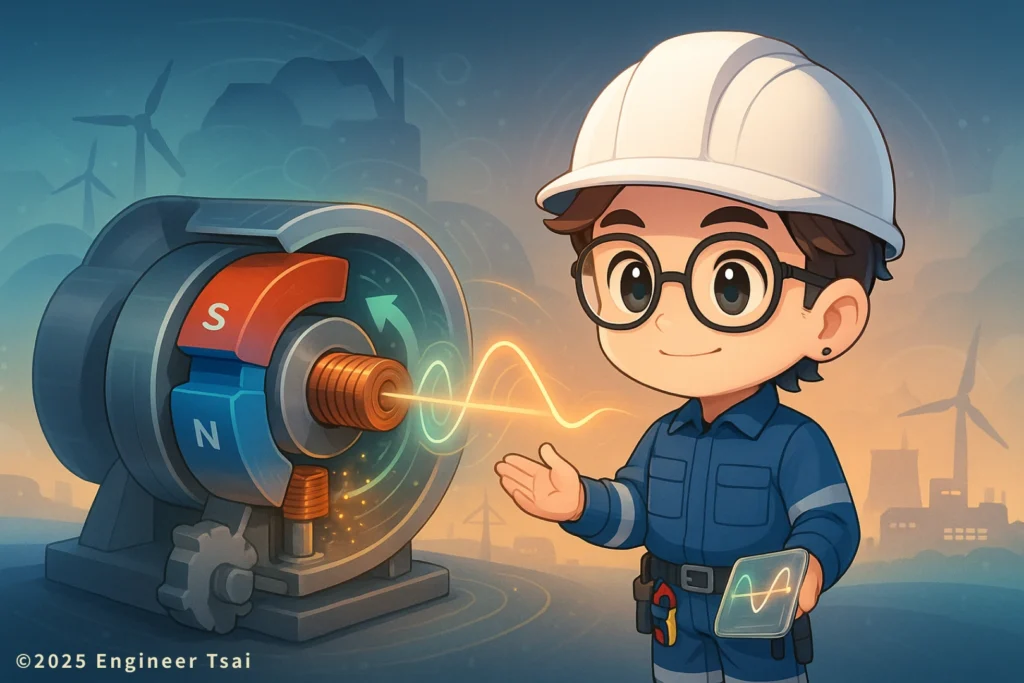
Inside an AC generator: four key components
Different applications (power plants, cars, backup generators) use different details, but the core structure is usually built from four main parts. Together, they turn the abstract AC generator working principle into a real machine that can deliver power day and night.
- Rotor
The part that rotates. It can be a permanent magnet or a wound electromagnet (a coil supplied with DC current).
The rotor creates a magnetic field. As it spins, it produces a time-varying magnetic flux in the surrounding space. - Stator
The stationary part, usually made of multiple coils wound on an iron core.
When the magnetic flux through these stator coils changes, Faraday’s law says a voltage is induced. That induced voltage is the AC output we care about. - Slip rings and brushes
These are used to transfer electric power or excitation current between the rotating rotor and the external circuit.
For example, in many car alternators, slip rings deliver DC excitation current into the rotor windings to control the magnetic field strength. - Mechanical input (prime mover)
Something has to spin the rotor. The mechanical input converts energy like water flow, wind, steam, fuel combustion, or engine torque into rotational motion.
Common prime movers include: water turbines, wind turbines, steam turbines, diesel engines, and car engines.
How AC voltage becomes a sine wave: magnetic field × rotation × time
Now let’s connect the physics with the waveform you see on an oscilloscope.
Imagine a coil rotating at a constant angular speed inside a magnetic field:
- When the magnetic field lines pass straight through the coil (perpendicular), the magnetic flux is maximum, and the induced voltage is also at its peak.
- When the coil is rotated until it is parallel to the magnetic field, the flux through the coil is close to zero, and the induced voltage momentarily drops near zero.
- As the coil keeps rotating, the magnetic flux changes in a way that naturally follows a sine function, so the induced voltage becomes a sine wave over time.
In North America, the standard frequency is 60 Hz.
That means the AC voltage completes 60 full cycles per second. For a simple two-pole machine, that corresponds roughly to the rotor making 60 revolutions per second relative to the magnetic field.
So the familiar “smooth” AC sine wave you see on diagrams is really just:
A record of how the magnetic flux through the stator coils changes as the rotor spins.
Quick note: it’s not always the magnet that spins
A common misconception is that “the magnet always spins and the coils stay still.”
In reality, designs can go either way:
- The magnetic field can rotate around a stationary set of coils, or
- The coils can rotate inside a stationary magnetic field.
From the perspective of Faraday’s law, what matters is relative motion and changing magnetic flux—not which side is physically moving.
Key takeaway: as long as the magnetic flux through the coil keeps changing with time, you can generate AC voltage.
Why do power grids use AC power? Three engineering reasons
From the massive generators in power plants to the outlet on your wall, the modern power system is built around AC power for several very practical reasons:
- Transformers make voltage changes easy
With a transformer, you can easily step up the voltage for transmission or step down the voltage for safe use in homes and businesses.
This fits perfectly with the “generate → transmit → distribute → use” flow. - Lower losses over long distances
By stepping up the voltage and reducing the current, long-distance transmission can significantly cut line losses (I²R losses).
This is one of the main reasons AC beat DC in the early “war of currents.” - Mature ecosystem of equipment
Motors, appliances, industrial machines, transformers—the entire hardware ecosystem is optimized for AC.
That makes installation, maintenance, and replacement much easier and cheaper.
For a more general grid-level picture of how AC power is generated and delivered, the U.S. Energy Information Administration has a simple overview of how electricity is delivered to consumers.
Real-world examples: where AC generators show up
If you think of an AC generator as a black box that “spins and outputs power,” then any system with:
rotation + electrical load
likely involves an AC generator somewhere in the chain.
Common examples where the AC generator working principle shows up in real hardware:
- Hydro power plants
Water flowing from a dam or river pushes a turbine, which spins the generator’s rotor.
The generator produces large amounts of AC power, which is then stepped up in voltage by transformers and sent onto the transmission lines. - Wind turbines
Wind turns the blades, which drive a shaft connected to an AC generator.
Many designs use gearboxes and power electronics (like converters) to keep the output frequency and voltage within the required range. - Car alternators
The engine turns a belt that spins the alternator.
The alternator supplies all the electrical loads in the vehicle and charges the battery.
When the engine is off, loads run from the battery; when it’s running, the alternator keeps everything supplied. - Backup generators
Hospitals, data centers, and large buildings often have diesel or natural-gas backup generator sets.
Inside those sets is an engine-driven AC generator that takes over when the grid fails.
Try this at home: feel “hand-crank power” with a magnet and a coil
You don’t need a full-size generator to experience the AC generator working principle in real life.
A simple tabletop experiment is enough to feel how changing magnetic flux creates AC voltage.
What you need
- A small strong magnet (for example, a neodymium magnet)
- A small coil of enamelled copper wire (dozens of turns)
- A small LED or a sensitive voltmeter
Steps
- Connect the LED across the two ends of the coil. Make sure the connections are solid.
- Move the magnet quickly through the middle of the coil and watch the LED. It should flash briefly.
- Now move the magnet back and forth. You’ll notice the LED flickers in both directions, corresponding to the current switching directions.
✅ What you just built
You’ve essentially created the simplest form of a hand-crank AC generator.
The coil isn’t spinning, but as long as the magnetic flux through the coil is changing, an induced voltage appears—and your LED shows it.
FAQ: AC generators and AC power
Q1: What’s the difference between an AC generator and a DC generator?
A:
The biggest difference is whether the output is AC or DC.
An AC generator (alternator) is designed so that the magnetic flux in the coils changes periodically, naturally producing a sine-wave AC voltage.
A DC generator uses a commutator or other rectifying structure so the output seen at the terminals is mostly one-directional (DC) instead of alternating.
Q2: If a car alternator fails, what symptoms will I see?
A:
Typical signs of alternator trouble include:
The battery warning light on the dash turns on or flickers.
Headlights get dim, or their brightness fluctuates, especially at idle.
Blower fan, power windows, or other accessories feel weak or slow.
The engine may be hard to start, stall more easily, or refuse to crank once the battery is drained.
All of these point to insufficient charging from the alternator.
A mechanic will usually measure the charging voltage (often around 13.5–14.5 V for many passenger vehicles) to confirm.
Q3: Does an AC generator always use permanent magnets?
A:
No.
Some small generators use permanent magnets in the rotor. They’re simple and don’t require extra excitation.
Larger power-plant generators and many car alternators use electromagnet rotors (field windings). DC excitation current is supplied to control the magnetic field strength.
Using an electromagnet rotor makes it possible to adjust the output voltage and power more flexibly.
Q4: How is generator speed related to grid frequency (like 60 Hz)?
A:
The output frequency of an AC generator depends on its rotational speed and the number of magnetic poles.
For a simple two-pole machine (one N–S pair), spinning the rotor at 60 revolutions per second yields roughly 60 Hz AC.
In practice, generators are designed so that the combination of speed and pole count matches the target frequency (50 Hz or 60 Hz).
Q5: Do small home backup generators work on the same principle as large power-plant generators?
A:
Yes. The core physics is identical:
Electromagnetic induction + rotating magnetic fields.
The main differences are in scale and complexity:
Home units use smaller engines and simpler construction.
Utility-scale generators have detailed designs for cooling, insulation, stability, parallel operation, and grid control.
But if you zoom in on “magnetic field × coil × relative motion”, your small experiment, a portable generator, and a huge power-plant generator are all members of the same family.
Q6: Why should I learn this? Does it really help with exams or work?
A:
If you’re studying for exams or licenses:
AC generators show up often in subjects like electrical machines, power systems, and general electrical engineering.
Understanding the chain “changing flux → induced voltage → sine wave” makes many calculation problems much easier.
If you’re interested in hands-on work or career change:
Any time you see something that spins and produces power, you can quickly identify its basic structure and potential failure points.
Later, when you learn about motors, transformers, and inverters, you’ll find it much easier to connect them into one mental picture — all of them are variations on the same AC generator working principle and electromagnetic induction.
Conclusion: when the rotor spins, you’re “printing” AC power
An AC generator might look like a heavy, industrial-grade machine, but the physics inside it is no more mysterious than your magnet-and-coil experiment:
- Give yourself a magnetic field, a coil, and relative motion, and you’ll get changing magnetic flux.
- Whenever the flux changes, electromagnetic induction creates a voltage in the coil.
- If you make that process continuous, stable, and controllable, you get a practical AC generator.
From hydro, wind, and thermal power plants all the way to car alternators and backup generator sets, AC generators are the devices that turn rotation into electricity.
So next time you see a generator running, keep the AC generator working principle in mind and remember just one line:
It’s using electromagnetic induction to “print” sine waves of AC power into the grid.
Once you see it that way, textbook formulas, one-line diagrams, and real equipment on site will all feel much more meaningful.
Further reading
What Is Electromagnetic Induction? Faraday’s Law Explained
Build the “math + physics” foundation behind AC generators by understanding how changing magnetic flux creates induced voltage.
Magnetic Fields and Electric Currents: The Core of Electromagnetism
Learn how current creates magnetic fields and how those fields push on conductors—key to seeing the family resemblance between generators and motors.
How Do Transformers Change Voltage? Principles, Types, and Applications
Once AC power is generated, transformers handle the “step-up / step-down” part so electricity can travel long distances and arrive safely at your outlet.
Read next in this topic
- What Is Electricity ? Everything You Need to Know
- Current & Voltage for DIY Enthusiasts : Unlock the Basics
- AC vs DC: What’s the Difference and Why It Matters (From Phone Charging to 120 V Home Power)
- Basic Parts of an Electric Circuit (Power Source, Wires, Loads)
- Conductor vs Insulator: How Your Home’s Wiring Keeps You from Getting Shocked
- Ohm’s Law Explained: V = IR for 120V Home Circuits
- What Is a Resistor? How It Works, Types, and How to Choose the Right One
- Series vs Parallel Circuits: Simple Guide for Home Wiring (With Formulas & Examples)
- How Electromagnetic Wave and Electricity Shape Modern Technology
- What Is Voltage? Simple Definition, Everyday Examples, and Safety Tips
- What Is a Battery? How It Works, Types, and Everyday Uses Explained
- What Is Ampere’s Law? A Visual Guide to How Current Creates Magnetic Fields
- What Does a Capacitor Do? Uses, Energy Storage, and Everyday Examples
- Types of Electrical Wire: How to Choose the Right One for Your Home
- How AC Power Is Converted to DC: What’s Really Inside Your Phone Charger?
- Electrical Energy Conversion: How Energy Transforms for Everyday Use
- Magnetic Field and Current: The Core Relationship Behind Motors, Generators, and Wireless Charging
- How Do Magnets Work? From Fridge Magnets to Maglev Trains
- What Is Inductance? Inductor Basics for Real-World Circuits
- What Is Impedance? A Plain-Language Guide to Resistance, Inductive Reactance, and Capacitive Reactance