Table of Contents
Table of Contents
If you’re still building your foundation in basic electricity, start with this beginner-friendly overview: 🔹 “Electricity 101: The Complete Beginner’s Guide to How Power Really Works”
After reading it, the concepts in this article will make a lot more sense.
Watch first: Understand AC vs DC in 60 seconds
This short video gives you an intuitive feel for the difference between direct current (DC) and alternating current (AC).
Watch it first, then come back to the article — everything will feel much more concrete.
Introduction: Why should you care about the difference between AC and DC?
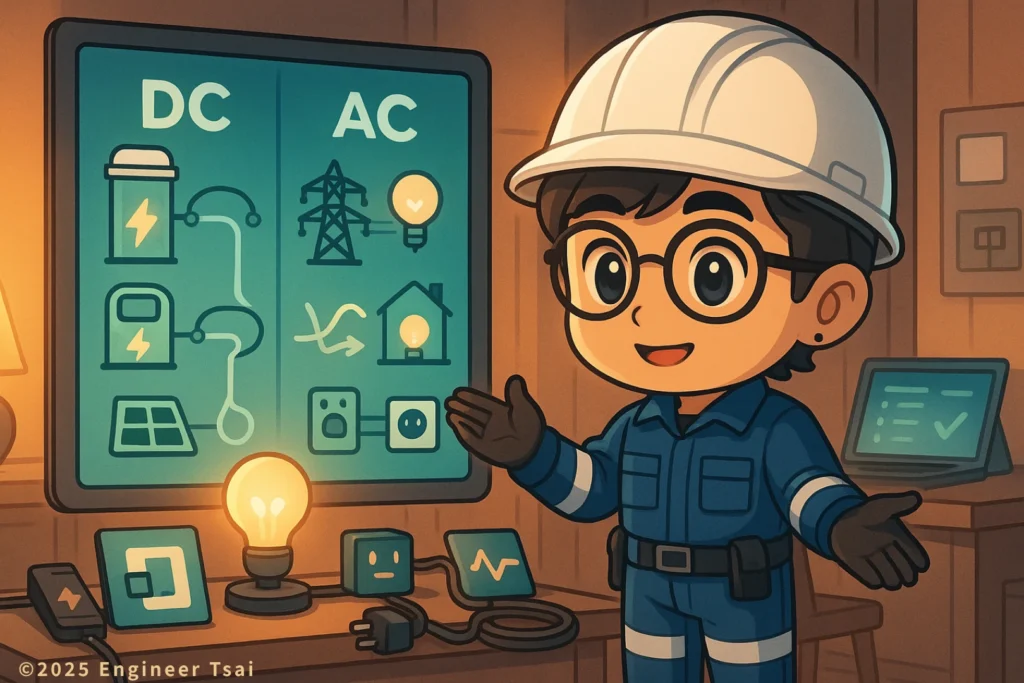
In basic electricity, the classic “AC vs DC” question shows up everywhere.
You see those two little labels on power adapters, spec sheets, and on the backs of appliances—even if you’ve never really stopped to think about what they mean.
And they’re not just textbook terms — you literally use both every single day:
- In the United States, most of the power you use at home comes from your utility as 120 V / 60 Hz AC. Many high-power appliances (like dryers or electric ranges) use 240 V circuits.
- Your phone, laptop, tablet, and power bank all run on stable DC power inside.
- Solar panels, battery storage, and EV batteries all live in a mostly DC world.
Most people only know “if I plug it in, it works,” but can’t quite answer:
- Is the electricity in my wall outlets AC or DC?
- Why do I plug my phone charger into AC, but the phone battery uses DC?
- How do “new things” like solar, EVs, and home batteries relate to AC vs DC?
In this article, we’ll use everyday U.S. home scenarios to explain the difference between AC and DC, so that next time you see “100–240 V, 50/60 Hz” on a label, you’ll actually know what it means — and which part of that label refers to the type of current.
If you’re still a bit fuzzy on “current” vs “voltage,” read our current/voltage basics article first, then come back to this one.
Key takeaways if you’re in the U.S.:
• The power in your wall outlets is AC (120 V / 60 Hz, and 240 V for some big loads).
• Most modern devices and batteries quietly live on DC inside.
• AC moves energy around the grid; DC is how electronics and batteries actually use and store it.
What is DC (Direct Current)? Definition, behavior, and common uses
DC in one sentence: current that keeps flowing in the same direction
Direct current (DC) means the current flows only one way.
Electrons move steadily from the negative side of a source toward the positive side — they don’t “change their mind” and go back and forth.
Think of it as a one-way street:
- Cars only drive forward.
- They don’t keep switching between drive and reverse every fraction of a second.
In everyday life, DC shows up all over the place:
- Batteries (AA/AAA, 9 V batteries, car batteries, lithium packs)
- The power rails inside your phone, tablet, and laptop
- Solar panels and home battery systems
- EV batteries and the low-voltage systems in cars (12 V / 48 V)
If you’re trying to make sense of all this in real life, it helps to remember this: most of the “smart” stuff in your home — phones, laptops, routers, EV batteries, smart speakers — quietly live on the DC side of the AC vs DC story.
Advantages of DC: stable, easy to store, easy to control
1. Stable voltage and precise control
DC voltage is usually smooth and steady. That’s why it’s perfect for electronics, chips, and sensors.
Inside a laptop motherboard, you’ll see many different DC rails in the single-digit to tens of volts range (3.3 V, 5 V, 12 V, etc.).
All the “brains” of modern devices expect clean DC power.
2. Easy to store in batteries
When you think “battery,” you’re really thinking DC.
- Power banks
- UPS units under your desk or in a server room
- E-bike / e-scooter packs
- EV battery packs
All of these are DC energy storage systems. Charging and discharging them means you’re moving DC energy in and out.
Limitations of DC: not great for traditional long-distance transmission
1. Traditional low-voltage DC loses a lot over long distances
If you try to push low-voltage DC a long way through a cable, you’ll see big losses in the wire. That’s why, historically, big power systems chose AC — it’s easy to transform AC to higher voltages, which cuts current and reduces losses.
Modern high-voltage DC (HVDC) systems are a different story: they use very high DC voltages and special converters to move huge amounts of power over long distances and undersea cables with low losses, and to connect grids that don’t run in sync.Wikipedia – mains electricity
But that’s advanced infrastructure — for a beginner, remember:
At everyday low voltages, pushing DC over long distances is harder than using AC.
2. Voltage conversion is more complex
If you want to change DC from 12 V to 5 V or 48 V, you need power electronics (DC-DC converters). These circuits are more complex and use more components than a simple AC transformer.
Modern DC-DC converters are very efficient and compact, but compared with a plain AC transformer, the design work is more involved.
For now, a simple rule is enough:
Changing DC voltage is possible, but it’s more complex than changing AC with a transformer.
Where you’ll see DC in everyday U.S. life
In a typical American home, DC is hiding in places like:
- Inside your phone, tablet, and laptop
- The 5 V / 9 V / 20 V coming out of USB-C chargers
- The output of your power bank’s USB ports
- Inside solar panels and home batteries before they connect to the house
- 12 V and 48 V electrical systems in cars and EVs
If you’re reading this on a laptop, you’re almost certainly looking at a screen and motherboard powered by DC right now.
What is AC (Alternating Current)? The backbone of 120 V home power in the U.S.
AC in one sentence: current that keeps reversing direction
Alternating current (AC) means the current direction flips back and forth on a regular cycle. The voltage swings above and below zero in a repeating waveform.
If DC voltage looks like a flat line on a graph, AC looks like a smooth sine wave — up and down, positive and negative.
In the United States, the power in your wall outlets is:
- 120 V (often labeled 110–120 V)
- 60 Hz AC — it completes 60 full cycles per second.
Put simply, when people talk about how power gets from the grid into your house, the wall outlets are firmly on the AC side.
Many larger appliances (dryers, ranges, some HVAC equipment) use 240 V split-phase circuits, which are still 60 Hz AC but at a higher voltage.
Advantages of AC: great for long distances and big power
1. Excellent for long-distance transmission
AC can be stepped up and down very efficiently using transformers.
- For transmission, utilities raise the voltage to very high levels (tens or hundreds of kV), which lowers current and reduces losses in the lines.
- Closer to homes, substations step the voltage back down, eventually reaching 120/240 V at your service panel.
This is the main reason almost all large-scale power grids around the world use AC as the backbone.
2. Ideal for high-power loads
High-power equipment like:
- Air conditioners and heat pumps
- Electric ranges and ovens
- Electric dryers and water heaters
- Large motors and welders
are all much easier to feed with AC. The wiring, protection devices, and standards (like the National Electrical Code (NEC) in the U.S.) are built with AC distribution in mind.
Limitations of AC: not gentle enough for electronics
- AC voltage is constantly changing. Feeding raw 120 V AC straight into electronics would destroy them.
That’s why every phone charger, laptop adapter, and TV power supply includes circuits to convert AC into clean DC before it reaches sensitive chips. - The changing voltage and current also create changing magnetic fields, which can lead to electromagnetic interference (EMI). Sensitive systems may need shielding, filters, or careful layout to keep noise under control.
Where you’ll see AC in everyday U.S. life
Think of anything that plugs directly into the wall outlet:
- Standard duplex outlets in your living room, kitchen, and bedroom (120 V / 60 Hz AC)
- 240 V circuits feeding dryers, electric ranges, some EV chargers, and large HVAC units
- The breaker panel and meter base that your utility connects to
- Streetlights, store signs, building lighting, and most industrial motors
Every time you plug into a wall outlet, you’re touching the AC side of the system.
Three key AC vs DC differences you’ll actually notice at home
Let’s answer three common questions and use them to summarize the differences between AC and DC in a more practical way.
By the end of this section, this whole “AC vs DC” topic will feel less like a textbook phrase and more like something you can spot around your own house.
1. Direction of current: one-way street vs back-and-forth
- Direct current (DC):
Electrons flow in one direction only. Voltage stays around a fixed level (with some small ripple). - Alternating current (AC):
Electrons oscillate back and forth. Voltage swings as a sine wave, going positive and negative at the system frequency (60 Hz in the U.S.).
If the waveform looks like a flat line, you’re probably looking at DC.
If it’s a smooth sine wave flipping above and below zero, it’s AC.
| Aspect | AC (Alternating Current) | DC (Direct Current) |
|---|---|---|
| Direction of current | Back-and-forth, 60 times per second in U.S. homes | One-way flow from negative to positive |
| Best at | Long-distance transmission, high-power loads | Electronics, batteries, precise power control |
| Where you see it at home | 120 V / 60 Hz wall outlets, 240 V heavy appliances | Inside phones, laptops, EV batteries, solar and storage systems |
2. Who’s responsible for “delivery” and who’s responsible for “using it well”?
You can think of AC and DC as having different “jobs” in the system:
- AC: the delivery specialist
The grid, substations, and distribution lines are almost entirely AC. AC is in charge of moving energy over distance and feeding buildings. - DC: the precision user
Electronics, battery systems, motor drives, and most sensitive equipment need DC to work reliably.
In a typical U.S. home, the flow looks like this:
Utility → AC brought to your house → breaker panel → wall outlets →
power supplies and chargers → convert AC to DC →
phones, laptops, routers, TVs, and EVs quietly consume DC inside.
3. Changing voltages: transformers vs power electronics
- AC:
A transformer can step AC up or down with very high efficiency and no moving parts. That’s why we have:- High-voltage transmission
- Medium-voltage distribution
- 120/240 V service at home
- DC:
You need power electronic converters (DC-DC converters, rectifiers, inverters) to change DC levels or convert between AC and DC.
The upside is ultra-precise control. The trade-off is higher complexity and cost in the design.
How AC and DC work together: from phone chargers to solar systems
AC to DC: rectifiers and regulators
You run into AC-to-DC conversion all the time:
- Phone chargers
- Laptop “bricks”
- Desktop PC power supplies
- Many smart-home devices and LED drivers
What’s happening inside looks roughly like this:
- Step-down transformer or high-frequency converter lowers the incoming AC to a more manageable level.
- A rectifier converts the AC into DC (often with a bumpy waveform at first).
- Filtering and regulation circuits smooth and stabilize the DC to exactly what the device needs: 5 V, 9 V, 12 V, 20 V, etc.
From the device’s point of view, it never sees the wall’s 120 V AC. It only ever sees clean DC rails.
DC to AC: the world of inverters
In renewable energy, backup power, and EVs, inverters are the stars:
- Solar power:
Solar panels produce DC. Inverters convert that DC into grid-compatible AC so it can feed your home or be exported back to the utility. - Home battery systems:
The battery stores DC energy. A hybrid inverter converts DC to AC for your home circuits and, in some setups, can also export to the grid. - EV charging and fast chargers:
Some chargers deliver high-power DC directly to the battery, while others use AC and perform the AC-to-DC conversion inside the car. Either way, inverters and power electronics are doing the heavy lifting.
So AC and DC aren’t enemies. They’re more like a team:
AC is great at moving energy around.
DC is great at using energy precisely and storing it in batteries.
Power electronics (rectifiers and inverters) connect the two worlds.
Future trends: why DC is getting trendy again
Even though today’s grid is still dominated by AC, you’ll see DC mentioned more and more in modern systems.
High-voltage DC (HVDC)
HVDC transmission is used for:
- Very long-distance lines
- Undersea cables between countries or regions
- Linking grids that don’t run at the same AC frequency
HVDC can reduce losses over extreme distances and make it easier to connect large renewable projects to load centers.Wikipedia – mains electricity
DC microgrids and DC-heavy systems
In certain environments, it’s starting to make sense to keep more of the system DC:
- Data centers and server rooms
- EV charging hubs
- LED lighting systems
- Buildings with lots of solar and batteries
Many of the loads (servers, LEDs, chargers) and sources (PV panels, batteries) are natively DC, so using a DC bus can cut down on the number of conversion steps and improve overall efficiency.
A simple way to remember it:
- Between cities and regions: AC still runs the show.
- Inside equipment and specialized facilities: DC is becoming more important.
FAQ: Is my household electricity AC or DC?
Q1: Are outlets in U.S. homes AC or DC?
They’re AC (alternating current).
In the United States, standard wall outlets in homes are typically 120 V / 60 Hz AC. Many large appliances (like electric ranges and dryers) use 240 V AC circuits.
As long as your home was wired by a licensed electrician following code, you don’t need to worry about whether the outlets are “right” — they’ll be standard AC circuits.
That’s why, in this classic comparison between AC and DC, U.S. wall outlets are firmly on team AC.
Q2: So is phone charging AC or DC?
At the wall, you’re plugging into AC.
Inside the charger, the electronics convert that AC into DC, then send controlled DC power into your phone battery.
So:
The source at the outlet is AC.
What your phone actually uses internally is DC.
Phone charging is one of the easiest real-world examples to remember when you think about AC vs DC.
Q3: Why do some devices say “100–240 V, 50/60 Hz” on the label?
That means the power supply is designed as a “universal input” or “international voltage” device.
In practice, that label says:
It can accept anything from 100 to 240 V AC,
At either 50 Hz or 60 Hz,
Which covers most of the world’s grid standards.
For frequent travelers, this is great news: as long as you have the right plug adapter for the outlet shape, you usually don’t need a separate voltage converter.
Conclusion: Understanding AC and DC is the starting point for all electrical learning
If electricity were a language, then understanding the difference between DC and AC would be like learning the alphabet.
- DC: stable, easy to store and control, the main character inside electronics and batteries.
- AC: perfect for long-distance transmission and high-power loads, the backbone of the grid and your home wiring.
For someone living in the U.S.:
- The power in your wall outlets is 120 V / 60 Hz (and 240 V for some big loads) AC.
- The devices in your hands — phones, laptops, power banks, EV batteries — live in a DC world behind the scenes.
Once you can connect those dots, news about solar, EVs, home batteries, and data centers suddenly becomes easier to understand. Whenever you see AC vs DC mentioned in those stories, you’ll know which part is about moving energy around and which part is about using or storing it.
📌 Suggested extended reading
🔹 “Current vs Voltage for DIYers: Unlocking the Basics”
Explain current and voltage with everyday analogies, so readers who were confused by school physics can rebuild their foundation in a more practical, DIY-friendly way.
🔹 “How Does an AC Generator Work? Where Your Home Power Comes From”
Follow the AC/DC concepts upstream to the power plant. After this, readers will have a clear picture of how the utility turns mechanical energy into AC power and delivers it all the way to their 120 V outlets.
Read next in this topic
- What Is Electricity ? Everything You Need to Know
- Current & Voltage for DIY Enthusiasts : Unlock the Basics
- AC vs DC: What’s the Difference and Why It Matters (From Phone Charging to 120 V Home Power)
- Basic Parts of an Electric Circuit (Power Source, Wires, Loads)
- Conductor vs Insulator: How Your Home’s Wiring Keeps You from Getting Shocked
- Ohm’s Law Explained: V = IR for 120V Home Circuits
- What Is a Resistor? How It Works, Types, and How to Choose the Right One
- Series vs Parallel Circuits: Simple Guide for Home Wiring (With Formulas & Examples)
- How Electromagnetic Wave and Electricity Shape Modern Technology
- What Is Voltage? Simple Definition, Everyday Examples, and Safety Tips
- What Is a Battery? How It Works, Types, and Everyday Uses Explained
- What Is Ampere’s Law? A Visual Guide to How Current Creates Magnetic Fields
- What Does a Capacitor Do? Uses, Energy Storage, and Everyday Examples
- Types of Electrical Wire: How to Choose the Right One for Your Home
- How AC Power Is Converted to DC: What’s Really Inside Your Phone Charger?
- Electrical Energy Conversion: How Energy Transforms for Everyday Use
- Magnetic Field and Current: The Core Relationship Behind Motors, Generators, and Wireless Charging
- How Do Magnets Work? From Fridge Magnets to Maglev Trains
- What Is Inductance? Inductor Basics for Real-World Circuits
- What Is Impedance? A Plain-Language Guide to Resistance, Inductive Reactance, and Capacitive Reactance