On this page
Table of contents
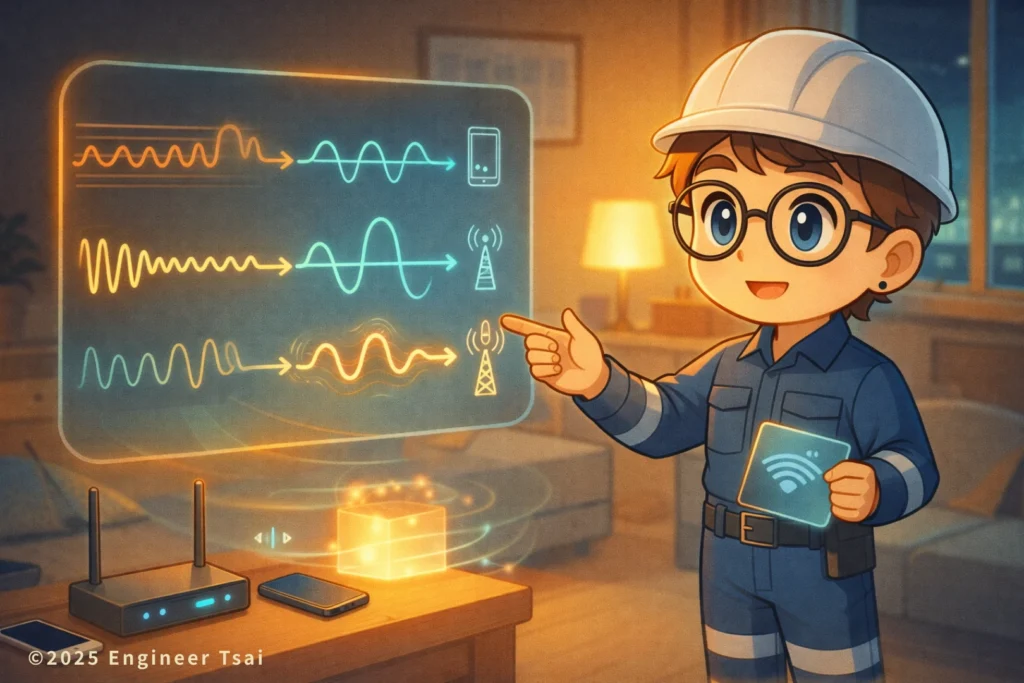
Antenna basics answers a super real—and honestly brutal—question: why does wireless sometimes “die” after just one wall, even when your phone says you have bars? If Wireless #1 helped you understand how data gets put onto a carrier (modulation), this one pulls it back to the real world: how does RF energy actually get from point A to point B?
Most “wireless problems” aren’t magic. They usually come down to four practical antenna basics: quarter-wave (λ/4) length, impedance matching (SWR), polarization, and path loss. Once you connect those dots, troubleshooting stops feeling like luck.
Quick internal reads (if you want the electrical intuition behind the RF words):
🔹 What is a PCB? (why traces and geometry matter—useful when you hear “matching network” or “microstrip”)
🔹 What is electrical grounding? (helps you “see” ground planes and return paths)
🔹 Smart home energy management (real home setups where Wi-Fi reliability becomes a safety/comfort issue)
🔹 What is a short circuit? (a fast refresher on “what energy does when it finds an unintended path”)
In this article, I’ll explain antenna basics using everyday US scenes: Wi-Fi, cellular, Bluetooth earbuds, garage door remotes, and walkie-talkies on job sites. You’ll see why “it’s only one wall” can still kill the link—because in wireless, distance, materials, and orientation literally eat signal energy.
▶️ Watch first: one diagram that connects Antenna basics & propagation
This short video ties antenna basics into one clean mental model: λ/4 → matching → polarization → path loss. Watch it first, then the article will feel way less like “RF vocabulary soup.”
If you’re thinking “Why does antenna length depend on frequency? Why 50Ω? Why does rotating my phone change everything? Why is 5GHz fast but fragile?”—that’s exactly what antenna basics is for. Let’s break it down.
Chapter 1|Wireless is everywhere: from your phone and Wi-Fi to garage remotes
A simple way to start antenna basics: an antenna isn’t magic. It’s a coupler—a device that couples high-frequency energy from a circuit into the air, or couples RF energy in the air back into a circuit.
That means your daily life is basically “antenna life”:
- Cellular (4G/5G): multiple antennas, multiple bands, switching patterns constantly.
- Home Wi-Fi: those “spikes” on routers aren’t decoration—placement and angle change stability.
- Bluetooth earbuds: short range, very sensitive to body blocking.
- Garage door remotes: common bands include 315MHz and 390MHz; placement can be the difference between “works from the driveway” and “only works right next to the door.”
- Walkie-talkies: grip, obstructions, antenna orientation, and nearby metal all matter.
Once antenna basics clicks, fixing wireless starts to feel like fault-finding: how much energy gets launched, how much is coupled back, and where it’s being lost—rather than guessing “buy a more expensive router.”
Chapter 2|Antenna basics: Quarter-wave (λ/4) antennas and why they’re everywhere
When people say “quarter-wave antenna,” they’re pointing to one of the most practical antenna basics patterns in the real world. It’s popular because it’s cheap, effective, and easy to manufacture. A lot of antennas that look like a tiny wire or stub are basically a λ/4 idea in disguise.
Reference (definition): Quarter-wave antenna.
Chapter 3|Antenna basics math: frequency ↔ wavelength (with common US bands)
The most used quick relationship in antenna basics is:
λ ≈ 300 / f(MHz) (meters)
Because RF in air travels close to the speed of light, c ≈ 3×10⁸ m/s.
Now plug in a few “US life” bands:
- 315MHz (common garage remotes): λ≈0.95m → λ/4≈0.24m (about 24cm / ~9.4in)
- 390MHz (also common garage systems): λ≈0.77m → λ/4≈0.19m (about 19cm / ~7.5in)
- 2.4GHz (Wi-Fi / Bluetooth): λ≈0.125m → λ/4≈3.1cm (~1.2in)
- 5GHz (Wi-Fi): λ≈0.06m → λ/4≈1.5cm (~0.6in)
- 6GHz (Wi-Fi 6E / Wi-Fi 7): λ≈0.05m → λ/4≈1.25cm (~0.5in)
The point is simple—and it’s core antenna basics: higher frequency → shorter wavelength → shorter antenna. That’s why phones can hide multiple antennas inside, while lower-frequency radios often need a longer “stick.”
Chapter 4|Why the real length isn’t the textbook number (velocity factor & end effects)
You can do the λ/4 math perfectly and still miss resonance. In antenna basics, that’s normal. Common reasons:
- Velocity factor: in coax, insulation, or PCB traces, wave speed is slower than in air, so the electrical length changes.
- End effects: the field around the tip shifts the effective electrical length vs the physical length.
- Nearby metal & enclosure effects: ground planes, battery cans, and chassis metal can shift resonance and impedance.
This is why antennas often need tuning margin—and why measurement can beat “perfect math.”
Chapter 5|Impedance matching: SWR and reflections—why power bounces back
Another core piece of antenna basics: even if your antenna length is “about right,” a mismatch can still waste energy. When the transmitter and antenna system are mismatched, part of the energy reflects back, creating standing waves and a worse SWR.
Reference: Standing wave ratio (SWR).
Chapter 6|Where 50Ω came from: not a rule, an industry compromise
In RF you’ll constantly see 50Ω. It’s not a law of physics—it’s a long-term industry compromise, and the ecosystem standardized around it. This matters because a lot of antenna basics troubleshooting starts with “Are we close to 50Ω, or are we fighting reflections?”
Chapter 7|What matching changes in real life (range, efficiency, transmitter protection)
In real life, matching shows up as three very practical outcomes:
- Range: more reflection means less power actually reaches the antenna.
- Efficiency: it hurts both transmit and receive coupling efficiency.
- Transmitter stress: with higher power, bad SWR can trigger protection or increase PA stress over time.
If you swap an antenna and suddenly everything gets “farther” or “more stable,” it’s often not magic—it’s improved matching, placement, or both.
Chapter 8|Polarization: it feels like “weak signal,” but it’s just misalignment
One of the sneakiest antenna basics: you can be “close enough” in distance, but lose signal because of orientation. If you rotate your phone and the signal changes a lot, polarization and body blocking are often the reason.
Reference: Wave polarization.
This is also why people angle router antennas differently (one vertical, one tilted): you’re improving the odds that at least one path matches how devices are held in real life.
Chapter 9|Path loss: why it gets worse as you walk away (FSPL, walls, people, rain)
Path loss is the part of antenna basics that feels “unfair”: even in open air, energy spreads out and weakens. Double the distance and the link can collapse faster than people expect—especially at higher frequencies.
Reference: Free-space path loss (FSPL).
In many homes, common signal killers are practical: metal HVAC ducts, brick/concrete, appliances, mirrors, fish tanks (water absorbs), and even your body (Bluetooth can drop fast when covered).
Wrap-up|Antenna basics mindset: treat wireless as energy coupling
If you think of wireless as “signal bars,” it feels mysterious. If you think of it as antenna basics—coupling → propagation → loss—it becomes engineering you can reason about.
The four takeaways:
- λ/4 is everywhere: simple and effective, but placement and tuning still matter.
- Matching matters: reflections reduce range; extreme SWR can stress transmitters.
- Polarization can trick you: “weak signal” is sometimes “wrong orientation.”
- Path loss is physics: farther means weaker; higher frequency usually suffers more through obstacles.
Wireless #2: Antennas & propagation FAQ
Q1: Is a quarter-wave (λ/4) antenna always better? Why does everyone use it?
A: Not always “better”—it’s often “best value.” λ/4 antennas are simple, low cost, and a practical size. Real performance still depends on the band, ground plane size, enclosure metal, matching network, and physical placement.
Q2: Does SWR really matter? What happens if SWR is high?
A: Yes. SWR reflects mismatch and reflections. Higher SWR means more energy bouncing back, less energy reaching the antenna, and usually worse range/stability. Low-power devices often just feel “short and flaky”; higher-power systems may trigger protection and stress the power amplifier.
Q3: Why does rotating my phone change signal strength so much?
A: Common causes are polarization and body blocking. Orientation affects coupling efficiency; if polarization doesn’t line up, you lose a lot. Also, your body absorbs/blocks RF—Bluetooth and Wi-Fi can drop fast when covered by a hand or body.
Q4: Why does 5GHz Wi-Fi drop sooner than 2.4GHz at the same distance?
A: Higher frequencies usually experience higher path loss and worse penetration through obstacles. 5GHz can be faster (more bandwidth, often less congestion), but it tends to be more fragile through walls compared to 2.4GHz.
Q5: What’s the most effective first step to improve Wi-Fi at home?
A: Before buying a pricey router, try (1) move the router/AP higher and more central to reduce wall crossings; (2) vary antenna angles; (3) if the home is long or walls are dense, use mesh/APs to shorten the link distance—this often beats “one stronger box.”
—
What wireless problem is annoying you lately—Wi-Fi dies behind one wall, Bluetooth cuts out in the kitchen, or the garage remote only works up close?
Drop your setup in the comments. With these antenna basics, you can usually guess what’s stealing your link in under five minutes.
Read next in this topic
- What Is Electricity ? Everything You Need to Know
- Current & Voltage for DIY Enthusiasts : Unlock the Basics
- AC vs DC: What’s the Difference and Why It Matters (From Phone Charging to 120 V Home Power)
- Basic Parts of an Electric Circuit (Power Source, Wires, Loads)
- Conductor vs Insulator: How Your Home’s Wiring Keeps You from Getting Shocked
- Ohm’s Law Explained: V = IR for 120V Home Circuits
- What Is a Resistor? How It Works, Types, and How to Choose the Right One
- Series vs Parallel Circuits: Simple Guide for Home Wiring (With Formulas & Examples)
- How Electromagnetic Wave and Electricity Shape Modern Technology
- What Is Voltage? Simple Definition, Everyday Examples, and Safety Tips
- What Is a Battery? How It Works, Types, and Everyday Uses Explained
- What Is Ampere’s Law? A Visual Guide to How Current Creates Magnetic Fields
- What Does a Capacitor Do? Uses, Energy Storage, and Everyday Examples
- Types of Electrical Wire: How to Choose the Right One for Your Home
- How AC Power Is Converted to DC: What’s Really Inside Your Phone Charger?
- Electrical Energy Conversion: How Energy Transforms for Everyday Use
- Magnetic Field and Current: The Core Relationship Behind Motors, Generators, and Wireless Charging
- How Do Magnets Work? From Fridge Magnets to Maglev Trains
- What Is Inductance? Inductor Basics for Real-World Circuits
- What Is Impedance? A Plain-Language Guide to Resistance, Inductive Reactance, and Capacitive Reactance