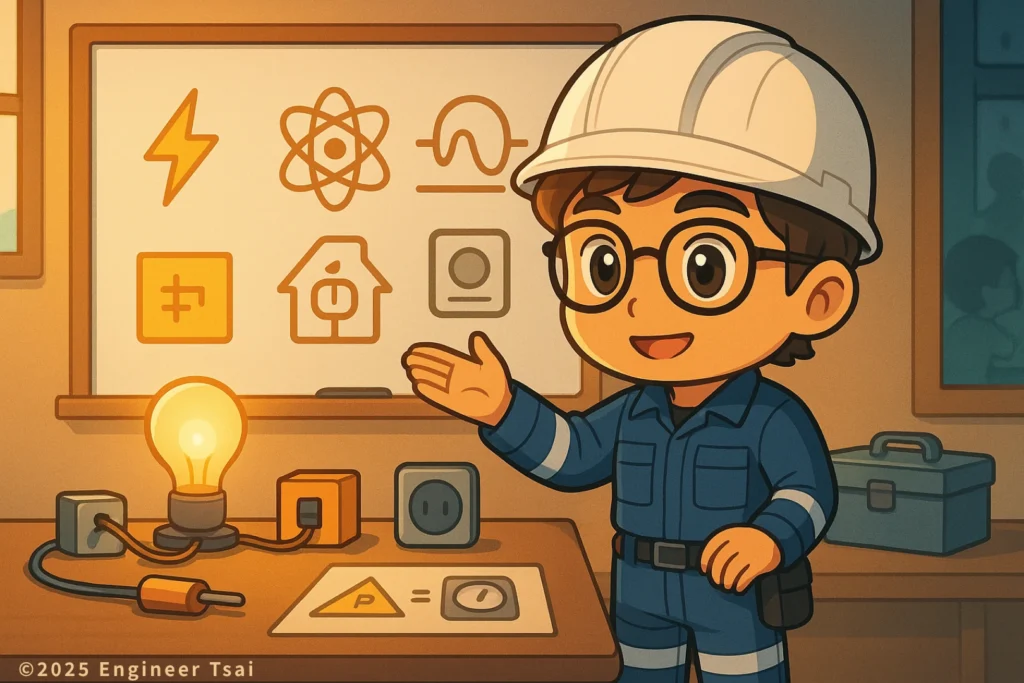
Table of Contents
Table of Contents
If you’re still building your foundation in basic electricity, start with this beginner-friendly overview: 🔹 “Electricity 101: The Complete Beginner’s Guide to How Power Really Works”
After reading it, the concepts in this article will make a lot more sense.
Watch first: See the basic parts of an electric circuit in 60 seconds
If you want to understand the basic parts of an electric circuit, you don’t have to start with heavy math.
Think of this article as your first map of the basic parts of an electric circuit before you dive into formulas or code requireme
The lights in your living room, your AC, your phone charger—they’re all just playing with the same idea:
how a power source, conductors (wires), and loads are connected in one loop.
Start with this 60-second short to get an intuitive feel for “circuit basics”, then come back to the text version—it’ll sink in much more easily.
Introduction: Why start with the basic parts of an electric circuit?
Whether you’re:
- thinking about switching careers into the electrical trade,
- already working on site as an apprentice, or
- just tired of being scared of your breaker panel at home,
you can’t escape this one idea:
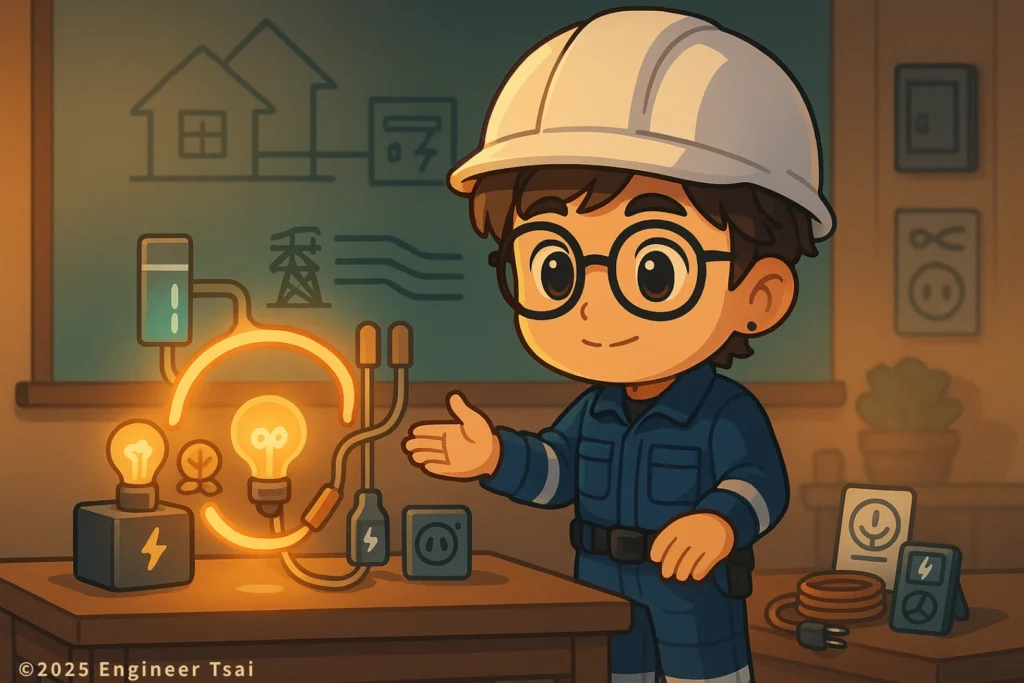
Every circuit is built on the basic parts of an electric circuit: a power source + conductors (wires) + loads.
From your local utility feeding the neighborhood, down to your main service panel, and finally to that one outlet behind your couch—it’s always these three pieces working together. In other words, those are the basic parts of an electric circuit showing up at different scales.
In other words:
- Power source – the side that “pushes” electricity out (utility power, generator, battery, solar with inverter, etc.).
- Conductors (wires) – the paths that decide where current goes and how much is lost along the way.
- Loads – the things that actually use the energy: lights, AC units, motors, chargers, computers.
Once you’re comfortable spotting these three roles, your home wiring, job-site diagrams, even industrial control panels stop looking like a mess of wires and start to feel like a story:
you’re simply tracing how the basic parts of an electric circuit show up at different scales.
where power comes from → which path it takes → who uses it in the end.
Power source: where current begins
What is a power source, and why is there no circuit without it?
In a complete circuit, the power source is the “pressure source”.
It creates the voltage that pushes electrons around the loop.
No power source = no voltage = no current.
You just have a quiet loop of copper that does absolutely nothing.
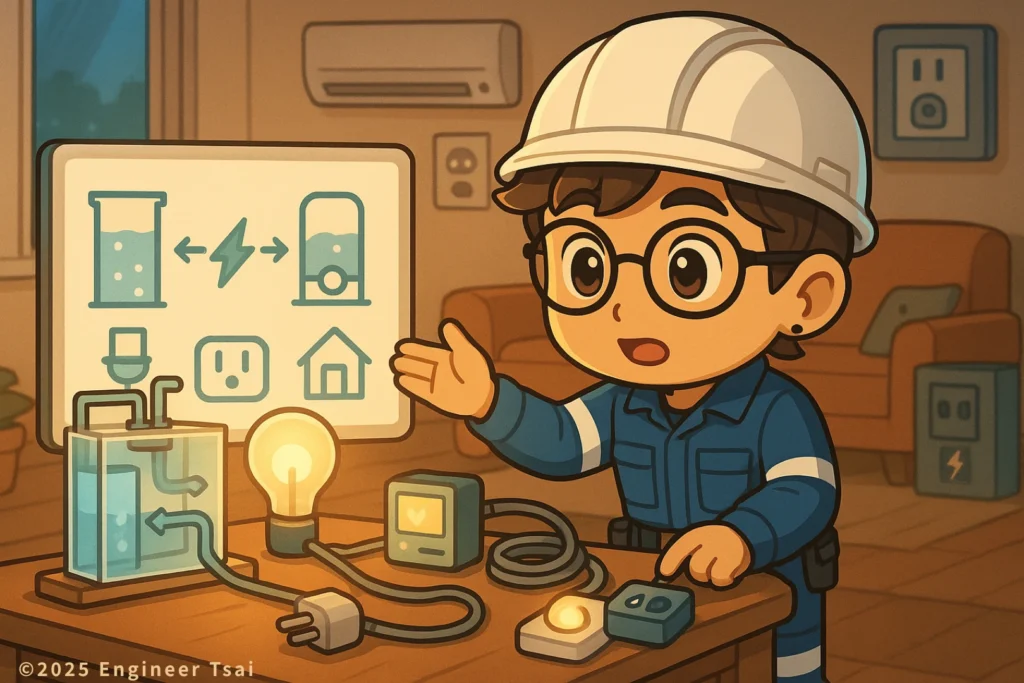
A common analogy is water:
- The power source is like a pump or water tower.
- Voltage is like pressure.
- Current is like flow.
If the pressure is unstable, water flow goes up and down and becomes annoying.
Same with electricity: if the voltage is unstable or the source is too weak, every load downstream will feel it.
The quality of your power source—voltage level, stability, and capacity—sets the stage for everything else in the circuit. It’s the first of the basic parts of an electric circuit, and if it’s wrong, nothing downstream will behave the way you expect.
Common types of power sources (US context)
Here are the ones you’ll see most often:
- Utility power (the grid)
In the US and Canada, typical homes are supplied with 120/240 V, 60 Hz split-phase power.
The outlets in your walls are branch circuits coming from your main service panel fed by the utility. - Batteries
Phone power banks, remote controls, flashlights, cordless tools, laptops—all use DC (direct current) from batteries.
The big advantage: you can move them around. Perfect for low-to-medium power portable devices. - Generators
Common on job sites, RVs, and as backup during outages. Most small generators provide 120/240 V AC.
They’re often used as a temporary power source or emergency backup. - Solar + inverter systems
Roof-mounted solar panels produce DC. An inverter converts that DC into 120/240 V AC that can power your home or be tied into the grid.
If you’re learning circuit basics, a great starting habit is to ask:
“Where is the power coming from here? Is it AC or DC? What’s the approximate voltage?”
Once you answer that, choosing wires and loads becomes much clearer.
Two things that really matter when choosing a power source
When you pick or design a power source, there are two big questions:
- Stability
Some systems absolutely hate poor power quality:
servers, medical devices, security systems, some smart electronics, etc.
That’s why you’ll often see voltage regulators + UPS (uninterruptible power supplies) in those setups.
Even at home, your fridge, PC, or NAS benefit from cleaner, more stable power. - Capacity (how much and how long)
For batteries and generators, capacity isn’t just “watts”. You also care about time.
Example: if you want to keep a fridge + some lights running during an outage, you need to estimate
total watts × hours of backup → then pick a system that can handle that.
You can compress all of this into one line:
Match the voltage, size the capacity, and aim for stable power.
That’s the core power-source mindset behind every reliable circuit.
Conductors (wires): the highways that carry current
What do wires actually do in a circuit?
Having a power source isn’t enough.
You need a path for current to leave the source, pass through the load, and return.
That “loop” is only complete when all the basic parts of an electric circuit are in place.
That path is your conductors (wiring).
They have two main jobs:
- Let electrons flow smoothly from source → load → back to source.
- Deliver power to where you need it while keeping losses (and heat) under control.
But wires are not perfect conductors—they have resistance.
If the wire is too small, too long, or the material is wrong, you’ll run into:
- Excessive heating
- Excessive voltage drop (the far end doesn’t get the voltage you expect)
That’s why picking the right material, gauge, length, and routing is a core practical skill.
Common wire materials: why copper is still king
The material of the conductor directly affects how well it carries current:
- Copper
Low resistance, high conductivity. It’s the standard choice for residential and commercial wiring in the US.
In the field, you’ll see copper wire sizes labeled in AWG (American Wire Gauge), like 14 AWG, 12 AWG, 10 AWG, etc. - Aluminum
For the same size, aluminum doesn’t conduct as well as copper, but it’s cheaper and lighter.
It’s often used for larger feeders or longer runs (like service entrance conductors) where weight and cost matter.
To carry the same current, aluminum typically needs to be larger than copper. - Insulation
The part you see—the colored jacket—is the insulation (PVC, XLPE, etc.).
The metal inside carries current.
The insulation’s job is to prevent shock, short circuits, and leakage.
In a house, the quality and sizing of those “invisible” copper conductors inside walls and conduit is a big part of what makes a system safe—or dangerous.
Wire size and voltage drop: why “too small” is risky
In the US, wire size is usually given in AWG.
The gauge affects at least three things:
- How much current it can safely carry (ampacity).
- How hot it will run under load.
- How much voltage drop you get over a long run.
A very rough way to think about it:
- Small loads (phone chargers, lamps, electronics) → can go on general-purpose branch circuits with 14 AWG or 12 AWG (according to code).
- Big loads (AC units, electric water heaters, dryers, ovens) → usually need larger conductors and dedicated circuits so the wires don’t overheat and the voltage doesn’t sag.
If you only remember one rule from this section, let it be:
Big power + long distance = think about wire size and voltage drop.
That single habit will save you from a lot of headaches—both in homes and on job sites.
(Actual wire sizing must follow the National Electrical Code (NEC) and local amendments. When in doubt, check the tables and talk to a licensed electrician.)
Loads: where electricity turns into something useful
What is a load?
In a circuit, the load is the part that uses the electricity and turns it into something you actually care about:
- Light – LED fixtures, track lights, floodlights
- Heat – electric water heaters, space heaters, ovens
- Motion – AC compressors, pumps, fans, conveyor motors
A power source and wires with no load is like a pressurized pipe with nowhere for the water to go.
It looks like a system, but it’s not doing any work.
In other words, until the load joins the power source and conductors, you don’t really have the basic parts of an electric circuit doing anything useful.
Common types of loads: resistive, inductive, capacitive
In basic circuit theory, we often group loads into three categories:
- Resistive loads
These convert electrical energy directly into heat or light.- Incandescent bulbs, some heaters, toaster elements, oven elements
- Many “pure heater” devices are mostly resistive
- Inductive loads
These rely on magnetic fields and usually involve coils.- Motors, pumps, fans, compressors
- Transformers
Inductive loads often have higher starting current and can affect power factor.
- Capacitive loads
These store and release energy in an electric field.- Capacitors used for filtering or power factor correction
- Parts of UPS systems and certain power supplies
Understanding the basic behavior of each type helps you make sense of questions like:
- “Why does the breaker trip more easily when the AC kicks on?”
- “Why does the light flicker when a big motor starts?”
How the power source, wires, and loads affect each other
Matching the source and the loads
Designing a circuit is really about one core question built on the basic parts of an electric circuit:
Can the power source comfortably support all the loads, through the wiring you’ve chosen?
Two key points:
- Voltage and power must match
- If the load wants more power than the circuit is designed to deliver → the source and wiring can be overloaded.
- If the voltage is wrong (e.g., a 240 V appliance on 120 V, or vice versa) → best case it won’t work, worst case you damage it or cause a hazard.
- What happens when they don’t match?
- Overvoltage – components overheat, insulation wears out faster, and lifespan drops.
- Undervoltage – motors may fail to start or stall, lights dim, electronics misbehave.
In a typical US home, one of the most common problems is:
Stuffing too many high-wattage devices on the same branch circuit.
Think: microwave + toaster oven + air fryer plugged into the same kitchen circuit.
The utility power is fine—but that single 15 A or 20 A branch circuit was never meant to feed all of that at once.
Result: the breaker trips to protect the wiring.
How wiring choices affect the whole circuit
Even if the power source and loads are “right”, bad conductor choices can still cause trouble:
- Overloaded conductors → overheating
If the wire gauge is too small for the current, the conductor runs hot.
Over time, the insulation can harden, crack, and eventually fail—raising the risk of shorts and fires. - Long runs → excessive voltage drop
The longer the wire, the more voltage is lost along the way.
At the far end, motors may be weak or noisy, lights can dim, and some electronics may not behave reliably.
That’s why, in real design work, you always think in a chain:
Power source capacity → wire size & length → load distribution.
If each link is sized reasonably, the whole system feels solid and safe.
Real-world examples: from your home to a production line
Example 1: a typical US home circuit
The simplest way to look at your home wiring is in three pieces:
- Power source
Utility power comes in through the meter to your main service panel.
From there, breakers feed different branch circuits around the house. - Conductors
Each breaker feeds a circuit wired with 14 AWG, 12 AWG, or larger conductors, routed through walls, ceilings, and sometimes conduit. - Loads
Receptacles, lighting circuits, kitchen appliances, HVAC equipment, water heaters, EV chargers, etc.
Once you see your home this way, planning upgrades becomes less scary:
- What wire size do I need?
That depends on the breaker size and the expected load on that circuit. - Does this appliance need a dedicated circuit?
High-wattage devices (like electric dryers, ranges, or large AC units) usually do. - What protection devices should I use?
Breakers, GFCI outlets, AFCI protection, and proper grounding work together to trip early—before things become dangerous.
Example 2: industrial or commercial circuits
In factories, commercial buildings, or large mechanical rooms, the same three elements still apply—just scaled up: the basic parts of an electric circuit, only with bigger sources, heavier conductors, and more demanding loads.
- Power source
Often from a medium-voltage transformer, stepped down to something like 480/277 V or 208/120 V three-phase. - Conductors and busbars
Now we see larger cables or busbars carrying high current over longer distances.
Ampacity, temperature rise, and voltage drop become even more critical. - Loads
Motors, pumps, fans, welding machines, VFDs, PLC panels, conveyor systems, etc.
Each type of load has its own requirements for starting current, protection, and power quality.
You’ll also see more:
- Advanced protection & monitoring – overload, short-circuit, undervoltage, phase-loss, phase-reversal, etc.
- Maintenance space – clearances around panels, accessible disconnects, well-labeled circuits.
Different scale, same skeleton: source → conductors → loads + protection.
How to design a safer, more efficient circuit
Step 1: Know what your power source can actually provide
Before you start drawing lines or pulling wire, answer two questions:
- What is the supply voltage and system type?
(120/240 V split-phase? 208/120 V three-phase? 480 V three-phase?) - What is the maximum expected demand when everything that matters is running?
Once you know that, you can size:
- the service,
- the main panel and subpanels,
- main feeders and branches,
- and any backup systems (UPS, generator, etc.).
Critical or sensitive loads may also call for voltage regulation, UPS backup, or redundant feeds.
Step 2: Choose conductor sizes and routing
Now it’s the wiring’s turn:
- Size conductors by current (ampacity)
Estimate the current on each circuit, then use NEC tables to pick a suitable AWG size.
When you’re not sure, leave some margin. - Keep routes as clean as practical
Avoid unnecessary detours and long, looping paths.
Shorter, cleaner routes mean less voltage drop and easier maintenance. - Separate power and low-voltage/communication wiring
Keep line-voltage circuits separate from low-voltage wiring (Ethernet, security, door access, audio) to reduce interference and risk. - Consider the environment
Damp locations, outdoors, or areas exposed to damage need extra care: correct cable ratings, conduit, fittings, and mechanical protection.
Step 3: Distribute loads and choose protection
Finally, place the loads and layer in protection:
- Give large loads their own circuits
Central AC units, electric water heaters, electric dryers, ovens, EV chargers, and some workshop tools usually belong on dedicated circuits. - Use appropriate breakers, fuses, GFCI/AFCI
Protection devices should be sized to protect the conductors and reduce shock and fire risk.
In many locations, GFCI and AFCI protection are required by code. - Grounding and bonding matter
The ground isn’t “just an extra wire”.
Proper grounding and bonding provide a safe path for fault current and help trip breakers quickly in a fault—hugely reducing shock risk.
If you consistently think in this order:
power source → conductors → loads → protection,
your designs naturally become safer and more reliable.
The future of circuits: smarter, more efficient, easier to manage
Smarter circuits: power systems that can “think”
When people talk about “smart homes” or “smart buildings”, they’re really talking about putting a brain on top of traditional circuits.
Modern and future systems are moving toward:
- Real-time monitoring
Sensors track current, voltage, temperature, and energy use on each circuit.
Abnormal patterns trigger alerts before failures. - Automatic optimization
Systems can shift or stagger loads based on time of day, utility rates, or available solar power. - Remote visibility & control
You can check your home or facility’s electrical status from a phone or dashboard and make adjustments as needed.
For electricians and techs, it’s still the same three elements—source, conductors, loads—just with more data and control layered on top.
New materials and higher-efficiency loads
At the same time, the wires and loads themselves are evolving:
- High-efficiency loads
LED lighting, high-efficiency motors, VFDs (variable frequency drives), and modern HVAC systems do more work with less energy. - Improved conductors and systems
For very long-distance transmission or special applications, better conductor designs and even superconducting technologies are being explored to reduce losses.
But no matter how advanced the tech becomes, the mental model stays surprisingly simple:
a source feeding loads through conductors.
FAQ
What is a “household circuit,” and how does it relate to basic circuit theory?
A household circuit is just the basic parts of an electric circuit—power source, conductors, and loads—implemented in your home.
The power source is your utility feed, through the meter, into your breaker panel.
The conductors are the branch-circuit wires running through walls, ceilings, and conduit.
The loads are your lights, receptacles, appliances, and equipment.
Once you understand how those three pieces fit together, most of your home’s wiring layout starts to make sense.
My breaker keeps tripping. Is it a power problem or a load problem?
Most of the time, it’s a load problem on one branch circuit, not that the whole house “doesn’t have enough power”.
Each breaker has a rated current.
If you plug too many high-wattage devices into the same circuit, the current exceeds that rating and the breaker trips to protect the wiring.
Typical fixes:
Move some large loads to other circuits.
Give big appliances their own dedicated circuits.
Have a licensed electrician evaluate the panel and wiring if it’s happening often.
Do big appliances like AC units and electric water heaters really need dedicated circuits?
In most cases, yes, they should have dedicated circuits, sized and protected according to code and the manufacturer’s instructions.
Large loads like:
central AC
electric water heaters
electric dryers
ranges and ovens
draw a lot of current and often run for long periods.
If you mix them into general-purpose lighting/receptacle circuits, it’s easy to overload the wiring and cause nuisance tripping—or worse.
Sizing and protection should always follow the NEC and local code, so this is work for a qualified electrician.
How can I tell which slot is hot, neutral, and ground on a US receptacle?
On a standard NEMA 5-15 (typical US 120 V) receptacle:
The smaller slot is usually hot.
The larger slot is neutral.
The round or U-shaped hole is ground.
However, receptacles can be miswired, especially in older or DIY work.
So appearance alone is not 100% reliable.
To be safe:
Use a receptacle tester or a non-contact voltage tester, and
When in doubt, have a licensed electrician verify wiring and fix any issues.
Avoid opening or rewiring receptacles yourself unless you know exactly what you’re doing and follow all safety rules.
Is it okay to use an extension cord as permanent wiring?
Short answer: no, don’t do that.
Extension cords are designed for temporary use, not as a replacement for permanent building wiring. Using them long-term:
increases the chance of overloading the cord,
can cause overheating and damage, and
raises the risk of fire and shock.
If you need power in a location permanently, the right solution is to:
install additional receptacles, or
run new branch circuits as needed—
always according to code and done by a qualified electrician.
How should I start learning circuit basics so I can understand my home panel?
A simple three-step path:
Learn the basic circuit model
Get comfortable with the idea of power source → conductors → loads in a loop.
Understand typical US home wiring
Learn about 120/240 V split-phase service, breaker panels, branch circuits, and common breaker sizes.
Match the concept to real hardware
Look at your own panel (from a safe distance), note which breakers feed which areas, and compare that to diagrams and tutorials.
Once those three layers click, topics like wire sizing, breaker selection, GFCI/AFCI, and grounding become much easier to digest.
What are the three basic elements of a circuit again?
The three basic elements are:
Power source – supplies voltage and current.
Conductors (wires) – carry current to where it’s needed.
Loads – convert electrical energy into light, heat, or motion.
If you can spot those three roles in any diagram or real-world system, you’ve already grasped the backbone of circuit theory.
Conclusion: basic parts of an electric circuit—power source, conductors, and loads
By now, you’ve seen the basic parts of an electric circuit in theory and in real hardware—from wall outlets and branch circuits to panels and three-phase systems.
Let’s recap:
- Power source – provides the driving voltage and current.
- Conductors – carry power through the system; their material, size, and length affect loss and safety.
- Loads – where electricity becomes light, heat, or motion—the part you actually care about.
From a small 120 V home circuit in the US to a large industrial three-phase system, it’s all built on this same skeleton:
power source + conductors + loads, plus the right protection and grounding.
Once you start seeing the world through that lens, electrical systems stop being mysterious and start looking logical.
⚠️ Safety note
This article is here to help you build intuition.
Actual work on electrical systems must follow the National Electrical Code (NEC) and local regulations, and should be performed or supervised by a licensed electrician. Don’t take risks beyond your training.
Further reading
🔹 Voltage vs Current: What’s the Difference, Really?
A friendly, analogy-driven guide to what voltage and current each do in a circuit. If you’ve ever mixed those two up, start here.
🔹 AC vs DC: What’s the Difference and Why Does It Matter for Your Home?
Builds on what you learned here and zooms out: how power gets from the grid to your home, and why AC and DC are used in different places.
🔹 Home Circuit Safety Checklist (coming soon)
A practical walkthrough for spotting common home electrical risks—overloaded power strips, undersized extension cords, missing GFCI protection, and more—so you can talk to your electrician with confidence.
🔹 Basic circuit analysis overview (Khan Academy)
A free, reputable course that walks through the basic parts of an electric circuit and how they behave in simple and complex circuits.
If you’re thinking about moving into the electrical trade, already working as an apprentice, or just want to stop being afraid of your breaker panel, you can treat this article as your “Circuit Basics, Chapter 1”—a friendly starting point for learning the basic parts of an electric circuit.
Save it, come back to it, and when something in your home confuses you, ask yourself:
“Where is the power source? Which path do the conductors create? What are the loads doing?”
If you’re stuck on a specific situation, feel free to tell me about it—I can help you rewrite it into a learning example for your readers too.
Read next in this topic
- What Is Electricity ? Everything You Need to Know
- Current & Voltage for DIY Enthusiasts : Unlock the Basics
- AC vs DC: What’s the Difference and Why It Matters (From Phone Charging to 120 V Home Power)
- Basic Parts of an Electric Circuit (Power Source, Wires, Loads)
- Conductor vs Insulator: How Your Home’s Wiring Keeps You from Getting Shocked
- Ohm’s Law Explained: V = IR for 120V Home Circuits
- What Is a Resistor? How It Works, Types, and How to Choose the Right One
- Series vs Parallel Circuits: Simple Guide for Home Wiring (With Formulas & Examples)
- How Electromagnetic Wave and Electricity Shape Modern Technology
- What Is Voltage? Simple Definition, Everyday Examples, and Safety Tips
- What Is a Battery? How It Works, Types, and Everyday Uses Explained
- What Is Ampere’s Law? A Visual Guide to How Current Creates Magnetic Fields
- What Does a Capacitor Do? Uses, Energy Storage, and Everyday Examples
- Types of Electrical Wire: How to Choose the Right One for Your Home
- How AC Power Is Converted to DC: What’s Really Inside Your Phone Charger?
- Electrical Energy Conversion: How Energy Transforms for Everyday Use
- Magnetic Field and Current: The Core Relationship Behind Motors, Generators, and Wireless Charging
- How Do Magnets Work? From Fridge Magnets to Maglev Trains
- What Is Inductance? Inductor Basics for Real-World Circuits
- What Is Impedance? A Plain-Language Guide to Resistance, Inductive Reactance, and Capacitive Reactance