
Table of Contents
Table of Contents
If you’ve ever mixed up amps and volts, this article will finally clear it up.
This whole guide is about making the difference between voltage and current feel like everyday common sense — not like a test question.
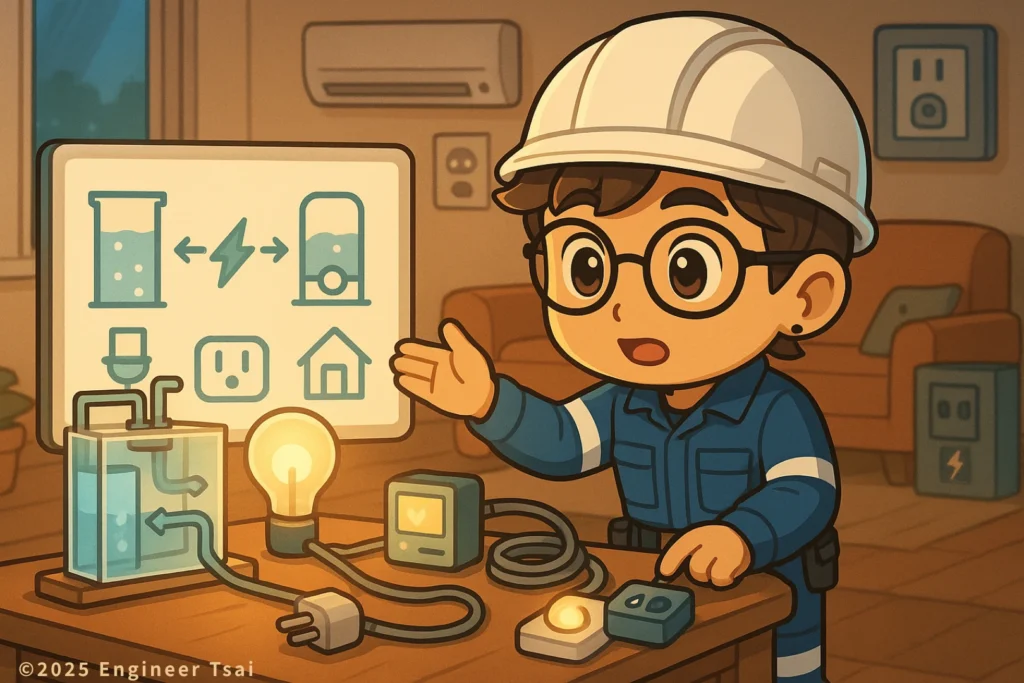
If you’re still building your foundation in basic electricity, start with this beginner-friendly overview: 🔹 “Electricity 101: The Complete Beginner’s Guide to How Power Really Works”
After reading it, the concepts in this article will make a lot more sense.
Watch first: what’s the difference between voltage and current?
If you’re into DIY, thinking about becoming an electrician, or just tired of your breaker tripping for “no reason,”
this 1-minute YouTube Short will give you a quick, visual feel for the difference between current and voltage.
Watch it first, then keep reading – everything below will click a lot faster.
Intro: why the difference between voltage and current matters in a U.S. home
You use electricity all day, every day:
- The A/C kicks on and the room finally feels livable.
- Your phone starts charging the moment you plug in the cable.
- Sometimes you plug in “one thing too many,” the breaker trips, and you have to walk over to the panel.
Behind all of that are two basic ideas: current and voltage.
In a typical U.S. house, most outlets are on 120-volt circuits:
- Standard receptacles → usually 120 V.
- Big loads like electric water heaters, ranges, some dryers or large mini-splits → often on
240-volt dedicated circuits.
If you want to:
- read outlet and extension-cord labels without guessing,
- do basic, safe DIY (choosing extension cords, replacing receptacles, checking your home’s wiring),
- or even test the waters for an electrical / trades career,
then you really need to get this one question clear first:
what’s the difference between current and voltage?
So what is the difference between voltage and current, in plain English?
Here’s the one-sentence version:
- Voltage: the “pressure” or height difference that pushes electrons to move.
- Current: how much electron flow is actually going through the circuit.
In the rest of this article, we’ll use familiar things – your 120V outlets, phone chargers, A/C unit, extension cords –
to show how current and voltage work together in real life.
If you still feel fuzzy about “what electricity even is,” you can start with this one:
“What Is Electricity? The Basic Ideas You Really Need”
What is current? — how much electron flow you actually have
Think of current as “how much water is flowing in the pipe”
The easiest way to picture it:
treat the wire like a water pipe, and electrons like tiny water droplets.
- Current (I): how many electrons pass a point per second.
- Unit: ampere (A), or “amps.”
- 1 amp is roughly 6.24 × 10¹⁸ electrons per second – an absurdly big number.
You don’t need to memorize it; just remember: 1 A = a lot of electrons moving.
For everyday thinking, this is enough:
At the same voltage, more current = more power used – more heat, more load, more energy.
So when people ask about the difference between voltage and current, current is the “how much is really flowing” part of the story.
DC and AC: two ways current can move
Once you talk about current, two terms show up everywhere:
1. Direct current (DC)
- Current flows in one steady direction.
- Common sources: batteries, USB chargers, power banks, solar panels on the DC side.
- Used in: phones, laptops, control boards inside appliances, most electronic circuits.
- It’s “steady and gentle,” which makes it perfect for small, precise devices.
2. Alternating current (AC)
- Current keeps changing direction, like water sloshing back and forth.
- Household power in the U.S. is AC, typically 120 V / 60 Hz.
Larger appliances use 240 V AC. - Why AC is a big deal:
- You can transmit it at high voltage over long distances, then step it down safely.
Great for utility power grids. - It’s ideal for motors, compressors, refrigerators, A/C units – anything needing big power.
- You can transmit it at high voltage over long distances, then step it down safely.
Don’t overcomplicate DC vs AC at the start. Just keep this in mind:
Power comes from the utility as AC. Inside many electronic devices it gets converted to DC before use.
What is voltage? — the pressure that pushes electrons to move
Water-pressure analogy: higher voltage, stronger push
If current is “how much water is flowing,” then voltage is like water pressure:
- Voltage (V): the pressure or height difference that pushes electrons.
- Unit: volt (V).
- Or in physics language: energy per unit charge.
With no voltage, electrons are lazy – they don’t want to move.
Add voltage, and it’s like raising a water tank: water now has a reason to flow downhill.
Voltage matters a lot in any circuit:
No voltage → no current.
How high the voltage is, and where you apply it, determines if the circuit runs normally or overheats.
That’s why, in the difference between voltage and current, voltage is the “push” that makes everything else possible.
Where does voltage come from? Three common sources
Most of the voltage you deal with comes from:
- Batteries
- 1.5 V AA / AAA, 9 V blocks, 3.7 V lithium cells, etc.
- Perfect for small, portable devices.
- Power supplies / chargers
- They turn 120 V AC from the wall into DC: 5 V, 12 V, 24 V, 48 V…
- Labels like “5V 2A” or “20V 3A” are talking about this output.
- Generators and the utility grid
- Power plants generate and transmit electricity at very high voltages, then step it down to safer levels for homes.
- This is all AC territory.
When you design or choose equipment, one rule never changes:
The voltage has to be right. Wrong voltage means “it won’t work” at best, “it blows up” at worst.
120 V / 240 V at home: what does it have to do with current?
In a typical U.S. home, you can simplify things like this:
- Most general-purpose outlets are 120 V:
computers, phone chargers, TVs, fans, vacuums, small kitchen appliances, etc. - Some big appliances use 240 V:
traditional electric ranges, water heaters, older large A/C units, some dryers.
Two key ideas for you as a homeowner or DIYer:
- Voltage (120 V vs 240 V) is the “height difference,” current (amps) is the actual flow.
- Same appliance, same voltage: if it draws more current, it’s using more power and putting more load on the circuit.
- When choosing cords and outlets, don’t just check the voltage. Always look at amps (A) or watts (W).
- Example: if an extension cord is labeled “125V / 15A”,
that means it’s designed for a typical 120 V system with up to 15 amps. - Push it past that, and the cord can overheat – and yes, that can mean fire.
- Example: if an extension cord is labeled “125V / 15A”,
So “current vs voltage” isn’t just a test question from a textbook.
It directly affects things like:
- why a certain breaker keeps tripping,
- why a cheap extension cord feels hot after a while,
- whether it’s safe to plug a space heater and another big appliance into the same outlet strip.
How current and voltage relate: the one formula behind the difference between voltage and current
Ohm’s Law: V = I × R
In basic electricity, there’s one formula you’ll use for the rest of your life whenever you think about the difference between voltage and current:
V = I × R
- V: voltage (volts)
- I: current (amps)
- R: resistance (ohms)
You can think of it this way:
- With resistance held constant, higher voltage → more current.
- If resistance goes up (thinner wire, longer wire, poor material),then at the same voltage, current goes down.
If you’d like to see a more math-heavy, physics-style explanation, you can check the Ohm’s Law article on Wikipedia.
A super simple little example
Say you have a light bulb whose effective resistance is 10 Ω:
- Connected to a 10 V source:
I = V / R = 10 / 10 = 1 A. - Connected to a 20 V source:
I = 20 / 10 = 2 A.
The current doubles, and so do heat, brightness (roughly), and energy use.
That’s why you often hear this summary:
Voltage is the “push,” current is the “result,” resistance is “how hard the path is.”
Measuring voltage and current with a multimeter (U.S. 120 V notes)
Lots of people own a multimeter but are nervous about actually using it.
With a few rules, you can safely measure basic voltage and current.
Measuring voltage: start with safe DC, then talk about 120 V outlets
- Turn the multimeter to the voltage range (DC or AC — they’re different settings).
- Practice on batteries first:
- Red probe on the positive terminal, black probe on the negative.
- You’ll see numbers like “1.5 V” or “9 V”.
- Only then think about measuring a household outlet (120 V AC).
- Set the meter to AC volts and choose a range above 200 V.
- As a beginner, if you’ve never had safety training,
do not experiment on live outlets just for fun.
Have a qualified electrician show you how, or stick to low-voltage practice circuits.
Key idea:
When you measure voltage, the meter goes in parallel with the circuit – you’re just “looking at the difference”
between two points. You don’t have to cut any wires.
Measuring current: in series — and much more risky on mains
- Switch the meter to the A range, and move the red lead to the correct jack (there’s often a separate 10 A jack).
- Open up the circuit at one point and insert the meter in series.
- Power the circuit and read the current.
Here are some real-world safety notes for U.S. household circuits:
- Don’t stick the meter directly into a 120 V outlet on the current (A) range to “see the amps.”
- You’ll almost certainly create a direct short:
best case you blow a fuse in the meter or trip a breaker; worst case you damage the meter or start a fire. - To measure appliance current (fridge, A/C, etc.), people typically use a
clamp meter around one conductor, or a dedicated plug-in watt meter – not a basic multimeter in series on a live 120 V branch circuit.
Treat this section as your “conceptual map”:
learn how to measure voltage and current safely on low-voltage DC circuits first.
When it comes to 120/240 V in a real panel or outlet box, work with a qualified electrician
or get proper training before touching anything.
For a step-by-step beginner’s guide, see:
“Beginner’s Guide: Using a Multimeter to Measure Voltage and Current”
How current and voltage pair up in different devices
Phone chargers: low voltage, higher current = fast charging
- Most chargers output 5–20 V DC.
- “1 A, 2 A, 3 A, 5 A” = the maximum current they can safely supply.
- Within the allowed voltage negotiation, more current = faster charging,
but cable quality and battery temperature also matter.
LED bulbs: high-voltage AC turned into low-voltage DC
- Wall outlets give you 120 V AC.
- The LED chips themselves are fed with low-voltage DC current.
- That tiny driver circuit inside the bulb handles
“step-down + rectifying + current limiting” so the LED gets just the right current.
Motors and welders: high voltage × high current
- Large motors, compressors, refrigeration units:
- Often use 240 V AC, sometimes three-phase in industrial settings.
- Design focuses heavily on wire size, overload protection, and starting current.
- Welders:
- To get a hot arc, they need very high current.
- Voltage isn’t always huge, but current can easily be tens or hundreds of amps.
In all these cases, how you combine current and voltage decides:
- whether the machine can even start,
- how hot things run,
- what wire size you need and what rating the breaker must have.
Solar systems: DC in, AC out
One more example tied to the future of energy:
- Solar panels produce DC. The total voltage depends on how you wire panels in series/parallel.
- Inverters convert that DC into AC at your home’s voltage (120/240 V).
- Designers care about:
- total string voltage and current,
- wire size, overcurrent protection, disconnects, grounding, and lightning protection.
It’s another classic “voltage + current + safety” design puzzle.
Current, voltage, and safety: how the difference between voltage and current shows up in a U.S. home
High voltage + high current = dangerous for both people and houses
This is where the difference between voltage and current stops being theory and starts affecting your safety at home.
Common risky situations at home include:
- Touching metal on a plug or cord with wet hands.
- Using outlets near sinks or tubs without proper GFCI protection.
- Running multiple high-wattage appliances (space heater, toaster oven, microwave) on one cheap extension cord.
If the voltage is high enough and a current path exists:
- Current through your body can cause muscle spasms, heart rhythm issues, and in serious cases, death.
- Wires can overheat, insulation can soften or discolor, and the fire risk goes up fast.
Inside your panel: breakers, GFCI, and friends
Take a look at your home’s main panel and you’ll typically see:
- A row of small switches → circuit breakers.
- They trip when current is too high (overload or short circuit), so the wiring doesn’t keep cooking.
- Outlets or breakers labeled GFCI with “Test” and “Reset” buttons – especially near kitchens, bathrooms, garages, or outdoors.
- Sometimes AFCI breakers in bedrooms and living areas that trip on arc faults (damaged cords, loose connections).
Once you understand “current vs voltage,” these protection devices make a lot more sense:
- Breakers watch that current doesn’t get too high for too long.
- GFCIs watch that current doesn’t leak off the intended path –
for example, through a person to ground. - Safe systems = reasonable voltage + controlled current + solid grounding and bonding.
Grounding: that extra hole on the outlet is not “just cosmetic”
Modern receptacles are usually three-prong, with a dedicated ground.
Where that grounding conductor actually goes, and how well it’s connected, directly affects:
- whether you get shocked if an appliance case becomes energized,
- whether fault current has a clean path back to the source, so breakers can trip quickly,
- how much damage lightning or surges might do.
Next time you see “equipment grounding conductor,” “bonding,” or “ground bar in the panel,”
you can map it back to today’s ideas:
Voltage determines whether a dangerous potential difference exists.
Current determines how severe the damage is.
Grounding and protection devices help give that dangerous current a fast, safe path away from you.
Looking ahead: current and voltage in the energy transition
If you’re curious about power systems and the future grid, keep these two ideas in mind:
- High-voltage DC transmission (HVDC)
- Uses extremely high DC voltages to send power over long distances with lower losses.
- Common in “offshore wind → mainland grid” and long-distance interconnects between regions.
- Smart grids
- Use sensors and data to adjust voltages and power flows in real time across neighborhoods and cities.
- Goal: fewer outages, better use of renewables, more stable voltages and currents everywhere.
No matter how fancy the tech gets, the trio of current, voltage, and resistance never goes away.
We just learn to use them more intelligently.
FAQ: common questions about the difference between voltage and current
Q1. What’s the difference between current and voltage, in one sentence?
You can remember it like this:
Voltage is the pressure or height difference that pushes electrons to move.
Current is how much electron flow is actually going through the circuit. In a typical U.S. home:
The 120V / 240V you see on labels is the voltage – how big that “push” is.
The amps (A) on appliance labels are the current – how much is flowing when it runs.
Plug a high-wattage appliance (space heater, big A/C, etc.) into a circuit and
the current goes up. That means more load on the wiring and the breaker.
Q2. What do 120V and 240V have to do with current?
In the U.S., most general-purpose outlets are 120V.
Some big appliances (electric ranges, water heaters, dryers) are on 240V circuits. You can think of it this way:
Voltage (120V / 240V): sets the “height difference” or pressure.
Current (A): is the actual flow of electricity.
For a device designed for 120V on a 120V circuit:
The more current it draws → the more power it uses → the more heat and stress on the circuit.
That’s why, when you choose extension cords, power strips, or outlets, you don’t just check the voltage.
You must also check the rated current (amps) or power (watts) to avoid overloading.
Q3. Which is more dangerous, voltage or current?
The thing that directly harms your body is current through you,
but voltage is what makes that current possible in the first place. High enough voltage plus a path through your body
(for example, one hand to the other, or hand to feet) can create dangerous current.
In many cases, tens of milliamps (mA) of current through the heart is already a serious risk.
So you can think of it like this:
Voltage: creates the conditions for current to flow.
Current: decides how bad the damage is.
Grounding, insulation, and protection devices (GFCI, breakers, etc.):
give that dangerous current somewhere else to go, or shut it off quickly.
The main takeaway: never underestimate household voltages.
120V / 240V can absolutely be lethal without proper protection and habits.
Q4. Can beginners safely use a multimeter on home outlets to measure voltage and current?
Measuring voltage is something you can learn; measuring current on live 120V circuits is not for beginners. A safer learning path:
– Start on low-voltage DC circuits (batteries, small practice circuits).
– Learn the idea that voltage is measured in parallel, current in series.
For measuring a 120V outlet:
– Your meter must be set to AC volts in the correct range.
– Your fingers stay behind the insulated parts of the probes at all times.
– If you’ve never been trained, it’s safer to have an electrician show you rather than guessing.
For measuring appliance current, pros use clamp meters or plug-in power meters.
Sticking a regular multimeter in series with a live 120V circuit is not recommended for beginners.
Q5. Why do some extension cords get really hot? Is that about current or voltage?
It’s mostly a too-much-current problem. Common causes:
– Plugging several high-wattage appliances (space heater, toaster oven, air fryer, etc.) into one cord or strip.
– Using a light-duty cord that’s only rated for 10A, then loading it close to or over that rating.
– Leaving the cord coiled up or stuffed in a tight space where it can’t get rid of heat.
When current is too high, the cord’s own resistance turns into heat inside the wire.
Over time that can:
– Soften or discolor the insulation,
– Create a hot smell around the plug ends,
– In the worst case, start a fire.
When you see a label like “125V / 15A,” use what you learned today:
It’s designed for a typical 120V system with a maximum safe current of 15 amps.
Pushing beyond that is asking for trouble.
Wrap-up: get this one idea straight and the rest of electricity gets easier
Take a second and check yourself:
- Can you explain in one sentence what current is?
- Can you do the same for voltage?
- Do you see how changing one affects the other?
- Does it make more sense now why some things use low voltage and others need higher voltage?
If yes, you’ve already poured the concrete for one of the most important foundations in basic electricity.
Topics like power, energy, and series/parallel circuits all build on top of this.
Once the difference between voltage and current feels natural to you, every other topic in basic electricity — power, kWh, wiring sizes — becomes much easier to learn.
If you can explain the difference between voltage and current to a friend in plain English, you’re already ahead of most beginners who only remember formulas.
If you’d like to connect “current and voltage” to your actual electric bill and kWh,
keep an eye out for the article
“What Is Your Electric Meter Really Counting? Understanding kWh and Usage” (coming soon).
📌 Further reading
🔹 Beginner’s Guide: Using a Multimeter to Measure Voltage and Current
Step-by-step practice with a multimeter, starting from small DC circuits so you can turn today’s concepts into hands-on skill.
🔹 What Is Electricity? Seeing the Whole Picture from 0
If “what is electricity, really?” still feels abstract,
this one zooms out and connects electrons, charge, and energy into a more complete story.
Once you really own the idea of current vs voltage in a 120V / 240V home,
a lot of everyday questions suddenly become easier:
- Why you shouldn’t daisy-chain cheap power strips.
- Why running “everything on one outlet” is asking for trouble.
- Why GFCI and AFCI protection are such big deals in modern codes.
From here, you can keep going in two directions:
- Concept-first:
How power (watts) works and which appliances actually drive your bill up. - Hands-on-first:
How to use a multimeter and a non-contact voltage tester to check outlets and extension cords safely.
I’ll walk through both paths in upcoming articles and videos, one small step at a time.
Read next in this topic
- What Is Electricity ? Everything You Need to Know
- Current & Voltage for DIY Enthusiasts : Unlock the Basics
- AC vs DC: What’s the Difference and Why It Matters (From Phone Charging to 120 V Home Power)
- Basic Parts of an Electric Circuit (Power Source, Wires, Loads)
- Conductor vs Insulator: How Your Home’s Wiring Keeps You from Getting Shocked
- Ohm’s Law Explained: V = IR for 120V Home Circuits
- What Is a Resistor? How It Works, Types, and How to Choose the Right One
- Series vs Parallel Circuits: Simple Guide for Home Wiring (With Formulas & Examples)
- How Electromagnetic Wave and Electricity Shape Modern Technology
- What Is Voltage? Simple Definition, Everyday Examples, and Safety Tips
- What Is a Battery? How It Works, Types, and Everyday Uses Explained
- What Is Ampere’s Law? A Visual Guide to How Current Creates Magnetic Fields
- What Does a Capacitor Do? Uses, Energy Storage, and Everyday Examples
- Types of Electrical Wire: How to Choose the Right One for Your Home
- How AC Power Is Converted to DC: What’s Really Inside Your Phone Charger?
- Electrical Energy Conversion: How Energy Transforms for Everyday Use
- Magnetic Field and Current: The Core Relationship Behind Motors, Generators, and Wireless Charging
- How Do Magnets Work? From Fridge Magnets to Maglev Trains
- What Is Inductance? Inductor Basics for Real-World Circuits
- What Is Impedance? A Plain-Language Guide to Resistance, Inductive Reactance, and Capacitive Reactance