On this page
Table of contents

If you’re still building your foundation in basic electricity, start with this beginner-friendly overview: 🔹 “Electricity 101: The Complete Beginner’s Guide to How Power Really Works”
After reading it, the concepts in this article will make a lot more sense.
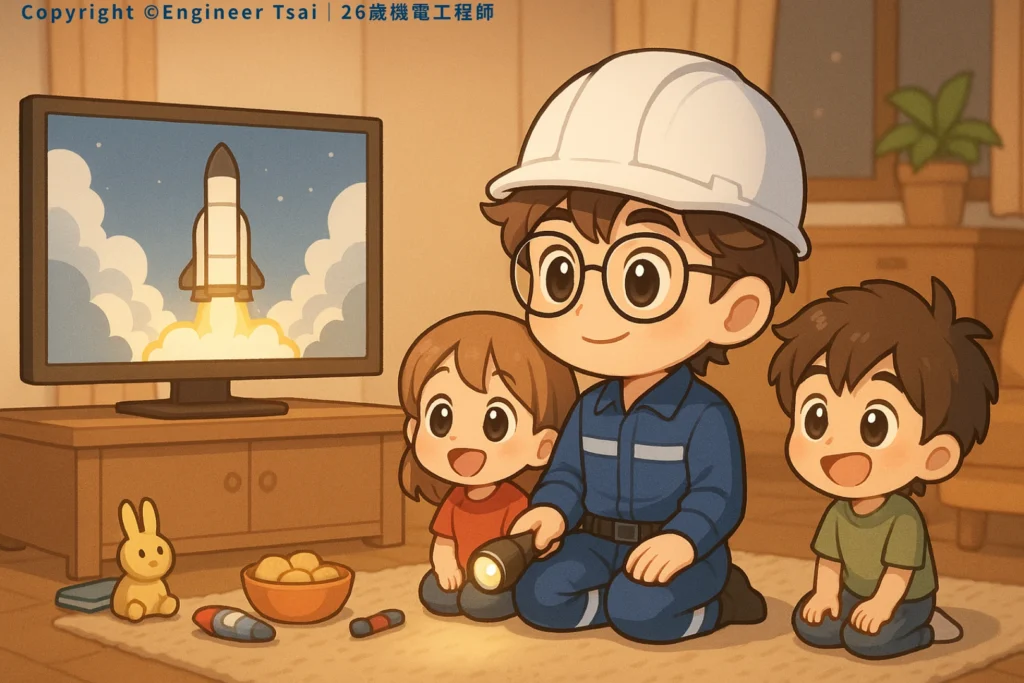
Picture this: your whole family is watching a rocket launch livestream. Your kid is bouncing on the couch asking, “How can a rocket fly? Can we build one too?”
Moments like this are the perfect doorway into easy science experiments for kids at home — not just watching big science on a screen, but bringing it down into your living room or balcony.
So why do science experiments at home?
Whenever something big happens — a SpaceX launch, a NASA mission — everyone is amazed. But the real magic for kids isn’t just watching the countdown. It’s using their own hands and brains to test ideas, make guesses, and see what happens.
The message I want to pass on is simple: science is not far away. With some easy science experiments for kids at home, every family can play, learn, and create together.
If you ever need more ideas later, two great (free) resources are NASA Kids’ Club and the activity library on Science Buddies. You can treat this article as your “starter kit” and those sites as your long-term library of easy science experiments for kids at home.
Easy science experiments for kids at home: start with the right entry point
You might be thinking, “But I’m not an engineer or a science teacher. We don’t have lab equipment at home. How am I supposed to do this?”
The good news: the starting point of science isn’t a lab. It’s curiosity — asking “why?” and being willing to try things out. As long as you choose simple, safe, and fun topics, your home can absolutely become a tiny science lab.
In this article, we’ll walk through two easy science experiments for kids at home that work well for busy parents and school-age kids:
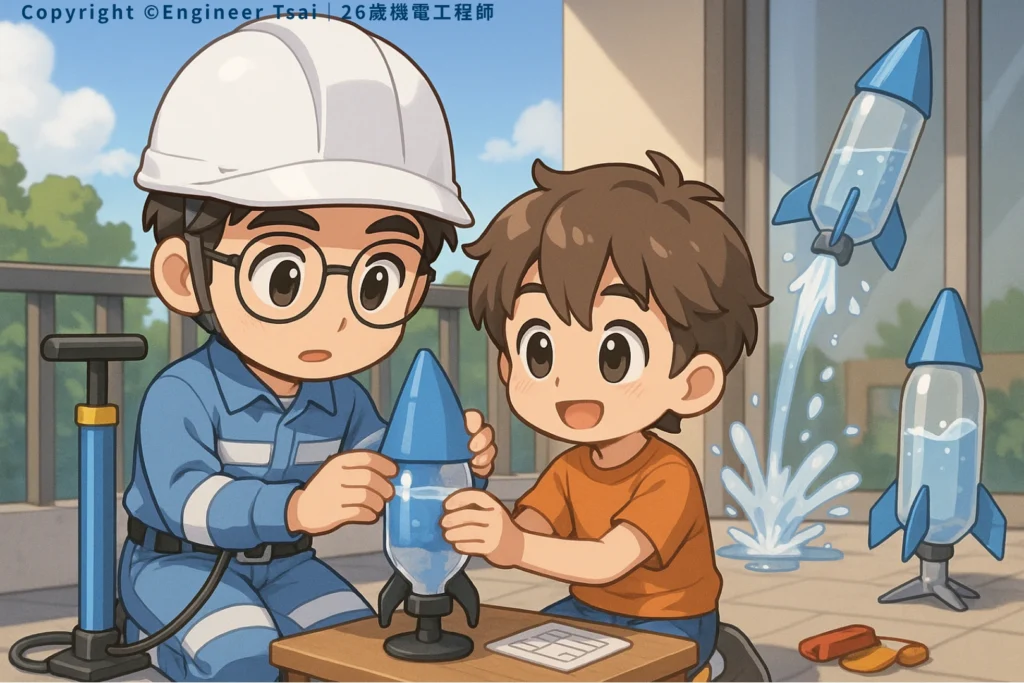
- DIY water rocket with a plastic bottle – a hands-on way to feel “thrust,” pressure, and gravity.
- Simple electric circuit to light a small bulb – so kids can literally see what “electricity flowing” looks like.
Most of the materials come from things you already have at home or can grab during your next grocery run. The point of these easy science experiments for kids at home is not to be fancy — it’s to create shared memories.
Together, these two experiments turn “science” from a test subject into something you play with on a Saturday afternoon.
Easy science experiment #1: DIY water rocket launch
What makes this experiment fun?
Using a plastic bottle to build a water rocket is one of the most classic easy science experiments for kids at home. Kids don’t just see the rocket fly; they can feel how “pressure,” “thrust,” and “gravity” all show up in real life.
Materials (most people already own these):
- One empty plastic bottle (water or soda bottle)
- Water (about one-third of the bottle)
- Cork or thick rubber stopper
- Bicycle pump (with a ball needle attachment)
- Some tape (the universal “engineer’s tool”)
Steps:
- Fill the plastic bottle with water until it’s roughly one-third full.
- Seal the opening tightly with the cork or rubber stopper (the tighter the seal, the better it holds pressure).
- Push the pump needle through the stopper so you can pump air into the bottle.
- Turn the “rocket” upside down, with the mouth of the bottle facing the ground. Fix it to a launch stand or a simple support. Make sure everyone steps back.
- Start pumping air in. As the pressure builds up, count down together: 3, 2, 1… The rocket will blast off with a big spray of water!
What kids learn from this easy science experiment at home:
- The more pressure you build, the faster the water shoots out — and the higher the rocket flies.
- Filling the bottle with too much or too little water changes how the rocket behaves.
- Getting a little wet is part of the fun. Science doesn’t have to be neat and dry.
Try this with your kid before each launch:
Before you pump, ask questions like, “What do you think will happen if we add more water?” or “What if we tilt the rocket a bit — will it fly farther instead of higher?”
Write down each change and what happened. Your child will start to see that science is not a set of test answers — it’s a loop of guessing, trying, and adjusting.
Easy science experiment #2: simple circuit to light a bulb
Why this one is worth doing:
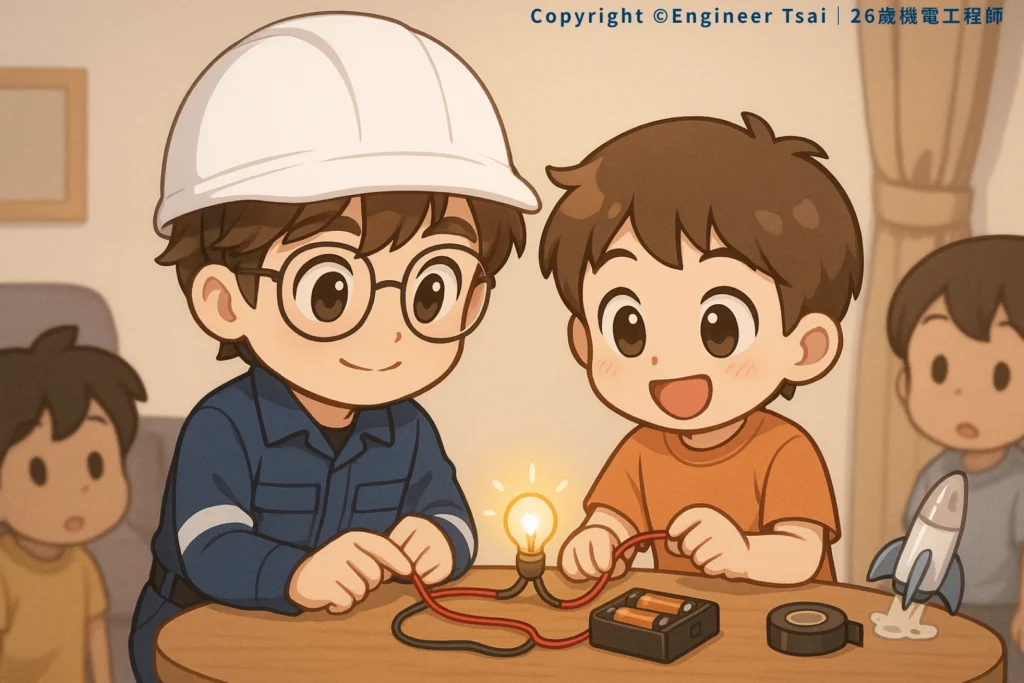
We use electricity every day, but for most kids “current” and “circuits” only exist as pictures in a textbook. When they connect wires themselves and see a light bulb actually turn on, “electricity” becomes real and memorable.
Materials:
- One or two AA batteries
- One small light bulb (or an LED)
- A few short wires (alligator clip wires are easiest)
- Some tape
Steps:
- Use one wire to connect the positive end of the battery to the bottom or one leg of the light bulb.
- Use a second wire to connect the other leg of the light bulb back to the negative end of the battery.
- Secure everything with tape so the connections stay in place. You’ve just built a simple closed circuit.
What kids learn from this easy science experiment at home:
- What a “closed circuit” means — the current has to make a full loop for the light to turn on.
- If the wire is loose or disconnected, the light goes out. Circuit diagrams stop being just drawings.
- You can add a switch, a second bulb, or a second battery and see what changes — brighter, dimmer, or no light at all.
How to guide the process:
Let your child do as much of the connecting as possible, even if it “doesn’t work” at first.
You can ask, “Why do you think the light didn’t turn on this time?” or “What changed between the last try and this one?” Every “failed” attempt is actually a recorded data point in your own little home lab.
Safety first: 3 ground rules for science experiments at home
Whether you live in a house with a backyard or a small apartment, these easy science experiments for kids at home can be both fun and safe if you follow a few simple rules:
- Rule 1: An adult is always present
Anything involving launching, pressure, or electricity should be done with an adult right there, supervising and giving the final “okay.” - Rule 2: Choose a safe location before launching
For the water rocket, pick an open space with a clear safety zone, like a backyard, open field, or empty parking lot. Avoid sidewalks with lots of people or areas near traffic. - Rule 3: Stick to safe low voltage
For electric experiments, use batteries only. Do not open outlets or work directly with your home’s 120-volt system. Low-voltage circuits are more than enough to teach the core idea behind electricity.
Why these easy science experiments are worth doing together
Many parents say, “I was never good at science. What if I explain something wrong?”
The most important thing isn’t having the perfect explanation. It’s being willing to look at your child and say, “Good question… let’s figure it out together.”
- Learning together makes questions feel safe
When kids see that even adults are still learning, asking questions stops feeling embarrassing. - Hands-on experiments make knowledge “real”
How high did the rocket go? Did the light get brighter with two batteries? Concrete results make ideas stick. - “Failure” becomes a normal part of science
A launch that doesn’t work or a light that doesn’t turn on is the perfect chance to practice adjusting, reasoning, and patience.
In the long run, a few easy science experiments for kids at home can quietly build something bigger: a mindset that it’s okay to try, adjust, and try again — which matters far beyond school science class.
Wrap-up: turn your home into a small “rocket base”
Next time there’s a rocket launch or a big science headline, try saying to your child, “Want to try something like this at home?”
You don’t need fancy equipment. You don’t need to be a science expert. As long as you’re willing to experiment together, your home is already becoming a small “rocket base.”
Start with these two easy science experiments for kids at home, and your child will slowly realize: a lot of impressive technology in the world — rockets, robots, smart devices — all come from simple ideas about water, force, and electricity that you can actually play with in your living room.
FAQ: easy science experiments for kids at home
Q1|Is it dangerous to launch a water rocket at home?
Water rockets can be a great fit for families if you follow a few rules:
・Launch only in open, safe areas away from cars and crowds.
・Have everyone stand back from the rocket and never lean over it.
・An adult should handle the pumping and launch trigger while kids observe, count down, or record results.
・Clean up any puddles or trash afterward.
If you truly can’t find a safe outdoor spot, you can start by watching videos and building a small model indoors, then do the full launch later at a park or school field.
Q2|We live in an apartment with no yard. Can we still do easy science experiments for kids at home?
Absolutely. You can focus on experiments that don’t need much space: simple circuits, magnet tricks, paper airplane tests, ramp-and-car experiments with toy cars, and more.
The goal is not to check off a specific experiment like the water rocket. It’s to help your child build the habit of seeing something in the world and thinking, “I wonder what would happen if we tried this?”
Q3|What ages are these easy science experiments for kids at home suitable for?
Water rocket: best for elementary school kids who can follow safety rules, but younger kids can still watch and help with counting down.
Simple circuit: with an adult right there, many early elementary kids can start playing with batteries, bulbs, and wires. You can start with just identifying the positive/negative ends and what happens when the loop is complete.
More important than age is your willingness to slow down and walk through things at your child’s pace.
Q4|Where can we buy materials? Will this be expensive?
Most of what you need for these easy science experiments for kids at home comes from everyday items:
・Plastic bottles, water, tape, bicycle pump
・AA batteries, small bulbs or LEDs, simple wires
Anything you’re missing can usually be found at a hardware store, electronics shop, or online as a beginner science kit. Many starter kits are quite affordable and can be reused for dozens of experiments over time.
Q5|What if the experiment “fails” and my child gets upset?
Real experiments are not supposed to work perfectly every time. You can guide your child like this:
・Check together: was there too much water? Was a wire loose?
・Treat each failed attempt as a data point, not a mistake.
・Tell stories about how engineers and scientists fail many times before success — the important part is learning a little more with each try.
For kids, the biggest win isn’t a perfect launch or a light that turns on right away. It’s discovering that they can think, adjust, and try again — and that you’re right there doing it with them.
📌 Recommended next reads
🔹 “Beginner-Friendly Science Experiments for Kids” (coming soon)
A curated list of easy science experiments for kids at home, using everyday materials and step-by-step photos.
🔹 “Rocket Science for Kids: How Do Real Rockets Fly?” (coming soon)
Explains rocket basics in kid-friendly language and connects them to the water rocket you built together.
🔹 “Electricity at Home: Safe Experiments with Batteries and LEDs” (coming soon)
A gentle introduction to circuits, voltage, and current — using only safe low-voltage setups.
🔹 “Tesla Robotaxi: Understanding the Self-Driving Revolution”
If your child is curious about how today’s experiments connect to real-world technology, this article shows how engineering and software are turning science fiction into everyday reality.
Have you tried any DIY science at home? Did your kid come up with a wild or clever idea during an experiment?
Share it in the comments so other families can see that “being a little engineer” doesn’t require a lab — just curiosity, a few simple materials, and a parent willing to play along. If you’d like more ideas for easy science experiments for kids at home, feel free to follow along — I’ll keep breaking down “electricity × science × everyday life” into small, practical steps for you.
Read next in this topic
- What Is Electricity ? Everything You Need to Know
- Current & Voltage for DIY Enthusiasts : Unlock the Basics
- AC vs DC: What’s the Difference and Why It Matters (From Phone Charging to 120 V Home Power)
- Basic Parts of an Electric Circuit (Power Source, Wires, Loads)
- Conductor vs Insulator: How Your Home’s Wiring Keeps You from Getting Shocked
- Ohm’s Law Explained: V = IR for 120V Home Circuits
- What Is a Resistor? How It Works, Types, and How to Choose the Right One
- Series vs Parallel Circuits: Simple Guide for Home Wiring (With Formulas & Examples)
- How Electromagnetic Wave and Electricity Shape Modern Technology
- What Is Voltage? Simple Definition, Everyday Examples, and Safety Tips
- What Is a Battery? How It Works, Types, and Everyday Uses Explained
- What Is Ampere’s Law? A Visual Guide to How Current Creates Magnetic Fields
- What Does a Capacitor Do? Uses, Energy Storage, and Everyday Examples
- Types of Electrical Wire: How to Choose the Right One for Your Home
- How AC Power Is Converted to DC: What’s Really Inside Your Phone Charger?
- Electrical Energy Conversion: How Energy Transforms for Everyday Use
- Magnetic Field and Current: The Core Relationship Behind Motors, Generators, and Wireless Charging
- How Do Magnets Work? From Fridge Magnets to Maglev Trains
- What Is Inductance? Inductor Basics for Real-World Circuits
- What Is Impedance? A Plain-Language Guide to Resistance, Inductive Reactance, and Capacitive Reactance