On this page
Table of Contents
If you’re still building your foundation in basic electricity, start with this beginner-friendly overview: 🔹 “Electricity 101: The Complete Beginner’s Guide to How Power Really Works”
After reading it, the concepts in this article will make a lot more sense.
Watch first: how electrical energy turns into light, heat, motion, and sound
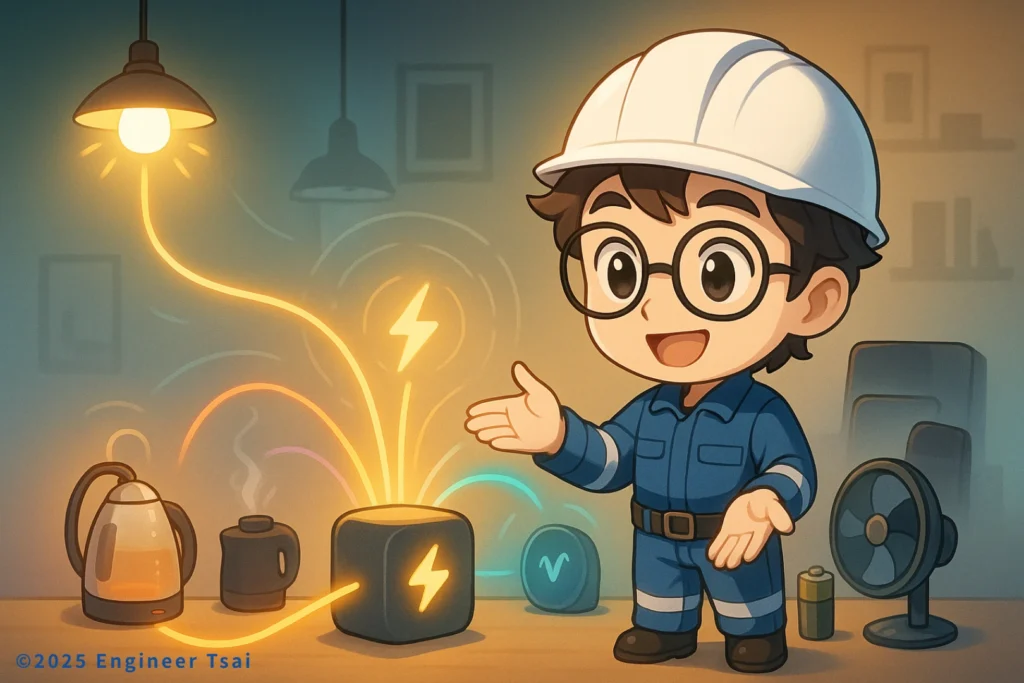
Electrical energy transformation happens every time you flip a light switch, turn on the AC, or charge your phone.
Every single time you do that, the same thing is happening behind the scenes: electrical energy is being transformed into something useful.
This short video uses everyday examples to show how electrical energy turns into light, heat, motion, or sound:
After you watch it, come back to this article. The explanations below will help you really see what’s going on inside the appliances around you.
Why do we need to transform electrical energy?
In most homes, electricity comes from power plants through the grid and into your outlets.
What we receive is basically electrical energy.
But what we actually want is:
- Lights to turn on (light energy)
- Fans and AC units to spin and move air (mechanical / kinetic energy)
- Water to heat up in an electric kettle or water heater (thermal energy)
- Speakers and headphones to play music (sound energy)
- Batteries to charge up and store energy (chemical energy)
So in almost every real-world situation, we are not using “electrical energy” directly.
We are using devices that transform electrical energy into other forms of energy we can see, feel, or hear.
Understanding this transformation helps you:
- Make sense of the physics questions you see in middle- and high-school science classes
- Tell which appliances in your home are wasting power and which ones are efficient
- Build a solid foundation if you want to go into electrical engineering, electronics, or trades like electrician or mechatronics
What is electrical energy transformation? (plain-language definition)
In simple terms:
Electrical energy transformation is also explained in more formal terms in resources like this energy transformation overview on Wikipedia, but let’s start with a plain-language definition here.
Electrical energy transformation (or electrical energy conversion) is the process of using components or devices to turn electrical energy into another form of energy — like light, heat, motion, sound, or chemical energy.
Some very common devices to remember:
- Electric motor: electrical energy → mechanical (kinetic) energy
- Heating element: electrical energy → heat (thermal energy)
- Bulb or LED: electrical energy → light (often with some heat)
- Speaker: electrical energy → sound
- Electrolysis / battery charging: electrical energy → chemical energy
Let’s break these down with everyday examples.
Common types of electrical energy transformation
1. Electrical energy → mechanical energy (motion)
When electric current flows through the coils of a motor, it creates a magnetic field.
That field interacts with magnets or other coils and produces torque — a twisting force.
That’s what’s really happening when you say “the motor is spinning”:
electrons moving in wires are being turned into visible rotation.
Everyday examples:
- Electric scooters and EVs
The battery’s electrical energy drives the motor, which turns the wheels. This is one of the most visible forms of electrical energy → motion on the street today. - Fans (desk fans, ceiling fans, box fans)
The motor spins the blades, pushing air toward you. What you feel on your skin is air that has gained kinetic energy. - Washing machines
The motor turns the drum or agitator, so clothes tumble and move in the water. Again, that’s electrical energy turning into mechanical energy.
2. Electrical energy → heat (thermal energy)
When current flows through a resistive wire (a heating element), Joule heating (I²R loss) turns electrical energy into heat.
The higher the resistance and current, the more heat you get.
Everyday examples:
- Space heaters and electric blankets
Heating wires warm up and transfer heat to the air, your bed, or your body. - Induction cooktops
Technically, they use a high-frequency alternating current to create changing magnetic fields. Those fields induce eddy currents in the pot or pan, which heats the cookware directly. It’s still electrical energy → heat, just via magnetic fields. - Hair dryers
Inside, you have both a motor (electrical → motion) and a heating element (electrical → heat). The air flows across the hot element and carries the heat out.
3. Electrical energy → light
To turn electricity into light, you need a material that emits light when current flows through it or when it’s excited by an electric field. Different types of lamps use different physical principles.
Everyday examples:
- Incandescent bulbs
Current flows through a tungsten filament. It gets so hot that it glows white. Electrical energy becomes light + a lot of heat, so the efficiency is low. - Fluorescent lamps
Electrical energy first makes mercury vapor inside the tube emit ultraviolet light. The phosphor coating on the glass then converts that UV into visible light. - LED lamps
In LEDs, semiconductor materials emit photons directly when carriers recombine under an electric field.
No glowing hot filaments needed — more of the electrical energy becomes light instead of wasted heat, so the efficiency is much higher.
4. Electrical energy → sound
Sound is basically air being compressed and expanded in waves.
If you can get a thin diaphragm to move back and forth in a controlled way, you can turn electrical signals into sound waves.
Everyday examples:
- Speakers in phones, laptops, and Bluetooth speakers
A coil in the speaker creates a magnetic field when current flows. That field pushes and pulls on a permanent magnet (or vice versa), moving the diaphragm. The diaphragm’s vibration pushes air — and that’s the sound you hear. - Headphones and earbuds
Same idea as speakers, just smaller and closer to your ears. - Buzzers, alarms, and doorbells
Some use small speakers, others use piezo buzzers, but they all do the same thing: use electrical energy to make something vibrate and shake the air.
5. Electrical energy → chemical energy (stored in batteries)
If electrical energy drives a chemical reaction that produces substances able to release energy later, you’re turning electrical energy into chemical energy.
You already interact with this every day through batteries.
Everyday examples:
- Charging a lithium-ion battery
During charging, an external voltage forces electrons and ions to move and rearrange between the electrodes.
Electrical energy is stored in new chemical states.
During discharge, those reactions run in the opposite direction, turning chemical energy back into electrical energy. - Fuel cells (reverse direction example)
Hydrogen and oxygen react at the electrodes, generating electric current and heat. That’s chemical energy → electrical energy, the reverse side of the same coin. - Electroplating and electrolysis
In an electrolytic cell, current drives ions to move and react, “growing” a metal layer on a workpiece. This is another example of electrical energy turning into chemical changes.
The future of electrical energy transformation: from saving power to changing how we live
As electricity prices rise and the world pushes for lower carbon emissions, transforming electrical energy efficiently is becoming a big deal.
Here are a few directions that will increasingly affect real jobs and daily life:
High-efficiency motors and smarter equipment
Factories, HVAC systems, and pumping stations are full of motors.
Using high-efficiency motors, variable-frequency drives (VFDs), and smart monitoring systems means you can get more useful mechanical work from the same amount of electrical energy, while wasting less as heat.
Solar and advanced photovoltaics
Solar panels do the opposite of what we’ve been talking about: they turn light energy into electrical energy.
New technologies like perovskite solar cells are all about “more electricity from the same sunlight,” improving the efficiency of that energy transformation.
Wireless power transfer
From wireless phone chargers to future curbside wireless charging for EVs, the core idea is the same:
Electrical energy → electromagnetic field in space → back to electrical energy in the device
Improving this end-to-end efficiency will be a key research and engineering challenge.
Electrical energy and biological systems
Pacemakers, implantable sensors, bio-batteries, and other medical devices all wrestle with questions like:
- How do we safely deliver electrical energy inside the body?
- How can we store or harvest energy from biological systems?
Here too, the heart of the problem is electrical energy transformation — but this time inside living tissue.
Simple experiments: safe ways to see electrical energy transformation at home
If you’re a student, a parent, or just someone who’s curious, you can do low-voltage experiments to see electrical energy transformation with your own eyes and hands.
🔒 Safety rule: stick to batteries and low-voltage DC.
Do not open household AC outlets or take apart mains-powered appliances unless you’re supervised by a qualified professional.
Experiment 1: Electrical energy → motion (small fan)
You’ll need:
- A small DC motor or fan module
- A battery pack (for example, 2–4 × 1.5 V batteries)
- Wires or alligator clips
Steps:
- Connect the battery pack to the motor terminals and watch the fan blades start to spin.
- Add or remove batteries in series (changing the voltage) and observe how the speed and airflow change.
This experiment shows:
chemical energy in the battery → electrical energy → mechanical energy in the spinning fan.
Experiment 2: Electrical energy → light and heat
You’ll need:
- A white LED (with an appropriate series resistor)
- A small incandescent bulb or a tiny heating element
- A battery and wires
Steps:
- Connect the LED and resistor to the battery.
- Observe the light.
- Touch nearby air or the LED body carefully — it’s usually barely warm.
- Now connect the small bulb or heating element to the same battery.
- Observe the brightness and how quickly it gets hot.
- Compare how much “light vs. heat” each device produces.
This helps you feel the difference between “electrical energy mostly turned into light” (LED) and “electrical energy mostly turned into heat” (incandescent bulb or heater).
FAQ: Electrical energy transformation, all in one place
Q1. What is “electrical energy transformation”?
Electrical energy transformation is the process of turning electrical energy into other forms of energy, such as light, heat, motion, sound, or chemical energy.
Whenever an electrical device is doing something useful — spinning, heating, lighting, or making sound — some kind of energy transformation is happening.
Q2. Is there always some “loss” in the process?
Yes. In the real world, no energy transformation is 100% loss-free.
Most devices give off unwanted heat, vibration, or noise.
The more efficient a device is, the larger the share of input electrical energy that becomes the form of energy you actually want — for example, light in an LED or useful torque in a high-efficiency motor.
Q3. How do middle- and high-school exams usually test this topic?
Common question patterns include:
Giving you a real-life device and asking:
“Electrical energy is mainly transformed into which forms of energy here?”
Multiple-choice questions where one option lists the wrong transformation for a common appliance
Problems that mix energy transformation + power + efficiency, asking you to calculate which device is more efficient or uses less energy for the same job
Being able to name the input and output forms of energy for everyday devices is already a big part of the game.
Q4. What safety rules should I follow when doing home experiments?
A few key points:
Stick to low-voltage DC (batteries, USB power supplies, etc.)
Do not open 120 V / 240 V outlets or take apart mains-powered appliances
Use insulated wires and avoid short-circuiting batteries
If you ever work with higher voltages, do it only under supervision from a teacher or qualified technician and use proper protective gear, fuses, and disconnects
Q5. How does this help if I want to go into electrical or related fields?
Electrical energy transformation is the common foundation for almost every electrical field:
Motor control and drives
Power systems
Electronics and embedded systems
Renewable energy and storage
Building services, HVAC, and industrial automation
In all of these, you’re really asking the same core question:
“How do we turn electrical energy into exactly what we want — with the highest efficiency and best control?”
If you want to become an electrician, work in mechatronics, or study electrical engineering, getting this idea solid will make the more advanced courses much easier to follow.
Wrap-up: understand electrical energy transformation, and every kilowatt-hour makes more sense
To sum up:
- Electrical energy is easy to transport and control, but it only becomes useful when we transform it into light, heat, motion, sound, or stored chemical energy.
- From the AC in your living room to motors in factories, and from EVs to future wireless charging systems, everything depends on these transformations.
- Once you can look at any device and say, “Okay, electrical energy goes in, and it comes out as this form of energy,” you’re no longer just a bill-paying consumer — you’re someone who can judge efficiency, choose better equipment, and eventually design systems yourself.
Further reading (English side)
If you’d like to keep exploring the ideas behind electrical energy transformation, these articles are a good next step:
🔹 What Is Electricity? Basic Concepts of Electric Current
A plain-language introduction to what electric current really is — the foundation for all electrical energy transformations.
🔹 What Is Voltage? How It Drives Electric Current
Voltage is like the “pressure” that pushes current. To understand efficiency and power, you need a solid feel for voltage first.
🔹 The Magic of Electromagnetic Induction: Turning Magnetic Fields into Electricity
From generators to wireless chargers, many “advanced” energy transformations hide inside electromagnetic induction.
🔹 The Future of Wireless Charging: How Contactless Power Transfer Works
A deeper look at how we can move electrical energy through space — and what that means for phones, EVs, and more.
Read next in this topic
- What Is Electricity ? Everything You Need to Know
- Current & Voltage for DIY Enthusiasts : Unlock the Basics
- AC vs DC: What’s the Difference and Why It Matters (From Phone Charging to 120 V Home Power)
- Basic Parts of an Electric Circuit (Power Source, Wires, Loads)
- Conductor vs Insulator: How Your Home’s Wiring Keeps You from Getting Shocked
- Ohm’s Law Explained: V = IR for 120V Home Circuits
- What Is a Resistor? How It Works, Types, and How to Choose the Right One
- Series vs Parallel Circuits: Simple Guide for Home Wiring (With Formulas & Examples)
- How Electromagnetic Wave and Electricity Shape Modern Technology
- What Is Voltage? Simple Definition, Everyday Examples, and Safety Tips
- What Is a Battery? How It Works, Types, and Everyday Uses Explained
- What Is Ampere’s Law? A Visual Guide to How Current Creates Magnetic Fields
- What Does a Capacitor Do? Uses, Energy Storage, and Everyday Examples
- Types of Electrical Wire: How to Choose the Right One for Your Home
- How AC Power Is Converted to DC: What’s Really Inside Your Phone Charger?
- Electrical Energy Conversion: How Energy Transforms for Everyday Use
- Magnetic Field and Current: The Core Relationship Behind Motors, Generators, and Wireless Charging
- How Do Magnets Work? From Fridge Magnets to Maglev Trains
- What Is Inductance? Inductor Basics for Real-World Circuits
- What Is Impedance? A Plain-Language Guide to Resistance, Inductive Reactance, and Capacitive Reactance