These Electrical Guides turn core electrical concepts into short, field-tested lessons with diagrams and checklists. Start with the basics, then follow a learning path for home wiring, safety, and components. Each Electrical Guide ends with a quick task, a tool list, and a study map so you can practice today and return later with confidence.
First, search a topic. Then, pick one guide and finish a quick task. Afterward, use the checklist to confirm the result. Additionally, each article links to tools and study maps, so you can learn fast and act with confidence.
To start, browse the latest posts. Then, pick one guide and try a single task. Afterward, use the checklist to confirm the result. In addition, each article links to tools and study maps, so you can learn and act with confidence.
All articles
-
NEC Article 90 and Article 100 for Apprentices: Scope, How to Read the Code, and 10 Definitions Apprentices Mix Up (2026 NEC)
What NEC Article 90 covers, how to read shall, shall be permitted and informational notes, and the 10 Article 100 definitions apprentices…
-
NFPA 70E, De-energization and Lockout/Tagout for Apprentices: The Steps in Order (2026)
How a circuit is made safe to work on: why OSHA says de-energize first, the six-step lockout/tagout sequence, testing for absence of…
-
Jobsite Safety for Electrical Apprentices: PPE, Ladders, Fall Protection and What OSHA 10 Really Is (2026)
Construction safety basics for first-year electrical apprentices: who pays for PPE, ladder setup and inspection rules, the 6-foot fall protection trigger, what…
-
Conduit Bending for Apprentices: 90° Stubs, Offsets, Saddles and the Multiplier Table (Worked Examples)
Conduit bending math for EMT apprentices: offset multipliers and shrink, 90-degree stub take-up, 3-point saddles and the 360-degree rule, with worked examples…
-
NEC 250 Grounding and Bonding: 5 Mistakes Apprentices Make, With Sizing Examples (2026 NEC)
Grounding vs bonding in plain words, and the five NEC Article 250 mistakes apprentices make most: trusting the earth to clear faults,…
-
NEC 310 Conductor Ampacity for Apprentices: Table 310.16, Correction, Adjustment and Worked Examples (2026 NEC)
How to find conductor ampacity under NEC Article 310 in the 2026 NEC: pick the column, correct for ambient temperature, adjust for…
-
NEC 314 Box Fill Calculation for Apprentices: Allowances, Counting Rules and Worked Examples (2026 NEC)
How to do an NEC 314.16 box fill calculation with the 2026 NEC: volume per conductor, how to count conductors, clamps, devices…
-
NEC Article 210 Branch Circuits for Apprentices: Required Circuits, GFCI, AFCI and Load Limits (2026 NEC)
An apprentice’s map of NEC Article 210 in the 2026 NEC: how branch circuits are rated, the required dwelling circuits, GFCI and…
-
From Journeyman to Master Electrician in Texas: The 2-Year and 12,000-Hour Gates, With Date Examples (2026)
Texas Master Electrician requirements explained: two years holding a Journeyman license, 12,000 supervised hours, the $45 application and the two-part PSI exam,…
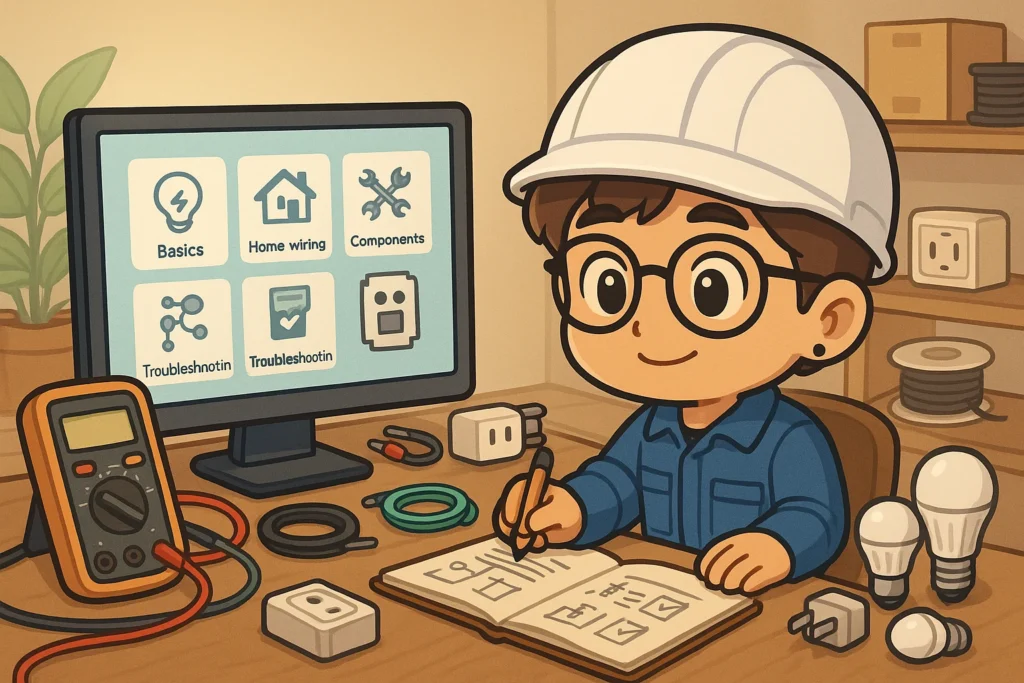
About this Electrical Guides Library
This page is your index for all electrical guides on Tsai Electro. Moreover, you can search and filter tutorials covering basics, home wiring, components, safety and troubleshooting. Because each guide keeps theory short and focuses on steps, diagrams and checklists, you learn faster. As a result, you can move from reading to doing with less guesswork.
Topics These Electrical Guides Cover
Electrical fundamentals · Ohm’s law · AC/DC basics · Home wiring and outlets · Protective devices and relays · Meters and safe measurement · Components and LED drivers · Troubleshooting common faults and practical fixes.
How to Use These Electrical Guides
- First, use the search box or category pills to find a topic.
- Next, open one guide and complete a single task with the checklist.
- Finally, save the tools and diagrams linked inside each article for later jobs.
FAQ
Where should beginners start?
For beginners, start with Tutorials, then the “Electrical Basics” path; after that, move to wiring and safety.
Are these tutorials safe for DIY?
Yes, but always follow safety notes; if unsure, consult a licensed professional.
What tools do I need?
Typically, a non-contact tester, a multimeter, insulated screwdrivers and proper PPE are enough.
What’s the difference between Articles and Tutorials?
In short, Tutorials are step-by-step lessons, whereas Articles are quick reads for specific topics.
Can I use these guides for my home wiring?
However, codes differ by region; therefore, always follow your local electrical code.
Popular paths: