Table of Contents
Table of Contents

If you’re still exploring whether the electrical trade is right for you, start with the full overview: 🔹 “U.S. Electrician Career Guide: Training, Licensing, and Your First 12 Months”
Reading that first will make today’s topic easier to understand.
TL;DR – Who this article is for
If you’re working in IT, admin, design, support, or any other “around-a-computer” job in the U.S. or another English-speaking country and quietly considering an electrician career change in the age of AI, this article is for you.
We’ll look at:
- Why electrician is one of the most resilient, well-paid skilled trades in an AI era
- Whether people like you (office workers, parents, immigrants, career switchers) are actually a good fit
- What the basic roadmap from zero to working on real job sites looks like
- How to test this path with a 90-day self-test instead of quitting your job tomorrow
Electrician Career Change in the Age of AI: Why I Chose the Job Site Over the Desk
Why I’m helping people become electricians in the age of AI has a lot to do with what happened to my own office job.
You’ve probably seen a scene like this on your lunch break, especially if you’ve quietly wondered whether people like you could ever become electricians instead of staying in a desk job forever.
A few coworkers crowd around the breakroom table.
Three cups of coffee, four phones.
One person is trying to “stump ChatGPT” with interview questions.
Another is watching an ad that says, “Learn AI tools in 3 months and land a six-figure job.”
Someone else is scrolling and sighing:
“Office admin is probably gone once AI gets good enough.”
“Design, translation, customer support… aren’t these all replaceable?”
“If I don’t learn to code or ‘do AI’, am I just falling behind?”
Back then, I was exactly one of those office people.
I studied public administration in college, came from a humanities track in high school, and on paper my future looked very “normal”: spreadsheets, slide decks, and meetings for the next 30 years.
Later I became a project manager at a solar company here in Taiwan.
My days were filled with schedules, budgets, and KPIs.
The actual job site, the place where wires, conduit, and panels were installed, still felt far away from me.
Until one day, I was standing on the roof of a building during a site visit, looking down at the crew working below, and a very simple thought hit me:
“What are those people actually doing when they run conduit and land wires in a panel?
How do a few lines on a drawing turn into real power for an entire building?”
At the same time, AI was improving at a ridiculous speed.
More and more office work started to feel like data that could be copied, optimized, automated.
And strangely, I found myself getting more curious about the things that didn’t look easy to replace:
- Holding a voltage tester in your hand
- Crawling above a ceiling to pull a circuit
- Designing a house so the family inside can use electricity safely for the next 20 years
So I did something most people around me thought was a little crazy.
I left the pure office track and went to a government vocational training program in electrical and plumbing.
I spent nine months learning how to bend pipe, pull wire, and wire panels, passed Taiwan’s indoor wiring and plumbing licenses, and then joined a mechanical, electrical, and plumbing (MEP) contractor as an engineer,
finally working side by side with real electricians, real drawings, and real job sites every day.
So when everyone else was asking,
“Is AI going to take our jobs?”
a different question started echoing in my head:
“If AI eats a lot of white-collar work, is it smarter in the long run for some of us to become electricians instead of chasing the next fragile office job?”
If you’re torn between trying to learn “AI skills” or looking for something more solid, it’s normal to quietly wonder whether you should just become an electrician instead.
More and more people are quietly wondering if the smarter move is to switch into a trade that can’t be fully automated, instead of chasing yet another fragile office role.
I didn’t choose to start teaching people how to code.
I’m not here to tell you that “learning AI tools will fix everything.”
Instead, I made a decision that feels almost backwards to some people:
In the age of AI, I decided to help people move toward the electrical trade.
This article is my personal manifesto and also a career guide for people who are asking a simple question: “Should we become electricians in an age where AI is eating so many office jobs?”
I’m writing mainly for normal workers who never thought they could become electricians, but are starting to question whether staying at a keyboard forever is really the safest bet.
In a world where everything is “moving to the cloud”,
I want to bring you closer to the breaker panel in your hallway and ask, seriously:
Could “electrician” be a real, long-term path for you,
not just a backup plan, but a skilled trade you can build a life on?
From Office Worker to Electrician: My Story From Spreadsheets to Breaker Panels
If you looked at my school background on paper, you’d probably be confused.
I was a humanities kid in high school, then studied public administration in college.
Everything pointed toward a “normal” office path, government, corporate planning, project coordination.
During my internship I joined a solar company and worked as a project manager.
My days were wall-to-wall with schedules, budgets, contracts, and meeting notes.
Anything related to “electricity” lived inside PowerPoint slides:
single-line diagrams, load estimates, proposal decks.
The real job site still felt very far away.
But after meetings, I’d often end up standing by the window, looking down at the construction site.
Down there were people pulling conduit, setting up racks, crouching in front of electrical panels making adjustments.
I honestly had no idea what they were doing, but the same little question kept looping in my head:
“Why is it that all the spreadsheets and processes I work on
only matter if they can pull every wire and land every connection
and actually make power flow?”
The turning point wasn’t some dramatic “life epiphany”.
It was one very specific moment on site.
We were doing a coordination meeting.
On the drawings, everything looked beautiful,
which circuits go where, where to leave space for outlets, how the lighting runs.
But when we walked the job, one of the senior electricians pulled me aside and said:
“This beam is too low. That conduit run you drew will never fit.
The plan looks nice, but it’s not buildable.”
I felt embarrassed… and honestly, a bit shaken awake.
I realized I was standing in a strange no-man’s-land:
I understood management and paperwork,
but I barely understood the real-world constraints faced by the people who actually make electricity work in a building.
There was a door between the “paper world” and the “job site world”
and I’d been stuck on the wrong side.
So I made a decision a lot of people around me thought was overkill:
I signed up for a government-funded vocational training program in electrical and plumbing here in Taiwan.
For nine months, I started from zero:
drawing wiring diagrams, bending conduit, pulling wire, wiring up breaker panels.
I studied and passed Taiwan’s licenses for indoor wiring and water piping,
and I still remember the first time I stood in the exam room, looking at a panel I had wired myself.
I flipped the breaker.
The light came on.
And the feeling was completely different from finishing a “perfect” slide deck.
It was a very physical kind of satisfaction:
you know that this light, this outlet, this run of conduit
will affect a real family’s daily life,
every time they turn on a light, cook dinner, shower, or turn on the AC safely.
About a month after finishing that training,
I joined a mechanical–electrical (MEP) contractor as an engineer.
Suddenly my days were spent walking job sites, equipment rooms, and electrical rooms:
- talking with foremen about how to route conduit so it doesn’t clash with structure
- discussing with designers how to break up the panel so future maintenance is easier
That’s when I finally understood something:
All those documents I used to write in the office,
if they’re not tied to the field, they’re just files floating in the cloud.
What I’m doing now is helping those drawings and plans
actually end up inside walls and ceilings as real wire, real panels, real systems.
So why didn’t I just quietly switch careers and keep my head down?
Why bother mapping the path out and inviting other people to walk it too?
Because I know most people are like me: we didn’t grow up on job sites.
You might also come from humanities, business, or any non-technical background.
Maybe you’ve already spent years in an office and feel that something is “off”,
but the moment you think about jumping into electrical or the trades,
it looks “too technical”, “too hardcore”, and you shut the idea down.
While I was learning on site, I started turning what I learned
into videos and articles in plain language:
- What is a circuit, really?
- Why do we split out dedicated circuits for certain appliances?
- Why do outlets get hot, and why is that a warning sign?
Slowly, people started knocking on my door:
“I’m a liberal arts major too. Can I realistically become an electrician?”
“I live overseas and there’s a shortage of electricians here. Do you think I have a shot?”
“I don’t know if I’ll switch careers, but I at least want to understand my own home’s wiring. Where do I start?”
That’s when it hit me:
I didn’t just “get a new job”.
I ended up in a position where I could open that door for other people.
I’m not a recruiter, and I don’t run a cram school.
I’m someone who went through office-job confusion,
went back to school for electrical and plumbing,
earned licenses, stood in front of real breaker panels and made real decisions,
and then chose to put that experience into writing and video so others can use it.
That’s why I started mapping this path for ordinary workers who might one day decide to become electricians themselves.
So I don’t see myself as a “course seller”.
I see myself as a running buddy:
I’m just a little bit ahead on the same trail,
I’ve stepped in some potholes,
I’ve put up some signposts and circled the danger spots,
and now I’m turning around to say:
If you’re thinking about stepping away from the screen
and into a more tangible job that’s much harder for AI to replace,
there is a way to walk this path, one step at a time.
Next, I want to lay out what’s really happening in the age of AI,
and why I think “electrician” deserves a serious spot on your list of options.
AI vs. Electrician Jobs: Why an Electrician Career Change in the Age of AI Is Harder to Replace
Let’s be honest: what AI can do right now is already way beyond what most people expected.
Need to write an email to a customer in English?
You can ask ChatGPT and get a pretty decent draft in seconds.
Need meeting notes and action items from a one-hour call?
There’s an AI tool that will spit it out faster than you can open Word.
Even simple logos, flyer layouts, Instagram post templates,
there are a dozen apps that can give you something “good enough” with almost no effort.
You start to notice a pattern:
The more a job is about staring at a screen and moving information around,
the more AI looks like a tireless junior employee
who works 24/7, never gets tired, and learns terrifyingly fast.
That’s exactly what AI is good at:
taking text, images, audio, code,
breaking them apart, remixing them, and handing you something that looks organized.
But AI has a huge blind spot:
It doesn’t show up in your house.
It doesn’t stand in a job site hallway with dust in its face and a breaker panel in front of it.
So let’s walk through a couple of very real situations.
It’s midnight.
Your living room suddenly goes dark.
The fridge stops humming.
You can grab your phone, open ChatGPT and type:
“Why did my power go out on just half of my apartment?”
It will give you a serious, detailed answer:
possible causes, safety warnings, maybe even a checklist.
But it will not:
- walk over to your breaker panel
- open the door
- test which circuit is tripping
- and decide what’s actually going on
The person who does that will be a real electrician, or you, if you’ve learned how.
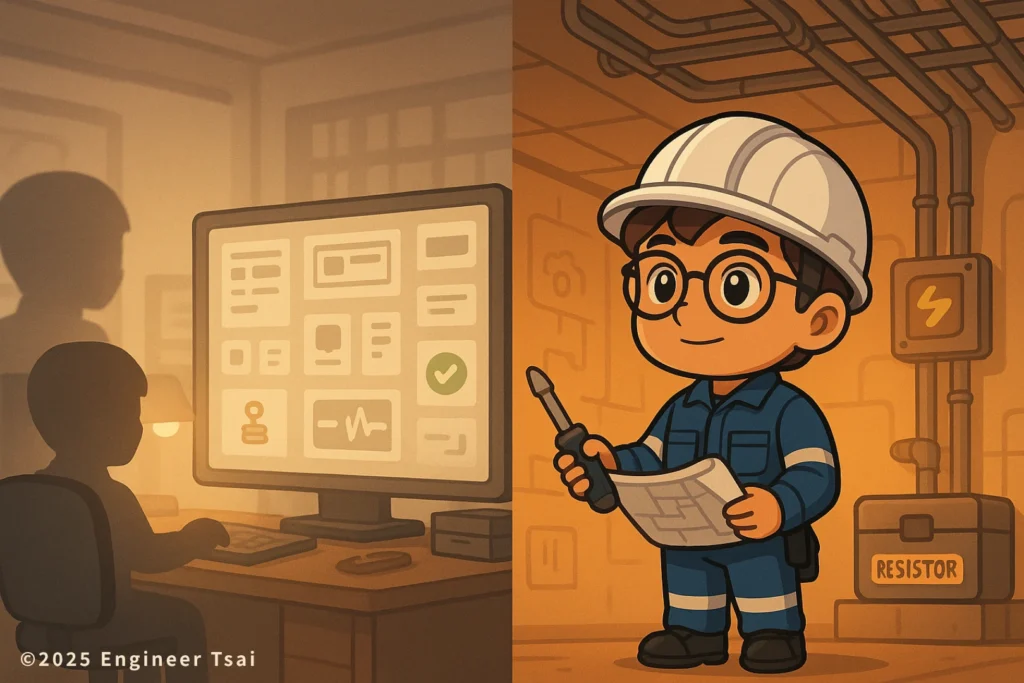
Is electrician a future-proof job in the age of AI?
Short answer: no job is 100% “safe forever”, but electricians sit in one of the most AI-resistant categories of work.
The reason is simple:
- The work is local and physical – someone has to stand in your hallway, open your panel, and actually fix the circuit.
- It is licensed and regulated – in most places you need real credentials to design, install, and sign off on electrical work.
- It is tied to safety and liability – if something goes wrong, a real human is responsible, not a chatbot.
AI can absolutely help with calculations, documentation, and even basic design checks. It cannot climb ladders, pull cable through a crowded ceiling, or sign its name on a live system. That combination of physical work + professional judgment is why I say electrician belongs on the short list of “most resistant to pure AI replacement.”
Another example: you’re about to move into a new place.
You’re planning for:
- multiple mini-splits or window AC units
- an induction cooktop, dishwasher, maybe a built-in oven
- washer, dryer, and all the usual electronics
At some point you start asking:
“Is all of this too much for the existing wiring?
Do I need extra circuits? Is this even safe?”
AI can tell you something that sounds smart, like:
“High-power appliances should be on dedicated branch circuits with sufficient capacity.”
That’s not wrong. But it also doesn’t answer the real-world questions:
- What does your actual panel look like right now?
- How big is the service coming into the house?
- What’s already in those walls, how many conduits, how many cables, how old are they?
- Is there physical space in the wall and ceiling to run new conduit or cable?
- What did the original design of this building allow for, and what would need to be upgraded?
Those answers don’t live in the cloud.
They live in the room you’re standing in, and you only get them by:
- looking with your own eyes
- measuring with real tools
- and using judgment that comes from experience
Now scale that up to something bigger:
an entire commercial building or a factory.
From that angle, the people who decide to become electricians are choosing a kind of work that AI can support, but not fully replace.
In one plenum space above the ceiling, you might have:
- chilled water pipes
- sprinkler lines
- electrical conduit
- low-voltage cabling
- ductwork for the HVAC
Everything has to fit.
Nothing can clash with structure.
You still need room for maintenance access, follow fire codes, and leave space for future expansion.
AI can absolutely help here:
- checking drawings
- doing load calculations
- maybe even generating a 3D model
But the moment you’re standing under that ceiling, looking up, someone has to decide:
- “Does this run need to be rerouted?”
- “Is this too crowded to be safe?”
- “If we install it this way, will the next person who has to fix it hate us forever?”
And that “someone” needs to understand the field, not just the drawing.
That’s the heart of the difference:
- A lot of white-collar work is about managing information inside a screen.
- Electricians (and similar trades) work by solving physical problems in real space.
AI will absolutely come into the electrical world.
It already is.
You can use it to:
- look up code requirements
- help you rough-check voltage drop
- organize job site notes and punchlists
- maybe one day monitor sensors in a panel and flag circuits that are running hot
But no matter how good the tools get, AI still needs a human to:
- decide where to put those sensors and how to route the wiring
- have the guts to open the panel when something trips and decide whether to kill power
- stand there on site and say, “This installation is safe, and I’m willing to put my name on it.”
That’s why I keep saying: electricians sit in a very special category.
It’s physical work + professional judgment.
The “physical” part means:
- you can’t offshore it to someone 10,000 miles away as easily
- you can’t fully digitize it and pretend buildings wire themselves
The “judgment” part means:
- it’s not just manual labor
- you actually have to think, decide, and take responsibility
AI can become a powerful partner.
But it’s much harder for it to replace the person who:
- puts on the hard hat
- opens the panel
- and says, “Wired like this, I’m comfortable taking responsibility.”
If you’re reading this and thinking, “Could I really do this?”, you might even catch yourself Googling late at night: “How do people like me actually become an electrician without blowing up my whole life?”
“Is there still a path for me to become that person on site?”
That’s exactly what I want to talk about in the next part,
especially if you don’t come from an engineering or technical background.
We’ll look at what the path actually looks like,
what obstacles you’ll face,
and where I can realistically walk alongside you in that process.
Why Electricians? From Taiwan to the U.S., the World Is Short on This Trade
Let’s start with something simple:
From the moment you wake up to the moment you go to bed,
when exactly are you not using electricity?
You roll out of bed and hit a light switch.
Make breakfast. Heat water. Blow-dry your hair.
On the way to work you’re scrolling on your phone,
sitting in a train or car full of electrical systems.
At the office, the AC is humming, servers are running in some room you never see,
Wi-Fi routers blink quietly in the corner.
You go home at night:
TV, laptop, modem, fridge, water heater,
all quietly pulling power in the background.
You walk into a convenience store:
freezers, POS systems, security cameras.
You walk into a hospital:
imaging machines, monitors, pumps, operating rooms.
The “online world” feels weightless,
but behind every app and every AI model
there’s a row of server racks in a data center somewhere,
burning very real kilowatts every second.
Electric vehicles, fast chargers, rooftop solar, battery storage,
all of it looks futuristic on a slide deck.
But if you land one wire wrong, size a feeder badly,
or overload a panel, those same systems can fail, overheat, or take a whole building down.
Where I live in Taiwan, this feels especially real.
We have a lot of older apartment buildings,
30, 40 years old or more,
built in a time when “one AC per room + a dozen chargers”
wasn’t even in the designers’ imagination.
But today’s reality looks more like:
- multiple air conditioners
- induction cooktop, rice cooker, oven or air fryer
- dishwasher, dryer
- every outlet packed with power strips and adapters
Result?
Tripped breakers become “normal”.
Outlets feel warm to the touch.
Wiring inside the walls quietly cooks for years before anyone notices.
People say, “Be careful, you don’t want an electrical fire,”
but almost no one actually goes back and asks:
“Can my existing wiring and panel really handle the way my family uses power now?”
That’s the first big point:
Old housing stock + modern high-wattage appliances
= a growing need for people who truly understand how to design and upgrade electrical systems safely.
And this isn’t just Taiwan.
Plenty of cities in the U.S., Europe, and Asia are dealing with the same combo:
aging buildings + ever-increasing electrical load.
Now zoom the camera out and look at the global picture.
Countries are:
- pushing electric vehicles and covering highways with charging points
- talking about energy transition and building more solar, wind, and storage
- racing to build new data centers to feed AI and cloud computing
Every one of those buzzwords, EV, renewables, AI,
turns into very physical electrical work:
- feeders and switchgear
- grounding and bonding
- protection, coordination, and backup power
- cable trays, busways, conduit runs
Quick snapshot: electrician demand and pay in the U.S.
If you’re reading this from the U.S., here’s what the numbers roughly look like:
- Job outlook: Over the next decade, the U.S. expects tens of thousands of electrician openings every year, many of them driven by retirements and by new projects (EV charging, data centers, renewables, and housing upgrades).
- Growth: Electrician employment is projected to grow faster than average compared to many other occupations.
- Pay: Median annual pay for electricians sits well above many general office roles, and experienced electricians, foremen, and contractors can earn into the six-figure range in high-demand regions or sectors.
In plain language: there are a lot of people who can type reports and emails. There are far fewer people who can open a panel, understand the system in front of them, and take responsibility for how it’s wired. That scarcity is a big part of why the trade stays valuable.
It is not just “pull a couple of extra wires”.
That leads to the second big point:
No matter how “cloud-based” technology becomes,
it always ends up running through real cables, real panels, and real switches.
Someone has to understand the job site, not just the diagram.
Some of the people who feel this shift the most are the ones seriously thinking, “Maybe it’s time to make an electrician career change and work on the side of the system that never goes fully virtual.”
So what does an electrician actually do?
It’s definitely more than “pull wire and install outlets”.
In a home, an electrician is the one who decides:
- When a fault happens, do you get a clean trip…
or a dangerous shock? - Does the routing of the wiring reduce fire risk…
or leave a bundle of overheated conductors hidden in a wall?
On the efficiency side, an electrician is constantly thinking:
- Should this load be on a separate circuit?
- How big does this conductor need to be?
- Will the voltage drop be acceptable over this run?
These sound technical, and they are,
but what they really decide is simple:
Will your appliances run smoothly for years…
or constantly trip, overheat, and die early?
When new technology shows up, electricians are the people who make it real:
- Smart home devices need power, data, and proper placement.
- If you want to add an EV charger later,
your panel and service need to be ready today. - If a data center is expanding,
someone has to confirm the existing feeders, UPS, and distribution can actually carry the extra load.
That’s why I say:
“There are a lot of people who can write code.
There are far fewer who are comfortable opening a panel and taking responsibility for how it’s wired.”
Coding matters, I use AI and small scripts myself to build tools and do calculations.
But for the world to run, you need the whole chain:
- Software and AI models running “up there” in the cloud
- Hardware and infrastructure living “down here” in the real world
And the people who connect those two,
who literally connect them with copper and steel and real decisions,
are electricians and other skilled trades.
That’s the core value of this trade:
You’re not competing with AI for a keyboard.
Instead, you’re joining the much smaller group of people who become electricians and make sure all that code and cloud infrastructure can actually run in the real world.
You’re building the stable, safe, trustworthy foundation
that everything electric depends on.
If you’re willing to learn this skill set,
you’re not just “getting a job”.
You’re putting yourself in a world that’s becoming more electrified every year,
as one of the relatively few people who can take abstract technology
and wire it back into everyday life without burning the building down.
In the next part, I’ll get more direct:
If you’re coming from a non-technical, office, or liberal-arts background,
are you actually a good fit for this path?
What do you need to be honest about,
and what challenges should you expect on the way into the trade?
Who Should Consider an Electrician Career Change in the Age of AI? (Office Workers, IT, Parents, Tinkerers)
Let me start with the punchline:
Being an electrician is not a “STEM-only, male-only” career. A lot of very normal office workers, parents, and career changers eventually step into this trade once they see what it’s really like.
It’s much closer to a life choice: a path for people who want physical, useful work that’s still badly needed no matter what AI does next.
Do you want to use your hands and your head
to change how you interact with the real world?
Over the past few years, I’ve met a lot of people who were standing at some kind of crossroads in life, and they were actually perfectly placed to move toward this trade, even if they didn’t realize it at first.
Many of them didn’t start with any plan to become electricians; they just wanted a path that felt more real, more useful, and less at the mercy of the next round of layoffs.
First group: the office worker whose back (and brain) are done with meetings.
You know this rhythm by heart:
Morning commute, same traffic, same train.
You get to the office and it’s just…
another meeting, another email thread, another “circle back next week”.
You talk in slides and spreadsheets all day.
By the time you get home and turn on the TV,
you see someone on a roof pulling conduit,
or running cable through a wall,
and there’s this tiny thought in the back of your mind:
“What if my job was to finish something
I can actually see and touch when it’s done?
Would I feel more satisfied?”
It’s not that you “can’t use a computer”.
It’s that you’re starting to wonder
if you might be better suited to work where the results are physical and obvious.
When that thought keeps coming back, it’s a sign you might be one of the people who could realistically become electricians and actually enjoy the day-to-day.
People like this, if they’re willing to give themselves a season to learn a new skill,
often end up doing surprisingly well as electricians.
Because this trade is very much brain + hands working together.
Second group: people with a technical background who just got laid off (or feel it coming).
Maybe you’ve spent years in tech, manufacturing, or a lab.
You know equipment, you understand processes,
you’re used to procedures, safety, and logs.
Then one day, a leadership slide deck changes,
and suddenly your whole department is “restructured”.
You realize something uncomfortable:
“Most of what I know is tied to this company’s tools and systems.
If I walk out, how much of that actually transfers?”
If you’re willing to aim your technical skills
toward something closer to infrastructure,
things like distribution, MEP, equipment installation and maintenance,
you’ll find that a lot of what you already know is reusable:
You can read drawings.
You understand safety culture.
You know how to follow procedures and document changes.
You just haven’t stood in front of a live panel before.
For this group, moving into electrical work can actually go faster than you’d expect,
because you’re not starting from zero, you’re re-wiring what you already have.
Third group: parents who want a trade they can grow into and maybe build into a small business.
If you have a family, your thoughts often sound like this:
“If my company lets me go one day,
what else could I do to keep us afloat?”
or
“Is there a way to work with my hands,
earn decent money,
and still be home most nights?”
For this group, the electrical trade is a very down-to-earth option.
You can:
- start as a helper or apprentice
- learn under a journeyman or master
- slowly build your skills and reputation
- and eventually (if you want)
pick up your own small jobs or even start a business
It’s not an overnight switch,
you don’t wake up one day and magically “own a shop”.
But the path is there, and a lot of people walk it in small, steady steps.
Fourth group: the natural “tinkerers” who have always loved taking things apart.
If something breaks at home and your first instinct is not “call a repair service”,
but “let me grab a screwdriver and YouTube this”…
you’re already halfway in the mindset.
You’re curious about how things work.
You like figuring stuff out.
You’re willing to fail a few times to get it right.
What the electrical trade does is:
take that “I like messing with stuff” instinct
and level it up into a structured, safety-driven profession.
You’re no longer just guessing and poking around.
You’re learning why each step exists,
what can go wrong,
and what you’re legally and ethically responsible for when you touch someone else’s power.
Of course, I also need to be honest:
there are situations where this trade is probably not a good fit, at least not right now.
If you absolutely cannot stand using your hands,
and any dust, sweat, or awkward work position makes you shut down…
If “safety” feels optional to you,
you roll your eyes at hard hats, lockout/tagout, or testing before you touch…
If you have zero patience for learning codes, reading diagrams, or following steps,
you just want someone to tell you “do A, then B” and never ask why…
Then the daily reality of being an electrician will feel miserable.
Because this work asks for both:
- a body that’s willing to sweat, climb, crawl, and carry
- and a mind that’s willing to slow down for details and take responsibility for safety
So instead of asking:
“Is being an electrician ‘good money’?”
try asking yourself these questions first:
- Am I willing to tie my work to real-world electrical systems,
not just digital files? - Am I willing to train my hands and judgment
to the point where I can be responsible for other people’s safety? - Am I willing to go through a season of starting from the basics again?
If your honest answer is even a soft “yes,” you’re already closer than you think to being the kind of person who could become an electrician and thrive in the trade.
If you’ve read this far and there’s even a small voice saying
“Honestly… I might be willing to try,”
you’re already ahead of most people,
because most never get past the daydream phase.
Next, I’ll show you what this path actually looks like in real life,
using my journey in Taiwan as an example:
How you can start from zero,
which licenses or training programs matter,
and what kind of options open up once you get your foot in the door.
Electrician Career Roadmap: From Basic Training and Licenses to Real Job Options
From Taiwan Licenses to Real-World Options
One of the most common DMs I get starts the same way:
“If I want to switch careers and become an electrician…
where do I even start?”
It sounds like a huge question, but if I break it down using my own path in Taiwan,
it really becomes three stages:
Build your foundation → Get a few key licenses →
Get on site and turn that knowledge into real judgment.

Stage 1: Build Your Foundation: Treat “Electricity” Like a New Language
You don’t need to collect every license on the planet. At the very beginning, you don’t need to obsess over exams yet.
You definitely don’t need to start by rewiring an entire house.
What usually happens is this: people pass that first exam, touch real gear under supervision, and suddenly “maybe I could become an electrician one day” stops feeling like a fantasy and starts feeling like a plan.
Stage 1 is not where you swear you’ll be an electrician for life; it’s where you test whether electricity as a “language” clicks enough that this trade even stays on the table for you.
What matters most are two things:
- basic electrical concepts
- and safety
You need to understand things like:
- What are voltage, current, and load really about?
- In a typical outlet, what do the hot, neutral, and ground actually do?
- Why do people say “always kill the power before you touch anything”?
- Why “looks dead” is not the same as “is safe”.
You can start with very small, low-risk things around you:
- open up an old outlet and learn how the three conductors are connected
- swap out a simple switch and see the difference between single-pole and three-way
- stand in front of your panel and figure out which breaker feeds which room
If you’re starting completely from zero,
this stage can be built from online courses, books, my videos, and basic training kits.
The first milestone isn’t “I can wire a whole building”.
It’s:
“When someone talks about a circuit or a breaker,
I roughly understand what they mean,
and I’m not terrified of the word electricity anymore.”
You don’t have to quit your job yet.
You don’t have to be on a construction site.
But you’ll feel yourself moving from “electricity is scary” to
“electricity is something I can learn to work with safely.”
Stage 1 is where a lot of people who eventually become electricians first realize, “Hey, maybe this isn’t out of my league after all.”
Plenty of my readers never planned to become electricians, but Stage 1 often surprises them by showing that the fundamentals are learnable with patience and respect for safety.
Stage 2: Get Licensed: Give Yourself a Ticket to Step on Site
Here in Taiwan, where I trained and work, if you want to seriously go into electrical / water-electrical work,
certain licenses become really important, they’re your door-knockers.
If you seriously want to work in this trade rather than just watch videos, this is the phase where licenses and formal training start to matter.
In my case, I went through a government vocational training program
focused on water & electrical work.
For nine months I:
- practiced hands-on skills during the day
- studied theory and code
- and prepared for the national exams
Eventually I passed:
- Interior Wiring – Class B
- Water Supply Piping – Class C
The pattern is similar to what you see in many countries:
- There’s a written side (code, symbols, calculations, basic theory)
- And a practical side (build a real wiring project under time pressure, to a standard, safely)
For most career switchers, there’s a season of:
work during the day → study at night →
practice on weekends → repeat
Is it tiring? Yes.
But you can feel that you’re not “studying in the abstract” anymore,
you’re training for a specific qualification that actually changes your options.
You don’t need to collect every license on the planet.
But that first card that proves you can safely work with real circuits
changes a lot:
- it helps you get that first job
- it strengthens your position when talking about pay
- and it proves to yourself you’re not just “thinking about” this path,
you’ve actually walked the first section of it
That piece of plastic is more than a card.
It represents having completed “entry-level theory + basic hands-on skills.”
For many adults, that first license is the moment they stop just daydreaming and start seriously planning how to move into electrical work over the next few years.
Stage 3: Real-World Practice: From “Can Do” to “Can Judge”
Once you’ve built your foundation and picked up some credentials,
you hit the part that really makes you an electrician:
showing up on site, over and over again.
This is where career-changers either wash out or truly become electricians – not just people who “helped on a job site once,” but tradespeople whose judgment others rely on.
When I joined a MEP (mechanical–electrical–plumbing) company after training,
my daily life moved into:
- construction sites
- equipment rooms
- electrical rooms and panels
And no, my first jobs were not glamorous mega-projects.
At the beginning, it was a lot of “small things that matter”,
shadowing more experienced techs and foremen:
- How do we bend this conduit so it clears a beam
and still looks clean? - How do we lay out this row of panels
so future maintenance isn’t a nightmare? - The design drawing looks perfect,
but when we open the ceiling we realize the duct and the beam leave no space for our run,
do we change the route, or push for a design revision?
Slowly, you move from:
“I follow the drawing step by step”
to:
“I see the drawing, but I design the actual solution based on reality.”
You also start learning the human side:
- how to explain to a homeowner why you need another dedicated circuit
- how to tell a client that a certain “shortcut” isn’t safe long term
- how to coordinate with other trades (carpenters, painters, HVAC, fire protection)
so you’re not all trying to stand on the same ladder on the same day
There’s no shortcut for this phase.
It’s:
- project after project
- problem after problem
- mistake, lesson, adjustment
You’re turning “things other people only talk about”
into “things you’ve personally solved on a real job.”
Where This Can Go: From Homes, to MEP, to Data Centers, to Overseas
Once you’ve gone through those cycles,
you start realizing how many branches this trade actually has.
Some people stick with residential and small commercial work:
- apartments, houses, small shops
- service calls, remodels, panel upgrades, safety upgrades
- starting as an apprentice, then journeyman, and slowly building their own client base
One day, they become “that person” in the neighborhood
everyone calls when something trips, hums, or smells burnt.
Others move into large-scale MEP work:
- office buildings, factories, hospitals, multi-story developments
- big power distribution, chilled water, HVAC, fire systems all layered together
- coordination meetings with designers, general contractors, inspectors
Their daily job becomes keeping a whole building’s systems
coherent, safe, and maintainable.
Some go toward low-voltage, communications, and data centers:
- racks, structured cabling, UPS, backup power, critical cooling
- solving problems in environments that “are not allowed” to go dark
- making sure the digital world stays online in the physical world
And some people treat this whole foundation as a launchpad for overseas work.
In my case, I’m building my trade in Taiwan first,
but I think a lot about how MEP / electrical skills transfer
to places like North America, Europe, or other regions that are heavily electrifying.
Is it a magical one-step upgrade? No.
You still have to learn local codes, licensing, and culture.
But you’re no longer starting from “generic office skills that only make sense in one company”.
You’re carrying infrastructure skills,
and those are needed almost everywhere.
I won’t lie to you and turn this into a
“3-month fast track to six figures” kind of story.
The electrical trade is much more like:
a craft that gets more valuable
the longer you do it well.
In the first years, you’re training:
- your eyes
- your hands
- and your basic pattern recognition
Then you’re training:
- your judgment
- your communication
- your feel for risk and safety
Over time, what you accumulate isn’t just wages.
It’s trust:
- people trust you to design and build safely
- they trust your name when something important is on the line
If you’re willing to invest a few years into this path,
it doesn’t guarantee you’ll become rich overnight.
But it does give you a very real chance
to own a profession that doesn’t just vanish
because a new AI model or a new corporate policy rolled out.
In the next parts of this series,
I’ll be even more direct about the reality:
- the physical side
- the pay curve
- the learning cost
- how family might react
- and very honestly, how far I can walk alongside you
So that before you make any big decisions,
you have a fuller picture of what you’re walking into,
not just the inspiring parts, but the honest ones too.
So What Exactly Am I Doing Here?
I’m Not a Test-Prep Factory, I’m Your Electrical GPS
After all this, a very practical question has likely already surfaced in your mind:
“Okay… but what are you actually trying to sell me?”
Honestly, I wrestled with that myself.
A lot of people around me chose the classic path:
- launch a course
- push “guaranteed pass” programs
- “XX hours to six figures” bootcamps
The more I walked this road, the clearer it became:
I don’t want to be one more test-prep “cram school.”
I want to be that thing in your pocket you can open anytime
and immediately see where you are and where you could go.
a kind of electrical GPS for beginners and career-changers.
A GPS doesn’t drive the car for you.
It just does three things really well:
- Shows you the map – what the world actually looks like
- Marks the on-ramps, traffic jams, and potholes
- Helps you reroute when you drift off course
What I’m building is basically that,
but for learning electrical basics and exploring the electrician path.
1) Turning Scattered Info Into a Road You Can Actually Walk
The internet is full of stuff:
- “Learn basic electricity”
- “Day in the life of an electrician”
- “How I passed my license exam”
For someone just starting, it usually feels like two extremes:
- either too hard (all formulas and code sections), or
- too scattered (short, disconnected tips with no bigger picture)
So I started stacking content in layers.
Maybe the first thing you bump into is a 60-second short:
- What is a circuit?
- Why does an outlet get hot?
- What does “ground” actually do?
That’s just enough to turn
“I have no idea what this means” into “Okay, I kind of get it now.”
If you want to go deeper,
you jump over to the blog:
- longer articles with diagrams
- real examples from homes and job sites
- the small details people on YouTube often skip
On top of that come tools, checklists, and quick-inspection sheets,
things you can literally hold in your hand and walk around your home with.
Like Move-in Lite:
a “30-minute whole-house safety check”
you can print or open on your phone and go room by room.
The point of all this is not to flex how much I know.
The point is to help you move from:
“I have no idea what I’m looking at”
to
“I at least know what this is, what to Google next,
and what my next safe step could be.”
2) Stuffing Real Job-Site Experience Back Into the Teaching
A lot of exam prep materials will teach you:
- how to do calculations
- which code section says what
- how to memorize definitions
Those are important.
But they often don’t tell you:
“Why does no one actually do it that way on site?”
“What happens when the drawing looks perfect but the ceiling doesn’t care?”
The mistakes I’ve made on site,
the tricks I’ve learned from older electricians and plumbers,
the awkward conversations with clients,
I try to shove all of those back into the content:
- into the articles
- into the videos
- into the checklists and templates
So instead of just:
“Here’s the definition of a GFCI.”
I’ll also talk about things like:
- In a typical Taiwanese apartment (and honestly a lot of older buildings anywhere),
which locations really should have GFCI protection? - If you’re upgrading an older home,
what ugly realities inside the wall will you probably run into? - What’s the difference between “what the book says”
and “what you can safely do in this specific building”?
These are the bits you don’t usually get
if you only read past exam questions.
3) Filtering and Prioritizing in a World That’s Drowning You in Info
Your problem is not “not enough information.”
Your problem is:
“At my stage, what should I read first?
What can wait? What’s noise?”
So I design things with different readers in mind.
- If you just want your home to be safer,
you don’t need a 300-page code handbook.
Free short videos, beginner-friendly posts,
plus something like Move-in Lite
are enough to get you taking action. - If you’re prepping for licenses
or seriously considering making this your trade,
that’s when the deeper tools show up:- full checklists
- cheat sheets
- things like Move-in Pro
- condensed reference sheets you can keep using on site
They’re there to save you detours
if you’ve already decided to invest real time into this path.
I’m not going to try to sell you something in every single post.
Because I know you’re here for a trustworthy route,
not to be “closed” by clever copy.
If I have to compress my role into one sentence, it’s probably this:
I can’t promise you’ll become some kind of success poster child.
But I’ll do my best to make sure that
while you’re learning electrical and exploring the electrician path,
you step on fewer landmines than I did.
From here, I’m going to get more down-to-earth:
- how much time this really takes
- the money side
- what your family might say
- and the first small step you can take now
without blowing up your current life
So this article doesn’t just leave you pumped up for 10 minutes,
then drop you back where you started.
I want it to be a real starting line
you can stand on and actually move from.
How to Use AI as an Electrician: Study Assistant, Not Replacement
I’ve spent a lot of this article talking about AI “taking jobs”.
But in my own day-to-day work, I actually have ChatGPT and other AI tools open all the time.
The difference is simple:
I don’t use AI to replace me.
I use it to amplify what I can do.
Used the right way, AI can actually shorten the path for adults who want to become electricians, by turning messy notes, dense manuals, and scattered questions into something they can act on faster.
You’re still doing the work.
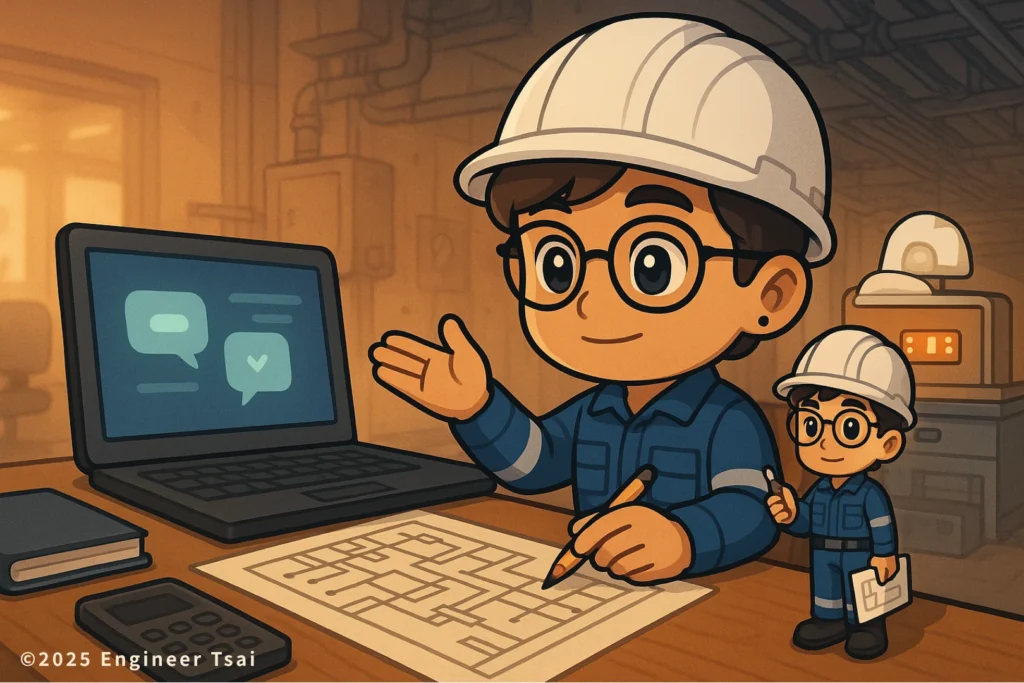
AI just becomes your personal teaching assistant — a force multiplier for career changers who are studying on top of a full-time job.
And in an AI era, an electrician who knows how to use AI
has way more options than someone who only types on a keyboard
and is afraid to even open a panel.
Let me make that concrete.
Studying for exams or learning the basics
Picture your desk when you’re studying:
- a thick code book
- printed handouts
- screenshots of diagrams
- notes from class
Before, you might grind through it page by page,
getting stuck every time a new term shows up.
Now you can:
- dump a section into AI and say:
“Rewrite this in plain language so a beginner can understand.” - ask it to pull out the key points and make a simple comparison table
- have it build you a 2-month study plan:
what to read each day, how many practice questions to do,
and when to review older material
You’re still doing the work.
AI just becomes your personal teaching assistant.
Used this way, AI becomes a serious accelerator for people who want to become electricians without quitting their jobs on day one.
Dealing with English-heavy manuals and tech articles
A lot of the best electrical content is in English:
- trade forums
- manufacturer install manuals
- safety bulletins
- white papers on new tech
Before, that might be the point where you give up.
Now you can:
- paste the important part into AI and say:
“Translate this and highlight the steps I actually need on the job.” - then go back and compare it with the original,
using it as a way to build your technical English
If you ever want to work abroad or sit for licenses in the US, Canada, or elsewhere,
AI can be your on-demand language coach:
- drafting emails
- role-playing phone calls with inspectors or clients
- helping you understand foreign codes and standards at a basic level
Before you touch the job site
AI can help you think through a job before you show up with a ladder.
Say you’re planning a small kitchen rewire:
- new circuits for range, dishwasher, microwave, outlets along the counter
- maybe future-proofing for more appliances
You can describe the layout, loads, and approximate distances, then ask AI to:
- sketch a rough bill of materials (wire lengths, boxes, breakers)
- list what to double-check on site before you start
- remind you of common code issues people miss in kitchens
That draft is not your final answer.
You still measure, plan, and price it yourself.
But it gives you a head-start and reduces the chance you forget something obvious.
Turning daily chaos into usable records
Real life on the tools:
- three jobs in one day
- photos all over your phone
- voice notes while you’re driving
- random scribbles in a notebook
At the end of the day, you can feed that mess into AI and say:
“Turn these into a clean daily log:
- what we finished
- what’s blocked
- materials to order
- what to bring next visit.”
Do this consistently and you’ll build your own job history:
- easier invoicing
- smoother hand-offs when you work with others
- a written record of how your thinking and problem-solving evolved
That’s not just convenient; it’s part of you becoming a pro.
But this part is non-negotiable
There’s one line AI can’t cross.
On site, you are still the one making the calls:
- Is it safe to work this live or do we shut it down?
- Is this connection acceptable, or are we building a future failure point?
- Is this location okay for this device long-term, or are we setting the next tech up to fail?
AI can give you:
- checklists
- reminders
- code excerpts
- “things to consider”
But the person who ultimately says “Yes, we’ll do it this way, and I’ll put my name on it”
is not the model on your screen.
It’s you, wearing the hard hat, standing in front of the gear.
That responsibility is what makes you a tradesperson, not a prompt operator.
So in my mind, AI isn’t here to steal your trade.
It’s here to be:
- your study buddy
- your note organizer
- your language helper
- your idea scratchpad
You bring:
- a brain that’s willing to learn and take responsibility
- hands that are willing to do the work safely and correctly
AI brings:
- instant summaries
- translations
- structure
- a second set of “eyes” on your notes and plans
Together, they’re far stronger than either one alone.
Use AI as your assistant, not your replacement,
and you’re no longer just afraid of being automated away.
You become the person who knows how to use AI
and isn’t afraid to open up the panel.
Next, I’m going to make things even more concrete:
If you really want to test whether this path is for you,
how can you set up your time, money, and daily life
so you can try it for real,
without burning your current life to the ground in one jump?
Still Unsure About an Electrician Career Change in the Age of AI? Try This 90-Day Self-Test First
If you’re reading this and thinking,
“Okay, this all sounds good… but do I really want to bet my whole life on becoming an electrician?”
that’s a very fair question.
I’m not going to tell you to walk in tomorrow and quit your job.
Instead of a one-way jump, I’d rather you give yourself a trial period with an exit:
90 days to find out whether you actually like this path, and whether it realistically fits you.
Think of it as a low-risk way to test whether you really want to walk toward the electrical trade, instead of just imagining what the work might be like.
Think of it as three 30-day blocks.
You don’t have to decide today that you’ll definitely be an electrician for the next 30 years.
What you can decide is to give yourself a clear 90-day window to test whether moving toward the electrical trade is actually a good fit for you.
Days 1–30: Warm-up, just you, a screen, and the basics
For the first month, don’t change your whole routine.
Treat it like a warm-up phase.
Pick a time that doesn’t hurt: on your commute, during lunch, or before bed.
Spend about 10 minutes a day doing something small but consistent:
- Watch one short beginner video on electrical basics
- Read a short article about safety or home wiring
- Learn one tiny concept at a time
Focus on simple, real-world questions, not heavy math:
- When should you always shut the power off before touching anything?
- Why do outlets and power strips overheat?
- What’s the difference between hot, neutral, and ground?
After a few weeks, you’ll notice a shift:
your breaker panel and outlets stop feeling like a “black box”
and start to look like something you can at least roughly understand.
Days 31–60: Get your hands involved (in very low-risk ways)
In the second month, let your hands join the party.
You don’t need to open walls or run new circuits yet.
Just do a few low-risk, observation-based exercises:
- Grab pen and paper and sketch a few simple circuits
- Stand in front of your panel and map which breaker feeds which room
- Walk around your home and guess which outlets might be on the same circuit
- Notice where high-load devices (microwave, space heater, window A/C, etc.) are plugged in
The goal here is to connect the dots between:
- the idea of a circuit, and
- the actual rooms and outlets you walk past every day.
Electrical diagrams slowly stop being abstract symbols
and start feeling like “this is how my place is wired.”
Days 61–90: Reality check, meet the trade in person
The last 30 days are the real test.
If, after two months, you don’t feel strong resistance,
maybe you even catch yourself thinking,
“Honestly, this is kind of fun”,
then it’s time to meet the trade in real life.
Depending on where you live, that could look like:
- Sitting in on an intro class at a community college or trade school
- Attending an info session for an electrical training or apprenticeship program
- Grabbing coffee with a working electrician or MEP engineer and asking about their day-to-day
- Visiting a training lab or shop floor (if possible) just to watch what students are actually doing
You’re not trying to make a lifetime decision on the spot.
You’re giving yourself a clear picture and asking:
“If this is me in three years, hard hat on, tools in hand,
working on real jobs instead of just staring at a screen,
would I be okay with that version of my life?”
These 90 days are not about gambling everything on one choice.
They’re about giving yourself a defined start and finish line
to honestly answer one question:
Are you just curious about the trade,
or do you actually want to give this path a real shot?
The whole point of this 90-day self-test is to find out whether you merely like watching electrician videos, or whether you actually want to work in this trade in real life.
Once you’ve walked through this 90-day self-test,
decisions like “Should I take an exam?”,
“Should I apply for training or an apprenticeship?”,
or “When (or whether) to fully switch careers?”
will feel a lot more grounded, and a lot less like a blind leap.
FAQ: Electricians, AI, and Career Change, Honest Answers to What You’re Probably Thinking
These are the questions I hear most often from readers who are wondering if they should become electricians in the middle of an AI boom, or stay where they are and hope their current job survives.
Q1. Will AI push down electrician salaries too?
In the short term, AI is much better at pushing down the price of “keyboard-only” work – jobs that live 100% in documents, emails, and screens.
Electrical work is different. Your income is tied much more to “are we short on people who can actually do this safely?” than to “how many people on earth can type?”
In the U.S. you’ve got:
An aging housing stock with old wiring
Growing residential loads (EV chargers, heat pumps, induction ranges, home offices)
A huge build-out of EV infrastructure, data centers, and renewable energy
All of that needs people who really understand power distribution and are willing to put their name on the line. Those people are rarely “cheap.”
AI will absolutely streamline parts of the job, load estimates, documentation, reporting, even parts of design.
Used well, it can help electricians:
Quote faster and more accurately
Deliver clearer documentation and reports
Take on better projects instead of just more grunt work
The people whose rates get squeezed the most will be the ones doing only the most basic tasks, never upskilling, and refusing to touch new tools, AI included.
Q2. Is being an electrician dangerous? How risky is working with electricity?
You’re right to respect it. Electricity does carry real risk. That part shouldn’t be sugar-coated.
But here’s the twist:
being a little scared is actually a good sign.
If you’re willing to:
Treat power with respect, not bravado
Follow lockout/tagout, verify de-energized, and re-check before touching anything
Use a tester or meter instead of “it probably isn’t live, I’ll just tap it with my hand”
…then the risks can be brought down to a very manageable level.
The people who get into real trouble are usually the ones who:
Skip PPE because “it’s just a quick job”
Don’t bother shutting off the power properly
Cut corners because they’re in a hurry
If you already know you’re detail-oriented and safety-minded, that’s not a weakness in this trade, it’s one of your biggest assets.
Q3. Can I become an electrician if I’m bad at math?
Most of the math used day-to-day in electrical work is around middle school to high school level:
Basic arithmetic (add / subtract / multiply / divide)
Ratios and percentages
Simple squares (e.g., I² in power equations)
Some basic trig in more advanced contexts
A handful of formulas (voltage drop, power, current, etc.)
You do not need to master calculus or linear algebra.
What you do need is the willingness to:
Patch any weak spots in your basic arithmetic and algebra
Break formulas down into “what each piece means”
Practice until the core patterns feel familiar, not scary
I’ve seen plenty of people who used to freeze up at formulas.
By taking it step by step, not pretending to understand, but actually asking “why?”, they still passed exams and became solid electricians.
Q4. Am I too old to become an electrician in my 30s or 40s?
A lot of people become electricians in their 30s or 40s; it’s not unheard of at all, it just means you have to be more intentional about how you manage your energy, money, and expectations.
If you’re in your early-mid 30s or 40s, it is important to be realistic:
The first few years can be physically demanding
You will start as a learner, not as the boss
But you also bring things a 19-year-old doesn’t:
Experience talking to customers and coworkers
A better sense of how projects, budgets, and timelines fit together
Usually, a more mature attitude toward safety and responsibility
In the electrical / MEP world, a lot of the most valuable roles over time are held by people who:
Understand the field
Can coordinate with other trades and stakeholders
Can explain risks and options clearly to non-technical people
Instead of asking, “Is it too late?”
try asking, “If I don’t change anything, what does my life look like in five years?”
If you’re willing to invest 3–5 years in building a trade you can keep using for a long time,
your 30s or 40s are not too late. They’re a realistic window to pivot.
Q5. Can a woman be an electrician? What is jobsite culture like for women?
Yes, women can absolutely be electricians, and there are more women entering the trades every year.
It’s true that some tasks are heavy and physically demanding:
carrying materials, overhead work, ladders, sometimes working in the heat or cold.
But not every role is about lifting the heaviest thing on site.
A lot of high-value work is about:
Clean, accurate wiring and terminations
Panel work and labeling
Documentation and coordination
Talking through options with clients
Those areas often reward patience, precision, and communication, which are not gender-specific.
Job site culture does vary. Some crews are old-school and rough; others are professional, respectful, and safety-driven.
The real skill you need is learning to tell the difference between:
Healthy pressure (meet code, work safely, keep quality high), and
Unnecessary garbage (hazings, sexist jokes, ego trips)
If you’re a woman considering the trade, it’s even more important to:
Be picky about your first employer or apprenticeship
Look for mentors who actually want you to succeed
That’s a topic worth its own article: how to choose your first electrical job.
Q6. Is an electrician career change in the age of AI worth it if my current job is “okay”?
No, you don’t.
That anxiety you’re feeling is a warning light, not a mandatory self-destruct button.
It’s telling you, “Hey, maybe it’s time to start building a Plan B,”
not “Quit tomorrow and burn the bridge behind you.”
You can:
Start with that 90-day self-test
Use evenings or weekends for intro classes
Attend info sessions, talk to people already in the trade
Treat electrical as a second skill you’re developing, not an all-or-nothing bet
This approach is usually healthier than trying to blow up your current life overnight.
You’re building options, not running from your existing job in panic.
Q7. What if I try the electrician trade and realize it’s not for me?
If you genuinely commit for a while, it’s very hard for that effort to be “wasted.”
At the most basic level, you’ll walk away with:
A much sharper sense of electrical safety
The ability to spot “this isn’t right” in your own home or workplace
A better idea of when to call a pro and how to talk to them
Those alone are meaningful for you and your family.
On top of that, the foundations you build, basic electrical theory, understanding loads, circuits, and safety, can spill over into:
Facility maintenance
Data centers and IT infrastructure
Energy management or building operations
Solar / storage / EV charging sales or consulting
Or simply being “the person who actually understands power” in your current field
What’s truly wasted isn’t “learning something you later pivot away from.”
It’s never testing paths you’re deeply curious about, and staying stuck in “what if?” for years.
If more questions are popping up in your head right now, write them down.
After you finish this series, or after you’ve gone through your own 90-day test,
come back to that list and ask:
Which worries solved themselves once I took action?
Which questions are still real, and need a deeper answer?
That’s your next task list, but for now, you’re already much further along than the version of you who only worried and never started.
Closing thoughts: You don’t have to become an electrician, but you do deserve a real skill
Let me be blunt for a second:
in the age of AI, there is no such thing as a job that’s “100% safe forever.”
You can sit in a big company with a decent title,
and one strategic shift can wipe out your whole department.
You can chase every new tool and buzzword,
but still go to bed thinking,
“Am I the next one who can be replaced by a cheaper tool or a cheaper person?”
Real security doesn’t come from a line on your business card.
It comes from the skills you can bring with you
even if the logo on your badge changes.
A skill you can point to and say:
“If everything else disappears, I still know how to do this –
and it’s useful in the real world.”
For me, that skill is electrical work.
For you, it might mean going all-in on the electrical trade, or it might simply mean you understand power well enough to protect your own home and make smarter career choices.
For some of you, the clearest next step may be to train as an electrician — not because it’s trendy, but because it’s a durable way to stay useful in an AI-heavy world.
I didn’t start there.
I studied public administration. I worked as a project manager in solar.
Most people who looked at my résumé would have guessed I’d stay in offices forever.
But I took the long way around – through reports, Gantt charts, and meeting rooms –
and eventually decided to walk onto job sites,
learn the trade from the ground up,
and take electricity seriously enough to stand in front of a panel and say,
“Wired like this, I’m willing to be responsible.”
That’s the path I chose, and it’s the path I’m willing to walk with you.
Will you definitely end up as a full-time electrician? Honestly, maybe yes, maybe no – and that’s okay. Some readers will go all-in and become electricians; others will borrow pieces of this trade and apply them in different careers.
The deeper decision underneath is this:
Are you willing to take a bit more ownership of your future,
and invest in skills that still matter when the software changes?
If somewhere in this article, one sentence hit you a little harder than the rest,
I hope you hang onto it.
Save it. Screenshot it.
Come back to it the next time you feel stuck in your job,
or when the next wave of “AI will replace X” headlines shows up in your feed.
I want it to remind you of one simple thing:
You are not limited to waiting passively for the world to change.
You are allowed to change lanes.
If you’d like that path to feel a bit clearer,
you’re welcome to stick around:
- Join my email list
- Follow along on YouTube, the blog, or social
- Use the free tools and checklists I’ve been building
Over time I’ll keep organizing everything about:
- Switching into electrical work
- Keeping your home’s wiring safe
- Using tools, checklists, and learning paths
- And navigating the AI era without pretending it’s not happening
…so that when you’re ready to move,
you’re not starting from zero.
📌 Recommended next steps:
🔹 3–12 Months from Zero: A Realistic Roadmap to Switching Careers into the Electrical Trade
We’ll break the journey into clear stages: basic electrical theory, safety, exam prep, your first job on site.
You’ll see what you can do in 3, 6, or 12 months, what the pay and pressure actually look like,
and how fast or slow you really need to move – so you’re not making decisions based on fantasy.
🔹 Move-in Lite: A 30-Minute Electrical Safety Check for Your Home (Free Checklist)
If you’re still just curious, start with your own place.
Use one simple checklist to walk through each room,
spot obvious issues, and get a feel for how much safer and clearer life feels
when you can actually read the story your wiring is telling you.
—
There’s no universal right answer about whether you “should” switch careers.
But if you start taking small, concrete steps now –
whether that’s learning basics, running the 90-day self-test,
or just making your own home safer –
you won’t just be “someone worried about AI.”
You’ll be someone with real options when the world shifts again.
Whether you go all-in on an electrician career change in the age of AI or simply borrow pieces of this trade to strengthen your Plan B, you deserve skills that still matter when the software changes.
Read next in this topic
- Electrolysis and Electroplating Explained: How Electric Current Changes Metals in Everyday Life
- Middle East Conflict and the Semiconductor Supply Chain: How It Hits Your Fab, Your MRO Budget, and Your Career
- AI and IoT in Construction: How to Turn Jobsite Tech into Your Career Advantage
- Should You Become an Electrician in the Age of AI?Why I’m Helping People Make the Switch
- 3–12 Months from Zero: A Realistic Roadmap to Switching Careers into the Electrical Trade
- When Cloudflare Went Down, One Thing Became Clear: Why I Help People Become Electricians in the AI Era
- Electrician Career Path USA: 0–12 Month Roadmap for Career Changers
- Electrician Career Paths in the AI Era: 5 Routes and a 0–12 Month Roadmap
- Electric Motors, Generators and VFDs: One Clear Picture from Electromagnetic Induction to Real-World Power Systems