Table of Contents
Table of Contents

If you’re still exploring whether the electrical trade is right for you, start with the full overview: 🔹 “U.S. Electrician Career Guide: Training, Licensing, and Your First 12 Months”
Reading that first will make today’s topic easier to understand.
This article is your electrician career change roadmap for the next 3–12 months, written for everyday adults in the US who are starting from zero with the electrical trade, but want a clear, realistic path into the field.
You’ve probably already seen a ton of titles like:
“Become an electrician in 30 days”
“No-experience trades job in 3 months”
“Double your income in half a year”
After scrolling for a while, it’s hard not to think:
“Is it actually possible to learn a trade in 3 months and really pay the bills with it?”
This article is here to say things out loud:
- In 3–12 months, what can you realistically get done—and what can’t you?
- As an everyday person in the US, how do you plan a realistic electrician career change roadmap that actually fits your life?
I’m not here to sell you a 30-day miracle.
I want to hand you something closer to a map + timeline + reality check:
- What to do at each stage
- Where you can probably get to
- Which real-world trade-offs you’ll run into along the way
Why 3–12 Months, Not a 30-Day Sprint?
Here’s the short answer:
3–12 months is a realistic window for a normal adult in the US to:
- Go from zero to basic electrical safety and fundamentals
- Start doing simple hands-on tasks
- Get into an apprentice/helper role or in a pre-apprenticeship program
It’s not the same as “fully licensed journeyman in 3 months”.
Most US states want you to log 4–5 years of supervised experience plus pass a licensing exam before you can work independently as a journeyman or master.
So in this article, when I say “3–12 months”, I’m talking about:
- Getting your feet in the door
- Building a solid foundation
- Being ready to step into the trade as a serious beginner, not a tourist
You can think of it as two broad rhythms:
Fast Track: 3–6 months
- For people who:
- Just got laid off
- Already have some technical background
- Or decided to go all-in and treat learning like a full-time job
- Goal:
Within 3–6 months, you want to:- Nail basic theory and safety
- Do simple projects on your own
- Get into an apprentice / helper position or a trade school / pre-apprenticeship
Standard Track: 6–12 months
- For people who:
- Still need their day job
- Can only study nights and weekends
- Goal:
Within about a year, you want to:- Build solid fundamentals
- Get some hands-on practice
- Be ready for formal apprenticeship interviews, or your first entry-level job in the field
So this article is not going to say:
“I guarantee you’ll double your salary in three months.”
I’d rather sit with you and ask:
“If you invest 3–12 months into this,
is it worth gaining a skill that’s a lot less at risk from AI, layoffs, and economic cycles?”
Before You Start: Where Are You Right Now?
Before we draw any kind of roadmap, one question really matters:
From which starting point are you actually leaving?
Three Common Starting Points
See which one feels closest:
1. True Beginner
- High school or college had nothing to do with trades or engineering
- Your job has nothing to do with electricity: admin, retail, customer support, content, etc.
- When you open your breaker panel, you mostly feel fear
2. Technical Background, No Hands-On
- You studied something like mechanical, civil, computer science, electronics…
- You’ve seen Ohm’s Law and some circuit diagrams
- But you’ve never actually pulled cable, made terminations, or worked on a real jobsite
3. Some Field Exposure
- You’ve worked around construction: maybe as a remodel coordinator, helper, or project assistant
- You’ve helped pull cable or watched trades work, but never took the lead
- Jobsite life isn’t totally foreign, but your theory and technique still feel shaky
A Few Honest Questions to Ask Yourself
You can literally tick these off in your head:
- How many hours can you really free up each week?
5 hours? 10? 15+? Only weekends? - How does your family / partner feel about you spending nights or weekends studying and doing side projects?
- What’s your tolerance for getting dirty, sweaty, and tired?
- Are you okay crawling in crawlspaces, attics, basements?
- Climbing ladders, lifting materials, kneeling on concrete?
- When someone raises their voice at you on a jobsite:
- Are you the type who explodes?
- Or can you take a breath, filter the emotion, and still learn something?
There are no “right” answers here.
But they heavily influence whether you should aim for a 3–6 month fast track, or a 9–12 month slower, steadier route.
Once you’re honest about your starting point, the 3, 6, and 12-month roadmap will make a lot more sense.
Big Picture: Your Electrician Career Change Roadmap in Three Timelines
These three fictional stories are just different ways of traveling the same electrician career change roadmap.
Let’s zoom out first, using three fictional people.
A. Full-Time Sprint (3–6 Months): Between Jobs, All-In
Alex, 32, just went through a round of layoffs.
Walking out of his old office, he realized:
“If I’m already out, maybe it’s time to switch into something real.”
What Alex does:
- Signs up for a full-time electrical training program or pre-apprenticeship
(community college, trade school, or a program tied to an IBEW/NECA apprenticeship) - Treats it like a job:
- Mornings: theory and safety
- Afternoons: hands-on lab time
- Evenings: homework, practice, and past exam questions
- Weekends: reviews notes, watches more install videos, keeps his brain in the game
At 3 months:
- Basics of electrical theory and safety covered once
- Comfortable looking into his own panel
- Swapping a light fixture or switch doesn’t feel scary anymore
At 6 months:
- Meets the entry requirements for an apprentice / helper role in his area
- Has a simple portfolio of lab projects and photos
- Starts applying for apprenticeships and entry-level jobs
He gave up a few months of income, but gained:
A completely new line on his resume and a new direction his career can grow in.
B. After-Work Learner (6–9 Months): Day Job + Night Progress
Jamie, 29, works as an office coordinator.
Spends all day in spreadsheets and emails, and feels stuck.
She can’t just quit, so she chooses to:
- Reserve one hour most weeknights for learning:
- Online classes, books, and electrician YouTube channels
- Dedicate part of the weekend to hands-on:
- Small projects at home
- Or in-person labs when she can
She doesn’t call it a “career change” at first.
She just thinks of it as a serious second skill.
At 3 months:
- She can roughly map which branch circuits feed which rooms in her home
- Understands why you can’t plug every high-wattage appliance into one power strip
At 6–9 months:
- Finishes a full beginner course
- Meets the theoretical requirements to apply for an apprenticeship or entry-level helper role
- Starts wondering, “What if I use a vacation day to shadow an electrician for a day?”
She hasn’t given up her old job yet,
but now has a realistic backup path.
C. Slow and Steady (9–12 Months): Family First, Testing the Waters
Marco, 40, has kids and a mortgage.
He does want a change, but he can’t gamble recklessly.
He chooses to:
- Spend the first 3 months doing just:
- Online learning
- Short videos
- Basic reading
- Small, low-risk home projects
- Only after that, in the 3–6 month window,
he starts:- In-person labs
- More serious hands-on classes
- He has hard conversations at home about time and money before committing to bigger steps:
- Savings
- Possible reduced income
- Schedule changes
At 12 months, he might still be in his original job, but:
- Has a real notebook full of theory and practice notes
- Finished at least one serious course
- Spent at least a few days shadowing or helping on jobsites
He hasn’t pushed all his chips to the center of the table,
but he has quietly built a realistic second option.
From here, we’ll break things down more concretely:
- Month 0–1
- Month 2–3
- Month 3–6
- Month 6–12
You can keep checking which tempo feels closest to you.
Months 0–1: Foundation First – “Don’t Hurt Yourself or Anyone Else”
Most people start learning electrical with this thought:
“If I learn this, I can wire my own stuff and never hire an electrician again.”
Let me gently ask you to park that thought for a bit.
In your first month, the goals are just:
- Understand the very basics of electricity
- Learn what not to touch, and how to avoid hurting yourself or your family
A Simple First-Month Plan
Aim for 30–60 minutes a day. The pace doesn’t need to be fast, but it does need to be consistent.
You could:
- Start with very basic content:
- What is voltage, current, resistance?
- What is a circuit?
- Why does electricity need a safe path home?
- After each video/article,
write down one concrete example from your home:- This outlet
- This power strip
- This space heater
- Get familiar with your breaker panel:
- Find the main breaker
- Find individual branch breakers
- Spot any GFCI (test/reset buttons) in kitchens, bathrooms, or outside
- Learn to spot dangerous situations:
- Power strips daisy-chained forever under a desk
- Outlets that are loose, cracked, or heat-stained
- Heavy-load appliances all on one small circuit
If you’re doing the 3–6 month fast track,
you can compress this into 2 weeks.
But whatever you do:
Don’t skip the safety part.
You’re not starting from “Can I make money?”
You’re starting from “Can I avoid burning something down?”
Months 2–3: Tools and Tiny Projects – Let Your Hands Catch Up
Once the foundation is there, the next step is simple:
Move from “just watching” to “actually touching things”—
but only safe, small-scope projects.
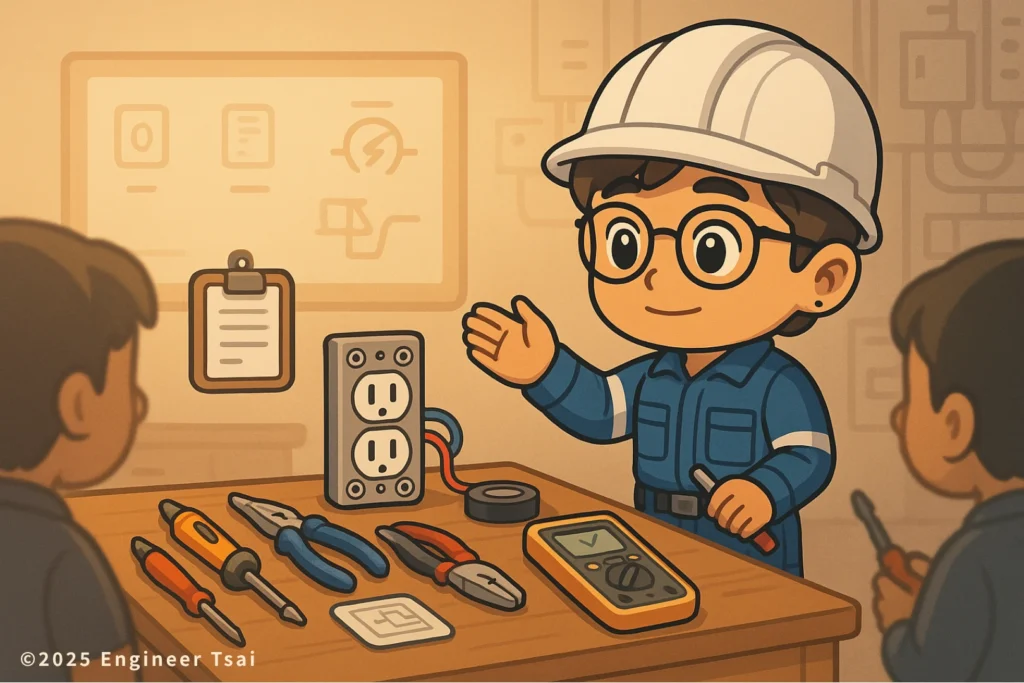
Minimal Starter Tool List (US)
You don’t need a fully loaded van.
At the beginning, something like this is enough:
- A non-contact voltage tester (from a reputable brand)
- A basic multimeter (voltage, resistance; current is optional at first)
- A couple of insulated screwdrivers (flat and Phillips)
- Needle-nose pliers and diagonal cutters
- Electrical tape
- A few wire connectors (wire nuts/Wagos) for practice
Safe First Projects
Stay in the 1:1 replacement zone. No new circuits, no panel work:
- Replace a light fixture
- Swap a wall switch or a receptacle like for like
Get into the habit:
Breaker OFF → Verify with tester → Remove → Re-wire → Test again
Before you disconnect anything, take clear photos of the original connections.
As you reconnect, try to:
- Identify which conductor is hot, neutral, ground
- Notice how conductors are routed and secured
Also start playing with simple schematics:
- One switch controlling one light
- A three-way switch controlling a stair light
Draw them out, then relate the drawing to the physical wires you see.
If 2–3 months pass and you still don’t want to touch any tools—only watch videos and highlight notes—then it’s worth asking yourself:
“Do I really want to switch into the trades,
or do I just like the idea of being handy?”
Months 3–6: Exam Prep + First Real-World Exposure
By now, most people are thinking:
“Should I go into an apprenticeship program? Do I need a license right away?”
Every US state is a bit different,
but the general pattern looks like this:
- Formal apprenticeship programs
(for example IBEW/NECA or non-union contractor associations)
combine:- Paid on-the-job training
- Classroom time over multiple years
- State licensing
usually requires:- A certain number of documented hours
- Passing a written exam (and sometimes a practical)
So your 3–6 month window is usually about:
- Building the theory and safety required to be taken seriously
- Getting enough exposure that, when you show up to an interview or orientation, they can tell you’re not just curious—you’re committed
A Practical Plan for Months 3–6
You could:
- Set 2–3 evenings a week as “study nights”:
- Work through an NEC-aligned beginner book or exam prep material
- Do practice questions
- Use AI to unpack anything that looks like alien language
- Set time for hands-on:
- Community college labs
- Trade school workshops
- Or structured DIY projects at home (within safe limits)
- Start looking for ways to see real jobsites:
- Ask if you can shadow a licensed electrician for a day
- Ride along with someone you trust, if your state regulations allow helpers
- Volunteer on small community projects where a licensed electrician is supervising
You’ll notice fast that:
- Real ceilings and walls are messy
- Conduit and cable have to dodge real‐world obstacles
- Nothing looks as clean as textbook diagrams
One key mindset:
Passing a test is just your ticket through the door.
Your actual value—and income—comes from the next few years on the job.
Months 6–12: Your First Year in the Field – Pay, Learning Curve, and Reality
This is where a lot of people get blindsided.
Online, you see screenshots of:
“$100k+ as a journeyman”
“Six-figure contractor lifestyle”
But your first year usually feels more like:
“I’m getting paid, but I’m also confused and exhausted a lot of the time.”
Pay Reality (2025 Snapshot – US)
Let’s ground this in some current data instead of just “vibes”.
Looking at recent numbers from the U.S. Bureau of Labor Statistics (BLS) and 2025 trade salary guides:
- The median annual wage for electricians (all levels) is around $62,000, with most falling in a band from about $39,000 to $106,000+ depending on experience, state, and specialization.
- One 2025 salary guide summarizing a mix of sources suggests:
- Apprentice electricians starting out make roughly $21,000–$56,000 per year
- Journeyman electricians often land in the $43,000–$71,000 range
- Master electricians or business-owning electricians may see $48,000 to $90,000+, and significantly more if they run a successful company
- Union electricians (for example, through IBEW) often earn noticeably more than non-union techs—some estimates suggest an extra $10/hour or more on average.
So what does that mean for your first year?
- As a brand-new apprentice or helper,
your pay may not beat your current white-collar job—at least not yet. - The upside grows with:
- Hours in the field
- Passing licensing milestones
- Moving into better companies, or eventually starting your own
The crucial thing in Year 1 is not “How do I jump straight to $8k a month?”
It’s:
“Can I survive this learning curve while building skills and trust that will pay off over the next 5–10 years?”
These numbers are a 2025 snapshot and will shift over time, so always check your state and local rates when you’re comparing offers.
What the Work Actually Looks Like
Expect a lot of:
- Carrying materials, conduit, wire, and tools
- Pulling cable, drilling, fastening, labeling
- Climbing ladders and working overhead
- Crawling into tight, hot, or cold spaces
- Going home dusty, tired, and with a few nicks on your hands
It looks “rough”, but every small task is training you to:
- Read and trust drawings and one-line diagrams
- Plan cable paths and conduit runs
- Terminate cleanly and consistently
- Coordinate with other trades (framing, HVAC, plumbing, low-voltage, fire, etc.)
The Learning Curve
Roughly speaking, many people feel:
First 3 months on the job:
- You’re just trying to keep up
- You don’t understand half the conversations
- You go home and crash
3–6 months in:
- You start getting small tasks you own:
- “Run this section of conduit”
- “Terminate these devices”
- You understand your lead when they correct you (even if the tone is… spicy)
Around 1 year:
- You can handle small areas of a project mostly on your own
- Reading a basic drawing no longer feels like decoding hieroglyphs
- You sometimes find yourself explaining what you’re doing to homeowners or GCs
Hitting the Wall
There will be days when you think:
- “Why am I on a rooftop in 100°F heat pulling this cable?”
- “My friends are in an air-conditioned office right now.”
- “Online people said six figures. Why am I at this number?”
You might also meet:
- Leads whose communication style is… not gentle
- Bad scheduling, rushed jobs, or poor planning
When that happens, remember:
Your first year is basically a paid bootcamp.
You’re trading comfort now for skills that can feed you later, anywhere electricity is needed.
Safety is non-negotiable.
Boundaries matter.
But you’re also allowed to be a beginner and learn slowly.
Three Example Roadmaps: Pick Your “For-Now” Path
By now, you probably feel which path is closest.
Let’s summarize as three quick “profiles”.
A. Full-Time Sprinter (3–6 Months)
- Weekly hours: 40+ hours on learning (like a job)
At 3 months:
- Electrical basics and safety covered once
- Comfortable replacing basic devices (lights, switches, outlets) safely
At 6 months:
- Ready to apply for apprenticeships / helper roles
- Possibly finished a pre-apprenticeship or first semester of trade school
- Has a small photo portfolio of lab/projects
B. After-Work Learner (6–9 Months)
- Weekly hours: 10–15 hours (nights + weekends)
At 3 months:
- Understands home circuits at a basic level
- Can read beginner content without feeling totally lost
At 6–9 months:
- Finished a structured course or two
- Ready to start applying for entry-level roles or pre-apprenticeships
- Has at least one day of ride-along / shadowing under their belt
C. Slow but Steady (9–12 Months)
- Weekly hours: 5–10 hours (balanced with family & job)
At 3 months:
- Treating it as a test: “Do I actually like this, or is it a phase?”
At 12 months:
- Solid base in theory and safety
- Completed a serious course and several small projects
- Enough exposure to decide: “Do I really want to switch, or keep this as a side skill?”
And one important thing:
This is not a blood pact.
You can start “slow and steady” and speed up later, or start fast and decide to back off.
Reality Check: What You Should Know Before Switching
People don’t just ask, “How much does it pay?”
More often, they ask:
“Can I honestly handle that life?”
Let’s put a few realities on the table.
1) The Physical Load Is Real
- You’ll carry things
- You’ll climb
- You’ll kneel, crawl, and stretch in awkward positions
- Your back, knees, and shoulders will have opinions
So you’ll need to learn:
- To stretch and warm up
- To use proper lifting techniques
- To ask for help carrying heavy stuff instead of trying to look tough
2) Your Schedule May Not Be 9–5
- Some jobs are standard daytime
- Others are night work or weekend shutdowns only
- Storms and outages can mean emergency call-outs
Your family may need time to adjust to the idea that:
“Electricity doesn’t always break on a convenient schedule.”
3) How Family Sees “Blue-Collar”
You might hear:
- “You went to college and now you’re doing this?”
- “Why leave a nice office job for crawling in ceilings?”
That stings, especially if you’re already uncertain.
What you can do:
- Explain your reasoning clearly:
- Stability
- Demand for trades
- Desire for tangible work
- Show them what you’re learning:
- Improving safety at home
- Explaining why circuits are overloaded
- Let time and competence speak for you
4) There Is a Brighter Side
Over the longer term, this path has some strong upsides:
- Your skills travel:
- Residential, commercial, industrial, data centers, renewable energy
- You can move into:
- Foreman/lead roles
- Estimating
- Design coordination
- Project management
- Running your own shop
In a world where AI is eating a lot of desk jobs and routine tasks,
being someone who can safely build and maintain the electrical backbone of our buildings is… pretty valuable.
You’re not chasing a “chill high-pay job”.
You’re choosing a type of responsibility you’re willing to carry.
Using AI as Your Free Teaching Assistant (3–12 Months)
In a separate article I talked about why, in an AI era, I’m still nudging people toward the trades.
Here’s how AI can actually speed up your 3–12 month journey.
Study Planner
You can literally tell AI:
“I have 8 hours a week for 6 months.
I want to prepare to start an electrical apprenticeship in [your state].
Break that down into weekly learning themes and practice.”
It won’t be perfect, but it gives you a starting structure you can tweak as you learn.
Concept Translator
Hit a paragraph or formula you don’t get?
- Paste it into AI
- Say: “Explain this like I’m in 8th grade, and give me 2–3 examples from a normal US house.”
Then:
- Try to rewrite the explanation in your own words
- Paste your version back and ask: “Did I understand this correctly?”
English + Tech Vocabulary
If you’re not used to technical English:
- Paste a short section from a manual or code commentary
- Ask AI to:
- Highlight key terms
- Create mini flashcards
- Quiz you in a chat format
It’s a low-pressure way to get fluent in the language your trade actually uses.
One Hard Line AI Can’t Cross
AI can help you:
- Summarize notes
- Generate checklists
- Call out common mistakes
But it cannot:
- Tell you whether a circuit is safe without real measurements
- Take legal responsibility for work that fails inspection
- Stand in front of a judge if something went wrong
Some decisions will always be yours:
- Do we kill this breaker and lock/tag before work?
- Is this conductor size adequate for the load and distance according to code?
- Is this installation maintainable and safe in the long run?
AI is the assistant.
The person in the hard hat, signing off, is still you (and your licensed supervisor).
Before we wrap up this electrician career change roadmap, let’s tackle the questions almost everyone has about time, age, and money.
FAQ: Time, Age, Money – How Do You Balance It?
Q1: Can I really go from zero to a paid electrical job in 3 months?
If you’re starting from absolute zero and you have family depending on your income, going all-in for 3 months is risky.
A healthier way to frame it:
Use the first 3 months as a trial:
Build foundations
Do safe small projects
See how your body and brain respond
After that, ask:
Do I still want this, now that I’ve touched it?
Can my household handle the next level of commitment?
Some people do land apprentice/helper roles within 3–6 months.
Most people are better off planning on 6–12 months.
Q2: I’m 35 or 40+. Is it too late? Can my body handle it?
There are plenty of people who enter the trade in their 30s and 40s.
Differences:
You can’t treat your body like you’re 18
You’ll need to take recovery, stretching, and ergonomics more seriously
You can lean more on:
Communication
Planning
Organization
to compensate for brute force
If your current desk job already leaves you stiff and aching,
switching to a more active job can actually help if done carefully.
Still: give yourself 3 months to test your body’s reaction before you commit fully.
Q3: Do I have to get licensed before I can step on a jobsite?
In many states, you can start as a helper or apprentice under a licensed electrician while you work toward your license.
A realistic order (check your state’s rules):
Months 0–3:
Basics + safety + simple home projects
Months 3–6 and beyond:
Apply to apprenticeships
Start logging supervised hours
Prepare for your future licensing exams in parallel
If you jump into the field too early with zero background, you might feel crushed and confused.
If you only ever study for tests and never see the field, you’ll think the exam world is the real world (it isn’t).
You need both: books and jobsite.
Q4: I need stable income this year. How do I decide if I can afford this?
You’ll need to sit down and roughly calculate:
How long can you safely stay in your current job?
What is your bare-minimum monthly budget?
What will the transition cost?
Tuition / books / tools
Transportation
Potential pay cut as an apprentice
If you can’t stomach an immediate pay drop,
then the after-work or slow and steady routes are likely your best starting points.
Let your second skill grow some muscle
before you lean your full weight on it.
Q5: I’m a woman, or physically smaller. Will I be at a big disadvantage?
The trade is still male-dominated, but there are more and more women and smaller-framed electricians out there.
Is it harder sometimes? Yes.
Is it impossible? No.
Things that help:
Picking workplaces where:
Safety is taken seriously
Harassment is not tolerated
Teaching actually happens
Leaning into your strengths:
Attention to detail
Patience
Clear communication
Neat work and documentation
A good crew doesn’t just want someone who can lift heavy.
They want people who help the whole job go smoother.
Q6: What if after 6 months I realize this isn’t for me? Was it all a waste?
If you honestly tried for 6 months, it’s very hard to call that “wasted”.
You’ll walk away with:
Much better electrical safety awareness
The ability to read your own panel and not overload circuits blindly
A more grounded understanding of construction and trades
That’s useful even if you go back to:
Design
Project management
Facility operations
Product development in adjacent industries
Think of it as:
“Six months of upgraded perspective”
instead of a binary “success/fail” label.
Q7: I don’t want to be on jobsites forever. Is there a path toward design, estimating, or project management?
Yes—but that’s usually phase two.
Most people who later move into:
Estimating
Design coordination
Project management
BIM / VDC roles
spend a few years in the field first, so that:
Numbers on a spreadsheet feel like real labor, not fantasy
They know what’s actually buildable in a ceiling or a rack
Drawings they create or review respect field realities
In my AI-era article (“Why I’m helping people switch into the electrical trade”), I talk more about longer-term paths—from residential work all the way to large MEP systems, data centers, and even global work.
For now, your 3–12 month mission is simpler:
Build enough real-world foundation that any of those paths stays open to you later.
Wrap-Up: Your Next 3 Months on the Electrician Career Change Roadmap
After all this, you don’t have to decide:
“Will I be an electrician for the rest of my life?”
You only need to answer something much smaller but powerful:
“For the next 3 months,
am I willing to seriously give this a try?”
If you commit to walking this 3–12 month electrician career change roadmap, you might not end up as a full-time electrician—but you will gain safety, confidence, and a skill that’s actually in demand.
3–12 months is not about rebooting your entire life overnight.
It’s about giving yourself a structured trial period:
- Learn basic electrical theory and safety
- Do a handful of small, real projects
- Get a taste of what the trade actually feels like
The real difference isn’t how many formulas you can memorize today.
It’s whether you’re willing to:
- Put your hands on real tools
- Set foot on a real jobsite
- Take back some control over your future from AI, companies, and the economy
If you commit to walking this 3–12 month path,
not everyone will end up a full-time electrician—
but almost everyone will:
- Make their home and family safer
- Feel less helpless about their career
- Gain a skill that’s actually in demand in this new era
If you want a very concrete next step, try this:
- Open your calendar and, for the next 12 weeks, block off a recurring “electrician hour” every week.
- Decide which path describes you for now:
- Full-time sprinter
- After-work learner
- Slow and steady
Then tell me:
Which one are you, and where are you starting from?
From there, we can start sketching your version of this roadmap in more detail.
📌 Recommended next steps:
🔹Should You Become an Electrician in the Age of AI? Why I’m Helping People Make the Switch
Starting with “Which jobs are AI eating up?”, this article breaks down why the electrical trade is relatively hard to automate, who is a good fit for this path, and how to treat AI as your teaching assistant, not your enemy.
Read next in this topic
- Electrolysis and Electroplating Explained: How Electric Current Changes Metals in Everyday Life
- Middle East Conflict and the Semiconductor Supply Chain: How It Hits Your Fab, Your MRO Budget, and Your Career
- AI and IoT in Construction: How to Turn Jobsite Tech into Your Career Advantage
- Should You Become an Electrician in the Age of AI?Why I’m Helping People Make the Switch
- 3–12 Months from Zero: A Realistic Roadmap to Switching Careers into the Electrical Trade
- When Cloudflare Went Down, One Thing Became Clear: Why I Help People Become Electricians in the AI Era
- Electrician Career Path USA: 0–12 Month Roadmap for Career Changers
- Electrician Career Paths in the AI Era: 5 Routes and a 0–12 Month Roadmap
- Electric Motors, Generators and VFDs: One Clear Picture from Electromagnetic Induction to Real-World Power Systems