On this page
Table of Contents
If you’re still building your foundation in basic electricity, start with this beginner-friendly overview: 🔹 “Electricity 101: The Complete Beginner’s Guide to How Power Really Works”
After reading it, the concepts in this article will make a lot more sense.
▶️ Watch first: What is electromagnetic induction?
What is electromagnetic induction? The one-sentence answer
If you had to explain electromagnetic induction in one sentence, you could say:
Electromagnetic induction is what happens when a changing magnetic field creates a voltage in a conductor — and if the circuit is closed, that voltage drives an induced current.
In other words:
as long as the magnetic field through a loop of wire is changing over time, the loop will “feel” it as an induced voltage.
If you want a more formal physics-style explanation, you can also check an online reference from a university physics department or encyclopedia, for example this overview of electromagnetic induction.
Key takeaways
- It’s not about “having a magnet nearby” — it’s about magnetic flux changing over time.
- No change in flux → no induced voltage.
- Faster change in flux → larger induced voltage.
- This is the core of generators, transformers, induction cooktops, and wireless charging.
Basic idea: how “changing magnetism makes electricity”
Electromagnetic induction means:
When the magnetic field linked with a conductor changes over time, a voltage and (if the circuit is closed) a current are induced in that conductor.
Michael Faraday systematically demonstrated this in 1831.
He showed that a changing magnetic field can induce current in a coil, and that this is the shared foundation behind modern power generation, transformers, and wireless power.
Put in everyday language:
As long as the magnetic field through a coil keeps changing —
whether the magnet moves, the coil moves, or the angle between them changes —
the coil will see an induced voltage.Close the circuit, and that voltage drives an induced current.
Why the change matters: magnetic flux
The key is not “is there a magnet?” but “is the magnetic flux changing?”
More precisely, what matters is whether the total magnetic flux through the loop is changing with time.
- If a magnet flies through a coil, the magnetic field changes quickly.
The magnetic flux changes fast → induced voltage is large. - If the magnet moves slowly, flux changes slowly → induced voltage is smaller.
- If the magnet is perfectly still, even right next to the coil, and nothing else changes,
the flux is essentially constant → almost no induced voltage.
So in every real design we’re doing some version of:
“How can we make the magnetic flux through this coil change in the way we want?”
Everyday examples: where you already use this
Even if you’ve never heard the phrase “electromagnetic induction,” you interact with it almost every day in the U.S.:
- Power plant generators
Whether it’s a gas plant, hydroelectric dam, wind farm, or solar-plus-storage setup,
the main generator works by relative motion between coils and magnetic fields,
constantly changing magnetic flux and producing alternating voltage. - Induction cooktops
A coil under the glass cooktop surface carries high-frequency AC. That creates a rapidly changing magnetic field, inducing eddy currents in the metal pot. The pot heats up directly, instead of heating an element first. For a quick everyday overview, you can also see an induction cooking guide from a consumer energy agency. - Wireless charging
Your phone’s wireless charging pad and the coil inside the phone form a loose transformer.
One coil sends a changing magnetic field, the other coil picks it up and induces power. - Contactless cards and key fobs
The reader creates an alternating magnetic field.
The coil in your card or fob picks up that field, induces a small voltage,
wakes up the chip, and completes the transaction or access check.
Faraday’s law of induction: the math version
We can summarize Faraday’s law in one sentence:
The induced voltage is proportional to how fast the magnetic flux through the coil is changing.
Mathematically:
E = − N · dΦ/dt
This relationship is known as Faraday’s law of electromagnetic induction.
If you need a more math-heavy treatment (line integrals and Maxwell’s equations), you can look up a university-level note on Faraday’s law, such as an open-courseware lecture.
Where:
- E – induced voltage (volts)
- N – number of turns (loops) in the coil
- Φ (phi) – magnetic flux (weber)
- dΦ/dt – rate of change of flux with respect to time
- The minus sign comes from Lenz’s law: the induced voltage and current always act in a direction that opposes the change in flux.
Magnetic flux: what’s actually changing?
You can think of magnetic flux as:
“How many magnetic field lines are effectively passing through this loop?”
The formula is:
Φ = B × A × cos(θ)
Where:
- B – magnetic field strength (tesla)
- A – effective area of the loop (m²)
- θ – angle between the field direction and the normal (perpendicular) to the loop
So any change in B, A, or θ will change Φ.
As soon as Φ changes with time, Faraday’s law says there will be an induced voltage.
When does induction happen? Conditions and meaning
To induce a voltage in a conductor, at least one of these must be true:
- Magnetic field strength changes
- A magnet moves closer or farther.
- The current in an electromagnet changes.
- Effective area changes
- The loop is stretched or compressed.
- A conductor moves into or out of a region with strong magnetic field.
- Angle changes
- The loop rotates in a magnetic field.
- The magnetic field rotates relative to the loop.
These all boil down to the same thing:
They make the magnetic flux through the loop change over time.
From an engineering perspective, we’re using geometry, materials, and motion to shape:
- How large the induced voltage is
- What waveform (sine wave, pulses, etc.) we get out
Lenz’s law: which way does the current flow?
Lenz’s law is like the “direction rule” for Faraday’s law. It says:
The direction of the induced current is such that the magnetic field it creates opposes the change in the original magnetic flux.
So the circuit doesn’t just passively accept whatever change you throw at it.
It actively pushes back against that change.
This fits perfectly with energy conservation:
if induced current didn’t oppose the change, you could create energy out of nowhere — a kind of perpetual motion machine, which isn’t allowed.
How the induced current “fights back”
Think in concrete situations:
- When a magnet moves toward a coil, the flux through the coil increases.
The induced current creates a magnetic field that opposes that increase,
as if the coil is trying to push the magnet away. - When the magnet moves away from the coil, the flux decreases.
The induced current creates a field that tries to keep the original flux,
as if the coil doesn’t want the magnet to leave.
From your hand’s point of view, you feel this as a mechanical resistance when you push or pull the magnet. That mechanical work is where the electrical energy comes from.
From theory to hardware: generators, transformers, and wireless power
Generators: turning motion into electricity
Modern generators in power plants all share one goal:
Continuously change the magnetic flux through coils, using mechanical motion.
- Either the rotor (magnets) spins inside stationary stator windings
- Or the rotor windings spin inside a stationary magnetic field
In both cases, the relative position between coils and magnetic field keeps changing,
so the flux through each stator coil changes in a sinusoidal way.
Result: the terminal voltage is an AC sine wave — the same kind of power you get at your wall outlet.
Short version:
Spin the magnetic field relative to the coils →
changing flux →
induced voltage →
usable AC power.
Transformers: coupling power without moving parts
Transformers don’t generate new energy.
Instead, they use induction to step voltage up or down.
- The primary coil is driven by AC, creating a changing magnetic field in the core.
- The secondary coil shares that same field and sees a changing flux.
- By Faraday’s law, this induces a voltage in the secondary.
The turns ratio between primary and secondary coils determines whether we get:
- Higher voltage, lower current (step-up), or
- Lower voltage, higher current (step-down)
From long-distance transmission lines to phone chargers, this is everywhere in U.S. power systems and electronics.
Wireless charging and inductive power transfer
Wireless charging pads for phones, electric toothbrushes, and even some EVs are basically “transformers pulled apart”:
- One coil in the transmitter
- One coil in the receiver
- Air or plastic instead of a solid core
Energy moves across the gap through magnetic coupling.
This is often called Inductive Power Transfer (IPT).
Eddy currents and induction heating
When a solid conductor sits in a changing magnetic field, loops of induced current form inside the material itself. These circulating currents are called eddy currents.
As eddy currents flow through the resistance of the material, they produce heat.
Sometimes this is an unwanted loss, but sometimes we use it on purpose.
Induction heating in real life
Induction heating is about intentionally driving eddy currents to heat metal:
- Kitchen induction cooktops
The cooktop drives a high-frequency current in a coil.
The changing magnetic field induces eddy currents in the pot’s bottom, heating the pot directly. - Industrial heat treatment
Used for melting metal, surface hardening, and localized heating in manufacturing. - Medical devices
In some systems, induction heating allows contactless sterilization or localized warming without open flames. - Induction welding and cutting
Concentrated induction heating can bring a metal joint to welding temperature quickly and precisely.
Pros and cons of induction heating
Advantages:
- No open flame, no direct contact with a hot coil → safer and cleaner
- Very fast heating and high efficiency
- Easy to target specific regions of a workpiece
Drawbacks:
- Best suited for conductive, often magnetic materials
- Equipment cost is higher than simple resistive heaters
- High-frequency fields can cause electromagnetic interference (EMI) if not managed well
Simple experiment: see electromagnetic induction yourself
You don’t need a lab to see induction in action.
A basic home or classroom experiment is enough.
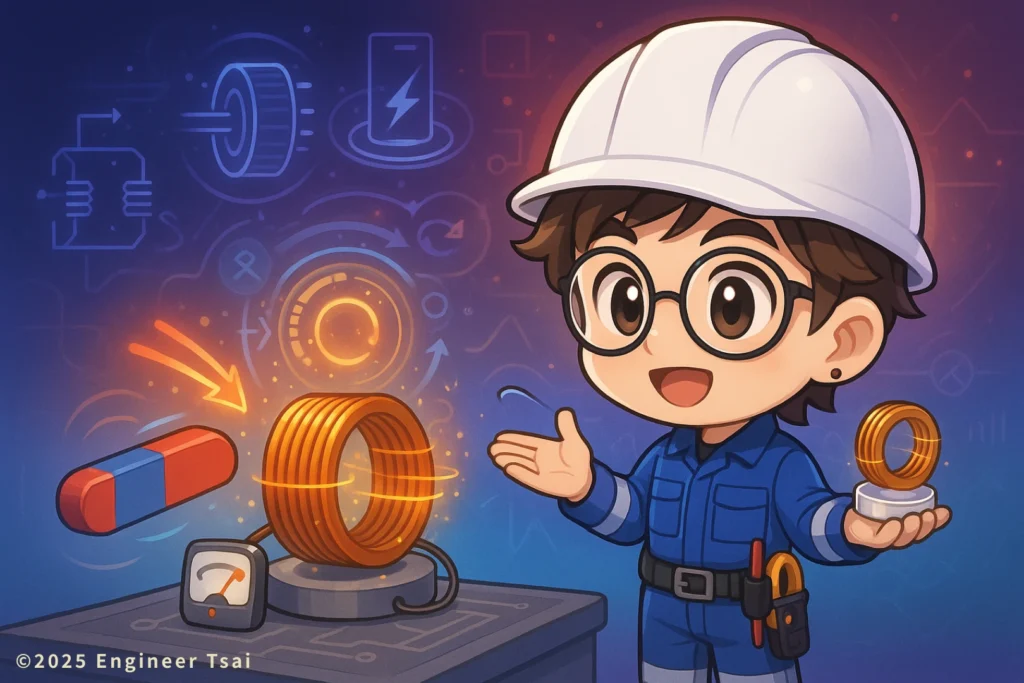
Materials
- A coil of insulated copper wire (many turns)
- A small permanent magnet
- A voltmeter or a multimeter with a voltage range
Steps
- Connect the voltmeter to the two coil terminals.
- Quickly push the magnet into the coil, then pull it out.
- Watch how the meter’s needle or digits move.
What you’ll notice
- Whenever the magnet is moving (toward or away from the coil),
the meter shows a noticeable voltage. That’s your induced EMF. - The faster you move the magnet, or the more turns the coil has,
the larger the voltage spike you see. - When the magnet stops in one position and nothing else changes,
the reading goes back close to zero — because the magnetic flux is no longer changing.
This simple setup visually demonstrates Faraday’s law:
The key is changing flux, not just “having a magnet nearby.”
You’ll also see the voltage change sign when you reverse the magnet’s motion.
That sign change reflects Lenz’s law: the induced current direction always opposes the change.
AC vs DC: why AC is better for induction
A steady DC current creates a steady magnetic field.
Once things settle, the field is not changing, so it doesn’t keep inducing new voltage in nearby coils.
Yes, you can still see induction in DC circuits during:
- Switching moments (turning the circuit on or off)
- Rapid changes in current
- Moving magnets or coils
But those are temporary transients, not a continuous effect.
With AC (alternating current):
- The current constantly changes in magnitude and direction
- The magnetic field around the conductor keeps changing
- That naturally produces continuous electromagnetic induction
This is why AC is ideal for:
- Transformers
- Induction heating
- Wireless charging
- Many kinds of sensors and power electronics
Rotating coils and sine waves
When a coil rotates at constant speed in a uniform magnetic field,
the magnetic flux through the coil varies as a sine function of time.
By Faraday’s law, the induced voltage is also a sine wave.
That’s the origin of the standard AC waveform used in most power systems worldwide.
Motors and generators: same hardware, opposite roles
Structurally, motors and generators look very similar:
- Coils
- Magnetic field (from magnets or electromagnets)
- A rotor and a stator
The difference is the direction of energy flow:
- Generator
- Input: mechanical energy (a turbine or engine turns the rotor)
- Output: electrical energy (induced voltage and current in the stator windings)
- Motor
- Input: electrical energy (you supply current to the windings)
- Output: mechanical energy (electromagnetic forces create torque and rotation)
You can think of them as mirror images of each other, both built on the same induction principles.
Design considerations: losses, materials, and efficiency
When engineers design induction-based systems, they care a lot about where energy leaks away.
Common loss sources
- Copper loss
Resistance in windings causes I²R heating as current flows. - Core loss and flux leakage
Not all magnetic field lines pass through the intended coils.
Some “leak” into space or parts of the core that don’t help transfer energy.
Frequency and materials
- Higher frequency can make induction more effective,
but it can also increase eddy current losses and EMI problems. - Choosing the right magnetic material (like laminated silicon steel or ferrite)
helps concentrate the magnetic field and reduce unwanted eddy currents.
Ways to improve induction efficiency
- Use high-conductivity wire (e.g., oxygen-free copper) to reduce resistive losses.
- Design multi-layer or toroidal coils to better concentrate the field.
- Use laminated cores or low-loss magnetic materials to cut down core losses.
- Pick an appropriate operating frequency that balances efficiency, heating, and EMI.
Future directions: from wireless EV charging to wearables
Wireless charging for electric vehicles
As EVs become more common, park-and-charge via wireless pads is a natural next step:
- You park over a ground pad containing a large induction coil.
- The car has a receiver coil in the underbody.
- High-power inductive coupling transfers energy into the battery pack.
No cables to plug in, and the process can be automated —
great for fleets, autonomous vehicles, and public charging hubs.
Super-sensitive magnetic sensing and medical applications
When induction meets superconductors and advanced sensors, you get extremely sensitive MRI and magnetoencephalography systems:
- MRI (Magnetic Resonance Imaging)
Strong magnetic fields and precise induction coils pick up tiny signals from the body. - Brain and nerve monitoring
Specialized sensors can detect extremely small changes in magnetic fields from neural activity. - Non-contact physiological sensing
In research, induction-based sensors are used to detect breathing, heartbeat, and other signals without direct contact.
Energy harvesting and wearables
Another interesting direction is energy harvesting:
- Smart textiles with embedded coils that generate small amounts of power from motion
- Wearable health trackers using micro-scale generators to extend battery life
- Battery-less sensors that draw just enough power from ambient fields to operate
All of these rely on the same basic rule:
changing magnetic flux can be turned into electrical energy.
FAQ: common exam questions about electromagnetic induction
Q1: What is electromagnetic induction in simple terms?
A:
Electromagnetic induction is the process where a changing magnetic field creates a voltage in a nearby conductor.
If the conductor is part of a closed circuit, that voltage drives an induced current.
Key point: it’s not just about having a magnet; it’s about magnetic flux changing over time.
Q2: Why is there no induced voltage when the magnet is not moving?
A:
Faraday’s law cares about the rate of change of magnetic flux.
If the magnet is not moving and nothing else changes, the magnetic field pattern is essentially fixed.
The flux through the coil is almost constant → dΦ/dt ≈ 0 →
no significant induced voltage.
To create induction, something has to change: the field strength, the area, or the angle.
Q3: Does electromagnetic induction happen in DC circuits?
A:
A steady DC current creates a nearly constant magnetic field, so once things settle, it does not keep inducing new voltages.
However, you can still see induction in DC systems when:
You switch the circuit on or off
The DC current changes quickly
You move magnets or coils relative to each other
Those are transient effects, not continuous like in AC systems.
Q4: How are generators and transformers related to electromagnetic induction?
A:
You can think of generators and transformers as engineered versions of “changing magnetism makes electricity”:
Generators: use mechanical motion to keep the magnetic flux through coils changing, turning mechanical energy into electrical energy.
Transformers: use AC in one coil to create a changing field in a core, which induces a new voltage in another coil, stepping voltage up or down.
Both are direct, large-scale applications of Faraday’s law.
Q5: Are induction cooktops and wireless chargers dangerous to human health?
A:
Standard household induction cooktops and wireless chargers have to meet strict safety and electromagnetic exposure limits in each country.
Used as intended and with certified equipment, they are considered safe for everyday use.
In practice, the bigger safety risks usually come from cheap, uncertified devices or damaged equipment — not from the induction principle itself.
Q6: Is this the same phenomenon I learned in high school physics?
A:
Yes — it’s the same electromagnetic induction you saw in high school, just taken further.
Textbooks usually start with a simple magnet-and-coil experiment and the basic statement of Faraday’s and Lenz’s laws.
This article adds more real-world engineering context: generators, transformers, wireless charging, induction heating, EV charging, and more — so you can connect the theory to actual hardware around you.
Wrap-up and further reading
So this “changing magnetism makes electricity” effect isn’t just a neat lab demo.
It’s the common foundation underneath:
- Power plants and distribution grids
- Transformers in almost every electronic device
- Induction cooktops and wireless chargers
- Many sensors, medical devices, and future energy-harvesting systems
If you keep two core ideas in mind—
- Magnetic flux must be changing
- The induced current always opposes that change
—you’ll find it much easier to read textbooks, solve exam problems,
and understand what’s going on inside real-world electrical equipment.
Recommended next reads (English side)
Magnetic Fields and Electric Currents: The Core of Electromagnetism
A friendly walkthrough of how current and magnetic fields interact, and why they always come in pairs.
How Does a Transformer Change Voltage? Types, Design, and Everyday Uses
See how electromagnetic induction is pushed to the limit in power grids and electronics.
How Does Wireless Charging Work? Inside the Coils and Control Circuits (coming soon)
A deeper look at coil design, control strategies, and efficiency trade-offs in wireless chargers.
Read next in this topic
- What Is Electricity ? Everything You Need to Know
- Current & Voltage for DIY Enthusiasts : Unlock the Basics
- AC vs DC: What’s the Difference and Why It Matters (From Phone Charging to 120 V Home Power)
- Basic Parts of an Electric Circuit (Power Source, Wires, Loads)
- Conductor vs Insulator: How Your Home’s Wiring Keeps You from Getting Shocked
- Ohm’s Law Explained: V = IR for 120V Home Circuits
- What Is a Resistor? How It Works, Types, and How to Choose the Right One
- Series vs Parallel Circuits: Simple Guide for Home Wiring (With Formulas & Examples)
- How Electromagnetic Wave and Electricity Shape Modern Technology
- What Is Voltage? Simple Definition, Everyday Examples, and Safety Tips
- What Is a Battery? How It Works, Types, and Everyday Uses Explained
- What Is Ampere’s Law? A Visual Guide to How Current Creates Magnetic Fields
- What Does a Capacitor Do? Uses, Energy Storage, and Everyday Examples
- Types of Electrical Wire: How to Choose the Right One for Your Home
- How AC Power Is Converted to DC: What’s Really Inside Your Phone Charger?
- Electrical Energy Conversion: How Energy Transforms for Everyday Use
- Magnetic Field and Current: The Core Relationship Behind Motors, Generators, and Wireless Charging
- How Do Magnets Work? From Fridge Magnets to Maglev Trains
- What Is Inductance? Inductor Basics for Real-World Circuits
- What Is Impedance? A Plain-Language Guide to Resistance, Inductive Reactance, and Capacitive Reactance