On this page
Table of Contents
If you’re still building your foundation in basic electricity, start with this beginner-friendly overview: 🔹 “Electricity 101: The Complete Beginner’s Guide to How Power Really Works”
After reading it, the concepts in this article will make a lot more sense.
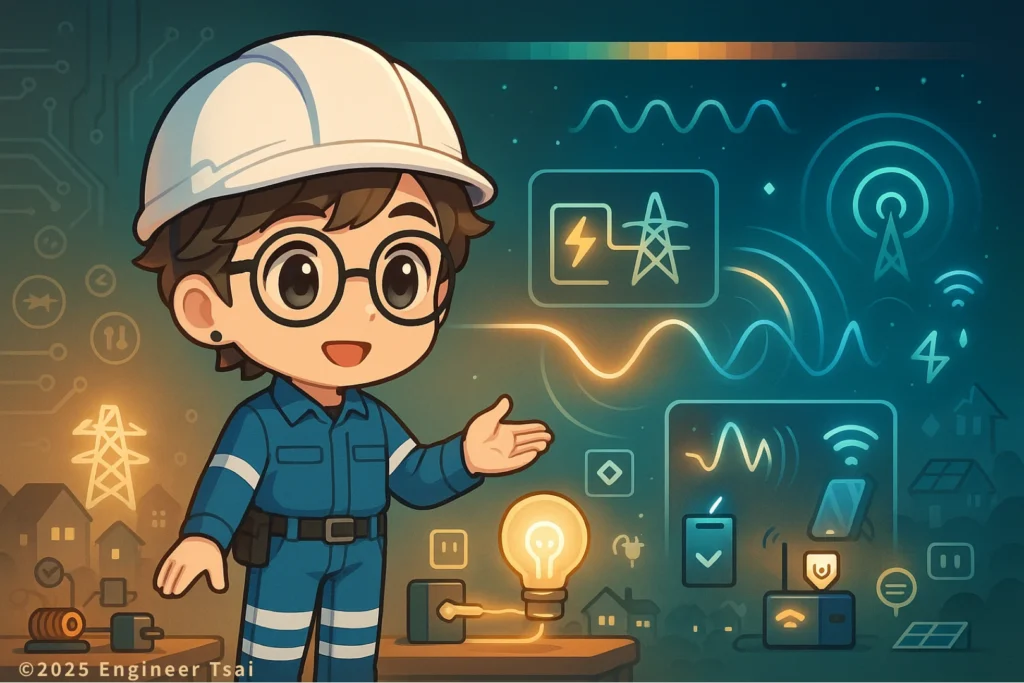
The relationship between electromagnetic waves and electricity sounds intimidating, but it’s hiding in almost everything you do: scrolling on your phone, turning on Wi-Fi, tapping a transit card, or dropping your phone on a wireless charging pad. In this article, we’ll use everyday examples to make this “electromagnetic waves × electric power” story clear and practical.
Watch first: a 60-second explainer on the relationship between electromagnetic waves and electricity
Electromagnetic waves and electricity sound like textbook physics,
but they show up every time you:
- scroll on your phone
- turn on Wi-Fi
- tap a transit card or contactless credit card
- drop your phone on a wireless charging pad
This article uses everyday examples to unpack the relationship between electromagnetic waves and electric power so you can see the whole picture, not just formulas.
Every time you scroll, stream, or charge wirelessly, you’re really watching one thing happen:
Electromagnetic waves move energy through space, then electricity does the actual work.
👉 Before diving into the text, you can watch this 60-second short to get a visual first:
Once you have that mental picture, the rest of this article will feel much easier.
How electromagnetic waves and electrical power show up in daily life
Electromagnetic waves and electricity are two quiet main characters in modern life.
- The 120 V outlets and 240 V circuits inside your walls are the kind of energy you see on your power bill, but not as “waves”.
- Your phone, Wi-Fi, 4G/5G, Bluetooth mouse, wireless headphones, and tap-to-pay reader all rely on electromagnetic waves sending energy or information through the air.
These are not two separate worlds. They’re really:
Two different faces of the same physics, in the same chapter of the textbook.
- Electric power = charges flowing through wires
- Electromagnetic waves = electric and magnetic fields pushing each other forward through space
Once you understand how electromagnetic waves and electricity convert back and forth, you’ll have a much easier time understanding:
- how a power plant can send energy dozens or hundreds of miles to your home
- why your phone can receive signals with no wires at all
- why wireless charging and contactless cards are just everyday applications of electric power × electromagnetic fields
What are electromagnetic waves?
One short sentence first:
Electromagnetic waves are “self-propagating” combinations of electric and magnetic fields that can carry energy without needing air or wires.
A few key properties help anchor the idea:
- No medium required
Sound needs air (or some medium) to travel.
Electromagnetic waves don’t. Outer space is a vacuum, but sunlight and satellite signals still get to us just fine. - Electric and magnetic fields vibrate at right angles
You can picture it like this:- the electric field “wiggles” up and down
- the magnetic field “wiggles” left and right
Both are perpendicular to the direction the wave travels, and they keep pushing each other forward.
- We classify them by wavelength and frequency
- Long wavelength, low frequency → radio waves, Wi-Fi, cell signals
- Short wavelength, high frequency → infrared, visible light, X-rays, gamma rays
- In vacuum, they all travel at the speed of light
In empty space, every electromagnetic wave travels at the same speed:
about 300,000 km per second (3×10⁸ m/s).
The basics of electric power
Now let’s zoom back to something more down-to-earth: electric power.
Electric power is the energy carried by charges moving through a conductor.
Some everyday terms you’ll see over and over:
- Current – how much charge flows per second, measured in amperes (A)
- Voltage – how much “push” drives the charges, measured in volts (V)
- Power – how much electrical work is done per second, measured in watts (W)
In a typical North American home:
- Most receptacles are 120 V circuits.
- Larger loads like ovens, dryers, and some EV chargers use 240 V split-phase circuits.
Your home’s power journey looks roughly like this:
Power plant → high-voltage transmission lines → substations → neighborhood distribution → your main panel → branch circuits → outlets / lights
This entire chain is trying to solve the same problem:
How do we deliver energy efficiently and safely from where it’s generated to where you need to use it?
Electromagnetic induction: the bridge between electromagnetic waves and electricity
So how are electromagnetic waves and electrical power connected?
The key is electromagnetic induction.
Faraday’s law of electromagnetic induction basically says:
“If the magnetic field passing through a loop of wire changes, a voltage is induced in that loop.
And if the current in a wire changes, it creates a changing magnetic field.”
Once you see this, you start noticing it everywhere:
- Generators – turning mechanical energy into electric power
Hydroelectric, gas, coal, wind, and many other power plants all rely on the same idea:- a coil of wire spins in a magnetic field, or
- a magnet spins near a stationary coil.
- Transformers – changing voltage without a direct electrical connection
High-voltage transmission reduces losses over long distances. Closer to homes and businesses, the voltage is stepped down with transformers.
The primary and secondary coils never touch electrically. All the energy transfer happens through a changing magnetic field in the transformer core. - Motors – turning electric power into mechanical motion
When current flows through motor windings, it creates magnetic fields that interact with permanent magnets or other coils.
That interaction creates torque, which makes the rotor spin—washing machines, fans, conveyor belts, you name it.
At this point, you can probably feel it:
The relationship between electromagnetic waves and electricity is really about how changing electric and magnetic fields trade energy back and forth.
A simple mental shortcut:
Changing magnetic field ↔ changing electric field → power and electromagnetic waves can convert into each other.
Real-world examples of electromagnetic waves × electric power
Here are some systems you probably use almost every day, all secretly powered by the same “electromagnetic waves × electricity” partnership.
- Wireless charging pads (phones, earbuds)
Inside the charging pad is a coil. When AC current flows through it, it creates a changing magnetic field.
The coil inside your phone picks up that changing field, which induces a voltage and current to charge the battery.
👉 This is classic near-field electromagnetic induction. - Contactless cards and NFC payments
Card readers and NFC terminals contain coils that continuously emit a field at a specific frequency.
When you bring a card or phone close, its coil picks up energy from that field, wakes the chip, and sends data back using modulation.
👉 It’s not just sending information – it’s also wirelessly powering the card or tag. - Solar power systems
Sunlight is a kind of electromagnetic wave.
When it hits solar panels, photons give energy to electrons in the semiconductor, allowing them to move and form current.
👉 Here the conversion is electromagnetic waves → direct current (DC) electricity. - Wi-Fi and 4G/5G base stations
Your phone’s RF circuitry converts electric signals into high-frequency electromagnetic waves.
The base station receives those waves, converts them back into electrical signals, processes them, then sends them out again.
👉 The “payload” is information, but the carrier is still electromagnetic waves generated from electric power.
Put all of this together and you can summarize it like this:
The relationship between electromagnetic waves and electricity is about preparing energy as electric power in wires, using electromagnetic fields to throw that energy or information across space, and then converting it back into electric power where it’s needed.
Challenges and risks: when waves and power make trouble
Of course, this partnership isn’t always friendly. Poor design can cause real engineering problems and safety concerns.
Some of the big ones:
- Energy loss and heating
Long-distance power transmission loses energy as heat in the lines.
Poorly designed high-frequency circuits and antennas can also waste power as unwanted heat instead of useful signal. - Electromagnetic interference (EMI)
Switching power supplies, motors, and variable-frequency drives can generate a lot of noise if they’re not filtered and grounded correctly.
That noise can make nearby instruments, medical devices, audio equipment, or communication systems behave unpredictably.
👉 That’s why we have EMC (electromagnetic compatibility) standards and certifications. - Health concerns and exposure limits
Strong fields near high-voltage lines, substations, or communication antennas raise questions about long-term exposure.
International organizations and regulators (like ICNIRP, WHO, FCC, and others) publish exposure limits and safety guidelines,
and equipment has to be designed and installed to meet those standards.
The key idea isn’t “electromagnetic waves are always good” or “always bad”. It’s this:
Use them within reasonable limits of power, distance, time, and regulation.
FAQ – Common questions about electromagnetic waves and electricity
Q1. Are electromagnetic waves and electricity the same thing?
Not exactly, but they’re very closely related.
Electric power is the energy carried by charges flowing in a conductor.
Electromagnetic waves are electric and magnetic fields propagating through space as a wave.
Through electromagnetic induction, they can convert back and forth:
generators,
transformers,
wireless charging systems
are all trading energy between electric power in wires and electromagnetic fields in space or inside cores.
Q2. Why do wireless charging and contactless cards have anything to do with electromagnetic waves?
Both wireless chargers and contactless readers contain coils:
When you energize the coil, it creates a time-varying electromagnetic field around it.
When a phone, card, or tag with another coil enters that field, it picks up energy and a voltage is induced.
Sometimes that energy is used primarily to transfer power (wireless charging).
Sometimes it’s used to power a tiny chip and exchange data (transit cards, key fobs, NFC payments).
Q3. Can electromagnetic waves “mess up” the electricity in my house? Do they interfere with appliances?
If the design is poor, yes, certain equipment can generate electromagnetic interference (EMI):
high-frequency circuits,
motors and drives,
switching power supplies
can inject noise into nearby cables or radiate it through space.
That can lead to:
noisy audio,
random reboots,
communication errors,
or strange behavior in sensitive instruments.
That’s why in real-world engineering we use:
filters,
shielding,
proper grounding,
and good PCB / wiring layout
to make sure electromagnetic energy stays on the paths where it belongs instead of leaking everywhere.
Q4. Do power lines or cell towers pose health risks because of electromagnetic waves?
Electric and magnetic fields near high-voltage lines, substations, and communication towers are an active research topic.
Most countries, including the United States, base their rules on international recommendations. They define:
exposure limits,
minimum distances,
and power constraints
that equipment designers, utilities, and installers must follow.
If you’re worried about a specific site near your home, you can usually:
check public information from local authorities or regulators, or
ask a qualified consultant with proper instruments to measure and evaluate the fields.
Q5. Are higher-frequency electromagnetic waves always more dangerous?
Higher-frequency waves mean each photon carries more energy.
X-rays and gamma rays are ionizing radiation, which can damage biological tissue and must be strictly controlled.
Everyday Wi-Fi, cellular signals, radio, and microwave ovens operate in the non-ionizing range and are designed to stay within regulated power and shielding limits.
The real safety question is a combination of:
frequency + power + distance + exposure time,
not just “high frequency = always dangerous”.
Q6. Can electromagnetic waves completely replace wires? Will everything be powered wirelessly one day?
For short distances and low power, wireless power transfer is already very useful:
phone and earbud chargers,
contactless cards and tags,
some specialized industrial and medical applications.
But for long distances and high power—like entire homes, apartment buildings, factories, or transit systems—
wired power distribution is still much more efficient, controllable, and safe.
A more realistic picture of the future is:
Main power backbones stay wired, and electromagnetic waves handle the “last short hop” where wireless makes sense.
Q7. If I want to really understand “electromagnetic waves × electric power” applications, what basics should I learn first?
A good learning order looks like this:
What is electricity?
Voltage, current, resistance, and power.
Electromagnetic induction
How changing magnetic fields induce voltage in a loop.
The electromagnetic spectrum
Which frequencies correspond to radio, Wi-Fi, microwaves, visible light, X-rays, etc.
Applied topics
Wireless charging, antennas, communication systems, motor control, and power electronics.
If you build from these layers, you’ll have a much easier time connecting classroom theory to real-world hardware.
Conclusion: one physics language, two ways of talking about it
Let’s recap the big picture:
- Electric power is energy carried by charges flowing through conductors.
- Electromagnetic waves are electric and magnetic fields propagating through space and carrying energy.
The bridge between them is:
- electromagnetic induction (Faraday)
- time-varying electric and magnetic fields (Maxwell)
If you can clearly say:
- Electromagnetic waves are electric and magnetic fields vibrating together and moving at the speed of light.
- Changing magnetic fields can induce voltage, and changing currents create magnetic fields.
- Generators, transformers, wireless charging, and contactless cards are all practical uses of the same physics.
…then you’ve already nailed 80% of the key ideas behind the relationship between electromagnetic waves and electricity.
From there, everything else—communications, electrical engineering courses, or just understanding everyday tech—gets much easier.
Further reading and practical next steps
Electromagnetic waves and electric power touch a lot of physics and engineering details.
If you want to build a solid foundation, you can follow this path:
- “What Is Electricity? Everything You Need to Know”
Strengthen your understanding of charge, current, voltage, and power.
Once those are solid, electromagnetic waves and induction won’t feel mysterious. - “The Mystery of Electromagnetic Induction: From Faraday’s Law to Modern Applications”
Focuses on how changing magnetic fields create voltage,
with real-world examples like generators, transformers, motors, and wireless chargers. - “A Beginner’s Guide to the Electromagnetic Spectrum: From Radio Waves to Gamma Rays” (coming soon)
Lines up Wi-Fi, phone signals, microwaves, visible light, and X-rays on one scale,
so you can see how frequency and wavelength change what we can do with them.
For more background from international sources, you can also check:
- NASA – The Electromagnetic Spectrum
A clear overview of how different electromagnetic waves fit on one spectrum and what each band is used for. - WHO – Electromagnetic Fields (EMF) Project
Official information on exposure, health questions, and international EMF guidelines.
If you’re planning a career in electrical, electronics, or communications engineering, I strongly recommend:
- doing a few coil-and-magnet experiments to see induced voltages for yourself
- using an oscilloscope to look at AC waveforms
- trying simple antenna or field simulations in software
Hands-on experiments plus a clear mental model of the relationship between electromagnetic waves and electricity
will give you a huge advantage—both in the classroom and in real-world work.
Read next in this topic
- What Is Electricity ? Everything You Need to Know
- Current & Voltage for DIY Enthusiasts : Unlock the Basics
- AC vs DC: What’s the Difference and Why It Matters (From Phone Charging to 120 V Home Power)
- Basic Parts of an Electric Circuit (Power Source, Wires, Loads)
- Conductor vs Insulator: How Your Home’s Wiring Keeps You from Getting Shocked
- Ohm’s Law Explained: V = IR for 120V Home Circuits
- What Is a Resistor? How It Works, Types, and How to Choose the Right One
- Series vs Parallel Circuits: Simple Guide for Home Wiring (With Formulas & Examples)
- How Electromagnetic Wave and Electricity Shape Modern Technology
- What Is Voltage? Simple Definition, Everyday Examples, and Safety Tips
- What Is a Battery? How It Works, Types, and Everyday Uses Explained
- What Is Ampere’s Law? A Visual Guide to How Current Creates Magnetic Fields
- What Does a Capacitor Do? Uses, Energy Storage, and Everyday Examples
- Types of Electrical Wire: How to Choose the Right One for Your Home
- How AC Power Is Converted to DC: What’s Really Inside Your Phone Charger?
- Electrical Energy Conversion: How Energy Transforms for Everyday Use
- Magnetic Field and Current: The Core Relationship Behind Motors, Generators, and Wireless Charging
- How Do Magnets Work? From Fridge Magnets to Maglev Trains
- What Is Inductance? Inductor Basics for Real-World Circuits
- What Is Impedance? A Plain-Language Guide to Resistance, Inductive Reactance, and Capacitive Reactance