On this page
Table of Contents
If you’re still building your foundation in basic electricity, start with this beginner-friendly overview: 🔹 “Electricity 101: The Complete Beginner’s Guide to How Power Really Works”
After reading it, the concepts in this article will make a lot more sense.
▶️ Watch First: What Is an Electromagnetic Winding? A 60-Second Explainer
Grab the Core Idea in 3 Sentences
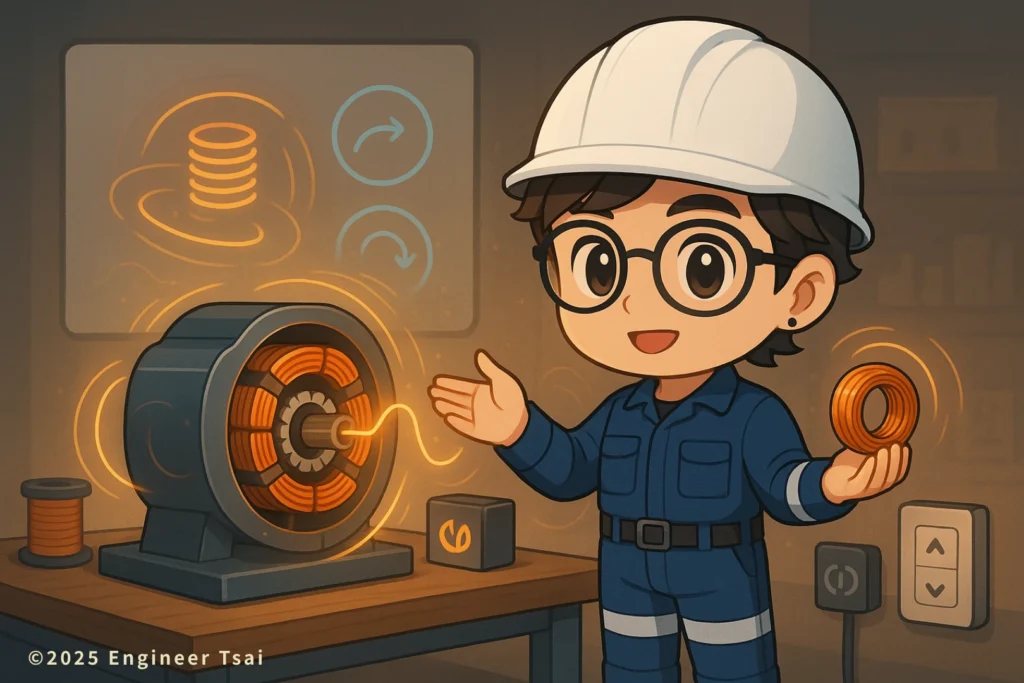
What is an electromagnetic winding? In plain terms, it’s a coil of wire wound around an iron core. When current flows through it, it creates a magnetic field that lets us control the direction and strength of force.
The same electromagnetic winding can turn electricity into motion (motors) or change voltage levels (transformers),
which is why it’s at the core of so many pieces of electrical equipment.
How well the electromagnetic winding is designed and wound directly affects efficiency, temperature rise, and lifespan —
which is why rewinding a motor coil is such a serious craft in the field.
The Key Skill: Making the Magnetic Field Listen to You
From motor coils to transformers, how do we “shape” force using copper wire?
On one job site, I was working with a contractor installing a big industrial blower. When the control panel was energized, the motor made a low, steady hum and the fan slowly spun up to speed. I asked the senior engineer, “What actually drives a motor this big?” He just smiled and said, “It’s all in those copper windings. Wind them right, and it runs smooth.”
Those copper coils are the star of today’s article — the electromagnetic winding. Once you really understand what an electromagnetic winding is, you’re basically understanding how electricity turns into force and usable energy in real machines.
Chapter 1|What Is an Electromagnetic Winding? A Plain-English Explanation
If you want a one-sentence answer to “What is an electromagnetic winding?”, here it is:
An electromagnetic winding is a neatly wound coil of wire (usually enamel-coated copper) placed on an iron core or coil former. When current flows through it, it creates a controlled magnetic field.
That magnetic field isn’t just “on” or “off.” It has a direction, a strength, and even a rhythm — and that’s what makes so many electrical devices either move or stay stable.
Typical places you’ll find electromagnetic windings include:
- Motors and generators
- Transformers and inductors
- Solenoid valves, doorbells, and relay coils
- Wireless charging coils and various types of electromagnets
You can think of an electromagnetic winding as a “pen” for drawing magnetic fields. Engineers use this pen to draw the path and timing of force in the physical world. Next time someone asks you “What is an electromagnetic winding?”, you can tell them: it’s the pen we use to sketch invisible magnetic lines of force in space.
Chapter 2|Basic Principles: How Electromagnetic Windings Create “Electric → Magnetic → Electric”
Once you know what an electromagnetic winding is, the next question is: how does it actually work?
Based on Ampère’s law and Faraday’s law, the interaction between current and magnetic field is a two-way energy conversion:
- When current flows through a winding → it creates a magnetic field (“electricity makes magnetism”).
- When a changing magnetic field cuts across a winding → it induces a voltage (“magnetism makes electricity”).
Because of this two-way relationship, an electromagnetic winding can serve as:
- A source of mechanical power (in a motor, it produces torque and rotation)
- An energy conversion link (in a transformer, it steps voltage up or down)
- A sensing element (in sensors, it generates a measurable voltage or current)
The number of turns, wire gauge (thickness), and how the winding is laid out all affect the strength and shape of the magnetic field. That’s why electromagnetic winding design is a serious discipline — not just “wrap some wire around and call it a day.”
Chapter 3|Electromagnetic Windings Inside Motors: Where the Torque Starts
If you’ve ever opened up a box fan or an older desk fan, you’ve probably seen the reddish copper coils inside. Those are the motor’s electromagnetic windings.
These windings are usually wrapped around an iron core (either on the stator or the rotor). When current flows, they create a magnetic field that pushes and pulls on the rotor, making it turn. Different types of motors use very different winding designs:
Single-phase AC motors – common in household appliances.
The windings often need a start capacitor to create a rotating magnetic field.
Three-phase induction motors – widely used in industrial settings.
Three sets of windings create a continuous rotating magnetic field with steady torque.
Servo motors and brushless DC motors – their electromagnetic windings
are more precisely designed and driven by controllers that constantly adjust the
field direction and strength.
When commissioning equipment in the field, you’ll often hear something like: “If the winding temperature gets out of hand, that motor’s toast.” It’s not a joke. The temperature and efficiency of the electromagnetic winding almost completely determine a motor’s lifespan and reliability.
Chapter 4|Electromagnetic Windings in Transformers: The Bridge for Voltage Conversion
Another classic application of electromagnetic windings is the transformer.
Inside a transformer, you’ll usually find two sets of windings: a primary winding and a secondary winding. When AC flows through the primary winding, it creates a changing magnetic field in the core. That changing field then induces a new voltage in the secondary winding.
By adjusting the turns ratio between the windings, the transformer can step voltage up or down. For example:
- 240 V → 120 V (step-down, common in North American residential systems)
- 12 V → 24 V (step-up, common in control circuits or DC systems)
When you install control panels or electrical enclosures in the field, you’ll often see small control transformers inside. They’re nothing more than two carefully wound electromagnetic windings converting electrical energy from one level to another. So if someone asks you, “What is an electromagnetic winding’s role inside a transformer?”, you can answer: it’s the part that adjusts the voltage to the level the system needs.
Chapter 5|Why Winding Quality Matters So Much
In motor repair shops and industrial maintenance, one of the most skill-intensive tasks is rewinding motor windings.
It’s not just about making the coils look neat or adding insulation. You have to calculate the exact number of turns, the wire size, and the winding pattern based on the original design. Being off by even a few turns can seriously hurt efficiency, cause abnormal starting current, or keep the motor from starting at all.
I once watched a seasoned technician rewinding a motor by hand without saying a word. Only when he laid down the final turn did he finally exhale and say: “If this thing is one turn short, it won’t spin, but it also won’t completely fail. That’s the worst kind of problem.”
That line stuck with me: in engineering, the scary part isn’t making mistakes — it’s making a mistake you can’t see. Electromagnetic windings are exactly that kind of place: small details, big consequences.
Electromagnetic Winding FAQ
Q1|What is an electromagnetic winding, and how is it different from a regular coil?
What is an electromagnetic winding? In simple terms, it’s a carefully designed coil of enamel-coated copper wire, wound around an iron core or coil former, that produces a controlled magnetic field when energized.
Unlike a random coil you might wind just for a quick experiment, an electromagnetic winding is engineered with precise turn counts, wire size, winding pattern, and insulation class to achieve specific voltage, current, torque, or induction characteristics — while also meeting efficiency and lifespan requirements.
Q2|Where do we commonly find electromagnetic windings?
In everyday life and in industrial environments, you’ll see electromagnetic windings in:
Household and industrial motors (fan motors, pumps, blowers, cooling tower fans)
Transformers and inductors (control transformers, power supplies)
Solenoid valves and relay coils (for water lines, pneumatic systems, and control circuits)
Wireless charging coils and electromagnets (door locks, lifting magnets, and more)
If a device works based on “current makes magnetism, changing magnetism makes voltage,” there’s a good chance an electromagnetic winding is inside.
Q3|What are the warning signs of a burned or failed electromagnetic winding?
When an electromagnetic winding overheats or its insulation breaks down, it can “burn out.” Common symptoms include:
Equipment trips a breaker or blows a fuse immediately on startup
The motor hums but won’t turn, or it stalls shortly after starting
Burning smell, discoloration, or unusually hot areas near the windings
Resistance measurements showing a short circuit between turns or an open circuit
When that happens, you have to decide whether it’s more cost-effective to replace the entire unit or send it out to a specialist to rewind the electromagnetic winding.
Q4|What are the most important design considerations for an electromagnetic winding?
Key design factors for electromagnetic windings include:
Number of turns and winding pattern – sets flux, voltage ratio, and starting behavior.
Wire gauge and material – affects allowable current, copper loss, and temperature rise.
Insulation class and cooling – determines how much heat the winding can survive over time.
Operating environment – high temperature, moisture, oil, dust, or vibration all matter.
A lot of people ask, “What level does an electromagnetic winding have to reach to be considered durable?” The honest answer is: there isn’t a single magic spec — the whole design has to match the real-world operating conditions.
Q5|What background knowledge do I need before learning electromagnetic winding design?
If you’re a beginner, it’s much easier to understand this kind of winding after you’ve nailed down a few basics:
How voltage, current, resistance, and power relate to each other
The difference between DC and AC, plus the idea of frequency and phase
Basic concepts of magnetic field, magnetic flux, and electromagnetic induction
Start with solid introductions to electricity, current and voltage, transformers, and electric motors. Once that foundation is in place, electromagnetic windings will feel much more intuitive instead of mysterious.
If you want a more math-heavy view, you can also check Khan Academy’s introduction to magnetic fields .
🔧 Conclusion|Those “Just a Few Coils of Wire” Are Holding Up the Whole System
By now, you probably have a clear picture of what this winding really does. It’s not just something hiding inside a motor — it’s a part you’re interacting with every single day: ceiling fans, elevators, transformers, power supplies, even the wireless charging pad under your phone.
These humble coils of wire let us control the direction of force, manage how energy flows, and keep entire systems stable. Understanding this tiny component is really about understanding
how modern electrical systems actually work.
📌 Further Reading
- “What Is Electricity?”
Get a feel for what current and voltage really are before diving deeper into electromagnetic applications. - “Current vs. Voltage: What’s the Difference?”
Understand the driving forces behind electromagnetic windings and why both matter. - “How Do Transformers Change Voltage?”
See how turn ratios in windings shape energy conversion in real power systems. - “What Is an Electric Motor? From Electricity to Motion”
Connect the theory of electromagnetic windings with the motors that spin our world.
Have you ever rewound a motor or dealt with a burned winding that kept tripping breakers on startup? Feel free to share your story in the comments — other people working in the field can learn a lot from your real-world experience.
Read next in this topic
- What Is Electricity ? Everything You Need to Know
- Current & Voltage for DIY Enthusiasts : Unlock the Basics
- AC vs DC: What’s the Difference and Why It Matters (From Phone Charging to 120 V Home Power)
- Basic Parts of an Electric Circuit (Power Source, Wires, Loads)
- Conductor vs Insulator: How Your Home’s Wiring Keeps You from Getting Shocked
- Ohm’s Law Explained: V = IR for 120V Home Circuits
- What Is a Resistor? How It Works, Types, and How to Choose the Right One
- Series vs Parallel Circuits: Simple Guide for Home Wiring (With Formulas & Examples)
- How Electromagnetic Wave and Electricity Shape Modern Technology
- What Is Voltage? Simple Definition, Everyday Examples, and Safety Tips
- What Is a Battery? How It Works, Types, and Everyday Uses Explained
- What Is Ampere’s Law? A Visual Guide to How Current Creates Magnetic Fields
- What Does a Capacitor Do? Uses, Energy Storage, and Everyday Examples
- Types of Electrical Wire: How to Choose the Right One for Your Home
- How AC Power Is Converted to DC: What’s Really Inside Your Phone Charger?
- Electrical Energy Conversion: How Energy Transforms for Everyday Use
- Magnetic Field and Current: The Core Relationship Behind Motors, Generators, and Wireless Charging
- How Do Magnets Work? From Fridge Magnets to Maglev Trains
- What Is Inductance? Inductor Basics for Real-World Circuits
- What Is Impedance? A Plain-Language Guide to Resistance, Inductive Reactance, and Capacitive Reactance