On this page
Table of Contents
If you’re still building your foundation in basic electricity, start with this beginner-friendly overview: 🔹 “Electricity 101: The Complete Beginner’s Guide to How Power Really Works”
After reading it, the concepts in this article will make a lot more sense.
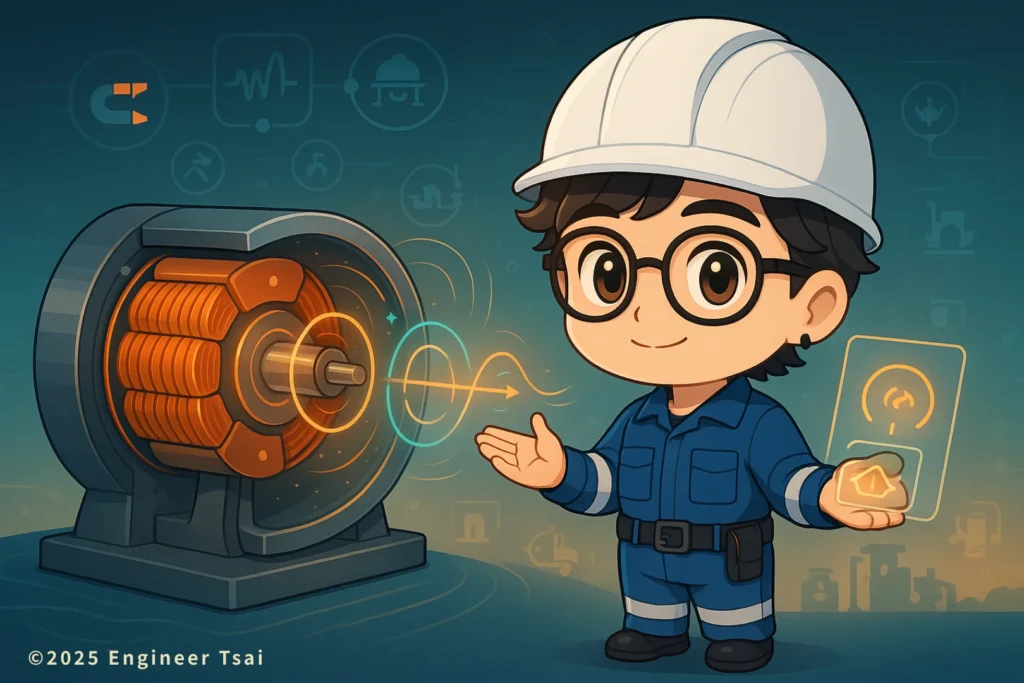
What Is an Electric Motor? How Electricity Turns Into Motion
In one sentence: an electric motor is the device that quietly turns electrical energy into mechanical motion.
From box fans and washing machines to EVs, conveyor belts, and robot arms, there’s almost always a motor spinning somewhere in the background.
You might not see it, but you feel its work every day.
Quick overview: key takeaways
If you’re in a hurry and just want to know what is an electric motor, here’s the big picture:
- Electric motors turn electricity into motion. Generators do the reverse: motion → electricity.
- The core principle is simple:
a current-carrying conductor in a magnetic field feels a force (Lorentz force). - Most motors share the same core parts: rotor, stator, bearings, housing, and (for brushed DC) brushes + commutator.
- The three workhorse types you’ll see most often are:
- DC motors – easy to control, great starting torque.
- AC induction motors – rugged, low-maintenance, perfect for pumps and fans.
- Brushless DC (BLDC) motors – efficient, quiet, ideal for EVs, drones, and modern appliances.
- Modern motor systems are really motor + drive + sensors working together for efficiency, comfort, and precise control.
- If you want to become an electrician, maintenance tech, or work in automation or EVs, understanding motor basics is a must-have skill, not a nice-to-have.
Introduction: the invisible force that keeps everything moving
You may not think about them often, but electric motors have quietly become the lead actors in modern life.
- Turn on a box fan? A motor starts spinning.
- Start a washing cycle? The drum motor ramps up and down.
- HVAC blower, fridge compressor, sump pump in the basement, garage door opener—
behind each of these is a motor doing the work.
In offices, factories, and hospitals it’s the same story:
- Printers and copiers, conveyor belts and packing lines,
- infusion pumps, surgical robots, powered hospital beds,
- and of course, electric vehicles and e-bikes—
All of them rely on some kind of electric motor.
So the real question is:
How does a motor turn “electricity in wires” into real-world motion you can see and feel?
If you’ve ever searched for “what is an electric motor”, “electric motor working principle”, or “how do motors work”, this article is designed to give you a clear, no-nonsense foundation.
We’ll start by answering the core question – what is an electric motor – and then move to the basic structure, working principles, and real-world use cases.
- core working principles,
- three common motor types,
- control and drive technology,
- everyday and industrial applications,
- common problems and basic troubleshooting ideas,
- and a simple DIY experiment so you can actually see “electricity → motion” on your desk.
If you’re thinking about becoming an electrician, maintenance tech, or working in automation or EVs, getting comfortable with electric motors is one of the required courses on your learning path.
If someone stops you in the hallway and asks, “So, what is an electric motor?”, this chapter gives you the short, clear answer before we dive into details.
Chapter 1 – What is an electric motor? One-sentence version first
An electric motor is a device that converts electrical energy into mechanical energy—in other words, it turns electric current into usable rotational force.
In more textbook language:
The working principle of an electric motor is that a current-carrying conductor placed in a magnetic field experiences a torque, producing continuous rotational motion.
A simple way to remember it:
A generator is “motion → electricity.”
An electric motor is “electricity → motion.”
| Device | Main job | Energy direction |
|---|---|---|
| Generator | Turn mechanical motion into electrical power | motion → electricity |
| Motor | Turn electrical power into mechanical motion (torque, rotation) | electricity → motion |
This energy conversion sounds straightforward, but under the hood you’re seeing the core ideas of electromagnetism at work:
magnetic fields, current, and the Lorentz force.
Common types of electric motors
There are many sub-types, but in day-to-day work you’ll repeatedly see these three:
- DC motor (brushed DC motor)
Uses a commutator and brushes to keep torque in the same direction.
Simple control, good starting torque. Common in toys, basic tools, and small mechanisms. - AC induction motor
Uses an induced current in the rotor and a rotating magnetic field in the stator.
It’s the rugged workhorse of industry—pumps, fans, compressors, HVAC, conveyors. - Brushless DC motor (BLDC)
Removes mechanical brushes and uses electronics for commutation.
High efficiency, quiet, long life. You’ll see it in drones, e-scooters, EVs, server fans, and many modern appliances.
Chapter 2 – The basic parts of an electric motor
Different motor types have different internal layouts, but most share a set of core components.
Once you recognize these, any motor diagram becomes far less scary.
🔹 Rotor
The rotor is the rotating part—the “heart” of the motor.
It carries conductors or windings that sit inside a magnetic field.
When current flows through these conductors, the magnetic field exerts a torque on the rotor, causing it to spin.
🔹 Stator
The stator is the stationary outer part of the motor.
Its main job is to provide a stable, controlled magnetic field.
That field can come from:
- Permanent magnets (small DC motors, many BLDC motors), or
- Stator windings (AC induction motors and many large machines) that produce a magnetic field when energized.
For designers, the more stable and controllable the stator field is,
the easier it is to predict and control torque, speed, and efficiency.
🔹 Brushes and commutator (for brushed DC motors)
In a brushed DC motor, the carbon brushes + commutator are the key parts that:
- deliver current to the rotating windings, and
- automatically flip the current direction every half turn.
The brushes press against the commutator segments, feeding current into the spinning armature.
The commutator switches the direction of current in the coils at just the right moments, so the torque keeps pushing in the same rotational direction instead of making the rotor rock back and forth.
🔹 Bearings, housing, and cooling
Around the electromagnetic core you’ll also find:
- Bearings – let the rotor spin smoothly without grinding metal on metal.
- Housing – protects coils and magnets, and provides mounting points.
- Cooling features – fans, fins, or ventilation paths so the motor doesn’t overheat during long runs
(think HVAC blowers, pumps, or industrial fans).
Chapter 3 – How does an electric motor work? From current to motion
📌 Core principle: Lorentz force
The heart of the motor principle is really just this one line:
A current-carrying conductor placed in a magnetic field experiences a force.
In many textbooks you’ll see a simplified formula for this:
F = B · I · L (for a conductor perpendicular to the magnetic field)
Where:
- B – magnetic flux density (Tesla)
- I – current (Ampere)
- L – effective length of the conductor in the magnetic field (meter)
- F – force acting on the conductor (Newton)
Now imagine arranging many such conductors into a coil mounted on a rotor.
The individual forces add up into a net torque, giving you continuous rotational motion, not just a single “push”.
That’s the classic motor story:
Current × Magnetic field → Force → Torque → Continuous rotation
🧲 Start simple: a single wire that moves
Picture a straight wire between the poles of a magnet.
You send current through the wire → it experiences a sideways force and moves.
That’s already the seed of an electric motor.
From there, engineers:
- bend the wire into loops (coils),
- stack and arrange those coils on a rotor,
- add a stator structure and support,
- then add commutation or rotating fields—
And you get the motor types we use every day.
🔁 Coils and rotor: turning a single push into smooth rotation
To avoid “push once and stop”, we:
- wind the conductor into multiple turns of a coil,
- mount that coil on a rotor, and
- arrange things so different parts of the coil are at different angles in the magnetic field.
The result:
- individual segments feel forces at different angles,
- all those forces combine into a steady torque,
- and the rotor spins smoothly, turn after turn.
In a brushed DC motor, the commutator flips the current in the coil every half turn so the torque continues in the same direction.
In an AC induction motor, we do something clever: we feed AC into the stator windings to create a rotating magnetic field. The rotor current is induced, and it chases this rotating field—creating torque without brushes.
Chapter 4 – Three common motor types (and how they compare)
All motors do “electricity → motion”, but how they do it—and where they shine—can be quite different.
Here are three types you’ll bump into again and again in real life.
✅ Brushed DC motor
For many people, brushed DC motors are their first encounter with motor physics—think RC cars, small fans, and hobby projects.
- Key parts
Rotor, stator, brushes, and commutator. - How it works
Brushes + commutator keep flipping the current direction in the armature windings so the torque keeps pushing the rotor the same way. - Pros
Simple control, good starting torque, easy speed control with voltage/PWM. - Common uses
Toys, small fans, pumps, basic power tools, lab setups, and many low-voltage mechanisms.
✅ AC induction motor
Induction motors are the workhorses of industry and building services.
You’ll find them in:
- HVAC blowers and compressors,
- water pumps and well pumps,
- conveyor belts, elevators, and many industrial machines.
- Key parts
Stator windings (create a rotating magnetic field) and a “squirrel-cage” or wound rotor. - How it works
Three-phase (or single-phase) AC in the stator creates a rotating magnetic field.
This induces current in the rotor. The stator and rotor fields interact and create torque. - Pros
Rugged, long life, low maintenance, excellent for continuous duty. - Typical classification
- Single-phase induction motors – for small household and light commercial loads.
- Three-phase induction motors – for industrial equipment, larger pumps, compressors, and fans.
✅ Brushless DC motor (BLDC)
You can think of a BLDC motor as a DC motor that took the mechanical brushes out and replaced them with smart electronics.
- Key parts
Permanent magnet rotor, stator windings, electronic drive (ESC/driver), and position sensors (Hall sensors or encoders). - How it works
Sensors report rotor position. The controller energizes the correct stator phases at the right timing—acting as a digital commutator. - Pros
High efficiency, low noise, long service life, minimal maintenance. - Common uses
Drones, e-scooters and e-bikes, EV drive motors and auxiliaries, server fans, high-end power tools, medical devices, and many “quiet, efficient” appliances.
Chapter 5 – Motor control and drive technology
Today, “a motor that just spins” isn’t enough.
We want motors to spin at the right speed, with the right torque, at the right time, and to save energy while doing it.
That’s where control and drive technology come in.
🔸 PWM control (Pulse Width Modulation)
For many DC and BLDC applications we use PWM – Pulse Width Modulation:
- Instead of changing the supply voltage smoothly, we rapidly switch it ON/OFF.
- By adjusting the duty cycle (the ratio of ON time to total period), we change the effective voltage and power.
- The motor “sees” a lower or higher average voltage and adjusts its speed/torque accordingly.
That “duty cycle” and “PWM frequency” you see in fan controllers, ESC settings, or microcontroller code?
That’s exactly this.
🔸 Speed control vs torque control
Two big control styles show up across EVs, industrial drives, and robotics:
- Speed control
Keep the motor at a target RPM.
Example: a ceiling fan at a fixed speed, or a CNC spindle holding 12,000 RPM. - Torque control
Keep the force stable instead of the speed.
Example: an EV smoothly ramping torque during launch or hill climbs.
High-end drives often blend both—controlling torque response while also managing speed limits and efficiency.
🔸 Motor drivers and ESCs
Motors don’t usually connect straight to a battery or AC line.
They need drivers:
- DC motor driver
Provides controllable voltage or PWM and often direction control (H-bridge). - BLDC ESC (Electronic Speed Controller)
Handles the heavy lifting of commutation:- reads rotor position (or estimates it),
- switches the correct phases at the right time,
- and applies PWM for speed and torque control.
- Protection functions
Over-current, over-voltage, over-temperature—crucial for protecting both motor and electronics.
🔸 Feedback from sensors (Hall sensors, encoders)
To make a motor “spin precisely, not just spin”, we add feedback:
- Hall sensors
Detect magnetic field changes and give a basic sense of rotor position. Very common in BLDC motors. - Rotary encoders
Provide high-resolution position and speed feedback. Essential for CNC, robots, and servo systems.
With feedback, controllers can do closed-loop control, hitting the setpoint more accurately and reacting to load changes.
Chapter 6 – Where do you see electric motors in real life?
Motors are everywhere—from your living room to factories and data centers.
Let’s look at a few major categories.
✅ Home applications
- Washing machines
Control drum rotation, reversing, and spin cycles. - Air conditioners & heat pumps
Compressors and indoor/outdoor fans are driven by induction or inverter-driven motors. - Vacuum cleaners, fans, electric toothbrushes
Use DC or BLDC motors for high-speed, compact power. - Bathroom exhaust fans, sump pumps, circulation pumps
Common examples of small motors in everyday building systems.
✅ Industrial applications
- CNC machines and industrial robots
Use servo and stepper motors for precise motion control. - Conveyors and automated production lines
Depend on three-phase induction motors plus encoders or feedback systems. - Pumps and fans
Water treatment plants, cooling towers, HVAC systems—
all packed with motors running for thousands of hours per year.
✅ Transportation
- Electric vehicles (EVs)
Typically use permanent magnet synchronous motors or induction motors for traction. - E-bikes and e-scooters
Rely on BLDC hub or mid-drive motors for a balance of efficiency and weight. - Subways, commuter trains, and high-speed rail
Use three-phase traction motors (synchronous or induction) as the main drive.
✅ Medical and healthcare
- Adjustable hospital beds and patient lifts
Need smooth, reliable actuation with consistent torque. - Powered wheelchairs and mobility devices
Use motors plus control electronics for safe, responsive motion. - Ventilators, suction pumps, infusion and dialysis systems
Rely on small DC or BLDC motors to drive internal pumps and fans.
Chapter 7 – A short history: how we learned to tame electromagnetism
The story of electric motors is really the story of how humans gradually learned to understand and harness electromagnetism.
🔹 Maxwell’s electromagnetic theory
In the 19th century, James Clerk Maxwell combined separate laws of electricity and magnetism into a unified theory.
His equations gave engineers a powerful toolkit: for the first time, they could calculate and design electromagnetic machines—generators and motors—with real precision.
🔹 Faraday’s induction experiments
In 1831, Michael Faraday discovered electromagnetic induction:
when a conductor cuts through a magnetic field, a voltage appears across it, and current can flow.
That discovery gave birth to the generator.
If moving a conductor through a magnetic field can create electricity, then feeding electricity into a conductor in a magnetic field should produce motion—and that’s exactly what a motor does.
Generators and motors are truly two sides of the same coin.
🔹 Edison vs Tesla – DC vs AC
Later, you get the famous “war of currents”:
- Thomas Edison championed DC systems and brushed DC motors—good for local, short-distance power.
- Nikola Tesla pushed AC systems and induction motors—easier to transform voltage and send power long distances.
AC power systems eventually became the backbone of modern grids, but DC and brushless motor technologies are still critical today—especially in EVs and precision control.
🔹 Modern development: from brushed to brushless, from big to tiny
With advances in materials, semiconductors, and control algorithms, motors have evolved along a few key directions:
- Brushless designs – higher efficiency, less maintenance, longer life.
- Miniaturization – tiny motors now live inside smartwatches, phones (vibration motors), and micro-pumps in medical devices.
- “Smart” control – combining sensors and algorithms to save energy, reduce noise, and hit precise performance targets.
Motors are no longer just “spinning machines”—they’re part of smart, connected systems.
Chapter 8 – Common motor problems and basic troubleshooting ideas
Motors are usually tough, but in real-world conditions—heat, humidity, dust, long runtimes—they do fail.
Below are a few symptoms and directions of thinking (for learning purposes only—anything involving mains voltage or high power should be handled by qualified professionals).
⚠️ Strange noises during operation
Possible causes
- Worn or damaged bearings
- Misaligned shaft
- Fan blades rubbing against the housing
- Loose mounting hardware
What technicians usually check
- Any obvious grinding, scraping, or wobble on the shaft
- Bearing condition and alignment
- Mounting bolts, fan guards, and surrounding structures
High-speed, high-power equipment should always be serviced by experienced technicians.
⚠️ Motor won’t start
Possible causes
- For brushed DC motors:
- Worn brushes
- Contaminated or burnt commutator
- For AC motors:
- Failed start/run capacitor (for single-phase motors)
- Burnt windings
- Overload protection tripped
- Others:
- Supply issues, blown fuses, or a failed controller/drive
Typical steps
- Confirm supply voltage is present and within spec.
- On single-phase induction motors, inspect capacitors for bulging or leakage.
- On DC motors, check brush length and contact, and look for heavy arcing or burnt segments.
- Check mechanical load—sometimes the motor is fine but the driven equipment is jammed.
⚠️ Overheating or burning smell
Possible causes
- Long-term overload
- Blocked ventilation or failed cooling fan
- Very high ambient temperature
- Incorrect voltage or frequency
Typical steps
- Clean ventilation paths and fan blades.
- Compare actual load with the motor nameplate rating.
- In some cases, add protection devices or upsize the motor.
🧰 Simple maintenance habits
A few basic habits go a long way:
- Periodically clean the housing, vents, and surrounding area.
- For larger motors that sit idle for long periods, run them at light load briefly before returning to full service.
- At the first sign of abnormal vibration, metallic scraping, or a burnt smell, shut down and investigate—don’t “hope it will go away.”
Chapter 9 – DIY: a simple electric motor experiment
Want to see electricity turning into motion with your own eyes?
You can build a tiny demonstration motor at home or in a classroom with a few simple parts.
📦 Materials
- One 1.5 V AA battery
- A length of thin copper wire (insulation removed on the ends)
- A small strong magnet (a neodymium magnet works best)
- Two paper clips or small metal clips (to act as supports and contacts)
🛠 Steps
- Bend the copper wire into a coil, leaving the two ends straight as an axle so it can rest on the supports.
- Attach the magnet to the bottom of the battery.
Use the two paper clips to touch the positive and negative terminals of the battery—these will support the coil and act as contacts. - Place the coil on the paper clip supports, making sure it can spin freely while touching both contacts.
- Once current flows through the coil in the magnetic field, the coil will begin to rotate.
⚠️ Safety note
Even with just a 1.5 V battery, this setup can create short-circuits and heat if the coil stalls.
Don’t let the coil sit stopped while powered for long.
Children should only do this experiment with adult supervision.
🔍 What you’re really seeing
This simple setup is a physical demo of:
Current in a coil + magnetic field → force → torque → rotation
Once the coil starts spinning, you’re watching the most basic version of the electric motor principle in action.
Add better supports, commutation, and proper bearings and cooling, and you’re on your way to the motors you see in real products.
FAQ: Electric motors, “motors” on site, and real-world use
Q1: What is an electric motor in one sentence?
The short answer to “what is an electric motor” is that it’s a machine that turns electrical energy into mechanical energy.
The shortest way to remember it:
A generator is motion → electricity.
An electric motor is electricity → motion.
In technical documents you’ll see “electric motor”.
On job sites, people will usually just say “motor”.
Q2: Is there a difference between “electric motor” and “motor” in everyday English?
In most real-world situations, “motor” just means “electric motor”, especially in building services and industrial maintenance.
More formal writing (specs, textbooks, standards) tends to use “electric motor”, but out in the field, technicians will simply say “motor”, “fan motor”, “pump motor”, and so on.
Q3: What’s the real difference between DC motors, AC induction motors, and BLDC motors?
Here’s a quick comparison:
DC motor (brushed)
Uses brushes + commutator to flip current in the armature windings.
High starting torque, easy to control speed, but brushes wear out and need service.
AC induction motor
Uses AC in the stator to create a rotating magnetic field, which induces current in the rotor.
Rugged, low-maintenance, ideal for pumps, fans, compressors, and many industrial loads.
Brushless DC motor (BLDC)
Replaces mechanical commutation with electronics and sensors.
High efficiency, low noise, long life—great for EVs, drones, high-end fans, and precision drives.
Q4: When an appliance fails, how can I tell if the motor is the problem?
Some common clues:
The unit makes a humming sound but doesn’t start, or only runs if you give it a manual push.
The housing becomes extremely hot after running, or you smell something burning.
There’s strong vibration, grinding, or metallic scraping.
That said, it still takes tools and experience to tell whether the problem is:
the motor itself,
a start capacitor,
a jammed load, or
the control board or wiring.
Anything involving mains voltage, high power, or rotating machinery should be checked by a qualified electrician or service tech to avoid shock and mechanical hazards.
Q5: If I want to move into electrical work or industrial
maintenance, how deep do I need to go with motors?
If your goal is general electrical work, maintenance, or plant operations, at minimum you should be able to:
Recognize the basic structure and symbols for DC motors, induction motors, and BLDC motors.
Understand the core motor principle: Lorentz force, rotating fields, and the relationship between torque and speed.
Know common starting methods (across-the-line, star-delta, variable-frequency drives).
Look at symptoms and roughly separate power-supply issues, protection trips, load problems, and motor failures.
From there, you can go deeper into:
VFD (variable-frequency drive) setup,
servo tuning,
and energy-saving upgrades—
All of which are high-value skills in today’s job market.
Conclusion and further reading
Electric motors are the key tools that turn electricity into motion.
From home appliances and vehicles to factories and medical equipment, they’re everywhere once you start looking.
When you understand how motors are built and how they work, you can:
- design better systems,
- troubleshoot more confidently, and
- see the connection between “electromagnetism in textbooks” and the real, physical world.
After reading this guide, if someone asks you:
“So… what exactly is an electric motor?”
In other words, when someone types “what is an electric motor” into a search bar, you now know how to explain not just the definition, but also the parts, working principle, and everyday examples.
you should now be able to answer clearly—in your own words.
Recommended next reads
If you want to go deeper, these topics connect naturally with what you just learned:
- What Is Electromagnetic Induction? Faraday’s Law Explained
Build a solid foundation in the physics that power both generators and motors. - How Do AC Generators Produce Electricity?
See the “motion → electricity” side of the story and how it mirrors motor operation. - How Do DC Generators Work and Produce Stable Current?
Understand early DC power systems and why stable DC sources still matter today. - How Do EV Motors Work? Comparing Three Common Drive Types (in progress)
A practical deep dive into BLDC, induction, and permanent-magnet synchronous motors in modern electric vehicles. - Wikipedia – Electric motor
A concise reference-style overview of definitions, equations, and history if you want a more formal summary. - All About Circuits – DC Motor Principles
A deeper dive into how torque, speed, and motor equations connect for DC motors.
Read next in this topic
- What Is Electricity ? Everything You Need to Know
- Current & Voltage for DIY Enthusiasts : Unlock the Basics
- AC vs DC: What’s the Difference and Why It Matters (From Phone Charging to 120 V Home Power)
- Basic Parts of an Electric Circuit (Power Source, Wires, Loads)
- Conductor vs Insulator: How Your Home’s Wiring Keeps You from Getting Shocked
- Ohm’s Law Explained: V = IR for 120V Home Circuits
- What Is a Resistor? How It Works, Types, and How to Choose the Right One
- Series vs Parallel Circuits: Simple Guide for Home Wiring (With Formulas & Examples)
- How Electromagnetic Wave and Electricity Shape Modern Technology
- What Is Voltage? Simple Definition, Everyday Examples, and Safety Tips
- What Is a Battery? How It Works, Types, and Everyday Uses Explained
- What Is Ampere’s Law? A Visual Guide to How Current Creates Magnetic Fields
- What Does a Capacitor Do? Uses, Energy Storage, and Everyday Examples
- Types of Electrical Wire: How to Choose the Right One for Your Home
- How AC Power Is Converted to DC: What’s Really Inside Your Phone Charger?
- Electrical Energy Conversion: How Energy Transforms for Everyday Use
- Magnetic Field and Current: The Core Relationship Behind Motors, Generators, and Wireless Charging
- How Do Magnets Work? From Fridge Magnets to Maglev Trains
- What Is Inductance? Inductor Basics for Real-World Circuits
- What Is Impedance? A Plain-Language Guide to Resistance, Inductive Reactance, and Capacitive Reactance