On this page
On this page
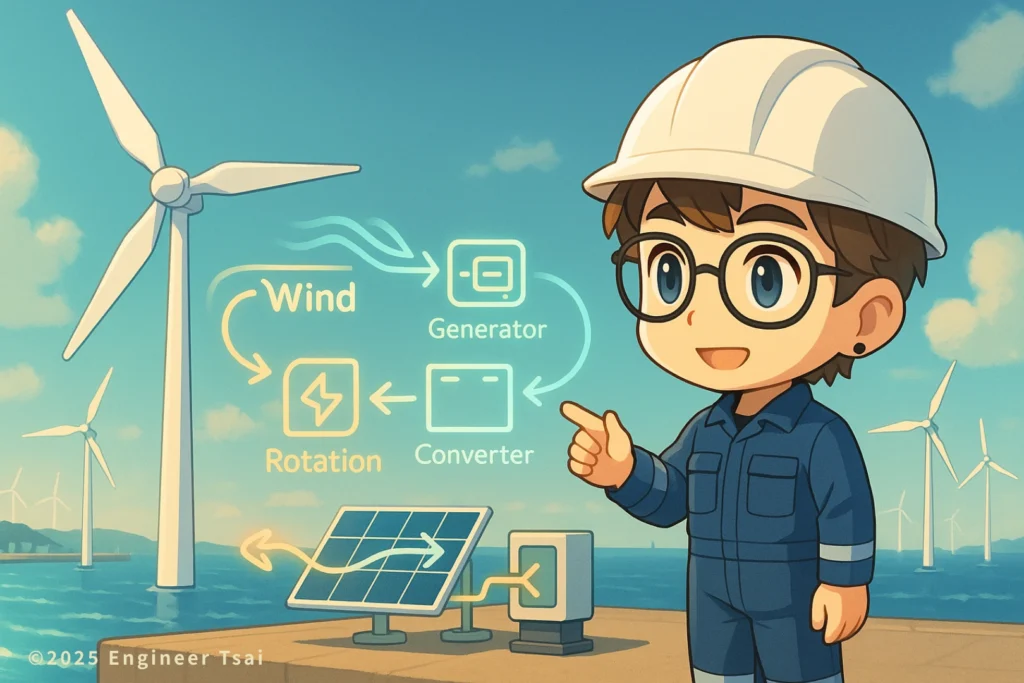
Most people ask the same thing the first time they see a wind farm: how does a wind turbine generate electricity—what’s the actual “wind → power” chain? Let’s walk it step by step.
Quick answer (for your brain to “lock in” the picture first):
How does a wind turbine generate electricity? It captures the wind’s kinetic energy with airfoil-shaped blades, turns that into rotation, generates electricity through electromagnetic induction, then uses power electronics to output grid-ready AC at 60 Hz, and finally steps up voltage to send it efficiently onto the grid.
If you’re still building your “electricity fundamentals” intuition, start here first:
🔹 Electricity Basics: from “What is electricity?” to reading a home panel
After that, this wind power article will feel way more visual.
Wind Power: how does a wind turbine generate electricity?
If you’ve ever driven past wind farms in the Midwest, seen turbines along a coastal highway, or watched offshore wind news and wondered, “Okay… how does wind turn into electricity?”—this is the full chain in plain English.
We’ll walk the whole route: wind → blades → shaft → generator → converter → transformer → grid. No mystery boxes.
▶️ Watch first: a simple diagram from wind to electricity
If the video makes you ask any of these questions—“Why do some turbines have gearboxes?”, “Why do we need a converter?”, “Why doesn’t stronger wind always mean more power?”—the article below is the detailed version that fills in the blanks.
Chapter 1 — What is wind power? Start with what the turbine is actually doing
Here’s the whole wind power principle in one sentence:
Wind power = capture the wind’s kinetic energy as rotation, then convert that rotation into electricity.
So when someone asks how does a wind turbine generate electricity, you can treat it like an energy-conversion chain—nothing “mystical,” just clean physics and tight control.
If you came here with one question—how does a wind turbine generate electricity—this chapter is the big-picture map before we zoom into blades, generators, and grid connection.
When you look at a wind turbine, you can mentally split it into a few “parts you can recognize at a glance”:
- Blades: the “wind catcher” (airfoil-shaped, like an airplane wing)
- Hub + main shaft: turns blade forces into steady rotation
- Nacelle: the housing that hides the serious stuff—gearbox (on some designs), generator, brake, sensors, control systems
- Tower: gets the rotor higher, where winds are typically faster and less turbulent
A lot of people assume “more wind = more electricity,” but a modern wind turbine is more like a stabilizer machine: it takes a messy, constantly changing natural input, and turns it into power the grid can actually accept. That means measuring wind, yawing into it, controlling rotor speed, protecting the structure, and conditioning the electrical output.
Chapter 2 — How blades turn wind into rotation: lift, pitch angle, and speed control
Blades don’t just “get pushed by wind.” They work like airplane wings: they create lift, and that lift creates torque that spins the rotor.
So if you’re still asking how does a wind turbine generate electricity, this is where the chain truly starts: the blades use lift to turn moving air into usable rotation.
Here’s a simple physical feel for it: put your hand out the window of a moving car. Change your palm angle and the force direction changes. A turbine blade is doing the same kind of “angle + shape” trick—except engineered to pull energy out of the wind efficiently.
Two keywords matter a lot here. If these click, wind turbines suddenly feel logical:
① Pitch angle (blade pitch)
Blades don’t stay at one fixed angle. The turbine constantly adjusts pitch to maximize efficiency in normal winds—and to protect itself in strong winds. When winds get too high, blades can “feather” (turn close to edge-on) to reduce loads and slow the rotor down.
② Rotor speed control (RPM control)
A turbine is not trying to spin faster forever. Too fast means higher noise, higher structural stress, and electrical overload risks. The control system keeps the turbine in the “best balance” zone: efficient, stable, and safe.
In the U.S., this “control engineering” side shows up in real conditions: steady Great Plains wind is very different from coastal turbulence, and offshore wind has its own beast-mode weather. That’s why a turbine looks graceful, but the brains behind it are doing constant work.
Chapter 3 — From rotation to electricity: generators and electromagnetic induction
At this point, you’ve “harvested” wind into rotation. Now the core question is:
How does rotation become electricity?
This is the moment the question how does a wind turbine generate electricity finally becomes concrete: the generator is where mechanical rotation turns into electrical energy.
The answer is still the classic: electromagnetic induction.
A generator is brutally honest: if you create relative motion between a magnetic field and a coil of wire, the changing magnetic flux induces a voltage. If the circuit is closed, current flows.
In wind turbines, you’ll typically see two common design directions:
- Gearbox-based (geared drive): the rotor spins relatively slowly, but many generators prefer higher RPM, so a gearbox steps up rotational speed to a generator-friendly range.
- Direct-drive: avoids the gearbox by using a generator designed for low-speed, high-torque rotation. You reduce one major maintenance point, but the generator can be larger/heavier and the cost trade-offs shift.
No matter which design you’re looking at, keep the core sentence in your pocket:
Wind turns the blades into rotation; rotation becomes electricity through electromagnetic induction.
If you want a deeper “why this always works” explanation, here’s the longer read:
🔹 What is electromagnetic induction? Faraday’s law explained (generators + wireless charging)
Once you see that, you’ll notice wind, hydro, and thermal plants share the same “electricity-making core.” The difference is just how they spin the rotor.
Chapter 4 — Wind power doesn’t plug straight into the grid: converter, step-up transformer, interconnection, and power factor
People often assume “once the generator makes electricity, you just send it out.” The real headache is this:
Wind changes → rotor speed changes → generator output changes.
If you tried to connect that raw output directly, the grid would hate it.
So when people ask how does a wind turbine generate electricity, the complete answer must include the converter—because “making electricity” isn’t the same as “making grid-compatible electricity.”
That’s why wind turbines rely heavily on power electronics, often referred to as a power converter (and the wider “power electronics + controls” system around it).
Think of the converter as the “power conditioning specialist”:
It takes the generator’s variable output, conditions it (rectifies/controls), and outputs grid-ready AC at a stable 60 Hz with controlled voltage and current quality. It can also support grid needs by managing reactive power, voltage behavior, and protective functions.
Then there’s a very practical step before power travels any meaningful distance: step-up voltage.
Inside a wind plant, power is commonly collected at medium voltage and then stepped up at a substation so it can move onto transmission more efficiently (lower current → lower losses). That’s why you’ll often see transformer and substation infrastructure as part of the wind project—not just turbines.
If “power factor” and “reactive power” still feel abstract, grid interconnection makes them painfully real—because the grid doesn’t only care that you produce energy; it cares about power quality and voltage support too.
🔹 What is power factor? How it affects efficiency and the grid
Chapter 5 — The U.S. reality: offshore, hurricanes, salt spray, icing, noise, and wildlife
Once you understand how wind power works, the next layer is the “engineering reality layer.” In the U.S., wind projects run into a different set of real-world constraints depending on region:
① Why so much onshore wind in the Plains—and why offshore is a different game
Onshore wind thrives where wind is strong and steady (think wide-open terrain). Offshore wind can be steadier and often stronger, but the project becomes a marine engineering challenge: installation windows, corrosion, logistics, and operations & maintenance at sea.
② Hurricanes and severe weather (and “survive first, generate later”)
Coastal wind has to plan for extreme storms. Turbines use protective strategies: pitch to feather, reduce loads, brake/lock, and enter cut-out modes. The goal is simple: survive the event, then go back to generating.
③ Salt spray, lightning, and icing
Offshore environments accelerate corrosion (salt + moisture). Many regions also deal with lightning exposure. In colder climates, icing can reduce aerodynamic efficiency and create safety constraints—so monitoring, heating/anti-icing strategies, and operational limits matter.
④ Noise, viewsheds, permitting, and wildlife
Onshore wind often faces siting questions: noise limits, setback distances, and landscape impact. Wildlife concerns can include birds and bats; offshore can involve marine ecosystems and fishing activity coordination. None of this is solved by a “better generator”—it’s a system + community + policy puzzle.
If you treat wind power as a large infrastructure project (not a single machine), everything makes more sense: turbines are one part of a full energy system that includes grid interconnection, operations, maintenance, and environmental coordination.
Conclusion — Wind power isn’t magic. It’s a chain of practical energy conversions
Wind power can look “clean” or even “romantic” from far away. But when you break it down, it’s extremely practical:
Wind (kinetic energy) → blades (lift captures energy) → rotation (mechanical energy) → generator (electromagnetic induction) → converter (power conditioning) → step-up + interconnection (electricity that actually reaches your home)
Next time you see turbines on a ridge line, across farm fields, or offshore on the horizon, you won’t just see “something spinning.” You’ll know how does a wind turbine generate electricity: a controlled system that turns unstable wind into stable, usable power for the grid.
And if a friend asks you the same question—how does a wind turbine generate electricity—you can answer it with that one chain: capture wind as rotation, convert rotation into electricity, then condition it for the grid.
📌 Recommended reading (internal links):
🔹Electromagnetic Induction: Faraday’s law explained (generators + wireless charging)
Wind turbines still rely on the same core physics you learned in textbooks—this article makes the key ideas crystal clear.
🔹How an AC generator works: turning rotation into electricity
If “rotor, stator, magnetic field, coil” feels foggy, this one clears it up fast.
🔹Power factor explained: why the grid cares about power quality
Grid connection isn’t only about “making power.” It’s about making power the grid can accept and control.
If you want a quick “big map” of motors, generators, drives, and converters:
🔹Motors, generators, and variable frequency drives: one complete map
External references (U.S.-friendly):
🔹Offshore Wind Energy (U.S. DOE / EERE)
🔹Wind Energy Research (NREL)
🔹Wind Explained (U.S. Energy Information Administration)
🔹Global Wind Report 2024 (GWEC)
Wind Power FAQ
Q1: How does a wind turbine generate electricity in one sentence?
A: How does a wind turbine generate electricity? It captures wind as rotation, converts rotation into electricity through electromagnetic induction, then uses a converter to deliver stable, grid-compatible AC at 60 Hz with acceptable power quality.
Q2: Why do some turbines use a gearbox while others are direct-drive?
A: Rotor speed is usually low, while many generators prefer higher RPM. A gearbox steps up speed; direct-drive uses a generator designed for low-speed, high-torque operation—reducing one major maintenance item but often making the generator larger/heavier with different cost trade-offs.
Q3: If the wind is stronger, does a turbine always generate more power?
A: Not always. Turbines operate with a cut-in speed, a rated wind speed region, and a cut-out (or protective) region. Very low wind produces little power, and very high wind can trigger curtailment or shutdown for safety—so it’s not “the stronger the better,” it’s “the right range is best.”
Q4: Why does wind power need a converter before connecting to the grid?
A: Because wind speed changes cause rotor speed changes, which makes generator voltage and frequency vary. The converter conditions and controls the output so the turbine can deliver stable, grid-compatible AC (and support voltage/reactive power needs) instead of raw fluctuating power.
Q5: What makes wind projects hard in the U.S.?
A: Beyond turbine technology, the real challenges are site and system realities: severe weather strategies (including hurricanes in some regions), offshore corrosion and logistics, icing in cold climates, noise and permitting constraints, wildlife impacts, transmission availability, and long-term operations & maintenance.
—
When wind power finally “clicked” for you, what was the one part that made it click—blades making lift, electromagnetic induction, or the converter / grid connection?
Drop your question in the comments. If I see repeated themes, I’ll turn them into a short “wind power from beginner to explaining it to a friend” cheat sheet.
Read next in this topic
- What Is Electricity ? Everything You Need to Know
- Current & Voltage for DIY Enthusiasts : Unlock the Basics
- AC vs DC: What’s the Difference and Why It Matters (From Phone Charging to 120 V Home Power)
- Basic Parts of an Electric Circuit (Power Source, Wires, Loads)
- Conductor vs Insulator: How Your Home’s Wiring Keeps You from Getting Shocked
- Ohm’s Law Explained: V = IR for 120V Home Circuits
- What Is a Resistor? How It Works, Types, and How to Choose the Right One
- Series vs Parallel Circuits: Simple Guide for Home Wiring (With Formulas & Examples)
- How Electromagnetic Wave and Electricity Shape Modern Technology
- What Is Voltage? Simple Definition, Everyday Examples, and Safety Tips
- What Is a Battery? How It Works, Types, and Everyday Uses Explained
- What Is Ampere’s Law? A Visual Guide to How Current Creates Magnetic Fields
- What Does a Capacitor Do? Uses, Energy Storage, and Everyday Examples
- Types of Electrical Wire: How to Choose the Right One for Your Home
- How AC Power Is Converted to DC: What’s Really Inside Your Phone Charger?
- Electrical Energy Conversion: How Energy Transforms for Everyday Use
- Magnetic Field and Current: The Core Relationship Behind Motors, Generators, and Wireless Charging
- How Do Magnets Work? From Fridge Magnets to Maglev Trains
- What Is Inductance? Inductor Basics for Real-World Circuits
- What Is Impedance? A Plain-Language Guide to Resistance, Inductive Reactance, and Capacitive Reactance