On this page
Table of contents
If you’re still building your foundation in basic electricity, start with this beginner-friendly overview: 🔹 “Electricity 101: The Complete Beginner’s Guide to How Power Really Works”
After reading it, the concepts in this article will make a lot more sense.
How do electric cars actually work?
Whether this is your first time seriously looking at EVs or you’re thinking about switching from a gas car, this guide will walk you through how electric cars work in a simple, visual way — from “electricity” to “motion.”
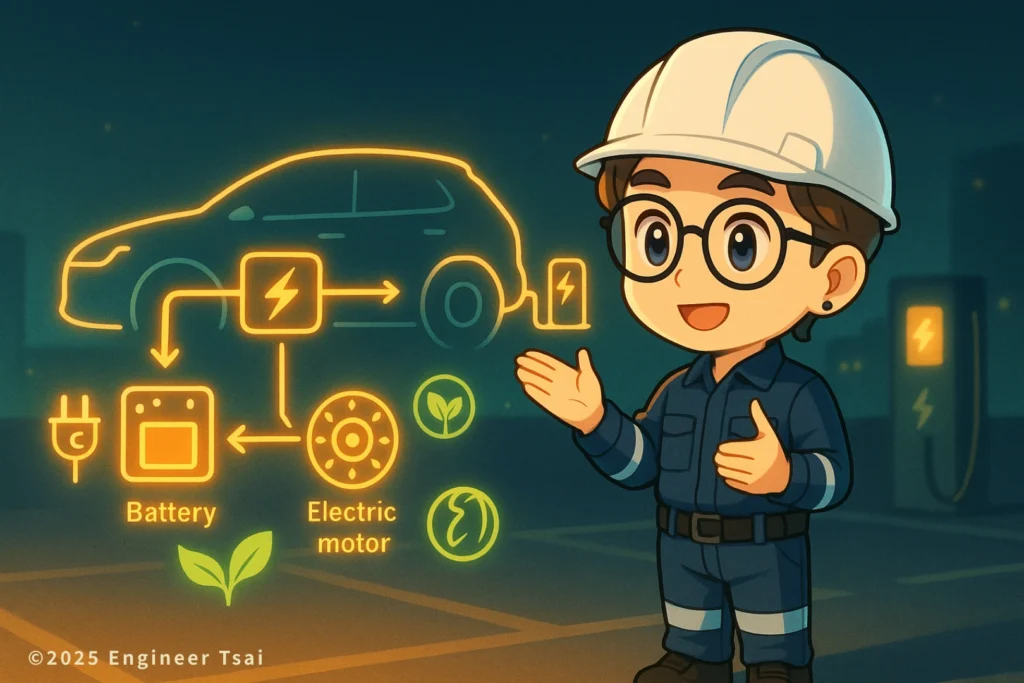
▶️ Watch now: How electric cars move – one diagram to see the whole EV power flow
On today’s roads, it’s hard not to see an electric car (EV):
maybe a silent Tesla gliding past you on the highway, or a compact EV parked at a charger outside a grocery store slowly “topping up.”
If that video makes you wonder, “Okay, but where is it really different from a gas car? What’s happening in the circuits when I charge, drive, and slow down?” — this article is your deep-dive companion on how electric cars work in real life.
We’ll walk through electric car basics in a way that matches real-world driving: the differences between gas and EV drivetrains, what the battery, motor, and controller actually do, and how the electricity you see on the charger screen turns into the force that pushes your car down the road.
1. What do electric cars really look like? Start with gas vs. EV
To really understand how electric cars work and how they differ from gas cars, it helps to first get a clear picture of the basic electric car layout.
Let’s start with a scene everyone knows: filling up vs. plugging in.
A traditional gasoline car works roughly like this:
- You pump gas → the fuel tank stores gasoline (chemical energy).
- The engine burns gasoline → creates hot, high-pressure gas (thermal energy).
- Pistons and crankshaft turn that into rotation (mechanical energy) → through the transmission and driveshaft to the wheels.
The whole system has a lot of moving, rubbing, and wearing mechanical parts: pistons, valves, gears in the transmission, oil pumps, exhaust components, and more.
An electric car is much simpler. You can think of the path like this:
- You plug in → the battery stores electrical energy (in chemical form).
- An on-board charger (OBC) + battery management system (BMS) make sure that energy is taken in safely and stored correctly.
- An inverter converts the battery’s DC power into three-phase AC power for the motor.
- The motor drives the wheels directly (usually through a single fixed gear reduction), so you don’t always need a multi-speed transmission like a gas car.
No explosions, no constant high-temperature combustion, no engine oil circulation — so the whole system runs quieter, smoother, and is easier to control precisely. That’s why so many first-time EV drivers say, “I can’t believe how quiet and smooth this is.”
For now, you can think of gas cars and electric cars as two different “power systems”:
- Gas car: a very complex mechanical system, with electronics mainly helping control ignition, fuel injection, and body functions.
- Electric car: the electrical and control system are the main characters, and the mechanical parts are much simpler.
2. How do electric cars turn electricity into motion?
At the heart of how electric cars work is one key question: how does electricity turn into torque at the wheels?
Let’s walk through one full energy flow route inside an EV, step by step — from the plug to the tires.
① From outlet / charging station: AC comes in
In most homes and many public locations, charging starts with AC power. In the U.S., that could be a Level 1 120 V outlet or a Level 2 240 V charger in your garage or parking lot.
This AC power first goes through the car’s on-board charger (OBC), which converts AC to DC suitable for the battery, while the battery management system (BMS) watches voltage, current, and temperature to prevent overcharging or overheating.
② The battery stores DC energy
The traction battery in an EV is like a giant power bank, except it’s not 5 V — it’s typically a high-voltage system in the 300–800 V range.
It stores energy in chemical form and releases it as DC (direct current) when the car needs power.
③ The inverter: turning DC into three-phase AC the motor can use
Most traction motors in EVs are three-phase AC machines (such as permanent magnet synchronous motors, PMSM, or induction motors). To drive them, you need a “translator” in between — the inverter.
- It chops the DC from the battery into high-frequency PWM and reshapes it into three-phase AC waveforms.
- At the same time, it adjusts voltage and frequency based on your accelerator pedal, vehicle speed, and road conditions to control motor speed and torque.
If you’ve worked with variable frequency drives (VFDs) in industrial settings, you can think of the inverter as a high-performance, EV-specific VFD for the traction motor.
④ The motor turns electrical energy into mechanical energy at the wheels
Once three-phase AC power reaches the motor, the stator windings create a rotating magnetic field that pulls the rotor along. That rotation then goes through a fixed gear reduction and directly out to the drive wheels.
If we summarize this whole path in one line, it looks like this:
Outlet / charger → On-board charger & BMS → Battery (DC) → Inverter (AC) → Motor (rotation) → Wheels (forward motion)
3. Battery, motor, controller: the three core parts of an EV
If you break an electric car down into “organs” to see how electric cars work as a system, three of them stand out:
- Battery = fuel tank + long-term energy storage
- Motor = muscles
- Controller & power electronics (inverter / ECU) = brain + nervous system
1. Battery: your driving range lives and dies here
Modern EVs almost all use lithium-ion batteries (you can also check this lithium-ion battery overview). Structurally, they look like this:
- Individual cells
- Cells grouped into modules
- Modules combined into a pack, usually mounted under the floor or in the center of the vehicle
The real hero that keeps the battery safe and long-lasting is the invisible one: the BMS (Battery Management System). It’s responsible for:
- Monitoring voltage, temperature, and current for each group of cells
- Preventing overcharge, over-discharge, and overheating during use
- Balancing cells so that each one shares the workload more evenly
- Estimating SOC (state of charge) and SOH (state of health) — the numbers behind your remaining range display
2. Motor: why EVs feel so quick off the line
If you’ve read my article “What is an electric motor? From electricity to motion”, you already know one superpower of motors: they can deliver high torque at low RPM.
That’s why many EVs don’t need multi-speed transmissions and still feel strong from a standstill — the motor can provide plenty of torque right away, instead of waiting to spin up like a gas engine and then relying on gear ratios to hit its sweet spot.
Even better, the traction motor doesn’t just push the car. When you lift off the accelerator or press the brake, it can switch roles and act as a generator — which brings us to regenerative braking in the next chapter.
3. Controller: turning your right foot into digital commands
In a modern EV, the “gas pedal” is really an electronic accelerator pedal. When you press it, you’re not pulling a cable — you’re doing this:
- A sensor on the pedal reads how far you pressed it down.
- The signal goes to the vehicle control unit (VCU / ECU).
- The controller then tells the inverter and motor exactly how much torque to deliver.
At the same time, a lot of other modules are chatting constantly: braking system, battery, motor, cooling system, ADAS sensors, and more. The in-car communication network (CAN bus, LIN, etc.) is basically a mini industrial automation system running inside your vehicle.
4. How do electric cars charge? Level 2, DC fast charging, and regen braking
Now that you’ve seen how electric cars work from the plug to the wheels, let’s look at the two big questions most drivers care about day to day:
- How do you charge an electric car? (And how long does it take?)
- How does the car save or recover energy while driving?
1. Level 2 AC charging: like letting your phone charge overnight
The most common setup at home or in apartment garages is AC Level 2 charging. Power levels typically range from a few kilowatts up to around 10–19 kW, depending on your installation.
You can think of it as: “Plug in before bed and wake up to a battery that’s full or close to full.”
For many commuters whose daily mileage isn’t extreme, a stable Level 2 charger at home or work is more than enough — you don’t actually need to hunt for DC fast chargers every day.
2. DC fast charging: great for road trips, not an everyday diet
On highways and around major shopping centers, you’ll see DC fast chargers with power ratings like 50 kW, 150 kW, or even higher. The benefit is obvious:
- Perfect for “quick top-ups” on long road trips
- Can bring the battery from something like 20–30% up to 70–80% in a relatively short stop
But keep in mind that batteries prefer gentler charging overall. Relying on high-power fast charging all the time isn’t ideal for long-term battery health — it’s a bit like sprinting at full speed every time you exercise. Your body might handle it, but it’s not exactly relaxing.
3. Regenerative braking: slowing down while picking some energy back up
Regenerative braking is one of the most interesting features of electric cars.
When you lift off the accelerator or press the brake pedal, the motor stops acting like a load that consumes power and switches to acting like a generator: the car’s motion turns the motor, the inverter routes that generated power back to the battery, and some of the kinetic energy is stored as electrical energy again.
That’s why many EV drivers say, “Just lifting off the pedal gives me a strong slowing-down feeling.” The car is literally helping you recycle energy.
For the driver, it’s a different pedal feel. For engineers, it’s just the motor and inverter switching operating modes.
Conclusion: Electric cars aren’t magic – it’s just electrical engineering on wheels
For a lot of people, their first experience with an electric car feels like “black magic”: quiet, quick off the line, capable of recovering energy when slowing down, and constantly estimating remaining range.
But once you crack it open, it’s really just the same principles we learn in basic electrical engineering:
- DC, AC, and three-phase power
- Motor principles and variable frequency control
- Battery charging and discharging, and power management
The difference is simply this: those principles are packaged into a system that moves, carries people, and talks to a whole network of sensors and controllers. The EVs you see on the road every day are electrical engineering made visible — and once you understand how electric cars work, they stop feeling mysterious.
Whether you have an electrical background, you’re thinking about switching your career into the EV industry, or you’re just curious about what’s really happening inside the car you drive, I hope that next time you look at power, voltage, current, and range on your dashboard, you’ll have a clearer mental picture of what’s going on.
If this breakdown of how electric cars work helped you visualize what’s happening under the floor and under the hood, feel free to bookmark it and come back to it when you’re shopping for your next car or explaining EVs to a friend.
📌 Further reading
🔹 What is an electric motor? From electricity to motion
If you want to understand why electric cars feel so quick and smooth, start here — this explains how motors turn electrical energy into torque.
🔹 What is a variable frequency drive? How it controls motors
EV inverters behave very similarly to industrial VFDs. Reading this will make EV power-flow diagrams much easier to understand.
🔹 How current affects battery life
EV batteries are huge lithium-ion packs. Knowing how current affects lifespan helps you understand charging speed, battery health, and range drop-off.
🔹 What is electrical grounding?
A great foundation if you want to understand EV safety systems and why grounding concepts still matter in high-voltage vehicles.
🔹 What is a short circuit?
Essential reading if you’re learning EV fundamentals — battery safety, current flow, and fault conditions all relate to this core idea.
If you want to dive deeper into motor behavior, you can also check out this overview of permanent magnet synchronous motors (PMSM).
Electric car FAQ
Q1: What’s the biggest difference between an electric car and a traditional gas car?
A: The core difference is the “energy source” and “energy conversion path.” A gas car turns the chemical energy in gasoline into heat through combustion, then uses the engine and transmission to turn that into mechanical energy. An electric car takes electrical energy stored in the battery and uses the inverter and motor to turn it directly into rotation. With no combustion and no multi-speed transmission, the system is quieter, mechanically simpler, and easier to fine-tune with electronic control.
Q2: Are electric cars more likely to run out of charge and leave you stranded?
A: Not if you build basic charging habits. Most EVs clearly show remaining battery percentage and estimated range on the dash, and they warn you well before things get critical. The real trouble usually comes from long trips with no charging plan, or intentionally running the battery very low before charging. Just like with gas cars, if you get used to “filling up” earlier rather than later, being stranded is pretty rare.
Q3: Do I have to install a home charger if I buy an EV?
A: Not strictly, but having one makes life a lot easier. If you live near reliable public charging and your daily mileage is modest, you could survive on public chargers. But for many U.S. drivers, a Level 2 home charger feels like having your own gas station in the garage: plug in at night, leave with plenty of range in the morning. Just remember that home charging involves electrical load and safety, so always work with a qualified electrician.
Q4: How long do EV batteries last, and can they be replaced?
A: Real-world life depends on usage, charging patterns, climate, and more. Most manufacturers offer multi-year or mileage-based battery warranties and design packs to remain usable over the normal life of the vehicle. When capacity drops enough to affect daily use, you can, in principle, replace modules or the whole pack — but it’s not cheap. That’s why good habits matter: avoiding long-term storage at 100%, not abusing fast charging daily, and keeping the battery within a reasonable temperature range all help extend battery life.
Q5: If I have an electrical or technical background and want to work in the EV industry, where should I start?
A: You can start from three directions: (1) Power electronics and motor control: inverters, PWM, three-phase motor drives; (2) Battery and BMS fundamentals: lithium-ion chemistry, safety mechanisms, SOC/SOH estimation; (3) Automotive communication and system integration: CAN bus, body control, charging communication protocols, etc. Build a solid base with general motors, VFDs, and AC/DC fundamentals first, then extend that into automotive-grade specs and real-world EV case studies — the more you see, the more it will all click together.
—
Have you driven an electric car yourself, or are you thinking about switching from a gas car to an EV?
What do you care about the most — range, charging convenience, performance, or maintenance costs? Share your experience or questions in the comments.
If you have a friend who’s currently researching EVs, feel free to send them this guide so they can make a more confident decision by actually understanding how electric cars work instead of just comparing spec sheets.
Read next in this topic
- What Is Electricity ? Everything You Need to Know
- Current & Voltage for DIY Enthusiasts : Unlock the Basics
- AC vs DC: What’s the Difference and Why It Matters (From Phone Charging to 120 V Home Power)
- Basic Parts of an Electric Circuit (Power Source, Wires, Loads)
- Conductor vs Insulator: How Your Home’s Wiring Keeps You from Getting Shocked
- Ohm’s Law Explained: V = IR for 120V Home Circuits
- What Is a Resistor? How It Works, Types, and How to Choose the Right One
- Series vs Parallel Circuits: Simple Guide for Home Wiring (With Formulas & Examples)
- How Electromagnetic Wave and Electricity Shape Modern Technology
- What Is Voltage? Simple Definition, Everyday Examples, and Safety Tips
- What Is a Battery? How It Works, Types, and Everyday Uses Explained
- What Is Ampere’s Law? A Visual Guide to How Current Creates Magnetic Fields
- What Does a Capacitor Do? Uses, Energy Storage, and Everyday Examples
- Types of Electrical Wire: How to Choose the Right One for Your Home
- How AC Power Is Converted to DC: What’s Really Inside Your Phone Charger?
- Electrical Energy Conversion: How Energy Transforms for Everyday Use
- Magnetic Field and Current: The Core Relationship Behind Motors, Generators, and Wireless Charging
- How Do Magnets Work? From Fridge Magnets to Maglev Trains
- What Is Inductance? Inductor Basics for Real-World Circuits
- What Is Impedance? A Plain-Language Guide to Resistance, Inductive Reactance, and Capacitive Reactance