On this page
Table of contents

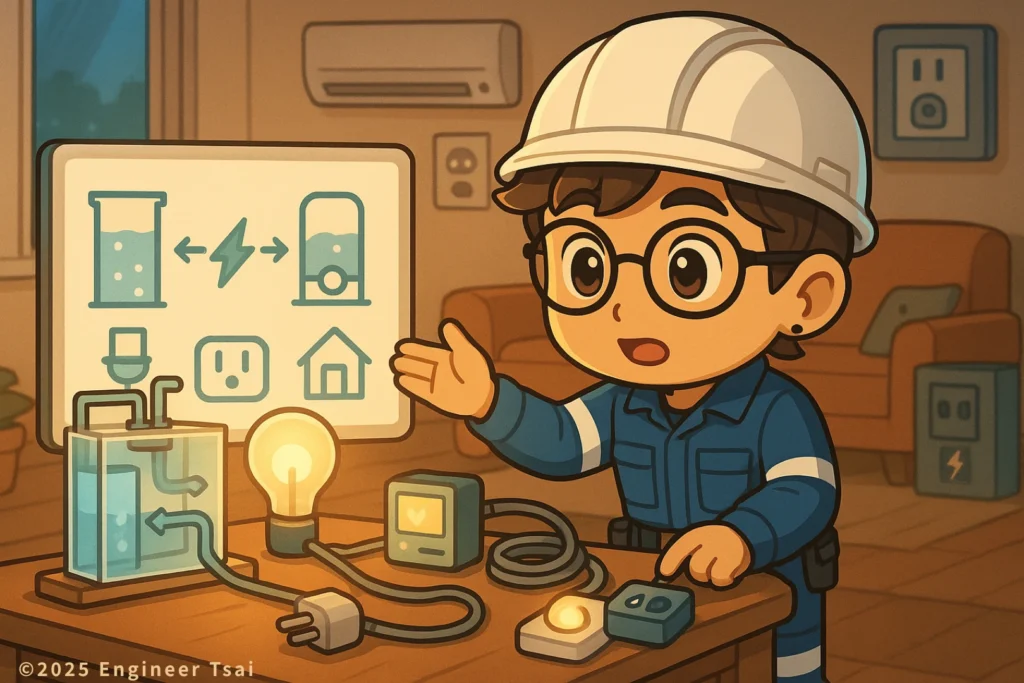
If you’re still building your foundation in basic electricity, start with this beginner-friendly overview: 🔹 “Electricity 101: The Complete Beginner’s Guide to How Power Really Works”
After reading it, the concepts in this article will make a lot more sense.
▶️ Watch now: how LED lights work & why they look brighter on less power (60 seconds)
The basic idea of how LED lights work is actually pretty simple: instead of heating a metal filament until it glows like old bulbs do, LEDs use a semiconductor to turn electrical energy directly into light. Less wasted heat, higher efficiency, much longer life.
This short video gives you a quick crash course on how LED lights produce light, why they use less energy, and what to look for when you buy them (color temperature / CRI) — so the next time you’re standing in the lighting aisle, you’ll actually know what you’re choosing.
How LED lights work: why they’re more efficient
Look around your home and think about the bulbs you’ve replaced over the last few years. The ceiling fixtures, table lamps, hallway night lights, even the tiny indicator lights on your electronics — chances are, most of them are now LED.
But a lot of people still have questions sitting in the back of their mind:
- How exactly do LED lights work? Are they just “more efficient bulbs”?
- Why is LED lighting considered more efficient than old incandescent bulbs or CFLs? What’s actually different?
- If they’re supposed to last so long, is it really worth paying extra to swap everything to LED?
In this article, I’ll walk you — from a jobsite perspective — through the old-school bulbs first, then all the way to modern LEDs. We’ll use plain language to unpack how LED lights work and why they really are both smarter and more efficient.
How traditional bulbs make light: the “old school” way
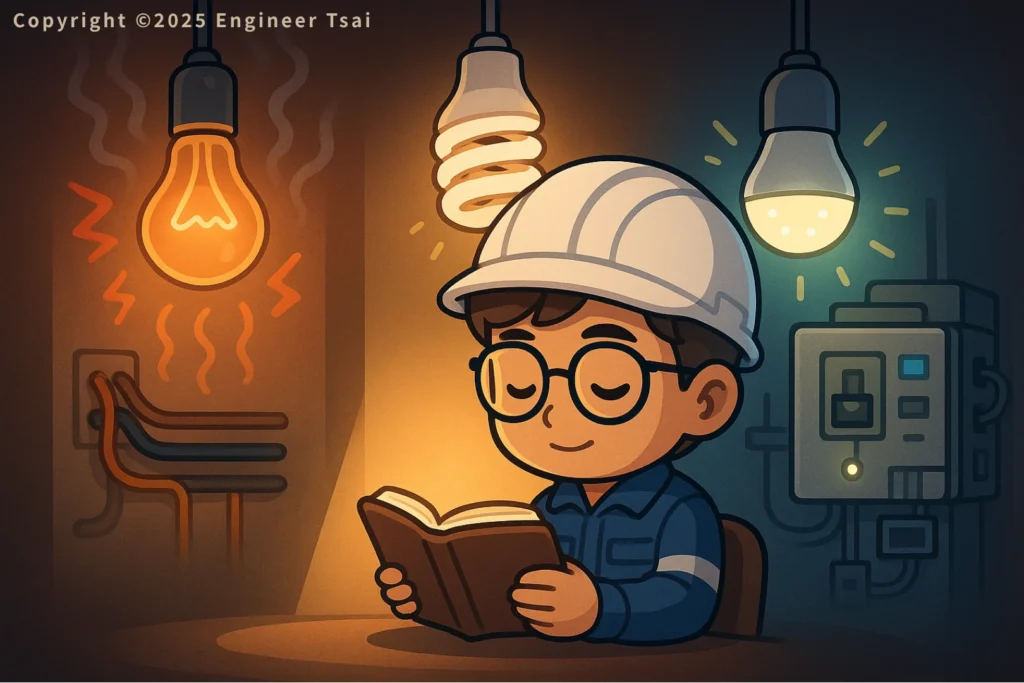
To really appreciate how LED lights work, it helps to look back at the previous generations of lighting. The contrast makes LED tech much easier to understand.
1️⃣ Incandescent bulbs: forcing light out with heat
Those classic yellowish bulbs you grew up with are incandescent bulbs. Their strategy is very brute-force: send current through a thin tungsten filament, heat it up to around 2,000–3,000°C (3,600–5,400°F), and it glows so hot it emits visible light.
The problem? This method is extremely inefficient. Out of 100 watts of power, roughly 90 watts are wasted as heat, and less than 10 watts actually become useful light. Stand under an old ceiling fixture and feel your head getting warm — that’s your electric bill turning into heat instead of light.
2️⃣ Fluorescent tubes & CFLs: indirect light with extra complexity
Later, we got fluorescent tubes and CFLs (compact fluorescent lamps). Instead of heating metal, they send current through mercury vapor inside the tube, which produces ultraviolet (UV) light. That UV then hits the phosphor coating on the inside of the tube and turns into visible light.
They’re more efficient than incandescent bulbs, but still come with trade-offs:
- They contain mercury, so breakage and disposal are a hassle.
- They rely on ballasts and extra circuitry, which can fail over time.
- Common annoyances: slow start-up, visible flicker, and color that’s a bit too green or too cold-white.
So when modern LED lighting showed up, it was basically the end of the “we make light by burning or exciting stuff” era.
How LED lights make light: they’re not just “bulbs”
LED stands for Light Emitting Diode. The key word isn’t “light” or “bulb” — it’s diode.
An LED is a specially designed semiconductor device with two regions, called P-type and N-type, forming what’s known as a PN junction. When you apply voltage in the right direction, electrons move across this junction. As they drop from a higher energy level to a lower one, they release tiny packets of energy called photons — which we see as light.
The key to understanding how LED lights work is this: they don’t rely on heating anything up until it glows. They rely on electron “jumps” inside a semiconductor. When current flows through the material, electrons change energy levels and directly emit light in the process.
This way of producing light gives LED fixtures several big built-in advantages:
- Less heat, less wasted energy: more of the power you pay for turns into light instead of cooking the room.
- Color is controllable: by choosing the right semiconductor materials, you can get red, green, blue, warm white, cool white, and more.
- Very long life: a good LED fixture can last 25,000–50,000 hours, which dramatically cuts down how often you’re changing bulbs.
- Compact and durable: no fragile filament, so they handle frequent on/off cycles and small vibrations a lot better.
That’s why you see so many strip lights, track lights, recessed downlights, under-cabinet lights, and tiny night lights using LEDs. The way LED lights work makes them naturally suited to almost any form factor designers can come up with.
Why LED lights are so efficient: let the numbers talk
“Energy efficient” can sound like marketing fluff, so let’s put some numbers to it. The key metric here is luminous efficacy — how many lumens (lm) of light you get per watt (W) of power.
Very roughly, you can think of it like this:
- Incandescent bulbs: about 10–15 lm/W
- CFLs / fluorescent lamps: about 50–60 lm/W
- Common home LED bulbs: typically 100–120 lm/W, with higher-end models reaching 150 lm/W or more
In other words, for the same 10 watts of power:
- an LED bulb can be almost 10× brighter than an incandescent bulb, and
- roughly twice as efficient as a CFL.
This is why, when you swap a living room full of bulbs to LED, the room stays just as bright or brighter while your electric bill noticeably drops. On top of that, LED lights are practically “instant on” — no warm-up time, no visible flicker — which is easier on your eyes and your mood.
The “brain” behind LED lights: the driver circuit
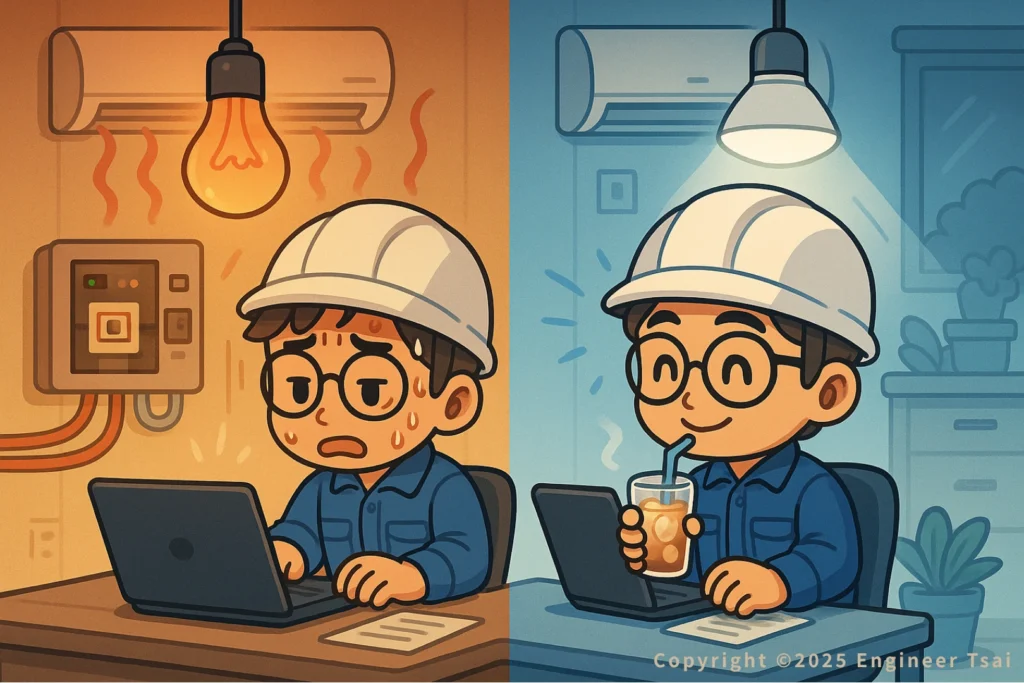
There’s one more important piece in how LED lights work: the driver. You can think of it as the LED’s mini power supply plus protection circuit.
Most homes in the U.S. use roughly 120V AC (alternating current). But LED chips prefer stable, controlled DC (direct current). The driver’s job is to:
- convert 120V AC from the wall into the right DC voltage and current for the LEDs
- limit current so the LEDs don’t get “overfed” and burn out
- keep the output stable to reduce flicker and extend the overall life of the fixture
When people complain that their “cheap LED bulbs died after a year,” it’s often not the LED chips themselves that were the main problem. In many cases, the driver circuit was built to a price, not to a standard — poor current control and weak thermal design slowly kill the LEDs or cause them to flicker and dim early.
So when you’re buying LED lights in the U.S., don’t just look at the price tag. Also pay attention to things like:
- whether the bulb or fixture is listed by UL or ETL
- clear labeling for rated voltage, wattage, and light output (lumens)
- extra marks like Energy Star or RoHS compliance, which usually mean better testing and safety standards
Home LED buying guide: how not to get burned
If you’re slowly switching your home over to LEDs, here are a few practical rules of thumb to help you choose smarter — without needing to memorize a textbook.
- ① How bright should it be?
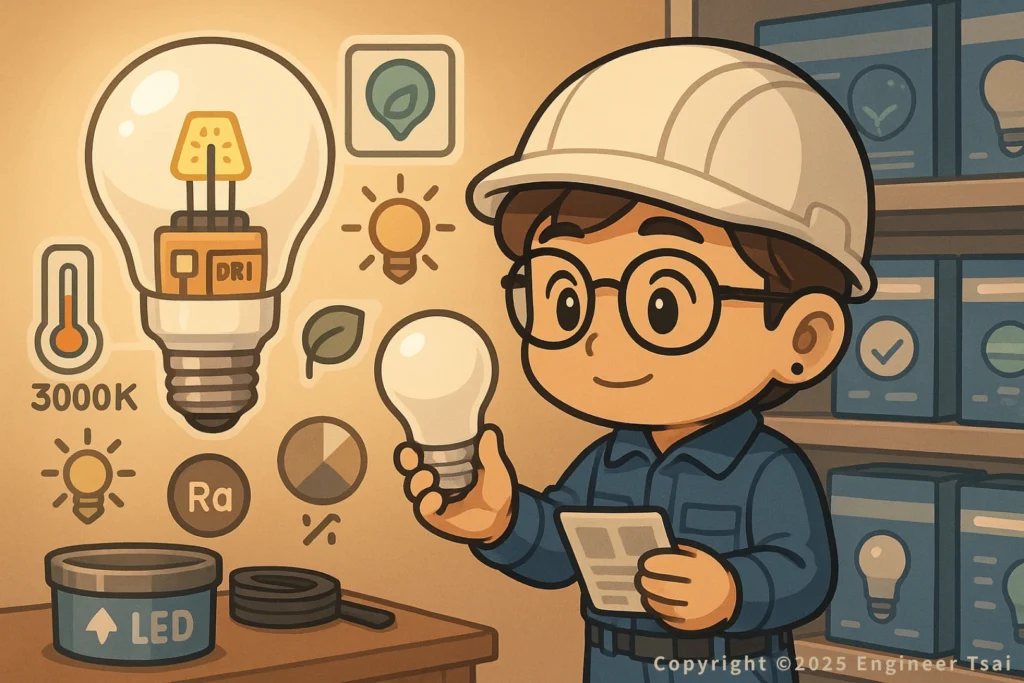
Instead of thinking “60W bulb” or “100W bulb,” look at lumens. For most living spaces, aiming for about 15–20 lumens per square foot is a good starting point.
So for a 200 sq ft living room, you’d want a total of roughly 3,000–4,000 lumens (spread across your ceiling light plus a few lamps). - ② What color temperature should I choose?
Around 2700–3000K (warm white): great for living rooms and bedrooms — softer, cozier light that helps you relax.
4000–5000K (neutral / cool white): better for kitchens, home offices, and work areas where you need to see details clearly. - ③ Color rendering index (CRI) really matters
Look for CRI 80+ as a baseline so colors don’t look washed out or strange. If you’re sensitive to color — painting, crafts, food photography — go for CRI 90+. - ④ Check efficiency labels
Products with Energy Star or similar efficiency labels have usually been tested for both performance and reliability. At the same brightness, they typically use less power and last longer. - ⑤ Cheap isn’t always bad — but know what you’re trading off
Ultra-cheap, no-name LED bulbs often cut corners on the driver and heat management. They can be fine for closets or rarely used spaces, but go in expecting a shorter lifespan and more risk of flicker.
Wrap-up: LED lights are the EVs of the lighting world
Seen from the perspective of how LED lights work, they’re not just “the next version of a bulb.” They’re much closer to the electric vehicles of the lighting world — faster, more efficient, and built to last:
- With the same amount of power, LED lights can “drive” much farther — they produce a lot more usable light.
- They generate less heat, which means more comfort in the room, especially in the summer.
- They turn on instantly and don’t flicker, which is kinder to your eyes and your brain.
- They last a long time, so you’re not constantly climbing ladders to replace bulbs — and you’re sending fewer dead bulbs to the landfill.
Yes, swapping to LEDs can feel more expensive up front. But once you factor in your electric bill, replacement costs, and everyday comfort, most households end up thinking the same thing: “We should’ve done this years ago.”
📌 Recommended next reads:
🔹“What Is Electricity? Everything You Need to Know”
If you want to understand how electricity actually flows, this article uses everyday examples to turn abstract terms into mental pictures you can remember.
🔹“Current vs. Voltage for DIYers: Unlock the Basics”
Which one affects brightness more? Which one is more likely to damage your devices? This piece breaks it down from a practical, hands-on angle.
🔹“What Is Resistance? The Unsung Hero in Every Circuit”
LED circuits also rely on resistors. If you’d like to see how they protect components and help share voltage, this article is a great companion read.
—
Have you ever bought super-cheap LED bulbs that started flickering or completely died within a year?
Share your story in the comments — or let everyone know which brands have been rock-solid for you. And if you know someone who’s still on the fence about switching to LED, feel free to send them this article so they can understand the basics before they buy.
LED lighting FAQ
Q1: Are LED lights always more efficient than CFLs?
In most real-world cases, yes. Traditional CFLs (compact fluorescent lamps) usually sit around 50–60 lm/W, while many home LED bulbs can hit 100 lm/W or more. That means for the same brightness (lumens), an LED often uses about half the wattage of a CFL. Just make sure you’re comparing products with similar lumen output, not just the watt number on the box.
Q2: How do I convert LED watts to brightness?
We’re all used to thinking in watts, but for LED lighting brightness is really about lumens (lm). As a rough comparison: a 10W incandescent bulb gives you around 100 lumens, while a 10W LED can deliver close to 1,000 lumens. When you’re shopping, look at the “light output” or lumens on the package instead of judging brightness by watts alone — that will help you avoid buying LED bulbs that feel too dim.
Q3: Can I use my old dimmer switches with LED lights?
Not always. Many older slide or rotary dimmers were designed for incandescent bulbs, not LEDs. Pairing them with standard LED bulbs can cause flicker, buzzing, lights that won’t turn fully off, or shortened lifespan. If you want dimmable LEDs, look for bulbs clearly marked “dimmable,” and match them with a dimmer that explicitly lists LED compatibility — or have an electrician confirm the combo for you.
Q4: Do LED blue light and flicker hurt my eyes? How do I choose safer products?
LED technology itself isn’t automatically bad for your eyes. Comfort mainly depends on blue-light levels and how well the driver controls flicker. To stay on the safe side, choose reputable brands that mention “low blue light,” “flicker-free,” or similar testing on the box. For long reading or screen time, pick warmer color temperatures (around 2700–3000K) and consider combining direct and indirect lighting so your eyes aren’t staring into harsh points of light.
Q5: My home still has a mix of incandescents and CFLs. Should I replace everything with LED at once?
You don’t have to do it all in one shot. A smart strategy is to start with the spaces where lights stay on the longest — living rooms, kitchens, home offices. Those are the rooms where switching to LED saves the most energy and reduces heat the most. After that, you can gradually upgrade lower-use areas like guest rooms, closets, or hallways as bulbs burn out or as your budget allows.
Read next in this topic
- What Is Electricity ? Everything You Need to Know
- Current & Voltage for DIY Enthusiasts : Unlock the Basics
- AC vs DC: What’s the Difference and Why It Matters (From Phone Charging to 120 V Home Power)
- Basic Parts of an Electric Circuit (Power Source, Wires, Loads)
- Conductor vs Insulator: How Your Home’s Wiring Keeps You from Getting Shocked
- Ohm’s Law Explained: V = IR for 120V Home Circuits
- What Is a Resistor? How It Works, Types, and How to Choose the Right One
- Series vs Parallel Circuits: Simple Guide for Home Wiring (With Formulas & Examples)
- How Electromagnetic Wave and Electricity Shape Modern Technology
- What Is Voltage? Simple Definition, Everyday Examples, and Safety Tips
- What Is a Battery? How It Works, Types, and Everyday Uses Explained
- What Is Ampere’s Law? A Visual Guide to How Current Creates Magnetic Fields
- What Does a Capacitor Do? Uses, Energy Storage, and Everyday Examples
- Types of Electrical Wire: How to Choose the Right One for Your Home
- How AC Power Is Converted to DC: What’s Really Inside Your Phone Charger?
- Electrical Energy Conversion: How Energy Transforms for Everyday Use
- Magnetic Field and Current: The Core Relationship Behind Motors, Generators, and Wireless Charging
- How Do Magnets Work? From Fridge Magnets to Maglev Trains
- What Is Inductance? Inductor Basics for Real-World Circuits
- What Is Impedance? A Plain-Language Guide to Resistance, Inductive Reactance, and Capacitive Reactance