On this page
Table of Contents
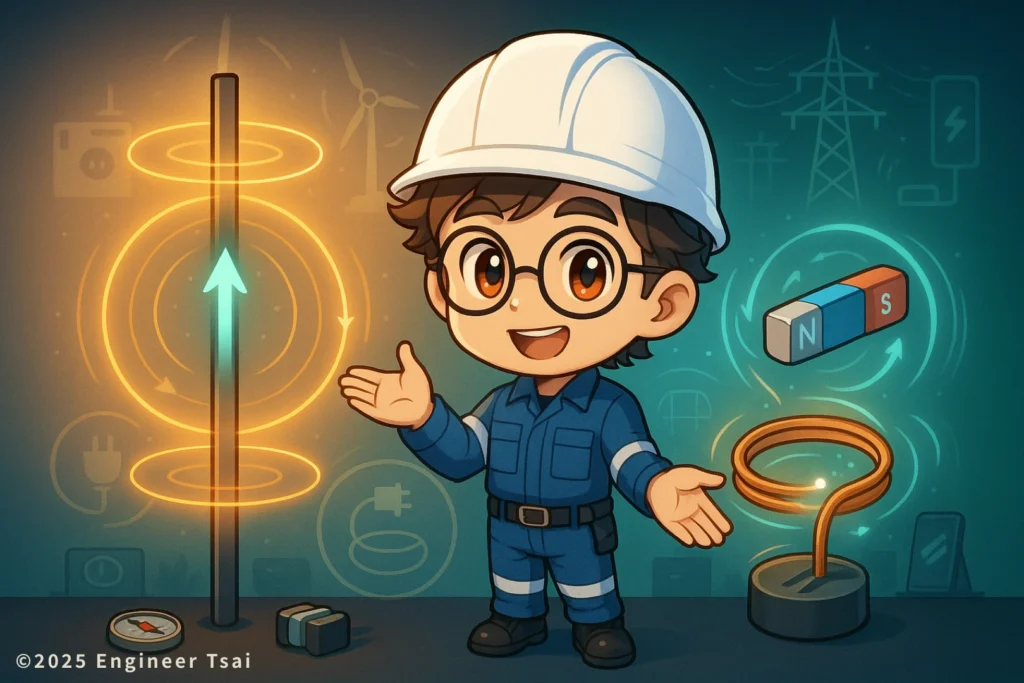
The magnetic field and current relationship is the core idea of this guide. We’ll keep coming back to how this relationship shows up in motors, generators, transformers, and even wireless charging.
If you’re still building your foundation in basic electricity, start with this beginner-friendly overview: 🔹 “Electricity 101: The Complete Beginner’s Guide to How Power Really Works”
After reading it, the concepts in this article will make a lot more sense.
Watch: How Magnetic Fields and Current Interact (Electromagnetism Isn’t That Scary)
In this short video, we walk through the magnetic field and current relationship in a very down-to-earth way.
Why does current always come with a magnetic field? Why can a changing magnetic field “create” current? The video uses simple demos so names like Ampère’s law and electromagnetic induction feel more like everyday scenes than scary physics terms.
Here’s the one-sentence version up front:
Electric current creates a magnetic field, and a changing magnetic field can induce electric current.
That’s the shared core behind motors, generators, transformers, and wireless charging.
Magnetic field and current relationship: the basic idea
In electromagnetism, the magnetic field and current relationship is like a pair of inseparable twins. According to Ampère’s law and Faraday’s law of induction:
- When current flows through a conductor, it creates a magnetic field around it (Ampère’s law).
- When a magnetic field changes, it “forces” a nearby loop to develop an induced electromotive force (EMF) and induced current (Faraday’s law of induction).
In more casual language, you can remember it like this:
- Current ➜ magnetic field (motors and electromagnets).
- Changing magnetic field ➜ current (generators, transformers, and wireless charging).
How does current create a magnetic field? — Ampère’s law
When current flows through a conductor, the space around that conductor is filled with circular magnetic field lines. That’s the phenomenon described by Ampère’s law.
To figure out the direction of the magnetic field, we use the familiar right-hand rule:
- Point your right thumb in the direction of the current.
- Curl your other four fingers around the wire.
- The way your fingers curl is the direction of the magnetic field wrapping around the conductor.
In everyday life, you’re already using this “current creates magnetic field” effect all the time:
- Electromagnets – When powered, they create strong magnetic fields used in magnetic lifting cranes, door locks, and some automation equipment. Turn the power off and the magnetic field disappears.
- More turns, stronger field – Coils with more turns of wire carry the same current but build up a stronger magnetic field. Transformers, motors, and generators all rely on “lots of turns + current” to stack up magnetic flux.
How does a magnetic field create current? — Faraday’s law of induction
Now flip the story.
If you have a changing magnetic field, and you place a closed loop of wire nearby, the loop will be “forced” to develop an EMF — this is electromagnetic induction. It’s the key idea behind both generators and transformers.
A few core points from Faraday’s law:
- Whenever magnetic flux changes through a loop, an EMF is induced.
If the loop is closed, this EMF drives an induced current. - The direction of the induced current follows Lenz’s law.
The magnetic field created by the induced current opposes the change in the original magnetic field, which keeps the system from changing too violently.
A lot of devices you interact with are basically playing this “changing magnetic field ➜ induced current” game:
- Generators – In power plants, wind turbines, hydro, and even car alternators, magnetic fields and coils interact so that mechanical rotation turns into electrical energy.
- Wireless charging – The coil in the charging pad creates a changing magnetic field. The coil inside your phone “feels” that changing field and generates current inside the phone to charge the battery.
Where the magnetic field and current relationship shows up in real life
1. Motors: current ➜ motion
A motor is a device that takes the idea of “current creating a magnetic field” and pushes it to the limit. When current and magnetic field interact, they create a force on the conductors, resulting in torque (rotational force). That’s how electrical energy becomes mechanical energy — one of the clearest everyday examples of the magnetic field and current relationship in action.
You see this every day in:
- Fans, washing machines, air conditioner compressors
- Electric vehicles, starter motors, and countless industrial motors
- Some devices also use electromagnetic actuators inside. They rely on that same interaction between current and magnetic field to move parts back and forth.
2. Generators: magnetic field ➜ electrical power
If you reverse the process and move a coil or magnet continuously inside a magnetic field, the magnetic flux through the coil keeps changing. That changing flux induces voltage and current in the coil — that’s a generator, and it’s the same magnetic field and current relationship again, just with the energy flow flipped.
Common examples:
- Hydro, wind, and gas turbine generators – They convert the mechanical energy of flowing water, wind, or steam turbines into electrical power.
- Car alternators – While you’re driving, the alternator charges the battery and keeps your vehicle’s electrical system stable.
3. Transformers: the electromagnetic bridge that changes voltage
A transformer takes “changing magnetic field ➜ induced current” and turns it into a highly practical voltage-conversion tool, using the magnetic field and current relationship to step voltages up or down efficiently.
The primary coil is connected to AC power, creating a changing magnetic field in the iron core. The secondary coil shares that same magnetic field and picks up a new voltage through induction.
Everyday use cases:
- Power adapters and chargers – They step down the voltage from the wall outlet to levels your phone, tablet, or laptop can safely use.
- High-voltage transmission systems – Power plants send energy out at very high voltages to reduce losses, then transformers near homes and buildings step the voltage down again to usable levels.
4. Wireless charging: an invisible magnetic “charging cable”
Wireless charging is basically a transformer pulled apart — a modern way of applying the same magnetic field and current relationship between two separate coils.
The transmitting coil generates a changing magnetic field. The receiving coil is placed a short distance away. As long as there’s enough changing magnetic flux linking the two coils, the receiving coil will see an induced current and charge the battery.
You may already be using:
- Wireless charging pads for smartphones
- Wireless EV charging parking spots (still being rolled out and tested in many places)
Simple hands-on experiments to see magnetic fields and current interact
If you like to build things with your hands, you can do a couple of very safe experiments using parts you can find at a hardware store or online. They let you actually see how magnetic fields and current affect each other and understand the magnetic field and current relationship more intuitively.
Experiment 1: Current creates a magnetic field (right-hand rule in action)
What you’ll need:
- One regular battery
- A piece of enameled copper wire or bare copper wire
- A small compass (any basic compass works)
Steps:
- Use the wire to connect the positive and negative terminals of the battery, forming a simple closed loop.
Keep the connection brief so the battery doesn’t overheat. - Place the small compass close to the wire and watch whether the needle deflects.
- Reverse the battery connection so the current flows the opposite way and watch the compass again. Does the needle swing in the opposite direction?
This experiment shows, in a very visual way, that whenever current flows, a magnetic field appears around the conductor — and the direction of that field follows a clear rule.
Experiment 2: Electromagnetic induction (turn your desk into a tiny generator)
What you’ll need:
- A few small magnets
- A coil of wire (just wrap copper wire into a tight coil)
- A simple voltmeter or a digital multimeter with high input impedance
Steps:
- Connect the two leads of the meter across the ends of the coil.
- Quickly move a magnet through the center of the coil and watch the meter needle or reading. Does it jump?
- Change how fast you move the magnet. Does the induced voltage change with speed?
- Add more turns to the coil, then repeat the test. Is the induced voltage easier to see now?
What you’re doing here is turning Faraday’s law into something you can see. You’ve basically built a mini generator on your desk: a changing magnetic field through a coil, and an induced voltage that shows up on the meter.
FAQ: One place to fix the “magnetic field and current” confusion
Q1. Is there a one-sentence way to remember the relationship between magnetic field and current?
Yes.
“Where there is current, there is a magnetic field. When the magnetic field changes, it tries to create current.”
The first half is Ampère’s law. The second half is Faraday’s law of induction. Together they are the foundation of generators, transformers, and wireless charging.
Q2. Is there an easy way to feel this interaction in daily life?
Yes, and you already use it constantly:
When you turn on a fan, the motor inside is playing with the interaction between magnetic field and current — that’s what creates torque and keeps the blades spinning.
When you drop your phone onto a wireless charging pad, the coil in the pad uses a changing magnetic field to “throw” energy into the coil inside your phone. The induced current charges the battery.
You just don’t see any of this because it’s all hidden inside the housings.
Q3. Why do people say motors and generators are “the same idea” in reverse?
Because both rely on the same interaction between magnetic field and current, but the energy flow goes in opposite directions:
Motor – Takes in electrical energy ➜ uses magnetic fields and current ➜ produces mechanical energy (rotation).
Generator – Takes in mechanical energy (rotation) ➜ changes the magnetic flux ➜ produces electrical energy in the coils.
The math and design details differ, but the core physics is the same.
Q4. Is wireless charging safe for my body?
Modern wireless charging for phones and home devices is designed to operate within strict limits on power and frequency, following safety standards in each country.
You can think about it like this:
It uses low-frequency, near-field magnetic fields that mainly act over a few centimeters between coils.
The power level is controlled for the device’s needs; it’s nowhere near the level needed to treat your body as a “load” and heat it up.
As long as you use the charger as intended (don’t wedge random metal objects between the phone and the pad, don’t cram it into weird gaps and leave it there), it’s considered safe for normal users.
Q5. I’m a student. How should I build a good foundation in electromagnetism?
A simple order that works for most people:
Get very comfortable with voltage, current, and resistance so you know how circuits “flow.”
Learn how current creates magnetic fields (Ampère’s law) and practice the right-hand rule with simple diagrams or hands-on experiments.
Move on to electromagnetic induction and Lenz’s law, and connect them to real applications: generators, transformers, and wireless charging.
Stack things step by step. It’s much easier than starting with long formulas or jumping straight into Maxwell’s equations.
Summary: once the magnetic field and current relationship feels natural
- Get very comfortable with voltage, current, and resistance so you know how circuits “flow.”
- Learn how current creates magnetic fields (Ampère’s law) and practice the right-hand rule with simple diagrams or hands-on experiments.
- Move on to electromagnetic induction and Lenz’s law, and connect them to real applications: generators, transformers, and wireless charging.
Stack things step by step. It’s much easier than starting with long formulas or jumping straight into Maxwell’s equations. Once the magnetic field and current relationship feels natural, the rest of electromagnetism stops feeling so mysterious.
External resources on the magnetic field and current relationship
- Khan Academy – Magnetic forces and fields: animated lessons in English if you want to hear another way of explaining the same ideas.
- PhET Interactive Simulations – Magnetism: interactive simulations where you can play with currents, coils, and magnets to visualize fields.
Read next in this topic
- What Is Electricity ? Everything You Need to Know
- Current & Voltage for DIY Enthusiasts : Unlock the Basics
- AC vs DC: What’s the Difference and Why It Matters (From Phone Charging to 120 V Home Power)
- Basic Parts of an Electric Circuit (Power Source, Wires, Loads)
- Conductor vs Insulator: How Your Home’s Wiring Keeps You from Getting Shocked
- Ohm’s Law Explained: V = IR for 120V Home Circuits
- What Is a Resistor? How It Works, Types, and How to Choose the Right One
- Series vs Parallel Circuits: Simple Guide for Home Wiring (With Formulas & Examples)
- How Electromagnetic Wave and Electricity Shape Modern Technology
- What Is Voltage? Simple Definition, Everyday Examples, and Safety Tips
- What Is a Battery? How It Works, Types, and Everyday Uses Explained
- What Is Ampere’s Law? A Visual Guide to How Current Creates Magnetic Fields
- What Does a Capacitor Do? Uses, Energy Storage, and Everyday Examples
- Types of Electrical Wire: How to Choose the Right One for Your Home
- How AC Power Is Converted to DC: What’s Really Inside Your Phone Charger?
- Electrical Energy Conversion: How Energy Transforms for Everyday Use
- Magnetic Field and Current: The Core Relationship Behind Motors, Generators, and Wireless Charging
- How Do Magnets Work? From Fridge Magnets to Maglev Trains
- What Is Inductance? Inductor Basics for Real-World Circuits
- What Is Impedance? A Plain-Language Guide to Resistance, Inductive Reactance, and Capacitive Reactance