Three quantities
Voltage (V, in volts) is the push. Current (I, in amps) is the flow. Resistance (R, in ohms) is what holds the flow back.
TEXAS · ENGLISH / ESPAÑOL
Choose where you are now. Leave with work you can review, not just another page read.Elige tu etapa actual. Conserva un trabajo que puedas revisar, además de lo que hayas leído.
Switching languages keeps your notes on this open page.Cambiar de idioma conserva tus notas en esta página abierta.
Your next useful resultTu siguiente resultado útil
You are considering an electrical contracting business and need a clear launch-readiness picture.Estás considerando una empresa de contratación eléctrica y necesitas una visión clara de lo que falta para iniciar.
A business-license evidence map, an estimate with stated assumptions and a week-by-week cash plan.Un mapa de evidencia para la licencia empresarial, un presupuesto con supuestos y un plan semanal de efectivo.
Separate the business license from the individual license. The business may employ its Master of record; ownership does not require the owner personally to hold Master status.Separa la licencia empresarial de la individual. La empresa puede emplear a su Master responsable; el propietario no necesariamente tiene que ser Master.
Read the cash-versus-invoice example below and official contractor requirements.Lee el ejemplo de efectivo frente a facturas y los requisitos oficiales para contratistas.
Open the free starting point →Abre el punto de partida gratuito →Work the existing contractor-readiness tasks with a cost, cash and evidence review sheet you can keep.Trabaja las tareas existentes de preparación del contratista con una hoja de costos, efectivo y evidencia que puedas conservar.
Compare the monthly plan →Compara el plan mensual →Next visit: En tu próxima visita: Review the next payment date, unresolved scope and document owner before choosing the next contractor task.Revisa la próxima fecha de cobro, el alcance pendiente y la persona responsable de cada documento antes de elegir la siguiente tarea.
A member application of the existing skillsUna aplicación de las habilidades existentes
An estimate with costs, assumptions and a stated pricing model.Un presupuesto con costos, supuestos y modelo de precio explícito.
Study model · supplied fictional valuesModelo de estudio · valores ficticios dados
In a simplified study estimate, margin uses selling price as its denominator; markup uses cost. Write what is included and excluded before trusting a percentage. Use supplied fictional values, not a market-rate recommendation.En un presupuesto simplificado, el margen usa precio de venta como denominador; el recargo usa costo. Escribe inclusiones y exclusiones antes de confiar en un porcentaje. Usa los valores ficticios dados; no son tarifas recomendadas.
Paper model: materials $6,000, labor $4,000 and allocated overhead $1,000. The model target is 20% margin on selling price. Tax, financing, contingencies and job-specific requirements are not modeled.Modelo: materiales $6,000, mano de obra $4,000 y gastos generales asignados $1,000. La meta del modelo es margen de 20% sobre venta. No incluye impuestos, financiación, contingencias ni requisitos específicos del trabajo.
With ET Member: make a review sheet, use the finish checks, retry a changed case and continue to the related member task. The example above stays free.Con ET Member: prepara tu hoja, usa los criterios, intenta un caso modificado y continúa a la tarea relacionada. El ejemplo anterior sigue siendo gratuito.
Review ET Member terms and monthly option →Revisa condiciones de ET Member y opción mensual →Source checked 2026-11-03: Fuente consultada 2026-11-03: Official contextContexto oficial. Fictional examples are original study exercises. Official bodies decide licensing and approvals.Los ejemplos ficticios son ejercicios originales. Las autoridades deciden licencias y aprobaciones.
Start with the free example when you are exploring one question. Choose ET Member when you want repeated practice across the current member activities, answer guides and related tasks. A separate exam-prep product has its own contents and purchase terms; it is not automatically added to membership.Empieza con el ejemplo gratuito si estás explorando una duda. Elige ET Member si quieres practicar de forma continua con las actividades actuales, guías y tareas relacionadas. Un producto de preparación para exámenes tiene su propio contenido y condiciones de compra; no se añade automáticamente a la membresía.
The four stages organize learning; they do not replace supervised training, official eligibility review or business authorization. Choose the stage that matches your current goal.Las cuatro etapas organizan el aprendizaje; no sustituyen formación supervisada, revisión oficial ni autorización empresarial. Elige la etapa que corresponda a tu objetivo.
Texas electrician path: free account and ET Member
Seven foundation skills, two guided scenarios and ten study missions. Build a calculation sheet, a checked count or a clear handoff note, then test your reasoning on a changed problem.
Try the complete drawing task free
Explore the helper study route: 43 lessons with worked examples. Start with the full fractions lesson free; continue with ET Member when you want the full collection.
US$14.99/month with a 7-day trial, or US$99/year paid upfront. Both renew until canceled. See payment and cancellation terms.
An existing saved-result example
Illustrative record: these scores are made up, not a real member result or a paid-screen capture.
Circuits, Ohm's law and power
Your next session in this example: review the missed answer, retry its check, then finish the three remaining paper exercises.
The first skill saves its latest result free. ET Member extends saved foundation practice and review across seven skills, and adds a current-progress CSV.
Example data only. A member's download contains their own saved progress.
"skill_id","skill","best_check_score","latest_check_score","check_questions","practice_solved","practice_questions","check_complete","practice_complete","last_saved_utc","record_scope"
"TXA_SK_Y1_04","Circuits, Ohm's law and power","4","4","5","2","5","no","no","2026-10-27 00:00:00","Current saved foundation progress; not full attempt history or a work qualification"
The CSV is a snapshot, not a full attempt history or a work qualification. See how the existing review loop works.
Inside the existing member workbook
Ten study missions turn the lessons into calculation sheets, drawing counts and clear handoff notes.
Worked example · Calculation mission
For the supplied ideal 12 V / 24 ohm paper model:
I = 12 / 24 = 0.5 A
P = 12 × 0.5 = 6 W
Reasoning: doubling resistance to 48 ohms halves current to 0.25 A.
Next attempt: use 18 V and 36 ohms. The checks are 0.5 A and 9 W.
Example from the existing exercise and answer guide.
A drawing count: E2.1 revision B totals six A and three S. Label the revision and flag X for clarification.
A handoff note: identify the supplied instruction, name what is unconfirmed and ask for the current task boundary and supervision.
In each mission: write your reasoning, compare it with the guide, try the changed problem and keep your next study step.
Keep the right record
Your starting checklist, personal hours and latest first-skill results stay in your account. Sign in to the same account on another device.
Foundation results and guided-scenario task progress stay in your account. Review saved foundation checks and export a current-progress CSV.
Download your written answers as TXT before leaving. Keep that file on your device or move it to your next device. Worksheet notes stay on the open page and clear when you leave or reload; they are separate from account-saved progress.
The public drawing task keeps answers on its open page. Homepage bookmarks stay on that device. Neither transfers into account-saved activity results.
Pay for the next stage you will use
Start free to plan your entry and test the first skill. Choose ET Member when you want to continue the foundation path and use the extended review tools.
| Your next task | Free account | ET Member adds |
|---|---|---|
| Turn a lesson into a worksheet | Try the first skill and complete public drawing task. | Ten study missions with answer guides, changed problems, finish checks and your own TXT worksheet. Download notes before leaving; activity scores save separately. |
| Prepare to enter the trade | Save the three Texas preparation checks, keep a personal hours ledger and use career-planning tools. | The Texas job-search pack to use when preparing applications. |
| Find out whether this practice suits you | Try the complete first skill: six explanations, five check questions and five paper exercises. Read feedback without an account; sign in free to save your latest first-skill results. | All seven foundation skills and their checks and practice activities, plus two guided scenarios. |
| Decide what to practice next | Review your latest saved first-skill answers and scores. | Saved foundation results across the path, with up to three checks needing review and links to their explanations and retries. |
| Review exam practice over time | Your total practice count and five recent entries. | Up to 200 saved entries, best scores for each exam, and up to three weakest topics per exam once you have answered at least five questions in a topic. |
| Keep a copy of your learning record | Your latest first-skill result stays in your free account, separately from paid foundation progress. | CSV or JSON learning-record export, plus a CSV of current foundation scores, solved practice counts and saved dates. |
Your basic hours ledger and career-planning tools are included free. ET Member adds the practice and review features above.
See the seven skills and two scenarios · See an example of the saved record · See pricing and trial terms
A complete first-skill preview
Learn the ideas, check your understanding, then solve five paper calculations. Read the explanations and try again until you can explain your answers.
Your outcome: calculate amps, ohms and watts, compare series and parallel circuits, and explain how current changes resistive heating.
Paper calculations only. You do not need equipment or live measurements. A free account can save this practice result. It stays separate from your paid skill progress.
Voltage (V, in volts) is the push. Current (I, in amps) is the flow. Resistance (R, in ohms) is what holds the flow back.
V = I × R. Turn it around when you need another value: I = V ÷ R and R = V ÷ I.
Power (P, in watts) is how fast energy is used. P = V × I. Put Ohm's law into it and you also get P = I² × R and P = V² ÷ R.
One path. The same current flows through every part, and the resistances add up.
Separate paths. Every branch has the same voltage, the branch currents add up, and the total resistance is lower than the smallest branch.
Heat in a wire or a connection grows with current squared (I² × R). That is why an overloaded circuit or a loose connection runs hot.
For these resistive examples, use V = I × R and P = V × I. When using AC values here, treat the stated voltage and current as RMS values.
Sources: OpenStax 9.4 Ohm's Law · OpenStax 9.5 Electrical Energy and Power · OpenStax 10.2 Resistors in Series and Parallel
Your free account saves your latest answers and scores for this first skill. It does not unlock the other paid foundation activities.
Keep your starting checklist and latest first-skill result with a free account. ET Member continues the other foundation activities, guided scenarios and saved review tools.
Keep my starting checklist free See the full first-stage path See ET Member pricing
Available in ET Member today
Start with the preview, then work through these seven skills. Each skill includes a lesson, an understanding check and applied practice. Your member activities save your results so you can return to what needs work.
Calculate amps, ohms and watts on paper, and compare series and parallel circuits.
Open the free skill previewUse a program tool list to decide what to confirm before buying.
Use a drawing legend, follow circuit tags and read a drawing scale.
Recognize common hazards and identify when to stop and ask.
Explain basic AC and 120/240 V relationships with paper examples.
Interpret supplied readings and distinguish practice from supervised field tasks.
Put rough-in, inspection and trim stages in order in a scenario.
A guided scenario with 9 steps to work through.
A guided scenario with 10 steps to work through.
Use the Texas job-search pack alongside the learning activities when you are preparing applications.
Continue through the remaining skills and both scenarios, retry checks that need review, and use the job-search pack. You can revisit these activities and your saved review tools while your plan is active. This is the current first-stage library; choose a plan based on the activities listed here.
These activities build online foundation knowledge and practice. They do not award a trade licence or a job qualification.
Make the next visit useful
Work through the seven skills and both scenarios; use the ten missions to revisit calculations, drawing revisions, stock assumptions and clear communication. Choose monthly or yearly around the current activities and review tools you expect to use.
Try an ET Member scenario
Use the same practice drawing and nine steps as the existing member activity. Count devices, follow circuit labels, work at scale and list what to confirm with your supervisor.
What you make: a practice plan sheet with device counts, a lighting-load calculation and questions to confirm before work.
Complete public sample. No account or payment needed. Answers stay on this page and clear when it reloads. This is paper practice, not a work instruction, approved design or proof of job competence.
New to drawing practice? Open the drawing larger to read its legend. Each question has Show a hint; use it before answering. If the load calculation is new, learn Ohm's law and power in the free first skill, then return here. Work at your own pace; you can check an incomplete attempt for feedback.
Your foreman hands you sheet E2.1 and says: "Room 104 is yours tomorrow. Tell me what is in there and what you need." Read the plan below, then answer each step.
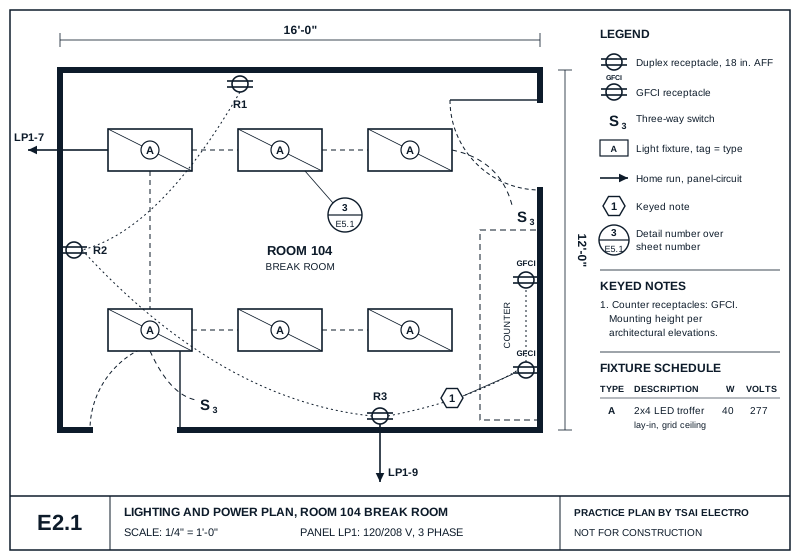
This worked result belongs to the fictional Room 104 exercise. Confirm actual drawings, specifications and work instructions with your supervisor.
| Room | 104 Break room, sheet E2.1, scale 1/4 inch = 1 foot |
|---|---|
| Lighting | 6 type A 2x4 LED troffers, 40 W each, on LP1-7. Two three-way switches, one at each door. |
| Lighting load | 240 W: about 0.9 A at 277 V, about 2 A at 120 V. Confirm the voltage first. |
| Receptacles | 3 duplex and 2 GFCI (counter) on LP1-9 |
| Device boxes | 7 (5 receptacle, 2 switch) |
| Devices to order | 3 duplex receptacles, 2 GFCI receptacles, 2 three-way switches |
| Fixture support | Detail 3 on sheet E5.1 |
ET Member includes the current seven foundation skills and two guided scenarios. Use the saved foundation results, review list and CSV export to return to skill checks that need work. The practice plan sheet you made here is a public sample; it is separate from those saved skill results.
Compare paid plans and trial terms
Still trying the basics? Return to the free first skill. A free account can save its latest result.
The member activity saves your correct steps and task progress so you can return to unfinished work. Continue to the second scenario or revisit the foundation skills you need. This public sample does not save progress.
The seven-skill review list and foundation CSV cover skill results separately from this practice plan sheet.
Compare ET Member plans and trial terms · Return to the free first-skill preview
Texas · Your first electrical job
Choose a route, prepare your next application and keep learning as you start.
Start free: compare routes, try the drawing task and keep preparation records.
Continue with ET Member: follow the foundation path, guided scenarios and study missions.
Free route comparison
Compare a primary route and two backups using official links, requirements and your next action.
Compare local routesFree account preparation
Understand the difference between job applications, an apprentice license and program admission. Use the three-row map and preparation checklist in the helper activity.
Open the helper activityOfficial Texas source
Use TDLR’s current apprentice-license instructions to check the application and supervision requirements.
Check the apprentice routeOfficial opportunity finder
Search by occupation and location, then check the named employer or program’s current application instructions.
Find opportunitiesFree account record
Record the application you actually used: target, date, official source, receipt status, later notice and next action. Return to the same account to update it.
Open my application recordFree first-skill practice
Work through the supplied drawing task, compare the answer guide and see which related member mission to practise next.
Try the drawing taskFree account preparation
Use the pre-start evidence grid to review the reporting, supervision and practical details that still need an answer. Confirm the actual arrangements with your employer.
Open my pre-start gridET Member activity
Use the helper first-week activity to practise clear questions, task boundaries and repeat-back. Check your reasoning and return to your saved progress.
See the first-week practiceWorked member example
Read a supplied drawing, check a count and compare your reasoning with the guide. See the completed example before choosing a plan.
See the worked exampleWhen you want a regular practice routine
Build a calculation sheet, a checked drawing count or a clear handoff note. ET Member includes seven foundation skills, two guided scenarios and ten study missions with answer guides.
Compare monthly plans ↗A calculation-mission example: 12 V ÷ 24 Ω = 0.5 A. Double the resistance: why does the current halve?
Foundation results and guided-scenario progress save in your account. Download written study worksheets as TXT before leaving; bring that file to your next session.
See how your progress and worksheets are saved ↗YOUR ROUTE INTO A HELPER ROLE
43 desk lessons, from fractions and electrical concepts to drawings, materials and a clear handoff. Each lesson gives you a worked example, a changed problem and questions to take into supervised training.
Try the fractions lesson free ↗
These lessons complement your existing seven foundation skills, two scenarios and ten study missions. Continue with ET Member for the full helper study collection. Your foundation and career-tool results keep their existing account records. Keep written lesson notes as TXT; bring the file to your next session.
Online study and supervised field practice work together. These lessons prepare your reasoning and questions; your employer or training provider teaches and assesses actual physical tasks.
Your previous job does not choose a separate electrical route. Use what you can already demonstrate, then practise the same helper foundations. If you have no relevant job example, use a clearly labeled study example.
Retail stock checks, hospitality handoffs, office document control and warehouse receiving can supply useful evidence examples. They do not automatically transfer electrical competence. Other backgrounds use the same task-and-evidence approach.
Use the public helper guide and practice cases alongside this collection. The full fractions lesson is free; the other linked lessons keep their existing ET Member access.
This is the first stage: your current background → electrical helper. The later learning stages are helper → Journeyman → Master → contractor. Each has its own requirements; completing a worksheet does not confer a license, job or promotion.
Use these desk lessons alongside hands-on instruction through your employer or training provider. Ask what you will practise, who will supervise and how performance will be assessed:
Keep study, observed demonstration, supervised practice and assessed performance separate in your own records. Record the specific task and reviewer role rather than awarding yourself general competence.
Compare existing Texas training routes; actual admission, availability and training are confirmed by the named provider or employer.
The lesson map draws on the published topic areas in NCCER Core and Electrical Level 1, O*NET helper work, and the official Texas and OSHA sources linked in the lessons. It is an independent study route, not an NCCER course, credential or substitute for an apprenticeship.
Choose the lesson for your next task. Review its prerequisites, explain the first case, compare the guide, try the changed case and keep your next-step note. A finished paper exercise is study evidence, not a license or field-competence assessment.
Your next practice
The free task lets you try the drawing. ET Member adds these existing study missions: write your reasoning, check it against the guide and try a changed problem.
Existing mission · worked example
A count sheet identifying the source revision and one question to confirm.
Example result: Room 104: A = 4, S = 2. Room 105: A = 2, S = 1. Totals: A = 6 and S = 3.
Fictional extract E2.1 revision B: legend A = light fixture, S = switch. Room 104 lists A, A, A, A, S, S. Room 105 lists A, A, S. An old revision A note says Room 104 had three A symbols. Do not use these invented symbols on another drawing.
Revision C explicitly changes Room 105 to three A symbols and leaves all S symbols unchanged. Recalculate the totals and name the revision.
E2.1 revision C: A = 7 and S = 3. The changed count is not evidence of an approved installation design.
The TXT below contains these worked answers and finish checks. In a member mission, your download contains your own written notes.
ET Member - study worksheet
WORKED EXAMPLE - existing drawing-count mission
Turn a drawing extract into a checked count
Fictional extract E2.1 revision B: legend A = light fixture, S = switch. Room 104 lists A, A, A, A, S, S. Room 105 lists A, A, S. An old revision A note says Room 104 had three A symbols. Do not use these invented symbols on another drawing.

1. Count A and S in each room, then total each type.
Room 104: A = 4, S = 2. Room 105: A = 2, S = 1. Totals: A = 6 and S = 3.

2. Which Room 104 count belongs on a sheet based on revision B, and why?
A = 4 for Room 104, because that is the supplied revision B extract. Record E2.1 revision B; do not mix the older count into the new sheet.

3. A label X appears in a later note but not in this legend. What should your handoff say?
Mark X as unresolved and ask for the applicable legend or clarification. Do not silently treat it as a fixture or switch.

Finish checks:
- Label the source E2.1 revision B and keep the room counts separate.
- Total A and S separately; leave X unresolved until its legend is confirmed.
- Recalculate with revision C and label the revision on the new count.
Try again: Revision C explicitly changes Room 105 to three A symbols and leaves all S symbols unchanged. Recalculate the totals and name the revision.
Worked second attempt: E2.1 revision C: A = 7 and S = 3. The changed count is not evidence of an approved installation design.
Next study step: repeat the count using the stated revision and keep the source label with the result.
Worked example from the existing answer guide, not a learner record. In the member workbook, download your own TXT notes before leaving; activity progress saves separately.
Existing ET Member mission
Your worksheet: A short calculation sheet showing your formula, units and reasonableness check.
Existing ET Member mission
Your worksheet: A count sheet identifying the source revision and one question to confirm.
Existing ET Member mission
Your worksheet: A concise message separating an observation, an unknown and a request for supervision.
Existing ET Member mission
Your worksheet: A fictional material request with arithmetic and unresolved items visible.
Practise: learn a concept, check your understanding and apply it to a supplied problem.
Keep: account-saved foundation results and a current-progress CSV.
Next visit: open Today, use Know what to review next and retry a saved foundation check.
Practise: read a small plan, then work through the receptacle scenario using the supplied information.
Keep: correct steps and task progress in your account.
Next visit: follow Your next action on Today and continue the steps left in your scenario.
Practise: write calculations, checked counts, comparison notes and clear handoffs; compare the guide and try a changed problem.
Keep: your written worksheet as a TXT download. Download it before leaving the mission.
Next visit: bring your note, revisit the related saved skill check or choose the next suggested study mission.
Use the current activities at your own pace. The free first-skill result and preparation checklist remain available in your free account.
Use the seven foundation skills, two guided scenarios, ten study missions and saved review tools already available in your plan.
See the monthly price and terms
Your study worksheet is a TXT download to keep before leaving. Foundation results and scenario progress save in your account separately.
Use the account linked to your plan. Open Today, choose Start a study mission and open the mission title shown above. Your existing saved foundation checks can guide the next session.
Return to the free drawing task · Review the first skill free
Built around your next action
01
Your free learning record shows your total practice count and five recent entries. ET Member adds the longer history and review features in the comparison above.
02
Use the hours ledger already included in your free account to organize your own entries by employer and supervisor.
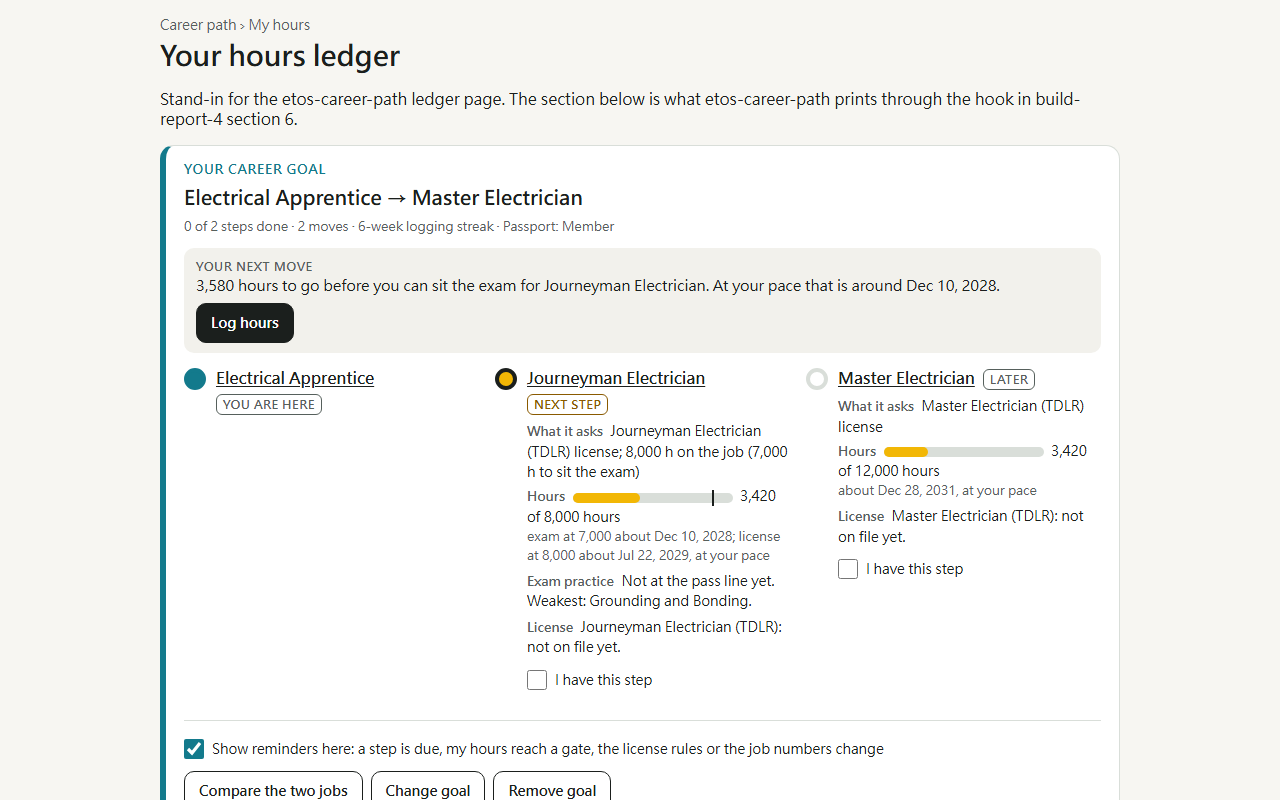
03
Keep your own target dates and next steps together with the free planning tools.
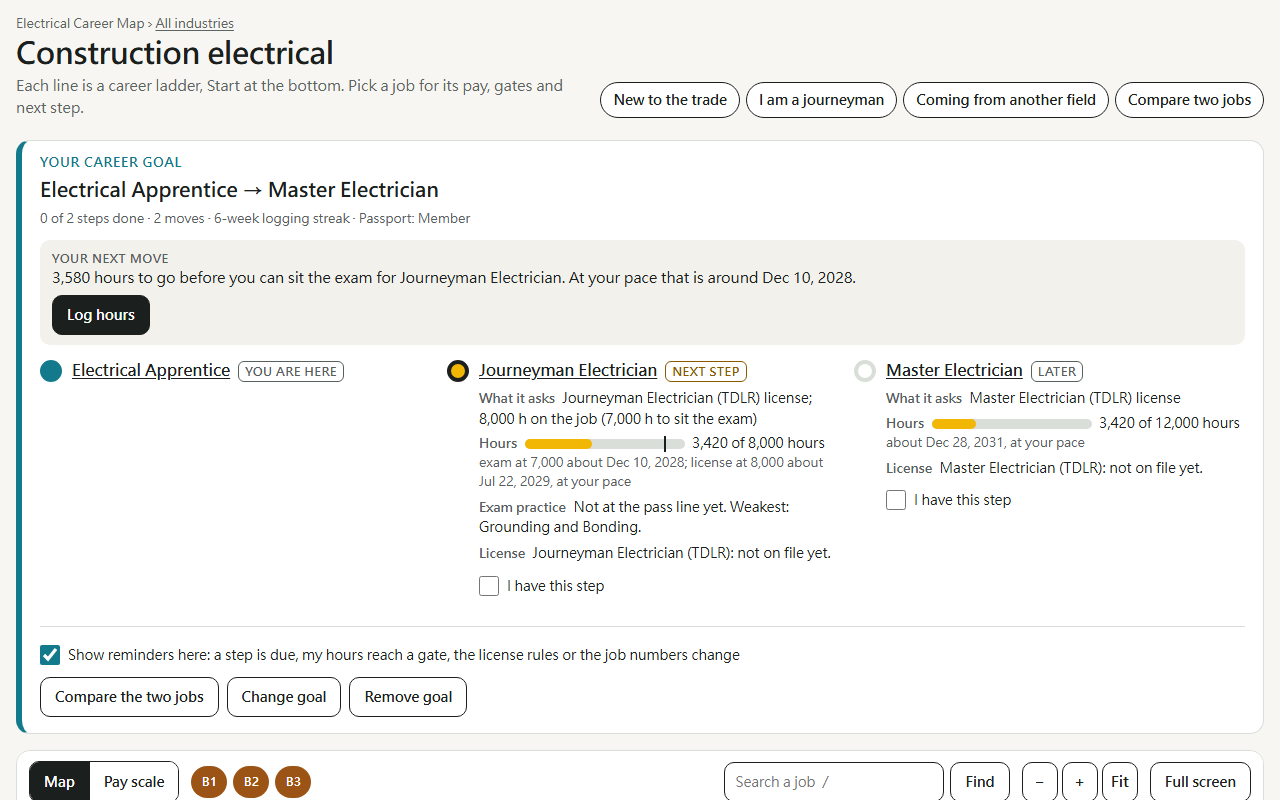
04
Explore electrical roles and save the career target you are working toward.
No setup maze
Compare Texas entry routes and choose one place to contact.
Create an account and select Texas and your current stage.
Save your preparation checks and continue when you sign in again.
The practical details
Yes. Save your Texas starting checklist and use the basic learning record and planning tools in your free account. ET Member adds the foundation activities and the extended review features listed in the comparison above.
Try the preview and read the feedback without an account. A free account saves your latest first-skill answers, scores and review list. This saved preview is separate from paid foundation progress.
ET Member includes seven foundation skills, two guided scenarios, ten study missions with TXT worksheets, the Texas job-search pack and saved review tools. It also includes extended exam practice history, weakest-topic summaries and learning-record exports. Your basic hours ledger and career-planning tools remain free.
Use a saved check to choose a skill, complete its related study mission, compare the answer guide and attempt the changed problem. Download your next-step note, then return to that skill or another mission. Choose around the current library and review tools.
No. These are online foundation learning and practice activities. They do not award a trade licence, verify field competence or replace supervised training.
Yes. The account pages fit phone and desktop screens, so you can study or log hours wherever you are.
Track practice progress, focus topics, your exam date, supervised hours, license milestones and career goals.
Try the free drawing task, or start with the first-skill lesson if the formulas are new to you. The optional entry-preparation guides help you investigate routes and applications. Choose ET Member when you want the remaining activities and saved review tools.
Save your Texas starting checklist with a free account, then return to the next preparation step.
Not affiliated with TDLR or PSI.
The paid plan
Seven foundation skills. Two guided scenarios. Ten study missions with a worksheet to keep.
Practice seven foundation skills. Apply them in two scenarios. Return to what needs work.
For Texas beginners who want to move beyond the free first skill: a structured first-stage library, saved review tools, the Texas job-search pack and learning-record exports.
How to cancel: sign in and open Manage or cancel your plan. It opens your billing page at Creem, our payment partner, where you press Cancel. Your plan stays on until the end of the period you paid for.
If you cancel, your free account and everything in it stay.
Try free, choose a plan when you need the remaining activities, then sign in with the same account. Open Today and follow Your next action. Return to Know what to review next for saved foundation checks and export. The free entry-preparation guides are an optional branch; they do not have to be completed before trying the practice.
Choose around the seven skills, two scenarios, ten study missions and review tools available today. The annual kit described below is an additional benefit of your first eligible yearly payment.
Choose yearly membership for US$99 a year and get the Texas First-Year Electrical Apprentice Kit at no extra charge with your first eligible yearly payment.
The kit includes a PDF with a pre-start checklist and questions for your employer, plus two editable CSV spreadsheets for your tool budget and inventory.
Annual members get the kit included.
Yearly membership renews at US$99 a year until you cancel. Any applicable tax is shown at checkout. Cancel future renewal using the existing billing controls in your account.
Once your eligible payment is confirmed, sign in to the same account and open Downloads. No separate purchase or coupon is needed.
Canceling future renewal or letting your membership expire does not remove your kit. Membership access still ends according to your paid membership period. You can keep the files you have downloaded.
If the qualifying yearly payment is fully refunded, future downloads granted by this offer end. We do not deduct the kit's price from your membership refund. Your existing refund rights still apply. A separate purchase of the kit keeps its own download rights.
One kit per account. Yearly renewals do not qualify. If you already own the kit, this offer does not provide a second copy, credit, cash alternative or substitute.
Monthly membership keeps its existing 7-day free trial and does not include this bonus. A free trial alone does not qualify. If you currently pay monthly, confirm your billing before changing plans so you avoid overlapping subscriptions.
