Table of Contents
Table of Contents
Ohm’s law is the first electrical formula most electricians and DIY learners memorize. In this guide, we’ll turn V = I × R into practical intuition you can use on 120V/240V home wiring, motors, and basic electronics.

If you’re still building your foundation in basic electricity, start with this beginner-friendly overview: 🔹 “Electricity 101: The Complete Beginner’s Guide to How Power Really Works”
After reading it, the concepts in this article will make a lot more sense.
Watch first: 60 seconds to “see” Ohm’s law (V = I × R)
Before we dive into the formulas, it helps to see Ohm’s law in action.
Watch this 60-second short video first. You’ll get a quick picture of:
- What Ohm’s law looks like
- How V = I × R works
- How it connects to a regular 120V outlet at home
After that, scrolling through the text version below will feel much easier.
Ohm’s law basics: what are voltage, current, and resistance “trading” with each other?
What is Ohm’s law? The one-sentence version
In plain English:
At a fixed temperature, the current (I) through a conductor is directly proportional to the voltage (V) across it, and inversely proportional to its resistance (R).
Mathematically we usually write it as:
V = I × R
We can rewrite the same relationship in three common forms:
V = I × R
I = V / R
R = V / I
That means as long as you know any two of them (for example, voltage + resistance, or voltage + current), you can calculate the third one.
That’s why in almost every circuit calculation—exam problems, choosing wire size, checking how much load a branch circuit can carry—you can’t really escape this law.
A very short history: where did Ohm’s law come from?
In 1827, German physicist Georg Simon Ohm was studying how current and voltage relate to the length and material of a wire.
From those experiments he noticed something big:
- Inside a conductor, the relationship between voltage and current is (roughly) a straight line.
- The slope of that line is what we now call resistance.
- For the first time, people could analyze circuits with math, instead of pure trial-and-error.
From light bulbs to motors, telephones to modern electronics, the same simple idea is still hiding behind them:
V = I × R
You can think of Ohm’s law as the starting line of electrical and electronics engineering.
As long as voltage, current, and resistance are in the game, Ohm’s law is somewhere on the field, quietly setting the rules.
Meet the three main characters: voltage, current, and resistance
Voltage (V): the “pressure” that pushes electrons
Voltage is the electric potential difference between two points. It decides whether electrons have a reason to move.
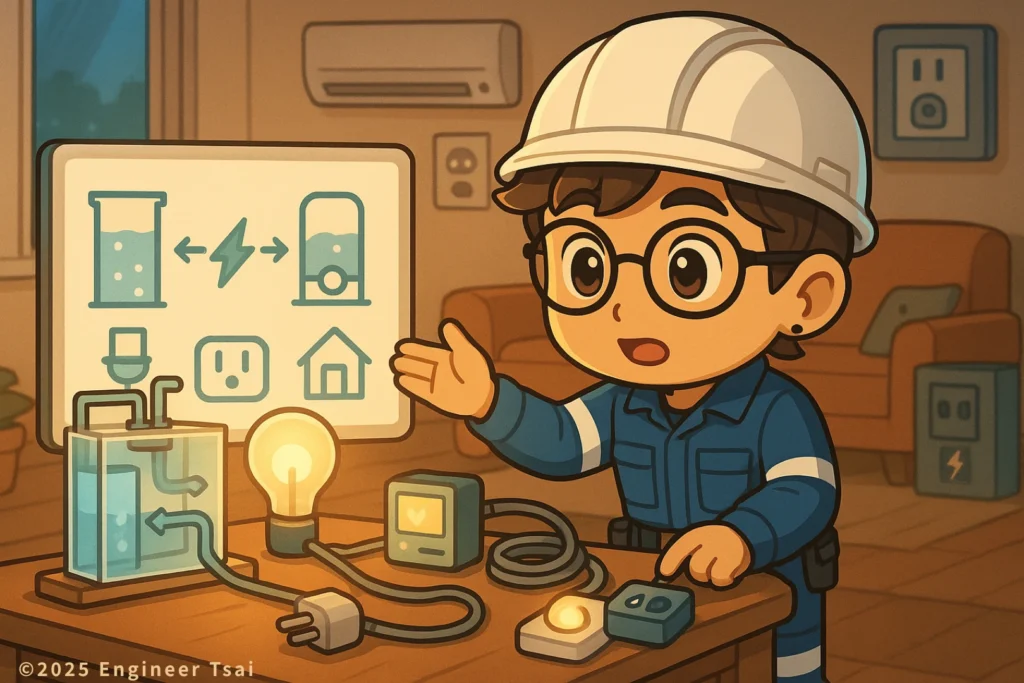
Water analogy: voltage is like water pressure.
- Unit: volt (V)
- In US homes, standard receptacles are around 120V (a lot of people still say “110V”, but the nominal value is ~120V).
- Large appliances like electric ranges, dryers, or some heat pumps use 240V circuits.
Higher voltage → stronger push → electrons are more eager to move.
Current (I): how much “water” is actually flowing
Current tells you how much charge passes through a cross-section of the conductor per unit time, like how many gallons per second flow through a pipe.
- Unit: ampere (A)
- In US residential wiring, common branch circuits are 15A or 20A at 120V.
Example: a 15A breaker on a 120V circuit can theoretically support:
P = V × I ≈ 120 V × 15 A = 1,800 W
If current gets too high, conductors heat up. In extreme cases, they can overheat insulation, damage devices, and become a fire hazard.
Resistance (R): how hard the path makes life for the current
Resistance is how much a material “doesn’t want” electrons to flow.
The more it resists, the higher the resistance.
- Unit: ohm (Ω), named after Georg Ohm
- Wires that are too thin, long, or corroded/loose at the connections all translate to higher resistance
- In the water analogy, resistance is like sand in the pipe, or a section where the pipe suddenly narrows
Put together:
- Voltage is the push
- Current is the flow
- Resistance is the friction in the path
Ohm’s law is the translator connecting all three.
Using Ohm’s law: change one, how do the other two respond?
1. What voltage really does: how hard are you pushing the current?
If the resistance R stays the same, then:
Higher voltage → higher current.
From the formula:
I = V / R
If you double the voltage and keep R the same, current doubles.
Real-world use #1 – long-distance power transmission
In transmission and distribution, engineers use both:
P = V × I and P_loss ≈ I² × R
To send the same power, raising the voltage lets us lower the current.
Lower current means much smaller I²R loss, so the line doesn’t just heat the air and waste energy.
2. How current behaves: too little doesn’t work, too much gets things fried
If the voltage V is fixed, current is mainly fighting with resistance:
I = V / R
- Larger R → smaller I
- Smaller R → larger I
That’s the basic trick behind light-bulb filaments, heating elements, and plenty of other loads.
Now look at heat:
P_loss ≈ I² × R
If current doubles, heating power goes up by four.
That’s why a power strip stuffed with space heaters and hair dryers gets alarmingly hot.
3. What resistance does in a circuit: protection, voltage sharing, and “flow control”
Resistance acts like a brake in the circuit:
- It limits how much current can flow
- It decides how voltage drops are shared between components
- It helps keep sensitive parts from being cooked
Two common types in real circuits:
- Fixed resistors – for things like voltage dividers, setting bias points, and defining operating conditions
- Variable resistors (potentiometers) – dimmers, volume knobs, some sensor circuits; you “turn” the resistance to tweak current or voltage
Whenever you pick a resistor value, you’re basically writing the rules for how much can flow, and who gets how much voltage.
4. A small example: let’s actually calculate something
Take a simple DC circuit:
- Supply: 12 V
- Resistor: 6 Ω
Using Ohm’s law:
I = V / R = 12 / 6 = 2 A
So 2 amperes flow in the loop.
If you change the resistor to 3 Ω and keep the same voltage:
I = 12 / 3 = 4 A
Current doubles.
You’ve just used Ohm’s law to answer the “what happens if I change this?” question.
Same story when you start combining resistors:
- Series:
R_total = R₁ + R₂ + … - Parallel:
1 / R_total = 1 / R₁ + 1 / R₂ + …
Those effective resistances go right back into V = I × R.
Ohm’s law in real life: not just an exam formula
1. Around the house: outlet load, energy use, and “why is this extension cord hot?”
Let’s use a typical US example: 120V receptacle, 15A breaker.
How much current does this appliance draw?
Look at the nameplate power P (watts).
Use:
I ≈ P / V
Example – 1,500 W space heater on 120 V:
I ≈ 1,500 / 120 ≈ 12.5 A
On a 15 A circuit, that single heater already uses most of the breaker’s rating.
Add a hair dryer or microwave on the same circuit and:
- Total current can exceed breaker rating
- The breaker may trip
- The cord and receptacle may run very hot
Estimating whether a circuit is overloaded (roughly)
- For each appliance on that circuit, note:
- Current I (A) or
- Power P (W) and approximate current using I ≈ P / 120
- Add up all currents that are on at the same time
- Compare the sum to the breaker rating (15A, 20A, etc.)
- As a rule of thumb for continuous loads, try to keep below ~80% of the breaker rating
This whole thought process is just:
- P = V × I
- I = P / V
- Plus a bit of safety margin
⚠️ If you’re going to change wiring or add circuits, that’s the time to involve a licensed electrician and follow your local electrical code (NEC or local amendments).
2. In industrial and mechanical systems: motor inrush and line losses
Motor starting current
If you slam a motor with full line voltage at startup, the initial current can be many times higher than the running current.
Engineers use combinations of:
- Series resistors,
- Reduced-voltage starters, or
- Variable-frequency drives (VFDs)
to control starting current, using Ohm’s law and related formulas to predict what those currents will look like.
I²R losses on feeders and transmission lines
In feeders and long runs:
P_loss ≈ I² × R
To reduce loss for a given power:
- Increase voltage → decrease current (P = V × I)
- Lower current → much smaller I²R losses
Again, the basic intuition is straight from Ohm’s law.
3. In circuit design and electronics: choosing resistors = setting the rules
A lot of everyday design questions are really just:
“I want this much current or voltage here. What resistance do I need?”
Examples:
- Designing a voltage divider
- Setting a sensor’s operating current
- Choosing an LED current-limiting resistor
You start from V = I × R, then check power:
P = V × I
or
P = I² × R
or
P = V² / R
All three show up in real design work.
Resistors also protect components:
- The resistor in series with an LED keeps current from skyrocketing and burning the LED
- Fuse and breaker ratings are chosen based on conductor size, allowable temperature rise, and expected currents—again rooted in the I²R heating idea
4. When does Ohm’s law “rule,” and when does it step aside?
Capacitors, inductors, and impedance
For purely resistive loads, DC or AC, Ohm’s law works great with a single R.
But once you add:
- Inductors (coils, motors, transformers)
- Capacitors
you start dealing with impedance (Z) instead of just R.
In AC analysis we upgrade the equation to:
V = I × Z
where Z includes:
- Resistance (R)
- Inductive reactance (X_L)
- Capacitive reactance (X_C)
The concept is the same: voltage, current, and “total opposition” are tied together.
We just use a more powerful version of the same idea.
Non-linear devices: diodes, LEDs, transistors
For ideal resistors, the I–V curve is a straight line → they are “ohmic” components.
For diodes and LEDs:
- At low voltage, almost no current
- Past a certain “forward voltage,” current shoots up
So we don’t ask “what’s the resistance of this LED?”
We instead look at:
- The I–V curve in the datasheet
- Or the “equivalent resistance” around a chosen operating point
The classical V = I × R applies cleanly to linear resistors.
Non-linear devices need different models, but you still use Ohm’s law locally as an approximation.
Where Ohm’s law starts to hit its limits
1. Non-linear materials: superconductors and semiconductors
- Superconductors:
Below a critical temperature, resistance drops essentially to zero.
Plugging R ≈ 0 into V = I × R gives V ≈ 0, but real behavior is described by more detailed physics. - Semiconductors:
In many operating regions, the I–V curve is curved, not a straight line.
There is no single, fixed R for all voltages; instead we talk about dynamic resistance or use exponential models.
In both cases, Ohm’s law isn’t “wrong”; it’s just not the whole story anymore.
2. Changing temperature and frequency: Ohm’s law is just step one
- Temperature:
For most metals, higher temperature → higher resistance.
For many semiconductors, the trend is the opposite.
In high-power designs, you need to combine Ohm’s law with temperature coefficients and thermal analysis. - High frequency:
At high frequencies, phenomena like:- Parasitic capacitance
- Parasitic inductance
- Skin effect
Resistance alone is not enough; you must use full impedance models that vary with frequency.
Lab and troubleshooting: putting Ohm’s law in your own hands
1. A basic Ohm’s law experiment (for students & self-learners)
You’ll need:
- A DC source (battery pack or adjustable DC supply)
- A few resistors with different values
- Some hookup wires
- A voltmeter and ammeter (or a digital multimeter that can measure both)
Steps:
- Build a simple series circuit: DC source → resistor → back to source
- Measure voltage across the resistor and current through the resistor
- Change the voltage (or swap in different resistor values)
- Record the V and I values and plot them
You’ll see:
- The V–I graph is (close to) a straight line
- The slope is the resistance R
That straight line is Ohm’s law revealing itself.
Safety notes:
- Pick appropriate ranges on the meter
- Don’t use currents high enough to heat resistors until they discolor
- Double-check polarities and connections before turning the power on
All of those are good real-world habits, not just lab rules.
2. Field troubleshooting: abnormal resistance, shorts, and overloads
Ohm’s law is also a mental checklist when something doesn’t work.
Abnormal resistance
Using a multimeter in resistance mode:
- If a resistor reads far from its labeled value, or
- Reads open (infinite resistance)
it’s a candidate for replacement.
Short circuits vs. overloads
- Short circuit:
Effective resistance drops close to 0 Ω. With:I = V / Rcurrent spikes dramatically. Breakers trip almost instantly; wires may heat up very quickly. - Overload:
Wiring and connections are fine, but too many loads are connected to the same circuit.
Total current exceeds the safe limit of the breaker and conductors.
Heating is still I²R, but more “slow burn” than instant flash.
That’s also why you don’t want to size everything right at its absolute limit—temperature, voltage swings, and aging all add uncertainty.
After Ohm’s law: where can you go next?
1. New materials and what they mean for “resistance”
- Graphene and other ultra-conductive materials
Extremely low resistance opens doors for high-speed, low-loss interconnects and advanced electronics. - Superconductors and long-distance transmission
Near-zero resistance at cryogenic temperatures points toward possible future systems with drastically reduced line losses.
Even here, the idea of “push vs. flow vs. opposition” is still central—Ohm’s law just becomes the first approximation.
2. Smart circuits and smart grids: resistance gets smarter too
- Digitally controlled / electronic “resistors”
Using electronics to dynamically adjust effective resistance so circuits can respond to temperature, load, or efficiency targets in real time. - Smart grids
Sensors and communication feed back live data on voltage, current, and loading.
Control systems use that data to adjust how power is routed, protected, and balanced.
Underneath all of that software, we’re still tracking:
How hard are we pushing?
How much is flowing?
What’s in the way?
Which is, again, Ohm’s law.
FAQ: common questions about Ohm’s law
Q1. What is Ohm’s law in one sentence?
A: Ohm’s law says that in a given circuit, voltage (V), current (I), and resistance (R) are always linked:
V = I × R I = V / R R = V / I
In practice, remember these two ideas:
At the same resistance, higher voltage → higher current
At the same voltage, higher resistance → lower current
It’s a tool that turns “push” (voltage), “flow” (current), and “friction” (resistance) into the same language so you can actually calculate things.
Q2. What do 120V and 240V in US homes have to do with Ohm’s law?
A: The voltage at your receptacle still obeys the same V–I–R relationship.
Typical US branch circuits: ~120V
Large appliances: often 240V
If the appliance’s internal resistance stays roughly the same:
Higher supply voltage → higher current (I = V / R)
Higher current → more heating in wires, plugs, and cords (I²R)
Any time you ask:
“Can this circuit handle one more space heater?”
“Is this extension cord big enough?”
you’re really combining Ohm’s law with the power formulas.
Q3. How can I roughly check if a circuit at home is overloaded?
A (rough, non-code-official way):
Look at each appliance’s nameplate for P (W) or I (A).
If you only have power (P), estimate current:
I ≈ P / 120 for a 120V circuit
Add up the currents for devices that are on at the same time on the same circuit (not just the same receptacle).
Compare that total to the breaker rating (15A, 20A, etc.).
For loads that run continuously, try to stay below about 80% of the breaker rating.
Inside those steps you’re really using:
P = V × I I = P / V
⚠️ If your panel is warm, breakers are tripping, or you’re not sure what’s on which circuit, it’s worth having a licensed electrician look at it.
Q4. Does Ohm’s law still work in AC circuits?
A: The basic idea still holds, but we upgrade “resistance” to impedance (Z).
For nearly pure resistive loads (space heaters, old-style incandescent bulbs), using V = I × R is fine as an approximation.
Once inductors (motors, transformers) and capacitors enter, we talk about:
V = I × Z
where Z is the combined effect of resistance and reactance.
A good way to think about it:
Beginner stage:
Treat heaters and simple loads as resistors; use V = I × R to estimate current.
Intermediate/advanced stage:
For motors, transformers, and power supplies, learn about impedance, power factor, and phase angle—basically the AC “upgrade pack” for Ohm’s law.
Q5. Why do diodes and LEDs look like they “break” Ohm’s law?
A: They don’t break the law; they just aren’t linear resistors.
An ideal resistor has a straight-line I–V curve → “ohmic”
A diode or LED has a curved I–V curve:
Very little current below a certain voltage
Current rises sharply once you pass the forward voltage
So we don’t ask “what’s the resistance of this LED in ohms?”
We instead ask:
“At this operating point, what current flows at this voltage?”
“What series resistor do I need so current stays in a safe range?”
Ohm’s law is perfect for the series resistor.
The LED itself is handled with its own I–V curve.
Q6. What are the most common beginner mistakes when using Ohm’s law?
Some very real-world ones:
Unit mix-ups:
mA vs A, kΩ vs Ω—off by 1000x is extremely common.
Ignoring power:
They use V = I × R but never check P = V × I, so resistors or LEDs quietly burn up.
Confusing series and parallel:
Thinking “add another resistor to reduce current,” but wiring it in parallel so the total resistance actually drops and current increases.
No safety margin:
Designing right at the component’s absolute limit; a little extra ambient temperature or a small voltage rise pushes it over the edge.
A safer habit:
Use V, I, R to get the theoretical values.
Check power with P = V × I (or I²R, or V²/R).
Add a safety factor instead of running everything at 100% of its rating.
Q7. If I only want the “practical version” of Ohm’s law, how should I learn it?
Here’s a simple “real-world route”:
Memorize and get comfortable with these two:
V = I × R
P = V × I
Practice with 3–5 fixed, realistic scenarios until they feel automatic:
Estimating how much load you can put on a 15A or 20A circuit
Checking whether an extension cord is working hard or just cruising
Picking a safe series resistor for an LED
Connect it back to the whole circuit:
Learn the basic parts of a circuit: source, conductors, loads
Understand series vs. parallel and how currents/voltages split
When you look at any piece of wiring and your brain automatically thinks:
“About how many volts are across this?
About how many amps are flowing?
What’s acting as the main resistance or load here?”
you’ve officially upgraded Ohm’s law from “formula on a page” to “gut instinct”—and the harder topics build on top of that.
Want another perspective on Ohm’s law? Check out this step-by-step tutorial from Simple English Wikipedia, and the Khan Academy lesson “Electric current, resistivity, and Ohm’s law” if you’d like more practice-style examples.
Conclusion: Ohm’s law is the old friend you’ll keep bumping into
Ohm’s law bundles three quantities—voltage, current, and resistance—into a single, simple relationship:
V = I × R
With that one line, you can predict:
- What happens if you change wire size
- What happens if you increase voltage
- What happens if you plug one more heavy load into an already busy circuit
Whether you’re:
- Trying to understand 120V/240V home wiring,
- Studying for an electrician’s exam,
- Or getting ready to design your own circuits and PCBs,
you’ll keep using Ohm’s law as a base layer.
Get comfortable with it now, and you’ll have a much easier time when you move on to AC analysis, impedance, power factor, and non-linear devices later.
Suggested “Read next”
“Basic parts of an electrical circuit: source, conductors, and loads”
→ Show how Ohm’s law fits into a whole loop, not just a single resistor.
“Using V = I × R to estimate appliance load on a 120V circuit”(Coming soon)
→ Real examples with space heaters, hair dryers, microwaves, and extension cords.
Read next in this topic
- What Is Electricity ? Everything You Need to Know
- Current & Voltage for DIY Enthusiasts : Unlock the Basics
- AC vs DC: What’s the Difference and Why It Matters (From Phone Charging to 120 V Home Power)
- Basic Parts of an Electric Circuit (Power Source, Wires, Loads)
- Conductor vs Insulator: How Your Home’s Wiring Keeps You from Getting Shocked
- Ohm’s Law Explained: V = IR for 120V Home Circuits
- What Is a Resistor? How It Works, Types, and How to Choose the Right One
- Series vs Parallel Circuits: Simple Guide for Home Wiring (With Formulas & Examples)
- How Electromagnetic Wave and Electricity Shape Modern Technology
- What Is Voltage? Simple Definition, Everyday Examples, and Safety Tips
- What Is a Battery? How It Works, Types, and Everyday Uses Explained
- What Is Ampere’s Law? A Visual Guide to How Current Creates Magnetic Fields
- What Does a Capacitor Do? Uses, Energy Storage, and Everyday Examples
- Types of Electrical Wire: How to Choose the Right One for Your Home
- How AC Power Is Converted to DC: What’s Really Inside Your Phone Charger?
- Electrical Energy Conversion: How Energy Transforms for Everyday Use
- Magnetic Field and Current: The Core Relationship Behind Motors, Generators, and Wireless Charging
- How Do Magnets Work? From Fridge Magnets to Maglev Trains
- What Is Inductance? Inductor Basics for Real-World Circuits
- What Is Impedance? A Plain-Language Guide to Resistance, Inductive Reactance, and Capacitive Reactance