On this page
Table of contents

If you’re still exploring whether the electrical trade is right for you, start with the full overview: 🔹 “U.S. Electrician Career Guide: Training, Licensing, and Your First 12 Months”
Reading that first will make today’s topic easier to understand.
🔗 Background news sources
- Investors.com reports that as tension between Israel and Iran rises, oil prices and freight costs move higher and global equities turn volatile. Major semiconductor names — including TSMC — remain viewed as key suppliers for AI chips and advanced process nodes, even as they pull back to digest gains.
- The Associated Press covers how Taiwan updated its strategic export control list, adding Chinese tech companies such as Huawei and SMIC. That underscores how semiconductors now sit at the center of both geopolitics and U.S.–China tech competition.
- Cresset and other research firms note that the Israel–Iran conflict is already affecting Middle East shipping routes, insurance costs, and inflation expectations — pushing up both supply chain costs and timeline uncertainty worldwide.
Taken together, these stories describe one thing: the Middle East conflict is not just “world news.” It’s an ongoing real-world stress test of global semiconductor supply chain risk.
Put simply, semiconductor supply chain risk is what you feel on the fab floor when a shipment slips, a quote gets re-priced, or a tool sits idle waiting for parts.
If you work in a fab, OSAT, or equipment supplier — maybe at Intel, Micron, TSMC Arizona, GlobalFoundries, Samsung, or any company tied to wafers, back-end packaging, or tool support — this conflict is already changing your lines, your material plans, and your overtime schedule. That’s semiconductor supply chain risk showing up in your day job.
This article uses language that makes sense on the shop floor to break down how Middle East conflict shapes semiconductor supply chain risk across five concrete impact areas — then closes with a 4-step action plan you can carry into your next meeting:
・How oil and freight hikes bend your MRO costs
・How rerouted and delayed shipping can stop a line on your shift
・How export controls rewrite “stable” customers and product mix
・Why U.S. fab build-outs are both a hedge and a career plot twist
・How cyber and energy attacks can quietly hit SCADA, tools, and uptime
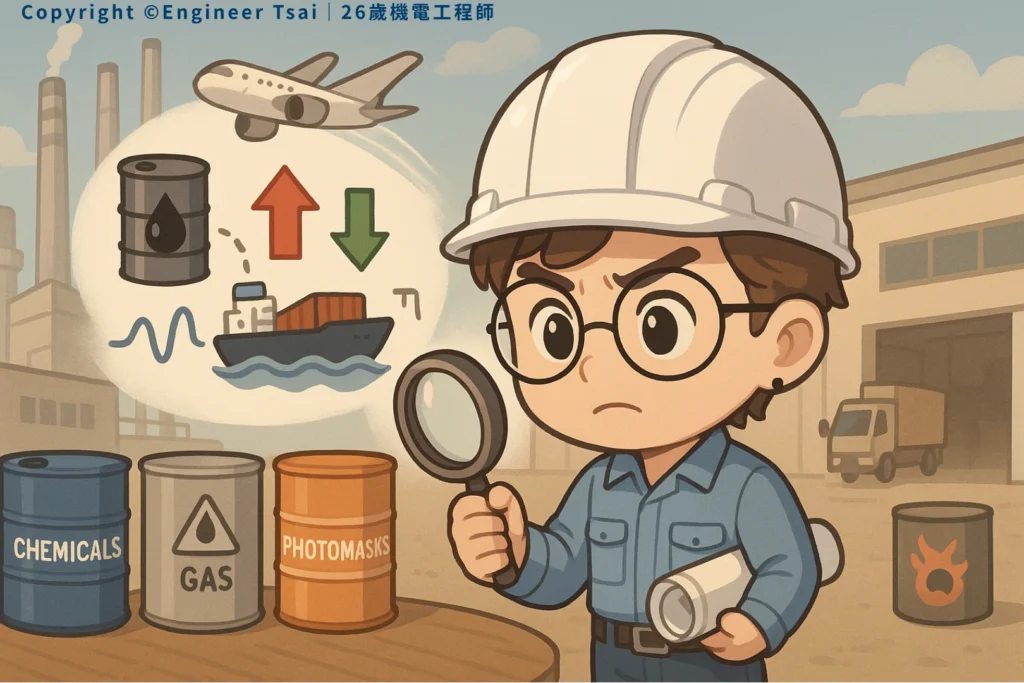
1 | 🌍 When Oil and Freight Spike, Your MRO Budget Bends First
Every time there’s a flare-up in the Middle East, oil prices, freight rates, and insurance premiums are the first to react. It’s common to see diesel up close to 8% and crude oil more than 7% in a short window when tensions escalate.
If you sit in a fab in Arizona, Texas, Oregon, New York, or in Asia supporting U.S. customers, those numbers don’t stay “just numbers” for long; they are one of the most immediate ways semiconductor supply chain risk shows up in your world. They slowly show up in:
- Higher freight costs on photoresist, CMP slurries, solvents (acetone, IPA), and etching gases
- Longer lead times and re-quoting on U.S., European, Japanese, and Korean tools and spare parts
- Rising on-site energy and utility bills that compress manufacturing margins
Key takeaway:
If you work in MRO, purchasing, or process support, this is a great time to put one simple question into your weekly review:
- “Which of our critical chemicals, gases, and critical spares are heavily exposed to high oil prices or Middle East–linked shipping routes?”
- “For each of those, how many days or weeks of inventory do we really have? Do we have qualified alternates?”
This isn’t just a finance problem. It’s the first step every engineering team can take to reduce cost volatility and protect capacity.
2 | 🚢 Invisible Shipping Bottlenecks: The Day Production Stops on Your Shift
The second impact layer of Middle East conflict for semiconductor supply chain risk is shipping disruption. Even when vessels still sail, routes can become longer, slower, and more expensive:
- Ships that would normally go through the Red Sea or Eastern Mediterranean reroute around longer paths
- Tension in the Strait of Hormuz pushes up risk premiums and insurance costs on oil and container ships
- Carriers quietly favor “big volume” customers and cut space for smaller or fragmented shipments
On your screen, everything still looks fine: the PO is cut, the ETD and ETA are in the system.
In reality, a handful of chokepoints or reroutes can quickly become the sentence every production engineer hates to hear: “Sorry, the vessel got delayed again. That shipment is another two weeks out.”
Key takeaway:
If you lead a production line, tools team, or planning group, sit down with purchasing and logistics to define:
- At least two alternative “sea + air” routing options for your most critical materials
- The minimum safety stock (in days or weeks) for gases, wet chemicals, substrates, and key consumables
- Which product lines can be ramped down first if delays exceed two weeks — and which lines must be protected at all costs
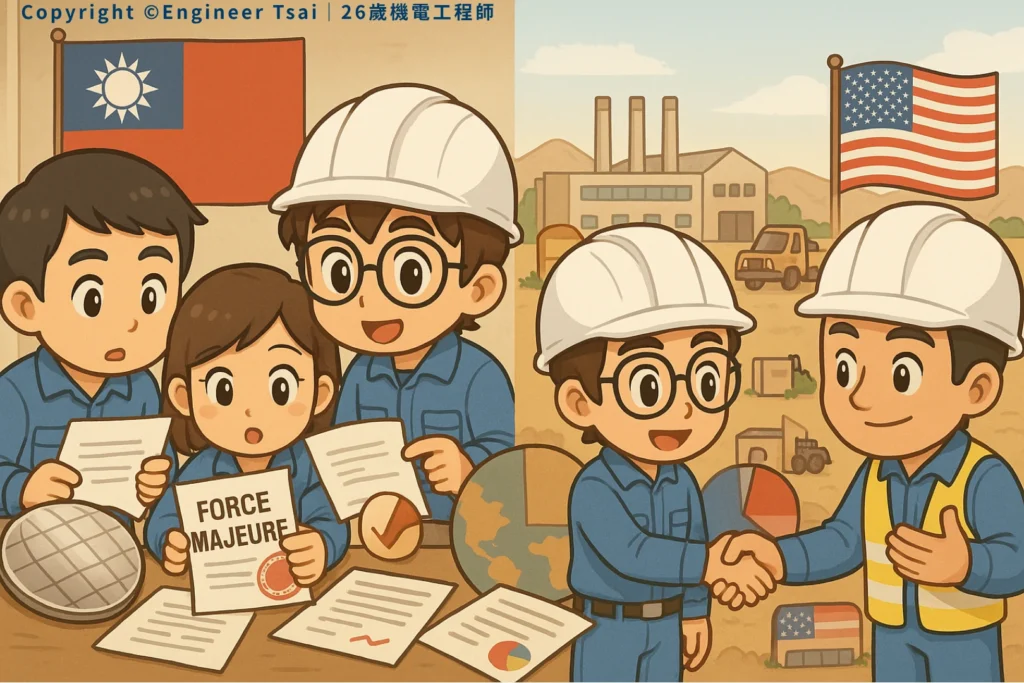
3 | 🔒 Dual Export Controls: Customers and Product Mix Get Rewritten
The third risk layer comes from export controls and entity lists.
U.S. export rules around advanced nodes (7 nm, 5 nm, and below), AI chips, and key tools keep tightening. Allies in Asia and Europe are updating their own strategic lists, often naming specific high-risk or Chinese entities as controlled end users.
For you, this doesn’t just live in legal memos. This is where semiconductor supply chain risk shifts from pure logistics to customers, contracts, and product mix. It can quickly turn into:
- Certain customers suddenly becoming restricted or off-limits for high-end products
- “Stable” loading on certain lines being reshuffled as orders are rerouted or cancelled
- New product introduction (NPI) needing an extra question: will this device be at risk of future restriction?
Key takeaway:
If you sit in B2B sales, product management, or production planning, now is the time to work with legal and compliance on a basic mapping:
- What does our current customer mix look like by region: U.S., Europe, China, rest of Asia, other?
- For each product family, which export regimes or controls could realistically apply in the next 12–24 months?
- If a specific region becomes restricted, what alternative markets or products can absorb that capacity?
4 | 🇺🇸 U.S. Fab Build-Outs: Risk Diversification and a Career Plot Twist
One big “macro” response to geopolitical and supply risk is obvious: build more fabs on U.S. soil. You see that in projects and roadmaps from TSMC Arizona, Intel, Micron, GlobalFoundries, and others, as governments push for “local for local” manufacturing.
At the same time, the headlines are clear: Arizona land and labor are expensive, union rules are different, and shop-floor culture is not the same as in Taiwan, Korea, or Japan. “Localization” is not just a matter of shipping the same tools and SOPs.
Key takeaway:
For engineers, U.S. fab expansion isn’t just “a corporate decision.” It’s both a hedge against semiconductor supply chain risk and a real career plot twist you can choose to ride or ignore:
- Cross-time-zone collaboration: late-night calls, remote debug, and NPI support across sites
- Multi-country supply chains: one process recipe, but different local materials and regulations
- Margin pressure in high labor-cost environments: leaning harder on automation and data
If you’re even slightly interested in a future assignment in the U.S. or global roles, start building a portfolio of:
- English slide decks that explain complex manufacturing problems simply
- Cross-site projects where you closed a gap between regions or factories
- Concrete “problem–action–result” stories you can drop straight into a resume or promotion packet
5 | ⚠️ Cyber and Energy Attacks: The Most Invisible, Most Lethal Risks
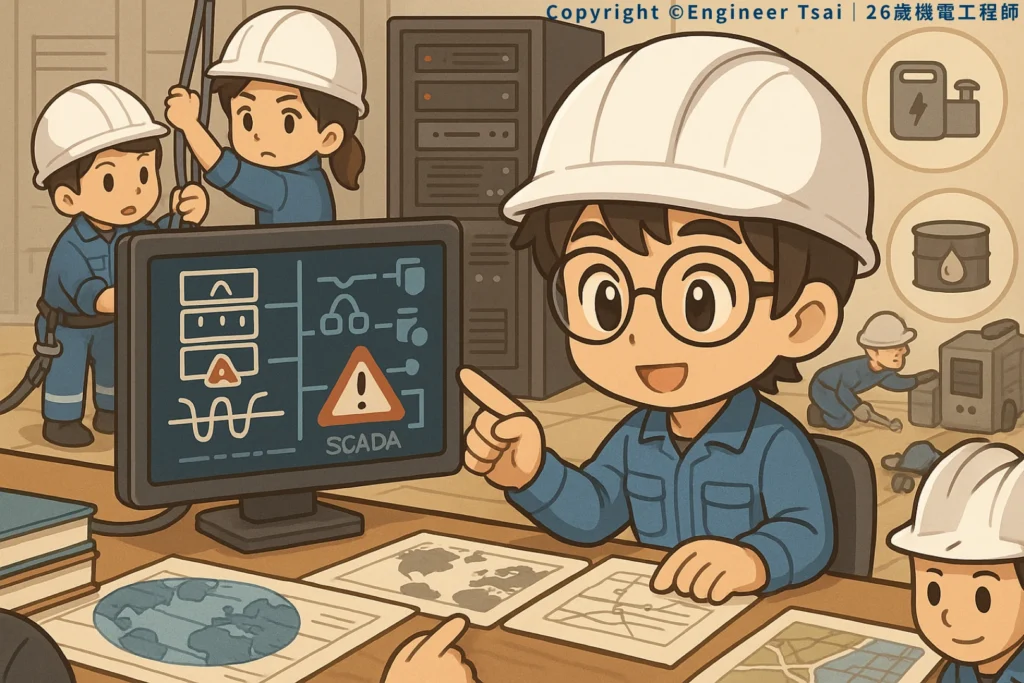
As Middle East tensions rise, security analysts consistently warn that cyber operations and attacks on critical infrastructure are part of the modern battlefield. For fabs, these attacks are yet another dimension of semiconductor supply chain risk.
For semiconductor fabs and OSATs, this is not science fiction. It can hit very concretely through:
- SCADA, DCS, or MES systems hit by ransomware or targeted malware, forcing unplanned shutdowns
- OT (operational technology) networks loosely connected to IT networks, amplifying attack paths
- Disturbances in regional grids or substations, causing power dips, surges, or blackouts
Key takeaway:
Even if you’re not a cyber security specialist, you can still help your site with a quick “three-second health check”:
- Does the plant have a dedicated security plan for SCADA / ICS / OT networks, or is everything treated as generic IT?
- Do we have at least three layers of defense: network segmentation (e.g., OT DMZ), firewalls, and IP/port whitelisting?
- If one site suddenly loses power or network connectivity, is there a documented, tested “graceful shutdown / load shedding” SOP?
Semiconductor Supply Chain Risk: A 4-Step Action Plan for Engineers
Knowing the risk is step one. What really sets you apart is how you turn Middle East conflict headlines into clear semiconductor supply chain risk action items your team can actually run.
- Map materials and inventory exposure
Sketch a simple map of your critical raw materials and spares with “origin country + transport route”:
・Which ones rely heavily on Middle East–linked shipping lanes or high oil prices?
・For each, how many days or weeks of inventory do you have on site? - Design backup supply and transport options
Work with purchasing and logistics to define:
・Alternative sea, road, and air options for key materials (at least one backup route)
・Clear triggers for when to switch routes — and who is responsible for the decision - Review contracts and force majeure language
With legal and sales, review major customer and supplier contracts:
・Are export country, origin, and main routes clearly described?
・Does “force majeure” explicitly include war, sanctions, and export controls?
・If a clause is triggered, what recovery or reallocation terms do you actually have? - Upgrade OT / SCADA security and drill the response
Even as a process or equipment engineer, you can help by:
・Raising the need for dedicated OT network segmentation and firewalls
・Pushing for basic SCADA / ICS incident response runbooks
・Running tabletop drills: if SCADA gets locked, how do we shut down safely and recover?
Conclusion | Semiconductor Supply Chain Risk Is Part of Your Job
Middle East geopolitics and conflict may feel far from your life in the U.S., Taiwan, Korea, or Europe. But through oil prices, shipping routes, export controls, and cyber threats, they are constantly stress-testing the global semiconductor supply chain. That’s the core of semiconductor supply chain risk in your daily work.
If you work in a fab, OSAT, equipment supplier, or systems integrator, this isn’t just a topic for pundits. It can turn into:
- The risk snapshot you took the lead on for your line or site
- The backup routing or inventory drill you organized with logistics and planning
- The first real “global risk” case study you can show on your resume or promotion packet
Now that you see how Middle East conflict and semiconductor supply chain risk connect, the next move is yours.
Will you use this as a starting point to propose a small risk review to your manager?
Or share it with your team as a prompt for your next ops meeting?
If you’re already working in semiconductors, I’d love to hear where you are in the chain — fab, OSAT, equipment, or materials — and what you’re seeing on the ground. Drop a comment and let’s learn from each other.
📌 Further reading
🔹“What Is Electromagnetic Induction? A Practical Guide to Faraday’s Law”
Understand the fundamentals of power generation and how AC generators turn mechanical motion into electrical energy — a key foundation for thinking about power supply chains and energy risk.
🔹“How Do Transformers Change Voltage? Principles, Types, and Real-World Uses”
Dive into how transformers work in global power transmission and fab equipment. Essential reading if you want to evaluate energy stability and equipment risk.
🔹“What Is a Diode and How Does It Control Current?”
Learn how diodes enforce one-way conduction in circuits and where they show up in chip processes, inverters, and voltage protection — useful when you want to see risk all the way down to the component level.
📣 If you enjoy this kind of “macro news, micro impact on the fab floor” breakdown, hit follow. I’ll keep unpacking global events through an engineer’s lens so you can protect your career, your plant, and your supply chain. 🔧
❓ FAQ: Middle East conflict and the semiconductor supply chain
Q1 | Does Middle East conflict really affect the semiconductor supply chain?
Yes — and it already does. The Middle East is a key hub for energy and shipping. When conflict drives up oil prices, insurance, or rerouting of major lanes, it adds uncertainty to raw material costs, freight rates, and lead times. Even if your fab is in the U.S. or Asia, your chemicals, gases, tools, and spare parts still ride on the same global logistics system. This is exactly what people mean by semiconductor supply chain risk.
Q2 | I’m a process or equipment engineer. What can I realistically do?
You don’t need to be a geopolitical expert. Start with what you know best: your line and your tools. 1) Map the origin and inventory days of your critical materials and spare parts. 2) Turn that into a one-page slide with risks and simple backup ideas, and bring it to your weekly meeting. 3) Sync with purchasing, logistics, and OT/IT security so everyone sees the same picture. These are small, concrete projects an engineer can own.
Q3 | How is this different from the supply chain impact of the Russia–Ukraine war?
Both crises impact energy and transport, but Middle East conflict hits crude oil supply and chokepoints like the Red Sea and the Strait of Hormuz more directly. That tends to make oil prices and marine insurance more volatile. For semiconductors, this means your chemicals, gases, and tool parts shipped by sea and air become more sensitive to disruption — so you need earlier and more detailed backup planning.
Q4 | My company isn’t talking about these risks. How do I raise the topic?
Approach it from a practical, engineering angle instead of a political one. For example, start by mapping current materials, origin countries, routes, and inventory days, then ask concrete questions: if a key lane is delayed two weeks, which tools or lines stop first? Do we have alternative suppliers or routes? When you frame it as risk management and uptime protection, managers are far more willing to listen and allocate time.
Q5 | I’m still a junior engineer. Am I overstepping if I bring this up?
You’re not overstepping. The engineers who get noticed aren’t the ones who just complain about global events — they’re the ones who turn risk into clear, simple action proposals. You don’t have to fix the whole global system. If you can create a small checklist or risk map for your slice of the process, you’re already ahead of most people and building a reputation as someone who thinks beyond their own tool.
Read next in this topic
- Electrolysis and Electroplating Explained: How Electric Current Changes Metals in Everyday Life
- Middle East Conflict and the Semiconductor Supply Chain: How It Hits Your Fab, Your MRO Budget, and Your Career
- AI and IoT in Construction: How to Turn Jobsite Tech into Your Career Advantage
- Should You Become an Electrician in the Age of AI?Why I’m Helping People Make the Switch
- 3–12 Months from Zero: A Realistic Roadmap to Switching Careers into the Electrical Trade
- When Cloudflare Went Down, One Thing Became Clear: Why I Help People Become Electricians in the AI Era
- Electrician Career Path USA: 0–12 Month Roadmap for Career Changers
- Electrician Career Paths in the AI Era: 5 Routes and a 0–12 Month Roadmap
- Electric Motors, Generators and VFDs: One Clear Picture from Electromagnetic Induction to Real-World Power Systems