On this page
Table of contents
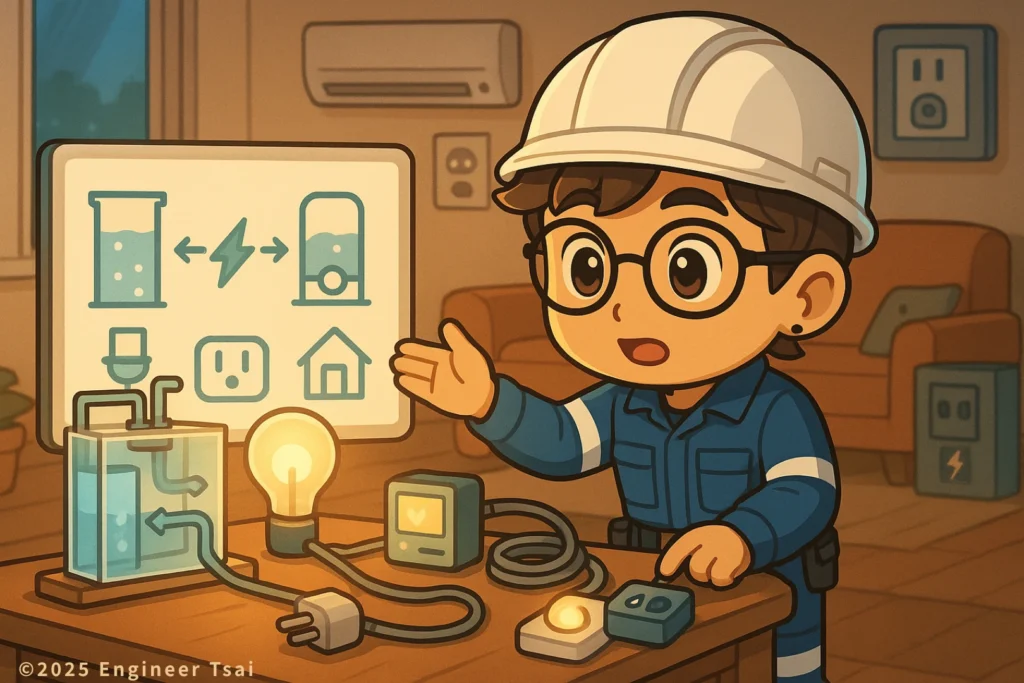
If you’re still building your foundation in basic electricity, start with this beginner-friendly overview: 🔹 “Electricity 101: The Complete Beginner’s Guide to How Power Really Works”
After reading it, the concepts in this article will make a lot more sense.
Watch first: see the difference between series and parallel circuits in 60 seconds
Your lights, outlets, and extension cords all follow the same idea:
are they wired in series or in parallel?
Watch this 60-second short for a quick visual, then scroll down for the full breakdown.
Series vs Parallel Circuits: Simple Guide for Home Wiring
You see them every day without noticing:
- the lights in your living room
- the outlets along your kitchen counter
- the power strip under your desk
They’re all using the same basic idea:
Are these devices connected in series or connected in parallel?
In this guide to series vs parallel circuits, we’ll use real home-wiring examples, not just textbook diagrams, to explain:
- what series and parallel circuits really are
- how voltage, current, and resistance behave in each
- when to choose one over the other
- how to quickly tell which one you’re looking at
Quick summary: series vs parallel (one-sentence memory hook)
Here’s the version you can memorize and say out loud in an exam:
- Series circuit
→ same current, voltage is shared, resistances add up → total resistance gets bigger. - Parallel circuit
→ same voltage, current splits, resistances add as reciprocals → total resistance gets smaller than any single branch.
Think of this whole section as your one-minute summary of series vs parallel circuits — something you can quickly recall in class, on an exam, or at work.
If someone asks, “What’s the difference between series and parallel circuits?”
you can basically answer with those two sentences.
Why series and parallel circuits matter in real life
In a typical North American home, anything you plug into the wall that:
- lights up
- spins
- heats up
is part of an electric circuit.
From 120-V table lamps and phone chargers, to 240-V dryers and EV chargers, to power strips and sub-panels, good circuit design is the difference between:
- a breaker that trips all the time vs a stable system
- warm, safe wiring vs overheated cables in the wall
- one outlet failing vs half the room going dark
And the foundation of all these circuits?
Two basic connection types:
- Series circuits
- Parallel circuits
Once you understand the difference, reading panel schedules, outlet circuits, and exam questions becomes much easier.
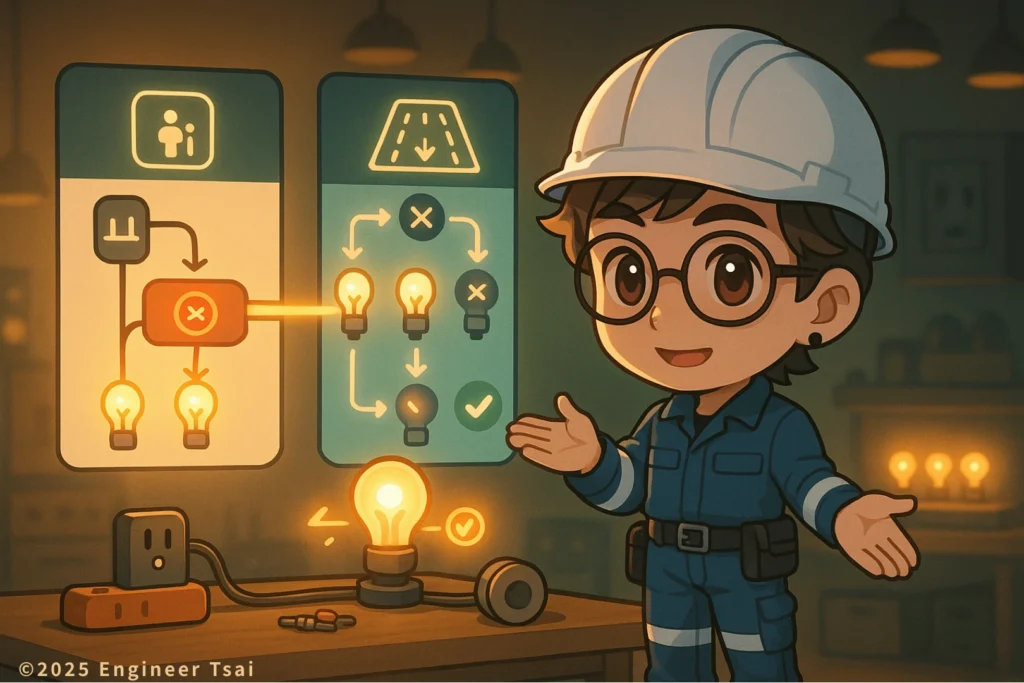
Series circuits: like standing in line at a narrow doorway
What is a series circuit?
In a series circuit, every component is connected one after another in a single loop.
There is only one path for current to flow.
So we get a very important result:
In a series circuit, the current is the same everywhere.
If any one component opens (breaks), it’s like someone blocking the only door in the hallway:
The entire circuit opens, and nothing else in that loop works.
That’s why pure series connections are rare in real-world home wiring — they’re not very reliable.
How voltage, current, and resistance behave in a series circuit
- Current (I) — same everywhere
- There’s only one path, so the current has nowhere else to go.
- Measure the current at any point in the loop (in an ideal circuit) and it will have the same value.
- Voltage (V) — gets split across components
- The supply voltage is shared by each resistor or load.
- Formula:
V_total = V₁ + V₂ + V₃ + …
- Resistance (R) — simply adds up
- Total resistance gets larger as you add more components in series.
- Formula:
R_total = R₁ + R₂ + R₃ + …
The longer the series chain, the bigger the total resistance, and the smaller the current.
The “all-or-nothing” problem in series circuits
Series circuits have one big downside:
Everyone’s fate is tied together.
If any of these happens:
- one bulb burns out and becomes an open circuit
- a connection in the middle becomes loose
- a wire breaks anywhere in the loop
then the entire series circuit stops conducting.
That’s why we don’t wire whole rooms of lights in pure series in modern homes — it’s just too fragile.
Real-world examples of series circuits (U.S. version)
- Old-style Christmas light strings
Many older light strings were wired mostly in series.
That’s why one dead bulb could sometimes take the entire string down. - Battery packs that need higher voltage
Put three 1.5-V AA batteries in series and you get 4.5 V.
Flashlights and small gadgets often do this:
series connection raises the voltage while keeping current the same through the chain.
Parallel circuits: like multiple lanes on a highway
What is a parallel circuit?
In a parallel circuit, components are connected side-by-side across the same two points.
Each branch has its own path for current to flow.
In other words:
In a parallel circuit, each branch has its own current,
but the voltage across each branch is the same.
How voltage, current, and resistance behave in a parallel circuit
- Voltage (V) — same on every branch
- All branches are connected across the same two nodes.
- So:
V_total = V₁ = V₂ = V₃ = …
- Current (I) — splits between branches
- The source current divides among all branches:
I_total = I₁ + I₂ + I₃ + … - Branches with lower resistance get more current.
- The source current divides among all branches:
- Resistance (R) — smaller than any single branch
- Total resistance in parallel is computed with reciprocals:
1 / R_total = 1 / R₁ + 1 / R₂ + 1 / R₃ + … - The result: R_total is always smaller than the smallest single resistor.
- Total resistance in parallel is computed with reciprocals:
That’s why parallel connections are so useful in high-power situations:
current is spread across multiple branches instead of crowding into one path.
Independence: why parallel circuits are great for home wiring
The biggest strength of parallel circuits is independence:
- If one branch is open (broken or disconnected),
you simply lose that path for current.
The other branches keep working.
That’s exactly why home branch circuits are wired in parallel:
If a kitchen outlet fails, your living-room lights don’t have to go dark.
Real-world parallel examples (U.S. home version)
- Household outlets and lighting circuits
In a typical U.S. home, receptacles and light fixtures on the same circuit are wired in parallel.
One burnt-out bulb or a damaged outlet doesn’t kill everything else. - Office or shop lighting rows
A long row of fluorescent or LED fixtures is usually many fixtures wired in parallel on the same branch circuit.
You can remove one fixture for maintenance and the others stay on.
Side-by-side comparison: series vs parallel circuits
This section doubles as your mental cheat sheet for series vs parallel circuits and a good summary for search engines / AI tools.
| Property | Series circuit | Parallel circuit |
|---|---|---|
| Current (I) | Same everywhere — one current flows through all parts | Splits between branches — each branch can have a different current |
| Voltage (V) | Divides — V_total = V₁ + V₂ + … | Same on every branch — each branch sees full source voltage |
| Resistance (R) | Adds directly — R_total = R₁ + R₂ + … | Adds as reciprocals — 1/R_total = 1/R₁ + 1/R₂ + …; R_total is smallest |
| Reliability | One failure can open the whole loop | One failed branch, others keep working |
| Typical uses | Battery packs in series, some light strings, simple demos | Home outlets, lighting circuits, appliances on the same branch |
Combination circuits: mixing series and parallel
What is a combination (series-parallel) circuit?
In real-world systems, pure series or pure parallel is rare.
Often you’ll see:
- some parts connected in parallel
- that whole group then connected in series with other parts
Any circuit that mixes both patterns is called a:
series-parallel (combination) circuit
Why use a combination circuit?
Combination circuits let you:
- use series parts to adjust overall resistance or voltage
- use parallel parts to improve reliability and current sharing
Examples:
- Indicator lights in a device might be wired in parallel with each other
- but the whole indicator section is in series with other parts of the control circuit
- so the system can keep working even if one small light fails
Example: R₁ and R₂ in parallel, then in series with R₃
Suppose you have three resistors:
- R₁ = 4 Ω
- R₂ = 6 Ω (in parallel with R₁)
- R₃ = 8 Ω (in series with that parallel pair)
Steps:
- Find the parallel part first 1 / R_parallel = 1 / 4 + 1 / 6
→ R_parallel = 2.4 Ω - Then add R₃ in series R_total = R_parallel + R₃ = 2.4 + 8 = 10.4 Ω
Key idea:
Solve small groups first (simplify parallel), then treat them like single resistors in series.
Work from the inside out.
How to choose the right circuit type
1) Based on voltage needs: raise voltage or keep it the same?
- Need higher voltage → use series
Example: putting batteries in series to go from 1.5 V to 3 V, 4.5 V, and so on. - Want every device to see the same voltage → use parallel
In North America, most outlets on a branch circuit each see around 120 V.
2) Based on reliability: can you accept “one failure = all off”?
- Don’t want one failure to shut everything down → parallel
That’s why home lighting and receptacle circuits are wired in parallel. - Low-risk, low-cost, or decorative uses where failure is acceptable → series might be okay
For example, some low-cost decorative light strings.
3) Based on power and current: spread the load or keep it small?
- High power, high current → better with parallel
Current can be shared across multiple branches so no single path is overloaded. - Low-power, small experimental circuits → series is common
For example, simple lab demos or indicator circuits with low current.
Quick guide for home wiring (U.S. version)
- Service panel → branch circuits → outlets / lights
These are mostly parallel structures, so each room and circuit can be controlled and protected separately. - Battery packs → devices
Common approach: first series for voltage, then sometimes parallel strings to increase current capability — always according to the manufacturer’s design.
Worked examples: practice with series, parallel, and combination circuits
Example 1: series circuit with three resistors
You have three resistors in series:
- R₁ = 5 Ω
- R₂ = 10 Ω
- R₃ = 15 Ω
- Supply voltage: V_total = 30 V
- Total resistance R_total = 5 + 10 + 15 = 30 Ω
- Circuit current I = V_total / R_total = 30 / 30 = 1 A
- Voltage across each resistor
- V₁ = I × R₁ = 1 × 5 = 5 V
- V₂ = 1 × 10 = 10 V
- V₃ = 1 × 15 = 15 V
Example 2: parallel circuit with three resistors
Now use the same three resistors, but in parallel:
- R₁ = 5 Ω
- R₂ = 10 Ω
- R₃ = 15 Ω
- V_total = 30 V (same across each branch)
- Total resistance 1 / R_total = 1 / 5 + 1 / 10 + 1 / 15
→ R_total ≈ 2.73 Ω (Notice: 2.73 Ω is less than the smallest resistor, 5 Ω.) - Current in each branch
- I₁ = V_total / R₁ = 30 / 5 = 6 A
- I₂ = 30 / 10 = 3 A
- I₃ = 30 / 15 = 2 A
- Total current I_total = 6 + 3 + 2 = 11 A Check: I_total ≈ V_total / R_total = 30 / 2.73 ≈ 11 A (small rounding error only).
Example 3: combination circuit (review)
Re-use the earlier example:
- R₁ = 4 Ω and R₂ = 6 Ω in parallel
- The parallel pair is then in series with R₃ = 8 Ω
- Parallel part 1 / R_parallel = 1 / 4 + 1 / 6
→ R_parallel = 2.4 Ω - Total resistance R_total = R_parallel + R₃ = 2.4 + 8 = 10.4 Ω
Rule of thumb:
Handle parallel sections first, then add series sections.
Work from small groups outward until you get the whole circuit.
Pros and cons: series vs parallel circuits
Series circuits: strengths and limitations
Pros
- Simple to draw and build — great for teaching and basic experiments.
- Useful when you need to raise total voltage (battery packs in series).
Cons
- Very low fault tolerance — one open component breaks the entire loop.
- Total resistance grows as you add more components, so current drops.
Parallel circuits: strengths and limitations
Pros
- High reliability — one branch can fail while others keep working.
- Lower total resistance, good for higher power and larger currents.
Cons
- Wiring and design are more complex.
- Poor design can overload a single branch or undersize the conductors.
In home wiring, this is why:
The internal design of devices may use series or combination circuits,
but the overall branch circuits in your walls are designed as parallel systems for safety and reliability.
How to quickly tell series vs parallel in real life
Some quick mental checks:
- A string of lights: one bad bulb, everything goes dark → likely series
- House outlets: one dies, others still work → parallel
- Battery holder: cells head-to-tail in a row → series
- Panel feeding multiple branch circuits going to different rooms → big parallel system made of many branches
Next time you look at a wiring setup, you can ask:
“If this part fails, will everything else go down with it?”
If yes → it’s likely part of a series chain.
If no → it’s probably a parallel or series-parallel setup.
FAQ: series and parallel circuits
1. What is the difference between series and parallel circuits?
Short answer:
In a series circuit, the current is the same everywhere, voltage is shared, and resistances add up.
In a parallel circuit, the voltage is the same on every branch, current splits, and resistances add as reciprocals.
Series is like a line of people going through one door;
parallel is like several lanes on a highway.
2. How can I tell if something in my house is wired in series or parallel?
The easiest way is to ask: “If one device fails, does everything go off?”
If one bulb failing turns the whole string off → mostly series.
If one light or outlet fails but others on the same circuit still work → parallel.
In a modern U.S. home, almost all branch circuits for outlets and lighting are designed as parallel circuits.
3. What happens if I add more bulbs in a series circuit?
When you add more bulbs in series:
the total resistance increases
the current decreases
each bulb usually gets dimmer
If one bulb burns open, the entire series loop opens and all bulbs go out — one reason series strings are less reliable.
4. Does a parallel circuit “use more electricity”?
“Using electricity” mainly depends on total power (watts) and how long you run it, not just the connection type.
Parallel circuits do draw more total current when you add more loads, but that’s because you’ve added more devices.
If you only have one device, its power consumption is determined by its wattage, regardless of series or parallel (assuming proper voltage).
5. Can I freely mix different brands or capacities of batteries in series or parallel?
In practice, it’s not recommended.
Mixing batteries with different capacities, ages, or brands in series or parallel can cause:
some cells to be over-discharged or over-charged
overheating, leakage, or damage
Safer practice: use batteries that are same brand, same type, same age, and follow the manufacturer’s recommended series/parallel configuration.
6. How can I quickly remember the formulas for series and parallel resistors?
Use this little memory phrase:
“Series: add directly. Parallel: add reciprocals.”
Series: R_total = R₁ + R₂ + …
Parallel: 1 / R_total = 1 / R₁ + 1 / R₂ + …
Combine that with:
series → same current
parallel → same voltage
and you’ll be much less likely to mix them up during exams.
7. Can I rewire my home outlets in series to “save power”?
Absolutely not.
Residential wiring in North America is designed to follow the National Electrical Code (NEC) and local building codes.
Most outlets and appliances are designed assuming parallel wiring at a fixed voltage.
Rewiring outlets in series:
will not meaningfully reduce your power bill
can cause undervoltage, malfunction, or overheating
can create serious fire and shock hazards
Any changes to home wiring should be done by a licensed electrician.
Conclusion: series vs parallel is your key to understanding circuits
On the surface, series vs parallel circuits are “just” about how you connect components.
- how voltage is shared
- how current flows
- whether total resistance goes up or down
- how reliable the whole system will be
If you can confidently say:
- Series: same current, voltage divides, resistances add
- Parallel: same voltage, current splits, resistances add as reciprocals
then you’re already standing on solid ground for reading circuit diagrams, solving basic exam questions, and understanding what’s happening in your walls and devices.
Once you’re comfortable with series vs parallel circuits, most beginner circuit questions and home wiring layouts start to feel much less mysterious.
Further reading & practice
“What Is Electrical Resistance? The Hidden Player in Every Circuit”
→ If you’re often stuck on “what value of resistor should I choose?”, this is a good next step.
“Electric Current vs Voltage: A Beginner-Friendly Guide”
→ Rebuild your intuition for “pressure vs flow” so today’s series/parallel ideas stick better.
“Electric Circuit Basics: Source, Wires, and Loads”
→ Go back to the three core parts of any circuit and see how home wiring really works.
“Ohm’s Law Explained: How Voltage, Current, and Resistance Relate”
→ Every calculation in this article secretly uses this one equation.
External references: learn series vs parallel circuits from other angles
If you want to explore Series vs Parallel Circuits with more practice and interactive tools, these are solid long-term resources I recommend:
- PhET – Circuit Construction Kit: DC
An interactive simulator where you can drag in batteries, resistors, bulbs, and switches to build your own series and parallel circuits. You can measure voltage and current with virtual meters and see how each change affects the circuit in real time. - The Physics Classroom – Parallel Circuits Concepts (Mission EC8)
A concept-builder with guided questions on parallel circuits: how adding branches changes total resistance, how current splits, and how voltage behaves across each branch. Great if you want more exam-style practice after reading this guide. - All About Circuits – Series-Parallel Combinations of Resistors
A more technical walkthrough of series-parallel combinations. It shows step-by-step how to reduce mixed circuits to a single equivalent resistance using the same formulas we used in the worked examples above.
Read next in this topic
- What Is Electricity ? Everything You Need to Know
- Current & Voltage for DIY Enthusiasts : Unlock the Basics
- AC vs DC: What’s the Difference and Why It Matters (From Phone Charging to 120 V Home Power)
- Basic Parts of an Electric Circuit (Power Source, Wires, Loads)
- Conductor vs Insulator: How Your Home’s Wiring Keeps You from Getting Shocked
- Ohm’s Law Explained: V = IR for 120V Home Circuits
- What Is a Resistor? How It Works, Types, and How to Choose the Right One
- Series vs Parallel Circuits: Simple Guide for Home Wiring (With Formulas & Examples)
- How Electromagnetic Wave and Electricity Shape Modern Technology
- What Is Voltage? Simple Definition, Everyday Examples, and Safety Tips
- What Is a Battery? How It Works, Types, and Everyday Uses Explained
- What Is Ampere’s Law? A Visual Guide to How Current Creates Magnetic Fields
- What Does a Capacitor Do? Uses, Energy Storage, and Everyday Examples
- Types of Electrical Wire: How to Choose the Right One for Your Home
- How AC Power Is Converted to DC: What’s Really Inside Your Phone Charger?
- Electrical Energy Conversion: How Energy Transforms for Everyday Use
- Magnetic Field and Current: The Core Relationship Behind Motors, Generators, and Wireless Charging
- How Do Magnets Work? From Fridge Magnets to Maglev Trains
- What Is Inductance? Inductor Basics for Real-World Circuits
- What Is Impedance? A Plain-Language Guide to Resistance, Inductive Reactance, and Capacitive Reactance