Practice the Texas Journeyman exam the way it is given
Since March 2025 the Texas Journeyman Electrician exam has two parts, and since September 1, 2026 it is referenced to the 2026 NEC. You must pass each part with at least 70%. This pack follows that format:
- Part 1, NEC Knowledge: 59 questions, 130 minutes.
- Part 2, Calculations: 26 questions, 110 minutes. Time left in one part does not carry over to the next.
Format source: PSI Candidate Information Bulletin for TDLR, updated September 15, 2026 (read it on PSI’s site). The real parts include 3 and 2 unscored questions; our mock scores every question. Every question is original, written for this pack in the PSI two-part format; none are PSI exam questions.
What you get
- 10 full two-part timed mocks. 85 questions each, 850 different questions with none repeated across mocks, drawn from a bank of 1,000 practice questions. After you submit, you see your score for each part, your score for each official topic area, and one line that names any part that scored below 70% on this mock.
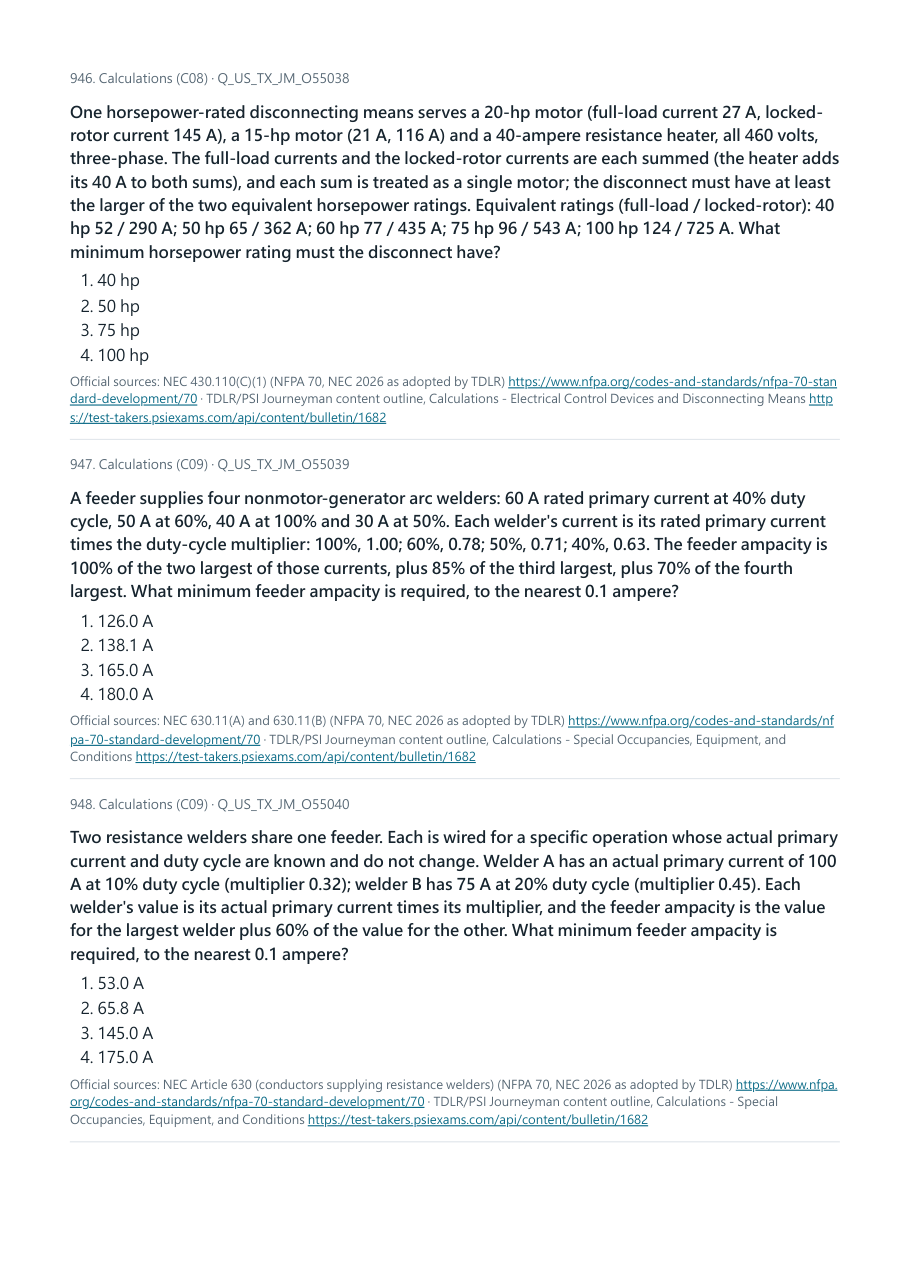
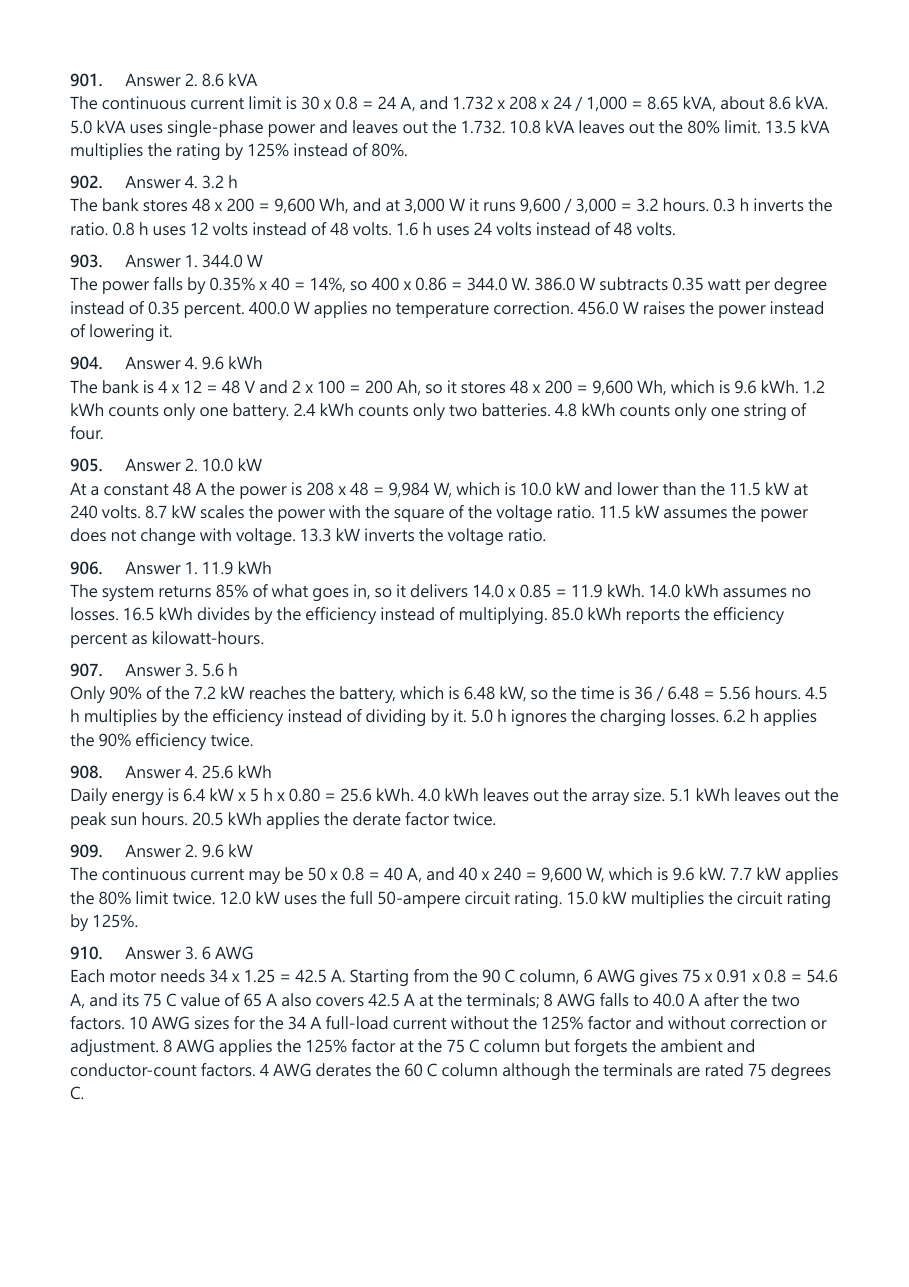
- Step-by-step solutions for every calculation question. Each shows the rule used, the numbers given, every step, the rounding rule where it matters, and why each wrong option is wrong.
- Practise finding the rule in your code book. Code-book navigation aids are included where available, so you can work on finding the relevant article, section or table in your own 2026 NEC.
- Find-these-first list. The code-book locations referenced most often by questions in this pack, ranked by frequency, including Article 120, the 2026 home of load calculations. Use it to plan which pages to learn first. PSI allows only permanent index tabs made or supplied by the NEC publisher; homemade tabs are not allowed in the exam room.
- NEC 2023 to 2026 transition guide. A printable guide for anyone who learned from 2023 material. Two tables with 16 entries on code location changes and reused section numbers, for example load calculations moving from Article 220 to Article 120 and wall switches moving from Article 404 to Article 406. Selected changes that alter exam answers, for example the dwelling general lighting load for the service dropping from 3 to 2 VA per square foot and the optional method first tier dropping from 10 to 8 kVA. The Texas rule that keeps the outdoor HVAC GFCI exception, plus advice on updating your 2023 study notes and checking answers in a 2026 NEC. Every code change in it is backed by at least two public sources, a state government source or NFPA technical staff, and is written in plain words with no code text copied.
- Printable workbook and printable PDF with answers, for offline study.
- Unlimited retakes of practice rounds and mocks, a wrong-answer list and a weak-area check.
Price
US$39, one payment, no subscription and no auto-renewal. For comparison, the PSI retake fee is US$78 per attempt.
Not sure yet? Try 70 questions free, no sign-up needed.
See how the pack helps you study
- Practise both parts under time pressure. Use 10 timed two-part mocks, then review your scores by part and topic.
- Work through the calculations. Each calculation solution shows the rule, the given values, the steps and why the other options are wrong.
- Try it before you pay. 70 free questions with answers and explanations, no sign-up.
- Keep your code book beside you. Use the references and navigation aids where available to practise looking up the rule. The 2026 NEC book is sold separately.
- Keep your review current. Use the public corrections log when revisiting a question, and send a code-backed issue through the question’s report link.
Self-directed Texas Journeyman exam-preparation practice: study original questions, work through the calculation steps and use your own code book for reference review.
What should I record when I miss a calculation question?
Record the given values, the rule you chose, the formula and the first step where your work differs from the solution. That makes the next study session specific. The Texas Journeyman practice pack shows worked calculation solutions, including why the other choices fail.
Source: Product contents
A study routine to try
- Label the values and units before doing arithmetic.
- Compare your rule and formula with the explanation.
- Work the problem again without looking at the answer, then write one check you will use next time.
Sources
Review the current product and access terms
FAQ
Should I copy the whole solution?
Try to write the step you missed in your own words, then solve it again.
Can a practice score predict my exam result?
Use it to choose what to study next. It does not establish what will happen on exam day.
Diagnose, practise and review with NEC 2026
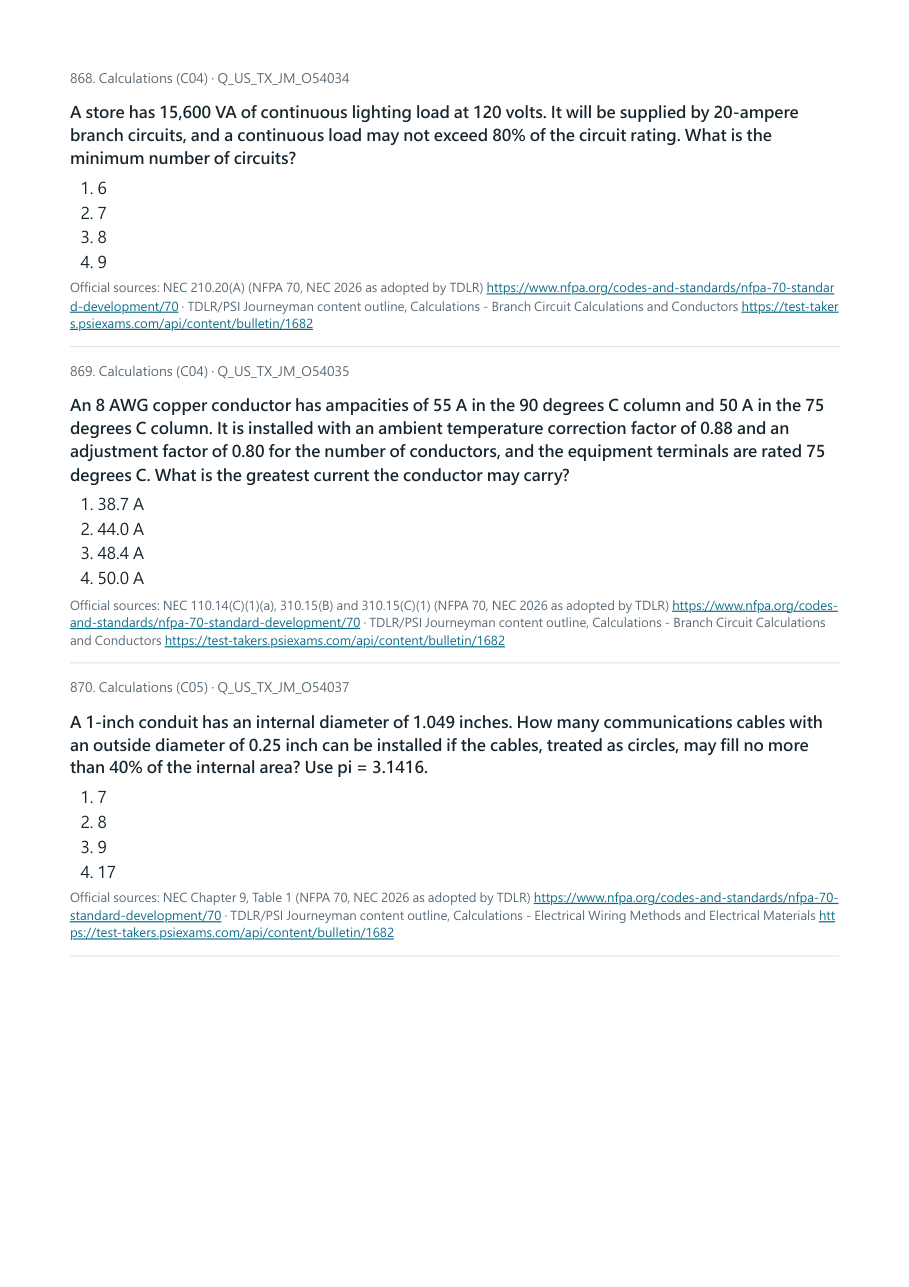
This addition to the existing US$39 Texas Journeyman practice pack includes a 40-question diagnostic in PDF and automatically scored Excel formats, two original 80-question timed mock exams with separate answer booklets, and a printable and editable error log. Your existing downloads remain part of the pack.
- Take the diagnostic before opening its answer key.
- Use your topic scores and weakest-first ranking to choose a Practice 01-10 review section in the diagnostic guide.
- Review the cited NEC 2026 rules and use the existing workbook for additional practice.
- Attempt mock A, then mock B on a later day. Each has 56 Knowledge questions in 130 minutes and 24 Calculations questions in 110 minutes. Time does not carry between portions.
- Record wrong and guessed answers, their NEC locators, the cause of the mistake and a review date in your error log.
The real PSI examination presents 85 questions, including 5 unscored trial questions. These mocks contain the 80 scored practice questions and retain the official time allowances; they omit the trial items and therefore allow slightly more time per question. Outline reference: PSI Bulletin 1682, printed pages 12-14, read October 23, 2026.
For a structure comparison, Mike Holt’s 2026 Journeyman Electrician Simulated Exams offers two 100-question exams across theory, code and calculations; this addition pairs two Texas portion-based scored mocks with a separate topic diagnostic and reusable error log.
Matching member stage: Apprentice year 4 / Texas Journeyman exam preparation (Calculations Readiness). Membership adds a staged learning path, practice scoring and progress across years, subject to the current plan and available steps. Start with a free account to see the available path. Buying these files does not unlock paid member steps.
Practise with original questions and worked explanations, then use the timed mocks and topic review to plan your next study session. Follow PSI’s current bulletin for official assessment instructions.
Turn a Journeyman mock result into a study plan
Keep the question you missed beside your next study session.
The Texas Journeyman Practice Pack combines a bank of 1,000 practice questions with 10 full two-part timed mocks.
What you can use
| Study step | Included material |
|---|---|
| Practice bank | 1,000 practice questions for the 2026 NEC. |
| Timed practice | 10 full two-part timed mocks. |
| Review | Worked calculation solutions, a wrong-answer list and a weak-area check. |
A study routine to try
Open the explanation for a missed question and note the first step you could not explain. For code questions, use the lookup aids where available to find the rule in your own code book.
US$39, one payment.
Practice with feedback on your computer
An additional offline companion is now included at the same US$39 price. Six Journeyman calculation-review decisions and a first-error reconstruction workspace for rule, inputs, units, arithmetic and later retry. Use the review workspace alongside the included question explanations and your own code-book references.
- 6 items with explanations and a wrong, unsure or needs-review queue. Your selections or numeric answers receive immediate feedback.
- Keep your own correction notes and export a private session file. Import that file later to resume this product’s practice.
- A topic-specific planning or record-check tool includes a separate fictional example. Its limits are stated beside the inputs.
Download us-electrician-practice-exam-pack-timed-printable-pdf-offline-companion.zip, extract the ZIP and open START-HERE.html in a current desktop browser. Work offline after downloading. Export your private session before closing or reloading to keep your answers, then import the backup when you return. Keep and transfer the exported file yourself when moving between devices.
Use the included PDF, templates and sample pages alongside the companion. Review the explanations, keep a note of the first uncertain step and return to it on another attempt. For planning figures, use your own inputs and confirm actual requirements with the responsible employer, program or authority.
TEXAS CAREER PROJECT · 02 / 04 · ENGLISH + ESPAÑOL
Journeyman cross-skill review project
Bring the skills together in one original project: eight linked tasks, worked reasoning, a changed case and four review criteria. The downloadable ZIP includes the complete project in English and Spanish, TXT study records, editable JSON save-and-restore and blank CSV worksheets.
Included with this product at its current price. Extract the ZIP and open START.html. Work offline without installing an app. Keep your existing study materials and add a project you can return to with your own saved record.
Try the first project task
Original classroom packet JX. A balanced three-phase load is 12 kVA at 208 V line-to-line; use√3=1.732. A separate single-phase load is 240 V RMS,16 A RMS,PF 0.75. A separate two-wire voltage-drop model gives 20 A and 0.20 ohm per conductor; both conductors have that resistance. Fictional arithmetic-only ampacity inputs: base 55 A, factors 0.80 and 0.90, independent terminal cap 40 A. Geometry exercise: 4 area-items×0.040 in² against 0.180 in²; 8 already-counted volume allowances×2.0 in³ against 18 in³. Current drawing JX-B has 21 devices, old JX-A 16, schedule 19. No supply is connected and no circuit design is released.
Calculate balanced line current; identify the required voltage definition.
Compare the worked reasoning
12,000/(1.732×208)=33.31 A≈33.3 A.208 V is line-to-line. The single-phase load is a separate case, not another branch to sum into this balanced model.
Proyecto completo en español: Proyecto integrado de revisión Journeyman
Ocho tareas conectadas, guías resueltas, caso cambiado y cuatro criterios de revisión. El ZIP incluye este proyecto completo en inglés y español, registro TXT, guardado y restauración JSON editable y hojas CSV vacías. Incluido en este producto al precio actual.
Paquete de aula JX. Carga trifásica equilibrada 12 kVA a 208 V entre líneas; usa√3=1.732. Carga monofásica separada: 240 V RMS,16 A RMS,FP 0.75. Modelo separado de caída de tensión de dos conductores: 20 A y 0.20 ohm por conductor; ambos tienen esa resistencia. Datos ficticios de ampacidad: base 55 A, factores 0.80 y 0.90, límite independiente 40 A. Geometría: 4 elementos×0.040 in² frente a 0.180 in²; 8 asignaciones ya contadas×2.0 in³ frente a 18 in³. Plano JX-B: 21 dispositivos; JX-A: 16; cuadro 19. Sin alimentación conectada ni diseño liberado.
Calcula corriente equilibrada de línea; identifica definición de tensión.
Comparar la guía resuelta
12,000/(1.732×208)=33.31 A≈33.3 A.208 V es entre líneas. La carga monofásica es caso separado; no se suma a este modelo equilibrado.
Use the supplied fictional packet for study; keep actual field assessment and official decisions with their responsible reviewers. / Usa el paquete ficticio para estudiar; las evaluaciones reales y decisiones oficiales corresponden a sus responsables.
Project download: texas-stage-02-integrated-project-en-es-v1.zip · English / Español
INCLUDED AT THE CURRENT PRICE · ENGLISH / ESPAÑOL
Build your next career move with skills you can show.
The new Texas Career Bridge Studio is included with this product:39 original English/Spanish practice stations,78 worked original-and-retry guides and a source-to-target planning worksheet across electrician, power-line and electrical-inspection work.
- Choose your starting work and target role, including cross-career and reverse moves.
- Practise AC power, controls, lighting, storage, equipment-label reasoning, line measurements and business decisions; use the skill-area map to find each exercise.
- Compare a worked answer, retry changed conditions and prepare evidence for a qualified review.
- Keep your private work in editable JSON or route-and-practice TXT; reopen your JSON later.
See the model. Then work the problem. Your studio includes 11 illustrated stations, with eight additional models for AC impedance, logic, resistance, lighting, markings, sources, optical loss and equipment labels. Each new figure has English and Spanish versions (16 language versions), plus editable SVG copies. Put them to work with the included 39 cases and 78 guides.
Find the first error while the problem is still fresh. Check 58 focused values and decisions across 16 original and changed model cases. Get feedback on the first number, unit or reasoning choice to revisit, add the check record to your written response, and keep it with the existing JSON or TXT export. The eight model checks work in English and Spanish, offline.
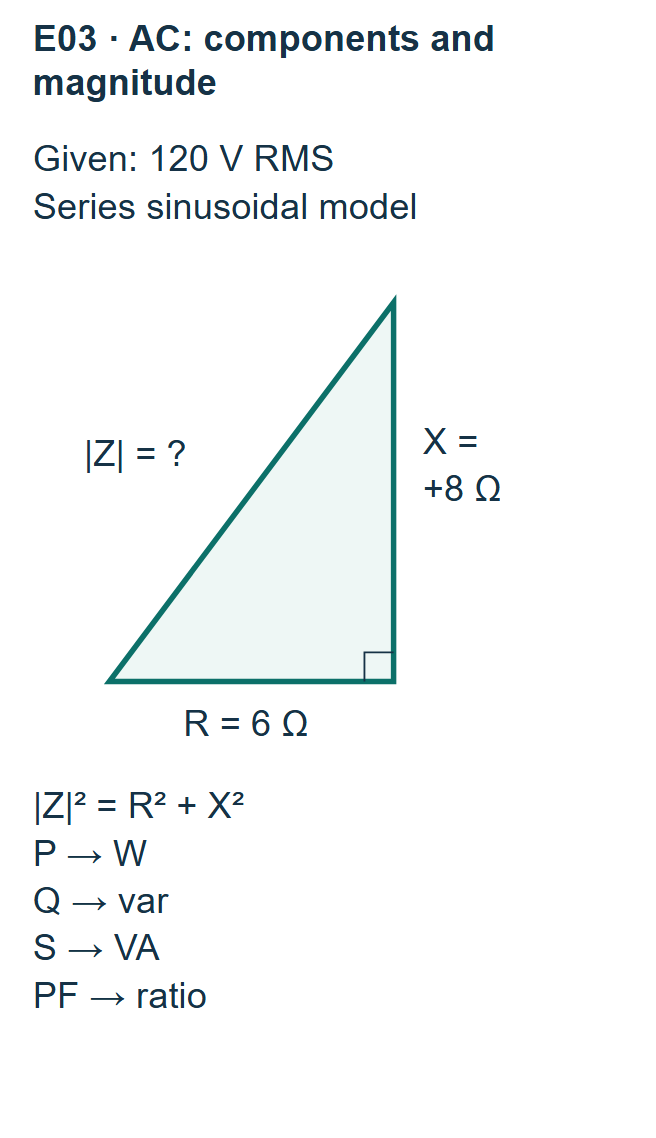
See an included diagram: AC: components and magnitude
Open START.html from texas-career-bridge-studio-en-es-v4.zip in a current browser. The studio runs offline without installation or an account. External reference and product links open only when you choose them.
Try an actual studio station: AC impedance and the power triangle
Learn the method
In an ideal sinusoidal series model, net reactance X=XL−XC and impedance magnitude |Z|=√(R²+X²). Use RMS voltage/current: I=V/|Z|, S=VI, P=I²R and Q=I²X. Power factor magnitude=P/S=R/|Z|. Positive X denotes an inductive, lagging-current model; negative X a capacitive, leading-current model. VA, W and var answer different questions. These equations describe a supplied model, not equipment selection or a capacitor installation.
Fictional packet
Fictional single-phase series model:120 V RMS, R=6 Ω, net X=+8 Ω. A worksheet adds 6+8 to obtain 14 Ω and calls all apparent power useful watts.
Your attempt: Calculate |Z|, I, S, P, Q and PF; explain both reasoning errors.
Compare the worked guide
|Z|=10 Ω; I=12 A; S=1440 VA; P=864 W; Q=+1152 var; PF=0.60 lagging. Check 864²+1152²=1440². Resistance and reactance combine as perpendicular components, not simple positive scalars. Apparent power is not equal to real power unless the relevant conditions, including unity PF, support that equality.
The included studio adds changed-condition retries, evidence notes and the related career bridge.
Español: un siguiente paso respaldado por evidencia
Texas Career Bridge Studio, incluido al precio actual
39 estaciones originales en inglés/español,78 guías resueltas de base/reintento y hoja de planificación entre electricidad de inmuebles, líneas eléctricas e inspección.
- Elige trabajo inicial y destino, incluso cambios entre carreras o de sentido inverso.
- Practica potencia CA, control, iluminación, almacenamiento, datos de equipos, medición de líneas y decisiones empresariales; encuentra ejercicios con el mapa de áreas.
- Compara respuesta, reintenta con datos nuevos y prepara evidencia para revisión cualificada.
- Guarda JSON editable o TXT de ruta/práctica y restaura tu archivo después.
Visualiza el modelo y resuelve el caso. El estudio incluye 11 estaciones ilustradas, con ocho modelos gráficos adicionales para impedancia CA, lógica, resistencia, iluminación, marcado, fuentes, pérdidas ópticas y datos de equipos. Las ocho nuevas figuras tienen versiones en inglés y español (16 versiones) y copias SVG editables. Aprende con los 39 casos y 78 guías incluidos.
Detecta el primer error mientras el problema sigue fresco. Verifica 58 valores y decisiones clave en 16 casos de modelos originales y modificados. Recibe una indicación del primer número, unidad u opción de razonamiento que revisar, añade el registro a tu respuesta escrita y consérvalo con la exportación JSON o TXT existente. Las verificaciones de los ocho modelos funcionan en inglés y español, sin conexión.
Mira una figura incluida: CA: componentes y módulo
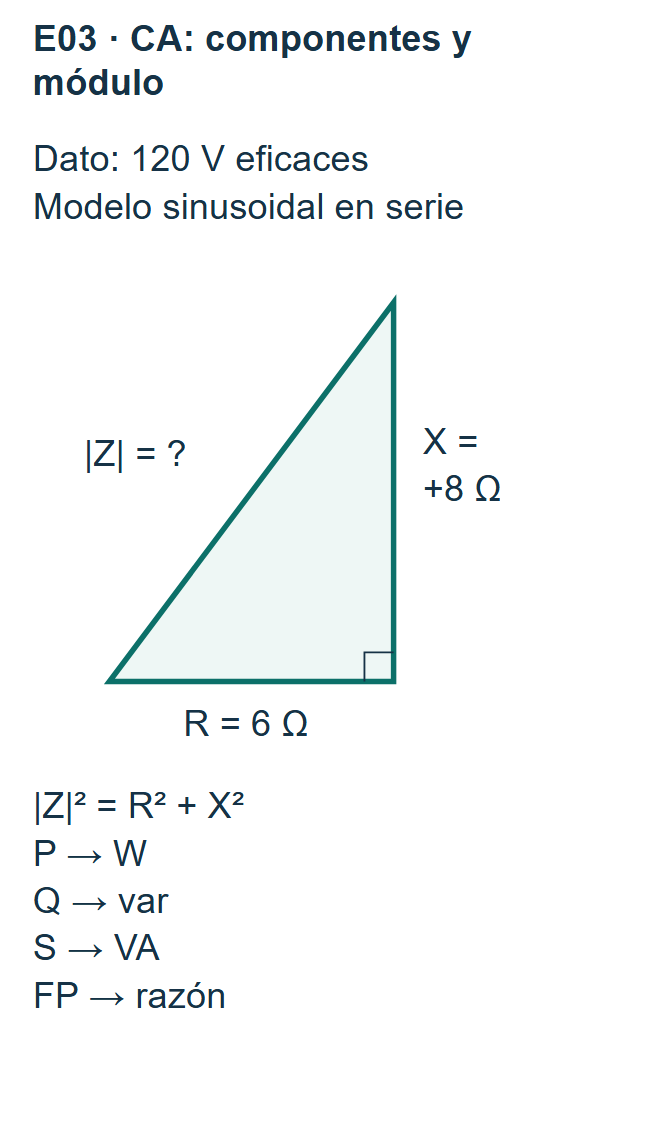
Abre START.html de texas-career-bridge-studio-en-es-v4.zip en navegador actual: sin instalación ni cuenta; estudio sin conexión. Enlaces externos solo se abren al elegirlos.
Prueba una estación real: Impedancia CA y triángulo de potencia
En modelo sinusoidal ideal en serie, reactancia neta X=XL−XC y módulo |Z|=√(R²+X²). Usa tensión/corriente eficaces: I=V/|Z|, S=VI, P=I²R y Q=I²X. Magnitud del factor de potencia=P/S=R/|Z|. X positiva indica modelo inductivo con corriente atrasada; X negativa, capacitivo con corriente adelantada. VA, W y var son magnitudes distintas. No selecciona equipos ni instalación de condensadores.
Modelo monofásico ficticio en serie:120 V eficaces, R=6 Ω, X neta=+8 Ω. Hoja suma 6+8 para 14 Ω y llama a toda potencia aparente vatios útiles.
Tu intento: Calcula |Z|, I, S, P, Q y FP; explica ambos errores.
Compara la guía resuelta
|Z|=10 Ω; I=12 A; S=1440 VA; P=864 W; Q=+1152 var; FP=0.60 atrasado. Comprueba 864²+1152²=1440². Resistencia y reactancia son componentes perpendiculares, no suma de escalares positivos. Potencia aparente no equivale a real salvo condiciones pertinentes, incluido FP unitario.
Ejercicios ficticios de preparación. Formación práctica, requisitos de licencia, experiencia aceptada y nombramiento se verifican con responsables competentes; cargo previo no concede créditos automáticamente.
Fictional preparation exercises. Pair the studio with the relevant project already included in this product. Practical training, accepted experience, credentials and work authority are verified with the responsible providers/employers/agencies; a source job title grants no automatic credit.
