On this page
Table of contents
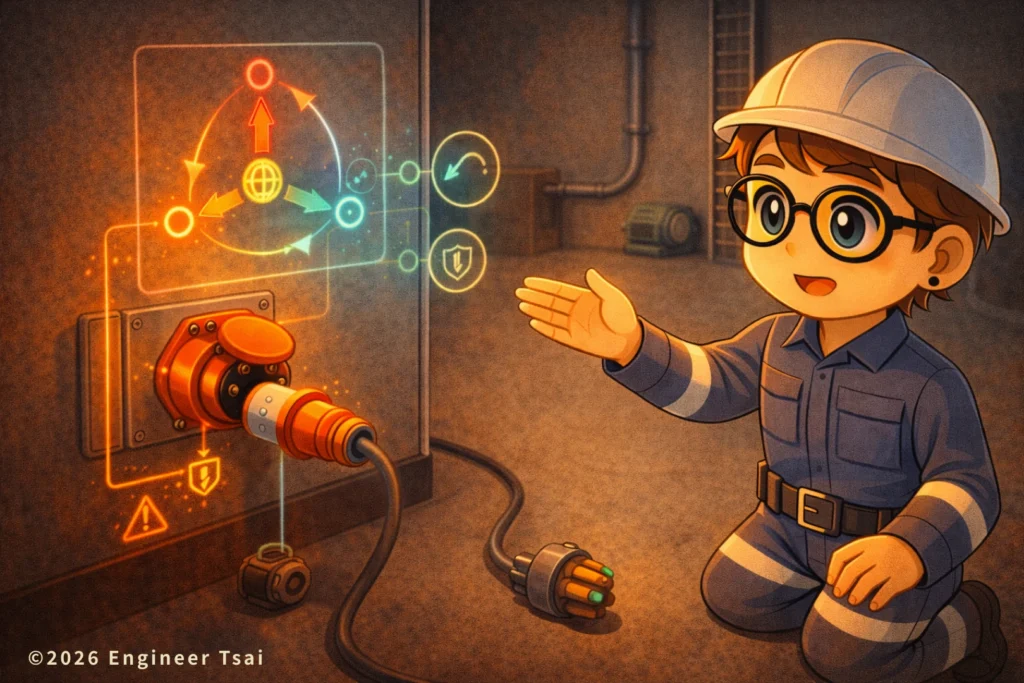
If you’re still trying to get a feel for how electricity actually works—especially when you start seeing heavy-duty connectors like a three-phase outlet—I recommend starting from this electrical basics overview:
🔹 “Electrical Basics 101: From ‘What is electricity?’ to understanding your home panel”
Once voltage, current, and power feel more natural, it’s much easier to see how three-phase voltage compares to the 120V/240V you use every day.
For many people, the first time they notice a three-phase outlet is in an industrial shop, a big walk-in freezer, or a commercial kitchen — a chunky, heavy-duty receptacle labeled “3P+E,” “3P+N+E,” “380V,” “3φ4W,” or similar.
Common questions sound like this:
- How is three-phase power different from the 120V / 240V I have at home?
- What do 3P, N, and E actually mean? And what’s the difference between 3P+E and 3P+N+E at a three-phase outlet?
- Why do we “have to” use a three-phase outlet here? Why not just a bigger single-phase outlet?
This article takes a field-first, U.S.-friendly view of the three-phase outlet and walks you from “what three-phase power is” all the way to “how to read a three-phase outlet labeled 3P+E,” with safety and wire sizing sprinkled in. The goal is that next time you see one of these outlets, you’re not scared of it — you understand what it’s protecting, roughly how much it can carry, and how to use it safely.
▶️ Watch now: understand a three-phase outlet in 60 seconds
In the short video, we use a simple diagram to run through the route from “three-phase supply → three hot conductors (L1 / L2 / L3) + equipment ground (PE) → three-phase outlet → motor load,” so you get a picture in your head first.
If you watched the video and started wondering things like “Why do shops love three-phase so much? What’s actually wired inside a three-phase outlet? When do you use 3P+E vs 3P+N+E?” — this long-form guide is your follow-up reading.
We’ll start with the basic idea of three-phase AC power, then decode outlet markings and real-world use, and finally collect the most important three-phase outlet safety checks so you know what to ask and what to look for on site.
Chapter 1|Understand three-phase power: line voltage, phase voltage, and why there are extra wires
To make sense of any three-phase outlet, you first need a clear picture of one thing:
What is three-phase power (three-phase AC)?
Here’s the super plain-English version:
- In a typical North American home, you mostly see “single-phase”: one hot leg (L) and one neutral (N), giving you 120V, or two hots for 240V loads.
- In a three-phase system, you have three hot conductors (L1 / L2 / L3). Their voltages are shifted 120° apart in time, like three runners taking turns pulling the load.
That design brings a few big advantages:
- For motors, three-phase power gives a much smoother torque. Starts are more stable and efficiency is higher.
- For the same power, a three-phase system can run with lower current per conductor, so your wire size doesn’t need to be ridiculously large.
- If the three-phase loads are reasonably balanced, the neutral current at the transformer can largely cancel out, which keeps the system running more smoothly.
If you want the more “engineering textbook” explanation with phasor diagrams and equations, check out the Wikipedia article on three-phase electric power. It walks through the math and typical wiring configurations in detail.
1. Line voltage vs. phase voltage: why do I see 208 / 240 / 277 / 480V?
In a three-phase system, you’ll usually hear about two different voltages:
- Line voltage: the voltage between any two hot legs, such as L1–L2.
- Phase voltage: the voltage from a hot leg to neutral, such as L1–N.
In a common “three-phase, four-wire” wye system (L1, L2, L3, N), the line voltage is √3 times the phase voltage. That’s why you see combinations like:
- 120V phase → about 208V line (208Y/120V systems in many U.S. commercial buildings).
- 277V phase → about 480V line (480Y/277V in larger facilities).
On many three-phase outlets and nameplates, the big number you see (208V, 240V, 400V, 480V) usually refers to the line-to-line voltage of the system it’s designed for.
2. Why don’t we use three-phase for everything?
In short:
- Small, portable loads (hair dryers, rice cookers, TVs, laptops) → single-phase power is more than enough.
- Big, long-running loads (elevators, air compressors, large refrigeration compressors, make-up air units) → three-phase is more efficient and kinder to the equipment.
So when you see a three-phase outlet on the wall, it usually means one thing: this location is reserved for a higher-power machine that was designed for three-phase service.
Chapter 2|How to read a three-phase outlet: 3P+E, 3P+N+E, pins and labeling explained
Once you’re comfortable with the basics of three-phase power, it’s time to meet the main character of this article: the three-phase outlet itself.
On site, you’ll often see markings like:
- 3P+E: three phase conductors (L1 / L2 / L3) + equipment grounding conductor (PE).
- 3P+N+E: three phase conductors + neutral (N) + equipment ground (PE).
A quick shorthand to remember:
👉 “P” stands for Phase (hot leg), “N” is Neutral, and “E” is Earth (equipment ground).
1. 3P+E vs. 3P+N+E: when do you need a neutral?
In general:
- 3P+E: the load is a pure three-phase load such as a three-phase motor wired in delta or wye, and it doesn’t need a neutral connection.
- 3P+N+E: the same branch circuit feeds both three-phase loads and single-phase loads (for example, a piece of equipment that has internal 120V or 230V controls, lights, or heaters), so the neutral is brought out too.
Whether you bring a neutral to the outlet depends on how much single-phase load will be present, how well-balanced the phases will be, and how the panel and transformer are designed. It’s not “the more wires the fancier” — it’s a design choice.
If you want to go deeper into international three-phase plug/receptacle standards, pin configurations, and color coding, you can look at the IEC 60309 standard on industrial plugs and sockets (IEC 60309 overview on Wikipedia), which maps pin layouts to voltage and frequency ranges.
2. Pin layout, orientation, and keying: why are three-phase plugs so big?
Most people’s first reaction when they hold a three-phase plug is: “This thing is huge!”
Inside that oversized housing are a few important design choices:
- Larger contact areas: to safely handle higher rated currents with less heating from contact resistance.
- Clear keying and orientation: to prevent you from plugging into a receptacle with the wrong voltage or pin configuration.
- Dedicated ground pin position: the equipment grounding pin is usually obvious and often designed to make ground connect first and disconnect last.
So when you see someone making a sketchy “three-phase to many single-phase outlets” adapter and stuffing a bunch of loads onto one three-phase outlet, your danger radar should go off: they’ve very likely defeated the original keying and rating assumptions of that outlet.
Chapter 3|Where you’ll see three-phase outlets in real life: shops, kitchens, cold rooms
In the U.S. and other countries that use three-phase distribution, you’re most likely to see a three-phase outlet or three-phase outlets in places like:
- Industrial shops and factories: lathes, CNC machines, air compressors, conveyor drives, pumps, and fans.
- Commercial kitchens: large exhaust fans, dishwashers, fryers, combi ovens, and high-power steamers.
- Cold storage and refrigeration: walk-in freezers, refrigerated warehouses, display case compressors.
- Mechanical and electrical rooms: elevators, large HVAC units, chillers, and big air handlers.
These locations tend to share a few traits:
- Equipment has high power and high inrush current when starting.
- Loads often run for long hours or continuously.
- Failures can mean lost production or spoiled inventory (imagine a walk-in freezer going down).
So when an engineer or electrician designs a circuit that ends in a three-phase outlet, they’re not just “pulling a circuit and installing an outlet.” They’re also thinking about:
- Whether the upstream panel, breaker, and wire size are sized correctly for starting and running current.
- Whether the three phases will be reasonably balanced, or if one phase is already heavily loaded.
- Whether the outlet location needs to be weatherproof, dust-tight, or protected from impact.
If you’re the owner or end user, you can treat these points as a checklist of questions to ask your contractor. If you’re on the technical side, this is the daily reality of designing, installing, and maintaining three-phase outlets safely.
Chapter 4|Before you plug in: checks you must do with three-phase outlets
To wrap up, let’s turn the key points into a small checklist of questions to ask before using a three-phase outlet, whether you’re the installer or the user.
1. Are the voltage and frequency correct?
The voltage and frequency on the equipment nameplate must match the supply from the three-phase outlet:
- Equipment: 3φ 208V 60Hz → supply should be three-phase 208V / 60Hz.
- Equipment: 3φ 480V 60Hz → do not plug into a 208V outlet and hope it “sort of works.”
Imported equipment (for example, 400V 50Hz from Europe) needs extra care: you may need a transformer, VFD, or multi-voltage design. Never assume “it’ll probably be fine” when the nameplate doesn’t match the system.
2. Do current rating, wire size, and protection match?
A three-phase outlet will have a marked current rating (20A, 30A, 32A, 50A, 63A, etc.). That rating should be consistent with:
- The upstream breaker or fused disconnect rating.
- The wire size (copper AWG or mm²) in the branch circuit.
- The motor or equipment’s starting and running current.
If the wire is undersized or the breaker is oversized, the first thing to overheat won’t be the breaker — it’ll be the cord, the plug, or the outlet itself. That’s how melted connectors and burned insulation happen.
3. Are adapters and extension cords being used safely?
One of the most common failure modes in three-phase systems is field-made “creative wiring”:
- Using a three-phase outlet to feed a bunch of single-phase outlets with no real load calculations.
- Running long extension cords with wire that’s too small for the equipment’s current.
- Loading one phase much more heavily than the others without realizing it.
All of these can destroy the protection assumptions built into the original design. Somewhere along that path, a segment of wire or a connector may be carrying far more current than it was ever meant to, and nothing is tripping — until it overheats.
If you truly need to adapt or extend a three-phase outlet, at minimum, have an experienced electrician or designer check the loads, wire sizes, and protection. Three-phase outlets are not the place for DIY wiring experiments.
Conclusion|Understanding three-phase outlets is more than “it fits, so it’s fine”
To a lot of people, three-phase outlets feel like something only factories need to worry about — as long as you don’t touch them, you’ll be okay. But if you ever set foot in a shop, a mechanical room, or a commercial kitchen, even a little three-phase knowledge about what’s behind each three-phase outlet goes a long way.
- You’ll understand the difference between 3P+E and 3P+N+E and what that means for the load.
- You won’t casually plug a 208V-rated machine into a 480V outlet “just to try.”
- You’ll pay much more attention to “wire size, protection, and sketchy adapters” — the small details that actually control risk.
Ideally, the next time you see a three-phase outlet, what pops into your head isn’t “this looks scary,” but a clear picture of how power and protection flow through that circuit. If you have friends who are just getting into electrical work, factory maintenance, or commercial kitchens, feel free to share this with them so everyone’s starting from solid fundamentals.
📌 Recommended reading:
🔹“Grounding vs. bonding (equipotential): why bathrooms and outdoor areas matter most”
Three-phase equipment often lives in damp or metal-heavy environments. This piece uses everyday examples to explain the difference between grounding and bonding, and why both matter for shock protection.
🔹“Outlet and switch ratings: why contact resistance leaves ‘burn marks’” (in progress)
Once you understand current ratings and contact resistance, it’s easier to see why a three-phase outlet is built so large and rugged — and why ultra-cheap adapters are so quick to overheat.
🔹Three-phase electric power (Wikipedia)
If you already have some math and electrical background and want the full vector-based explanation and formulas, this article is a solid next step.
Three-phase outlet FAQ
Q1: Will I ever see a three-phase outlet in a regular home?
A: In typical U.S. houses, almost everything is single-phase 120/240V, so you won’t usually see three-phase outlets inside the living space. You’re more likely to see them in commercial or light industrial buildings, mechanical rooms, or mixed-use spaces. If you do see what looks like a three-phase outlet in a residential setting, treat it with caution and ask an electrician to confirm its voltage and purpose before using it.
Q2: Can I use a three-phase outlet to feed a bunch of regular 120V outlets?
A: Not directly and not without design work. It is possible to derive single-phase loads from a three-phase system, but you must carefully calculate phase currents, wire sizes, and protection to avoid unbalanced phases and overloaded conductors. This should be done at the panel by a qualified designer or electrician, not improvised at the outlet with homemade adapters.
Q3: Does every three-phase motor need a plug and outlet, or can I hard-wire it?
A: Both are common. For permanently installed equipment, hard-wiring through a disconnect is typical. For movable or serviceable equipment, using a properly rated three-phase plug and outlet makes maintenance and lockout/tagout easier. Either way, the key is that the wiring, overcurrent protection, and disconnecting means all match the motor’s nameplate and code requirements.
Q4: I see 3P+N+E on the outlet. Can I just use two pins as a 240V source?
A: In theory you can get a line-to-line or line-to-neutral voltage from a three-phase system, but in practice you should only do this if the system was designed for it and the panel-side wiring and protection were set up accordingly. Randomly picking two pins from a 3P+N+E outlet and treating it as “just another 240V source” can break the original load-balancing and protection assumptions.
Q5: I’m in a technical/vocational program and want to learn three-phase outlets and wiring. Where should I start?
A: Start on three levels: (1) Electrical basics: three-phase AC concepts, the relationship between line and phase voltage, and power calculations. (2) Distribution practice: three-phase panel layouts, three-phase four-wire systems, conductor sizing, and breaker/fuse selection. (3) Field applications: common industrial loads (motors, compressors, fans), starting methods (across-the-line, wye-delta, VFD), and how they connect to outlets and disconnects. Once your single-phase safety and wiring skills are solid, extending to three-phase becomes much more manageable.
—
Have you ever walked into a mechanical room or shop and seen three-phase outlets or strange adapters you didn’t quite trust? When you think about safety, do you worry more about equipment reliability, wire heating, or how people actually use the outlets day-to-day?
Share your stories or questions in the comments. And if you know someone just starting out in industrial or commercial work, feel free to pass this article along — the more people understand three-phase outlets, the fewer avoidable mistakes we’ll see in the field.
Read next in this topic
- What Is Electricity ? Everything You Need to Know
- Current & Voltage for DIY Enthusiasts : Unlock the Basics
- AC vs DC: What’s the Difference and Why It Matters (From Phone Charging to 120 V Home Power)
- Basic Parts of an Electric Circuit (Power Source, Wires, Loads)
- Conductor vs Insulator: How Your Home’s Wiring Keeps You from Getting Shocked
- Ohm’s Law Explained: V = IR for 120V Home Circuits
- What Is a Resistor? How It Works, Types, and How to Choose the Right One
- Series vs Parallel Circuits: Simple Guide for Home Wiring (With Formulas & Examples)
- How Electromagnetic Wave and Electricity Shape Modern Technology
- What Is Voltage? Simple Definition, Everyday Examples, and Safety Tips
- What Is a Battery? How It Works, Types, and Everyday Uses Explained
- What Is Ampere’s Law? A Visual Guide to How Current Creates Magnetic Fields
- What Does a Capacitor Do? Uses, Energy Storage, and Everyday Examples
- Types of Electrical Wire: How to Choose the Right One for Your Home
- How AC Power Is Converted to DC: What’s Really Inside Your Phone Charger?
- Electrical Energy Conversion: How Energy Transforms for Everyday Use
- Magnetic Field and Current: The Core Relationship Behind Motors, Generators, and Wireless Charging
- How Do Magnets Work? From Fridge Magnets to Maglev Trains
- What Is Inductance? Inductor Basics for Real-World Circuits
- What Is Impedance? A Plain-Language Guide to Resistance, Inductive Reactance, and Capacitive Reactance