On this page
If you’re still building your foundation in basic electricity, start with this beginner-friendly overview: 🔹 “Electricity 101: The Complete Beginner’s Guide to How Power Really Works”
After reading it, the concepts in this article will make a lot more sense.
Quick answer first:
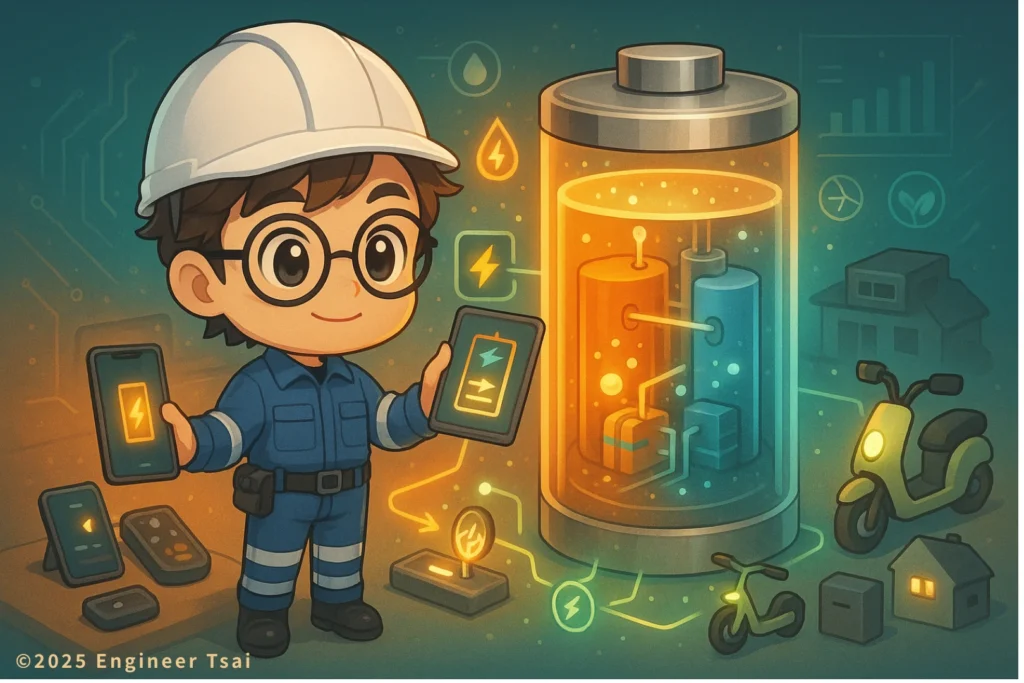
If you’re Googling “what is a battery”, you can think of it as a tiny power plant that slowly turns chemical energy into electrical energy. Thanks to batteries, your phone lights up, your car starts, and your TV remote works — even when there’s no outlet nearby.
You’re probably surrounded by more batteries than you realize:
phones, wireless mice, TV remotes, game controllers, power banks, transit cards, cordless tools, e-bikes, EVs… Anywhere you don’t see a power cord, chances are there’s at least one battery hiding inside.
If you understand what’s happening inside a battery, it’s much easier to:
- choose the right battery for a device
- charge it in a way that protects its lifespan
- follow what people are talking about when they argue about EVs, fast charging, or home energy storage
In this guide, we’ll walk through what a battery is, how it works, the main types you’ll see every day, and where battery tech is heading next. So if you’ve ever typed “what is a battery” into a search bar and closed the tab still confused, this article is meant to be your clear, no-jargon answer.
By the end, you’ll have a clear, practical answer to what is a battery that you can explain to a friend without sounding like a textbook.
Key takeaways
- A battery uses a chemical reaction between an anode, a cathode, and an electrolyte to give electrons a reason to “take a lap” through an external circuit.
- Primary (single-use) batteries are designed to be used once and thrown away. Secondary (rechargeable) batteries can be charged and reused many times.
- From TV remotes and smartphones to EVs and solar-plus-storage systems, batteries are what make electricity portable.
- Over the next few years, higher-energy batteries, solid-state designs, and greener materials will shape who leads the next wave of battery technology.
Together, these points give you a working everyday answer if someone asks, “what is a battery?”
Prefer to watch first? 60-second video: how a battery works
If you like visuals before text, start here: a 60-second short that shows, with simple animation, how a battery turns a chemical reaction into electric current.
Watch that first, then come back to the diagrams and explanations below — everything will feel much more intuitive.
What is a battery? A plain-English definition
If you’re still wondering what is a battery, at its core, a battery is a device that turns chemical energy into electrical energy.
As long as the chemical reaction inside is still going, the battery can keep pushing electrons through an external circuit and power your device.
A basic battery has three key parts:
- Anode (negative, where oxidation happens)
In a discharging battery, the anode loses electrons — an oxidation reaction. You can think of it as “throwing” extra electrons into the external circuit. - Cathode (positive, where reduction happens)
The cathode receives electrons from the outside circuit. A reduction reaction happens here, combining those electrons with ions from the electrolyte to form new compounds. - Electrolyte
The medium between the two electrodes. It lets ions move between the anode and cathode so the overall reaction can keep going.
Electrons move along the external wires, while ions move through the electrolyte inside the cell.
Those two flows work together to complete the circuit — that’s the key to how a battery can deliver a steady current.
How does a battery produce current? (Using redox without the headache)
The core of every battery is a redox (oxidation-reduction) reaction.
Here’s the process in three simple steps:
- At the anode: oxidation
The active material at the anode loses electrons and turns into positively charged ions that move into the electrolyte.
This step creates extra electrons that are ready to leave through the external circuit. - At the cathode: reduction
The cathode accepts electrons coming from the external circuit. Those electrons combine with ions from the electrolyte to form new products, completing the overall chemical reaction. - Electron flow: that’s your current
The extra electrons at the anode travel through the external conductor (the wires) toward the cathode.
This one-way flow of electrons is what we call electric current in the circuit.
A battery’s voltage, capacity, and lifespan all depend on the materials chosen for the anode, cathode, and electrolyte. That’s why the battery in a toy, a laptop, and a backup UPS all look and behave differently — they’re optimized for very different jobs.
Short answer to “How does a battery work?”
A battery uses the voltage difference between its anode and cathode to push electrons through an external circuit. That voltage difference comes from a specific redox reaction designed into the battery’s chemistry.
In other words, this redox reaction is the deeper, science-side answer to the question, “what is a battery and how does it work?”
Types of batteries: primary vs. rechargeable
In everyday life, most batteries you see fall into two big buckets:
- Primary batteries (single-use) – you use them until they’re dead, then you replace them.
- Secondary batteries (rechargeable) – you can feed energy back into them and use them many times.
Primary batteries: single-use and all about convenience
Primary batteries are not designed to be recharged. Once the chemical reaction has run its course, the battery is done.
Common examples:
- Alkaline batteries
The classic AA, AAA, C, and D cells in TV remotes, wall clocks, flashlights, and some toys. - Zinc-carbon batteries
An older, cheaper chemistry you may still find in very low-drain devices where performance isn’t critical.
Primary cells are:
- cheap
- easy to find
- great for low-drain devices that sip power over months or years
But in the long run, they’re more expensive per unit of energy and create more waste compared to good rechargeable options.
Rechargeable batteries: higher upfront cost, lower long-term cost
Secondary (rechargeable) batteries can reverse at least part of their chemical reaction when you apply electrical energy from a charger. That’s what lets you reuse them over and over.
Everyday examples include:
- Lithium-ion batteries (Li-ion)
Powering smartphones, laptops, tablets, cameras, cordless tools, e-bikes, and electric vehicles. They pack a lot of energy into a small, light package. - Nickel-metal hydride (Ni-MH)
Common in rechargeable AA/AAA cells for cameras, toys, wireless mics, and other household devices. - Lead-acid batteries
The old workhorse in cars and trucks for starting the engine, and in many backup power systems (UPS units, emergency lighting, some off-grid setups).
Rechargeable batteries shine when:
- you use a device a lot
- you care about long-term cost
- you want to cut down on waste
But they do need proper charging and care. Avoid deep discharges and overcharging if you want to get the most life from them.
Everyday battery use: from remotes to EVs
Where do all these battery types actually show up? Pretty much everywhere. Another way to answer “what is a battery” is to look at where it quietly shows up in daily life — from the tiniest sensor to the car you drive.
Around the house: if it’s cordless, it’s probably on a battery
At home, any device that’s portable or not worth plugging in all the time probably depends on a battery:
- TV remotes, wall clocks, wireless mice/keyboards
These often use primary alkaline batteries for long, low-drain use. - Smartphones, tablets, Bluetooth headphones
Built-in lithium-ion batteries keep you streaming, scrolling, and navigating throughout the day. - Power banks (portable chargers)
Essentially a pack of lithium-ion cells plus control circuitry to safely charge and discharge them. - Smart home gadgets
Door sensors, smart locks, thermostats, and some security sensors rely heavily on batteries to stay wire-free.
Transportation: starter batteries, hybrids, and full EVs
In vehicles, batteries are absolutely critical:
- Conventional cars and trucks
A lead-acid battery handles starting the engine and powering electronics like the ECU, lights, and infotainment when the engine isn’t running. - Motorcycles, scooters, e-bikes
Batteries don’t just start things — in electric models they power the motor itself. - Hybrid and electric vehicles (EVs)
Large lithium-ion battery packs are the main energy source.
Range, charging time, performance, and even safety are all closely tied to battery chemistry and pack design.
Renewable energy and home storage
In solar and wind systems — where generation is intermittent — batteries act as a “time-shifting” tool for electricity:
- When the sun is bright or the wind is strong, excess energy charges the battery.
- In the evening, at night, or on cloudy days, the system discharges that stored energy back into your home or the grid.
That’s the idea behind home battery systems (like Powerwall-style setups) and grid-scale battery farms that help balance supply and demand.
If you’d like to see how this plays out in real-world solar setups, check out this solar energy and storage basics guide from the U.S. Department of Energy.
Where battery technology is heading: more energy, solid-state, safer, and greener
Once you’re comfortable with the basic idea of what is a battery, the next step is to look at where the technology is going. When people talk about “next-generation batteries,” they’re usually talking about improvements in three big areas:
- Higher energy density
Storing more energy in the same size or weight. Benefits are obvious:- longer EV driving range
- thinner and lighter devices
- fewer charge cycles during the day
- Solid-state batteries
These replace the liquid electrolyte with a solid one.
In theory, that can boost safety (less leakage, lower fire risk) and enable higher energy density. Solid-state is one of the hottest research topics in the battery world right now. - Greener materials and better recycling
Future batteries will increasingly focus on:- using fewer scarce or problematic metals
- making cells easier to recycle
- recovering more material at end of life
Put simply: it’s not just about packing more energy into a battery, but also about what happens after it wears out.
FAQ: Common questions about batteries
Q1. What’s the difference between a battery and a power supply?
A battery already stores energy. It can deliver power even when you’re nowhere near an outlet, so it’s a portable energy source.
A power supply (like a laptop charger or phone brick) doesn’t store energy. It takes AC power from the wall, converts it into the DC voltage your device needs, and feeds it in real time.
In one line:
Battery = brings power with you
Power supply = converts power from the outlet into what your device can use
Q2. Is it safe to recharge “regular” single-use batteries?
No — don’t try to recharge primary (single-use) batteries.
They’re not designed to be charged, and forcing current back into them can cause:
leakage
swelling or rupturing of the case
in extreme cases, fire or explosion risk
If you want something reusable, buy batteries labeled as rechargeable, such as Ni-MH or lithium-ion cells that specifically say they’re made for charging.
Q3. Do I need to charge my phone battery to 100% every time?
For modern lithium-ion batteries, you don’t need to hit 100% on every charge — and constantly doing so isn’t ideal for lifespan.
In general, it’s healthier to:
avoid letting the battery sit at 0% for long periods
avoid keeping it at 100% while very hot (like under a pillow or in direct sun)
keep everyday use roughly in the 20%–80% range when you can
Don’t stress over it, but those habits are friendlier to long-term battery health.
Q4. If a battery is swollen or the case is bulging, can I still use it?
No. If a battery swells, bulges, or deforms, stop using it immediately.
Swelling usually means gas is building up inside because the chemistry has broken down. That comes with a risk of fire or rupture.
Don’t charge it again
Don’t puncture it or smash it
Follow local guidance for handling damaged batteries and take it to a proper drop-off or hazardous waste site
Q5. How do I dispose of batteries safely and in a more eco-friendly way?
Whenever possible, don’t throw batteries in regular household trash.
In many parts of the U.S.:
hardware stores, electronics retailers, and big-box stores have battery recycling drop-off bins
your city or county may offer household hazardous waste events or collection sites
Recycling helps recover metals and other materials, reducing long-term environmental impact.
For U.S. readers, the U.S. Environmental Protection Agency also provides guidance on recycling used lithium-ion batteries.
Check your local government or solid-waste authority website for up-to-date rules and drop-off locations.
Q6. What do mAh and Wh on a battery label actually mean?
You’ll often see batteries labeled with mAh or Wh:
mAh (milliamp-hours) tells you how much current the battery can theoretically deliver over time — it’s like the “size of the fuel tank.”
Wh (watt-hours) combines voltage and capacity (Wh ≈ V × Ah) and is a better measure of total energy stored.
For the same device:
higher mAh or Wh → longer run time
but how long it actually lasts still depends on how much power the device draws
Conclusion: understanding batteries = understanding your “invisible power source”
Batteries may look like simple little cylinders or flat packs, but they’re one of the most important building blocks of modern life. From handheld gadgets and transportation to renewable energy and grid stability, nothing works off-grid without some form of battery.
By now, “what is a battery” should feel like an easy question: it’s your portable, chemical power source that quietly keeps modern life running.
Once you can:
- explain how a battery turns chemical energy into electrical energy
- tell the difference between primary and rechargeable batteries
- see where batteries show up in home, transportation, and energy systems
- have a basic picture of where battery technology is heading
…you’re no longer just someone who “throws in a new pack of AA’s and hopes for the best.”
You become the person who understands what’s going on behind the scenes — and who can make smarter, safer choices about the batteries you use every day.
Further reading & next steps
If you want to go beyond the basic answer to “what is a battery” and cement your understanding of batteries and basic electricity, these are good next steps:
- “What Is Electricity? The Basic Idea Behind Current”
Build an intuitive picture of what “current” really is, so battery diagrams make more sense. - “Voltage 101: How Voltage Drives Current in a Circuit”
Once you understand voltage, current, and resistance, the numbers printed on a battery label stop being random. - “The Future of Lithium-Ion Batteries: Tech Breakthroughs and Real-World Use Cases” (coming soon)
Why lithium-ion is everywhere today, and how innovators are trying to make it safer, faster to charge, and longer-lasting. - “Battery Types Compared: From Lead-Acid to Lithium-Ion” (coming soon)
A side-by-side look at cost, lifespan, safety, and maintenance for different chemistries.
Bit by bit, as you put these pieces together, you’ll find that electrical concepts aren’t as scary as they first seemed — and batteries start to feel less like mysterious bricks and more like tools you really know how to use.
Read next in this topic
- What Is Electricity ? Everything You Need to Know
- Current & Voltage for DIY Enthusiasts : Unlock the Basics
- AC vs DC: What’s the Difference and Why It Matters (From Phone Charging to 120 V Home Power)
- Basic Parts of an Electric Circuit (Power Source, Wires, Loads)
- Conductor vs Insulator: How Your Home’s Wiring Keeps You from Getting Shocked
- Ohm’s Law Explained: V = IR for 120V Home Circuits
- What Is a Resistor? How It Works, Types, and How to Choose the Right One
- Series vs Parallel Circuits: Simple Guide for Home Wiring (With Formulas & Examples)
- How Electromagnetic Wave and Electricity Shape Modern Technology
- What Is Voltage? Simple Definition, Everyday Examples, and Safety Tips
- What Is a Battery? How It Works, Types, and Everyday Uses Explained
- What Is Ampere’s Law? A Visual Guide to How Current Creates Magnetic Fields
- What Does a Capacitor Do? Uses, Energy Storage, and Everyday Examples
- Types of Electrical Wire: How to Choose the Right One for Your Home
- How AC Power Is Converted to DC: What’s Really Inside Your Phone Charger?
- Electrical Energy Conversion: How Energy Transforms for Everyday Use
- Magnetic Field and Current: The Core Relationship Behind Motors, Generators, and Wireless Charging
- How Do Magnets Work? From Fridge Magnets to Maglev Trains
- What Is Inductance? Inductor Basics for Real-World Circuits
- What Is Impedance? A Plain-Language Guide to Resistance, Inductive Reactance, and Capacitive Reactance