On this page
Table of Contents
If you’re still building your foundation in basic electricity, start with this beginner-friendly overview: 🔹 “Electricity 101: The Complete Beginner’s Guide to How Power Really Works”
After reading it, the concepts in this article will make a lot more sense.
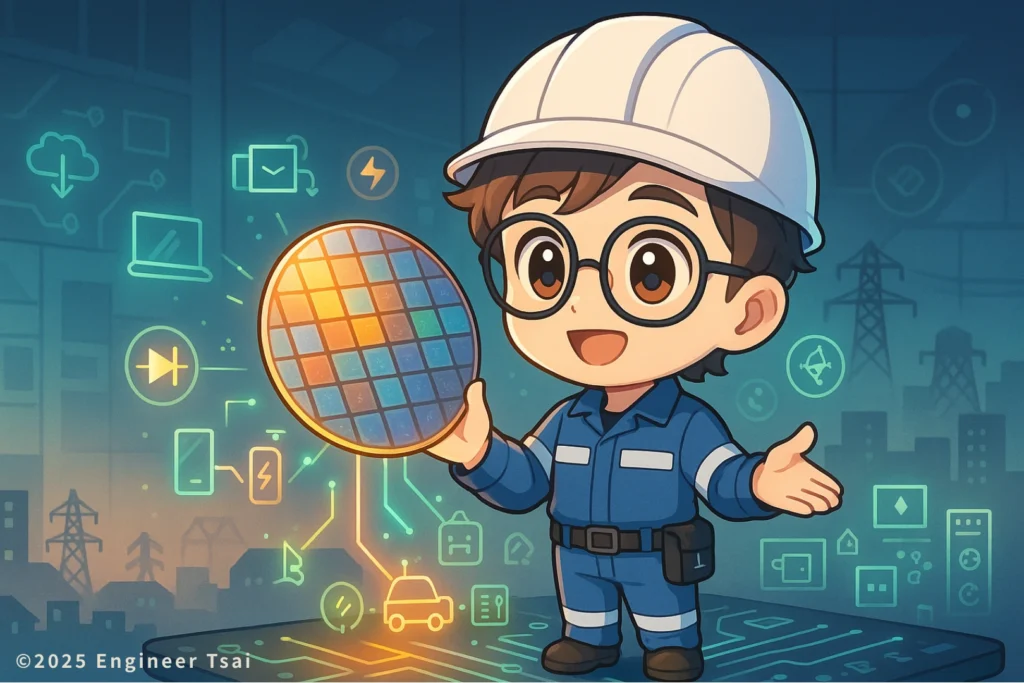
If you keep seeing people ask “what is a semiconductor?” in news and tutorials, this guide will finally give you a clear, practical answer to that question, without drowning you in equations.
What is a semiconductor? Start with a one-sentence definition
If we had to put “what is a semiconductor” into one simple sentence:
A semiconductor is a material whose ability to conduct electricity can be precisely controlled — it sits between a conductor and an insulator.
Its conductivity changes with temperature, applied voltage, and doping (adding a tiny amount of foreign atoms).
Because this “tunable” property is so powerful, we can build all kinds of chips from it: computers that process data, phones that go online, and electric cars that precisely control their motors.
That’s why you’ll often hear people say:
Modern electronics are built on semiconductors.
Common semiconductor materials
A few names you’ll see over and over:
If you want a more formal textbook-style overview, the Semiconductor article on Wikipedia is a good reference. For the physics of the P–N boundary itself, this PN junction overview shows how P-type and N-type materials behave where they meet.
- Silicon (Si)
The workhorse of the industry. Most CPUs, phone chips, logic ICs and many solar cells are built on silicon wafers. Foundries like TSMC, Intel and Samsung take plain silicon wafers and turn them into highly complex chips. - Germanium (Ge)
Historically very important. Pure germanium isn’t as stable at high temperatures, so today it’s often combined with other materials or used in special high-frequency or optoelectronic applications. - Gallium arsenide (GaAs)
Great for high-frequency and high-speed circuits. You’ll find it in radar systems, satellite communication, fiber-optic links and RF (radio-frequency) modules.
How semiconductors conduct: from intrinsic to doped
To really understand what a semiconductor is, it helps to start from the “pure” version first, then see how engineers tweak it to make real-world chips.
- Intrinsic semiconductor
This is an almost perfectly pure semiconductor material (like ultra-pure silicon). At room temperature, it only has a small number of free electrons and holes, so it doesn’t conduct very well.
Think of it as a barely-conducting insulator — important in theory, but not very practical by itself for most devices. - Doped semiconductor
In real chips, engineers intentionally add a tiny amount of dopant atoms to change how well the material conducts. This drastically changes the number and type of charge carriers:- N-type semiconductor
Add atoms like phosphorus (P) or arsenic (As), which bring extra electrons. These electrons become the majority carriers. - P-type semiconductor
Add atoms like boron (B) or aluminum (Al), which create “missing electrons,” called holes. Here, holes act as the majority carriers.
- N-type semiconductor
When you join a piece of P-type and N-type semiconductor together, you get a PN junction.
That PN junction is the common foundation for almost every semiconductor device you’ve heard of:
- Diodes
- Transistors
- LEDs
- Many sensor structures
They all start from that simple P-N “sandwich.”
Where you see semiconductors in real life: from phones and chips to EVs
Semiconductors matter because they’ve quietly slipped into almost everything that uses electricity in your daily life. Here are some of the biggest stars:
- Diodes
One of the most classic semiconductor parts. A diode lets current flow mostly in one direction only.
It’s used for:- Rectifier circuits (turning AC into DC)
- Power-supply protection
- LED lighting, indicator lights, and more
- Transistors
You can think of a transistor as an ultra-fast electronic switch, and it’s the core of all digital circuits.
A transistor can:- Amplify signals
- Turn current on and off
- Implement the “0 / 1” logic inside processors
- Integrated circuits (ICs)
Take thousands, millions or even billions of transistors plus other components, pack them into a tiny chip — that’s an IC. Examples:- Your computer’s CPU
- Your phone’s application processor
- Memory chips, Wi-Fi/Bluetooth chips, and countless controllers inside cars and appliances
- Sensors
Semiconductor tech also powers a huge variety of sensors, such as:- Image sensors in phone cameras
- Ambient-light sensor for automatic screen brightness
- Temperature and gas sensors
- Accelerometers and gyroscopes for motion detection
- Power electronics
Here we’re in the high-power world: semiconductors that handle high voltage and high current while staying under control. You’ll see power semiconductors in:- Variable-frequency drives for motors
- Solar inverters
- Industrial motor drives
- EV power management and fast-charging systems
Key trends in semiconductor technology
If you follow news about TSMC, NVIDIA, Intel or Apple chips, you’re really hearing about a few big themes in semiconductor technology:
- Moore’s Law
The classic rule of thumb says: “The number of transistors on a chip roughly doubles every two years.”
It’s getting harder to stick to that exact pace, but it still acts like a target — pushing manufacturers to shrink features, boost performance and cut power consumption. - Nanometer-scale processes
Today’s high-end chips use processes at just a few nanometers, like 3 nm. In plain language: the critical features on the chip are only a few billionths of a meter wide.
Smaller line widths mean:- More transistors on the same chip
- More performance
- Less energy per operation
- Carbon-based and compound semiconductors
New materials like graphene, gallium nitride (GaN) and silicon carbide (SiC) are becoming stars in power electronics and high-frequency applications. They’re showing up more and more in:- Fast chargers
- EV powertrains
- High-voltage supplies
- 5G base stations
- Quantum devices and new compute architectures
Quantum computers and neural-network accelerators (for AI) often rely on special semiconductor structures and processes. Most of them aren’t mass-market products yet, but they’re already shaping how engineers think about chip design today.
You can read more background in the Moore’s Law entry , or check out material-specific pages such as gallium nitride (GaN) and silicon carbide (SiC) , which are two of the most important wide-bandgap power semiconductor materials today.
Hands-on demo: feel the “switch” behavior of a transistor with an LED
Here’s a very simple battery-only experiment that lets you see how a semiconductor can act as a switch.
⚠️ Safety note: Use only low-voltage batteries.
Do not connect anything directly to 120 V / 240 V mains power.
You’ll need:
- A small LED (indicator-type is fine)
- A battery (for example: a 3 V coin cell, two AA batteries, or a 9 V battery)
- An NPN transistor (for example: 2N2222, 2N3904, or any common small-signal NPN transistor)
- One resistor around 1 kΩ (to protect the LED)
- A few hookup wires or a breadboard
Steps:
- Identify transistor pins
Look up the pinout for your specific transistor to find B / C / E (base, collector, emitter). - Wire the LED and transistor
- Connect the LED and the 1 kΩ resistor in series
- Put that series combo between the battery’s positive terminal and the transistor’s collector (C)
- Connect the transistor’s emitter (E) back to the battery’s negative terminal
- Add a little voltage to the base
Use a wire to temporarily connect the base (B) to the battery’s positive terminal.
(If you have a ~10 kΩ resistor, you can put it in series with the base for extra safety.)
Watch whether the LED turns on. - Remove the base voltage
Disconnect the base wire.
The LED should switch off.
What’s happening?
- When the transistor’s base gets the right bias voltage, current can flow through the transistor and LED, so the LED lights up.
- When the base is not biased, the transistor is almost “off,” and the LED stays dark.
This little circuit shows an important idea:
Semiconductor devices don’t just conduct — they can be designed to act as very sensitive switches and amplifiers.
That’s exactly how we build all digital logic and modern chips.
Semiconductor FAQ
When people first hear about semiconductors, they usually have questions like these. Let’s answer them in plain language.
Q: What is a semiconductor? Can you explain it in one short sentence?
A: If you boil it down to one line:
When someone asks “what is a semiconductor”, the short answer is:
A semiconductor is a material whose ability to conduct electricity can be designed and controlled, sitting between a conductor and an insulator — it’s the foundation of all modern chips and electronic components.
Q: How is a semiconductor different from a conductor or an insulator?
A:
A conductor (like copper wire) conducts electricity very easily almost all the time.
An insulator (like plastic) basically does not conduct under normal conditions.
A semiconductor lives in between — and the key is that we can tune how well it conducts by doping and by applying external voltages.
That tunability is what allows us to build diodes, transistors, memory cells, sensors and more.
Q: Why is the semiconductor industry such a big deal?
A:
Because a huge share of the world’s CPUs, phone chips, car chips and data-center chips depend on a relatively small number of advanced fabs and packaging houses.
If those factories stop, almost every modern industry feels it: smartphones, cloud services, cars, medical devices, industrial automation — you name it.
If you understand electricity and basic semiconductor concepts, you’ve opened the door to more career options than you might expect: from electronics and automation to chip manufacturing and equipment maintenance.
Q: Do I need to be great at physics to learn semiconductors?
A:
A physics background definitely helps, but you don’t have to start with heavy equations.
A more practical path is:
Get comfortable with voltage, current and resistance
Learn what a PN junction, diode and transistor do using diagrams and simple experiments
Only then slowly move on to deeper ideas like energy bands and energy levels
You don’t need a PhD to understand usable semiconductor basics.
Q: How is being an electrician related to semiconductors?
A:
There’s more overlap than most people think.
In many chip fabs and electronics plants, jobs in:
Equipment maintenance
Electro-mechanical integration
Power distribution and control
all require solid electrical and basic electronics knowledge.
A common real-world path looks like this:
Learn residential wiring and safety → move into industrial power and controls → step into roles that support semiconductor tools, automation or facility systems.
If you already understand semiconductors at a basic level, reading job descriptions and talking to engineers in these fields becomes much easier.
Summary: what is a semiconductor in everyday life?
Semiconductor technology underpins the entire modern electronics industry. From simple diodes to high-performance CPUs and AI accelerators, semiconductors show up in almost every product that contains a chip.
Once you understand:
- What a semiconductor is
- How a PN junction forms
- What diodes and transistors actually do
you’ll see phones, computers, appliances and even factory equipment in a very different light.
So the next time you see “what is a semiconductor?” in a headline or job description, you’ll have a mental picture of real devices, not just a vague buzzword. When someone asks you “what is a semiconductor” in everyday language, you’ll be able to answer with this simple picture instead of abstract jargon.
Whether you’re just curious about the basics, preparing for trade school, or thinking about a future in chip manufacturing, equipment maintenance, or electrical + automation work, these are the first layers of knowledge you’ll keep using again and again.
If you’re reading about semiconductors because AI news is making you rethink your career, you can also check out my guide on career change to electrician in the AI era to see how solid electrical skills connect to real job options.
📌 Recommended next reads:
- “Basic Electric Circuits: Power Sources, Wires and Loads”
Start from what a circuit physically looks like. Once you clearly see the roles of the source, conductors and loads, it becomes easier to visualize where semiconductor devices fit in. - “DIY Voltage and Current: Unlocking the Core Electrical Concepts”
Build stronger intuition for voltage and current. You’ll better understand why the same semiconductor device behaves so differently under different voltages and currents. - “Is Moore’s Law Dying? Where Semiconductor Technology Is Headed Next” (coming soon)
A plain-language look at scaling limits, new materials and new architectures — to help you connect what you see in tech headlines with the fundamentals you just learned. - “GaN and SiC: Why Wide-Bandgap Semiconductors Are Changing Power Electronics” (coming soon)
An introduction to why these new materials show up in fast chargers, EVs and high-voltage supplies, and how they differ from traditional silicon parts.
🔎 Want to keep learning about semiconductors and electrical basics?
Drop your email in the form below, and I’ll send you new articles and free learning resources as I publish them. 🚀
Read next in this topic
- What Is Electricity ? Everything You Need to Know
- Current & Voltage for DIY Enthusiasts : Unlock the Basics
- AC vs DC: What’s the Difference and Why It Matters (From Phone Charging to 120 V Home Power)
- Basic Parts of an Electric Circuit (Power Source, Wires, Loads)
- Conductor vs Insulator: How Your Home’s Wiring Keeps You from Getting Shocked
- Ohm’s Law Explained: V = IR for 120V Home Circuits
- What Is a Resistor? How It Works, Types, and How to Choose the Right One
- Series vs Parallel Circuits: Simple Guide for Home Wiring (With Formulas & Examples)
- How Electromagnetic Wave and Electricity Shape Modern Technology
- What Is Voltage? Simple Definition, Everyday Examples, and Safety Tips
- What Is a Battery? How It Works, Types, and Everyday Uses Explained
- What Is Ampere’s Law? A Visual Guide to How Current Creates Magnetic Fields
- What Does a Capacitor Do? Uses, Energy Storage, and Everyday Examples
- Types of Electrical Wire: How to Choose the Right One for Your Home
- How AC Power Is Converted to DC: What’s Really Inside Your Phone Charger?
- Electrical Energy Conversion: How Energy Transforms for Everyday Use
- Magnetic Field and Current: The Core Relationship Behind Motors, Generators, and Wireless Charging
- How Do Magnets Work? From Fridge Magnets to Maglev Trains
- What Is Inductance? Inductor Basics for Real-World Circuits
- What Is Impedance? A Plain-Language Guide to Resistance, Inductive Reactance, and Capacitive Reactance