On this page
Table of Contents
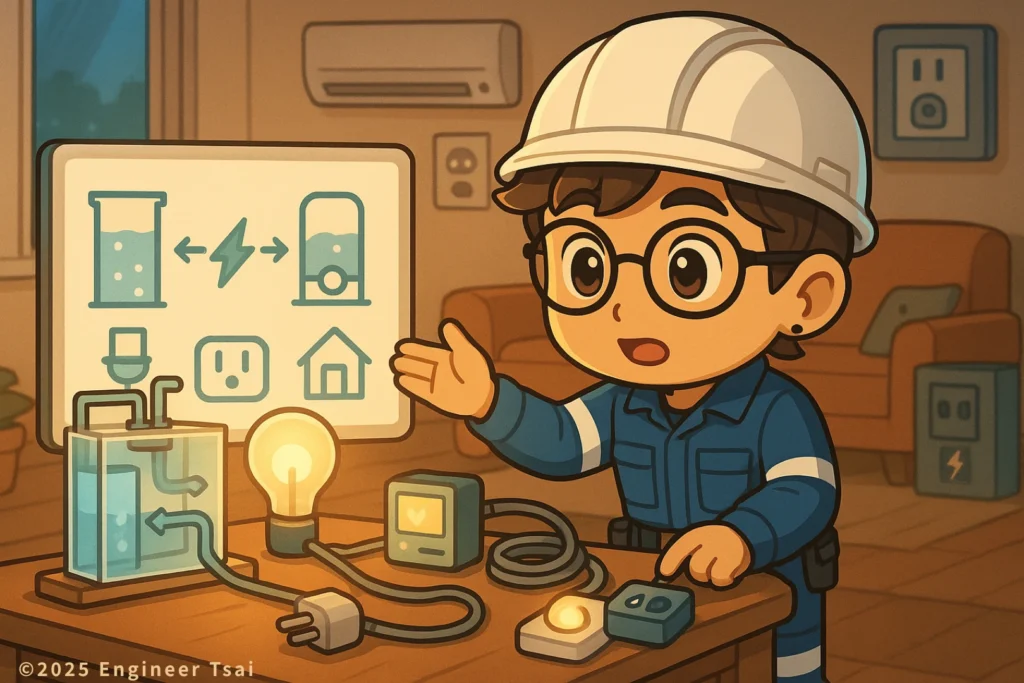
If you’re still building your foundation in basic electricity, start with this beginner-friendly overview: 🔹 “Electricity 101: The Complete Beginner’s Guide to How Power Really Works”
After reading it, the concepts in this article will make a lot more sense.
Watch first: what is inductance and how does it affect a circuit?
This short video walks you through what is inductance in a very visual way – how current creates a magnetic field around a conductor, and how that magnetic field “pushes back” on the circuit when things change.
If you’ve ever asked yourself, “What exactly is inductance? What is this inductor even doing in my circuit?” this is for you.
Watch the video first, then come back to this article. The diagrams and examples below will help you see what inductance is doing in power supplies, wireless charging, and everyday electronics.
If you just typed “what is inductance” into a search bar, you’re in the right place – this guide is written to answer that question in plain English, with real-world examples.
What is inductance? The plain-English version
A lot of people first meet inductors in a textbook and immediately ask:
“What is inductance, exactly? And why do I keep seeing these coils everywhere?”
If you think of a circuit as a water pipe, an inductor is a little like a water tank that hates sudden changes in flow. It doesn’t want the flow to jump from low to high in an instant, or from high to zero in one click.
Inductance is a property of a circuit – and also a family of components – that shows up all over:
- power supplies
- audio filters
- wireless charging coils
- power-management chips inside your phone and laptop
Put simply:
- When current changes, a magnetic field grows or shrinks around the conductor.
- When that magnetic field changes, it creates a voltage that fights back against the change in current.
So inductors are really good at two things:
- resisting sudden changes in current, and
- storing energy in a magnetic field and releasing it later
That’s why whenever you see filtering, smoothing, or wireless energy transfer, you almost always see inductors nearby.
The basic physics: from coil of wire to magnetic energy
To really answer “what is inductance,” it helps to look at the structure.
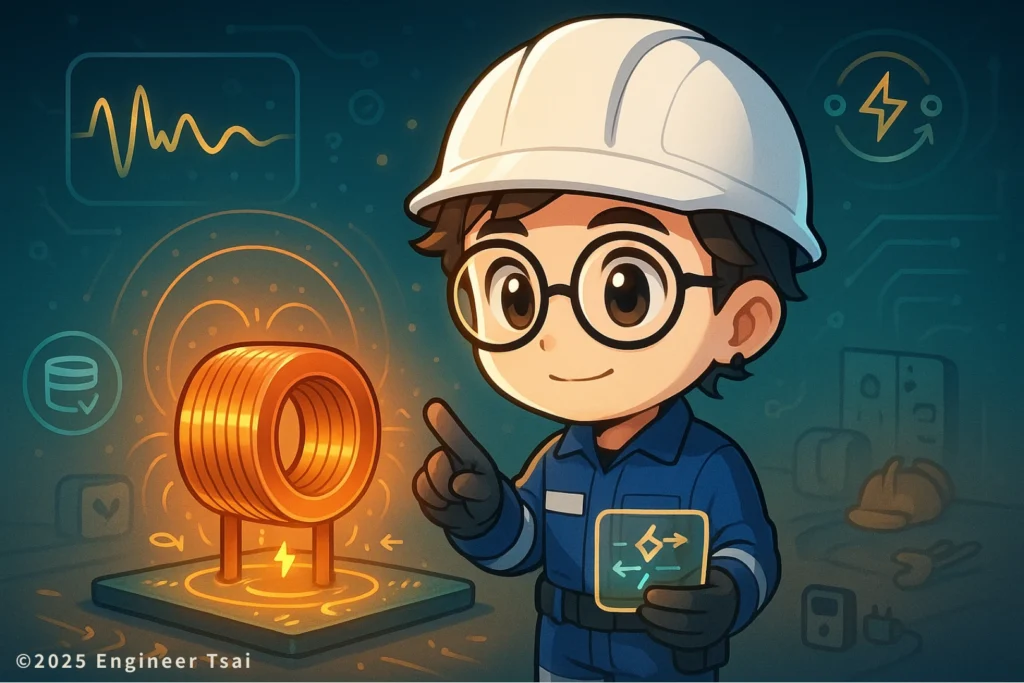
Most inductors you see on a board are just insulated copper wire wound into a coil. That coil is the inductor.
From Faraday’s Law of Induction, a few key things happen. If you want a more textbook-style explanation, you can also check this inductance tutorial on All About Circuits.
- When current flows through the coil, it creates a magnetic field around it.
- When the current starts to increase or decrease, that magnetic field also changes.
- A changing magnetic field induces a voltage (EMF) in the wire, and that induced voltage pushes against the original change in current.
This “your own current change creates a voltage that fights back” behavior is called self-induction.
That’s the root of inductance: the coil builds a magnetic field as current changes, and that field pushes back on any attempt to change the current too quickly.
In other words: an inductor is that friend who always says, “Slow down. One step at a time.”
Two key behaviors of an inductor
- It resists changes in current
- When current suddenly wants to jump up, the inductor generates a reverse voltage that pushes it down.
- When current suddenly wants to drop to zero, the inductor generates a forward voltage to keep current flowing a bit longer.
- It stores energy in a magnetic field
- While current is flowing, part of the energy is stored as a magnetic field around the inductor.
- When the circuit changes (for example, a switch opens), the inductor releases that magnetic energy back into the circuit.
The math and units: V = L × (dI/dt)
The size of an inductor is measured in henry (H). In real circuits you’ll usually see millihenry (mH) or microhenry (µH).
The classic equation that describes inductance is also the compact way engineers answer what is inductance in a changing-current circuit:
V = L × (dI/dt)
Where:
- V = the induced voltage across the inductor (in volts)
- L = the inductance (in henry)
- dI/dt = how fast the current is changing with respect to time (the rate of change of current)
From this one formula you can see two important things:
- The more “aggressive” the current change, the larger dI/dt becomes, and the larger the induced voltage will be.
- For the same rate of change, a larger inductance L will produce a larger voltage.
This is why inductors matter so much in fast switching circuits: when you switch current on and off quickly, dI/dt is huge, so the voltages and spikes can be huge too if you don’t design around them.
How does inductance affect a circuit? Four common scenarios
In real designs, inductors are not just abstract symbols. They quietly control how your home, office, and lab gear behaves.
Here are four everyday scenarios where inductance shows up. When you understand what is inductance doing in each of these cases, circuit design starts to feel much less mysterious.
1. Filtering: cleaning up noisy power
One big trait of inductors is that they are more sensitive to high-frequency changes than to slow changes. That makes them great for filters.
- Low-pass filters
Combine an inductor with a capacitor and you can let smooth DC pass while stripping away high-frequency noise. Your phone charger, Wi-Fi router, monitor power supply, and many other adapters all rely on this kind of filtering. - High-pass filters
With a different configuration, an inductor-capacitor pair can pass high-frequency signals and block low-frequency ones. You’ll see this in audio crossovers and RF (radio-frequency) circuits.
2. Power regulation: the star of switching power supplies
In almost every DC-DC converter (buck, boost, buck-boost, and so on), an inductor is one of the main characters.
It takes turns storing energy while a switch is on, and releasing energy when the switch is off. That back-and-forth is what makes the output voltage smoother and more stable.
- Boost converters
The inductor stores energy while the switch is on, then dumps that stored energy into the output when the switch turns off. Done right, the output voltage ends up higher than the input. - Buck converters
Here, the inductor’s job is to turn a very “choppy” pulsed current into a smoother one. That smoothing protects whatever is downstream from big current swings and voltage ripple.
Whenever you see a compact switching regulator on a board, that chunky little inductor nearby is doing a lot of heavy lifting.
3. Inductive sensors: detecting metal and motion
Inductors are also used as sensors. If you put a coil near metal or magnetic material, its inductance changes – and your circuit can detect that.
Common examples include:
- Metal detectors
A coil in the detector senses changes in inductance when there’s metal under the ground or in an object. - Wireless charging pads
The “coil” inside a wireless charging pad is basically an inductor. Its changing magnetic field induces current in the coil inside your phone, which then charges the battery. - Proximity and position sensors
Industrial gear often uses inductive sensors to detect when a metal part reaches a certain position, with no physical contact.
4. Wireless communication and antennas: LC resonant circuits
In RF and wireless designs, inductors and capacitors are often paired into LC resonant circuits. By choosing the right L and C values, you tune the circuit to a particular resonant frequency – basically choosing what band of signals you care about.
You’ll see this in:
- AM/FM radios and other receivers – adjusting inductance or capacitance lets you “tune” different stations.
- RFID tags and readers – both sides use coils and inductance.
- Cell-phone and Wi-Fi antennas – tiny inductors and matching networks help antennas work efficiently at specific frequencies.
Once you know what inductance does, those little coils and SMD inductors on RF boards start to make a lot more sense.
Try this at home (or in a simulator): feel how inductance slows current change
This next one is more of a concept demo than a lab exercise. If you’re not comfortable wiring things up, it’s much safer to start with a circuit simulator like Falstad Circuit Simulator or LTspice.
Experiment: observe how an inductor resists current changes
📌 Parts (conceptual):
- A battery (for example 3 V or 5 V)
- An LED with a series resistor
- An inductor around 100 mH
- A mechanical switch or momentary push button
📌 Basic steps:
- Wire the battery, inductor, LED (plus its resistor), and switch in series.
- Quickly toggle the switch on and off and watch how the LED turns on and off.
- Now repeat the experiment without the inductor – just battery, resistor, LED, and switch in series – and compare the behavior.
🔎 What to notice
With the inductor in the circuit, the LED usually feels a bit slower to respond. The changes in brightness aren’t as sharp, because the inductor doesn’t “like” the current to jump instantly.
Without the inductor, the LED snaps on and off more abruptly.
That difference is your eyes seeing inductance resisting changes in current.
Common inductor types: same idea, different packages
We call them all “inductors,” but their shapes and internal structures vary a lot depending on the job.
Here’s a quick comparison:
| Inductor type | Main traits | Typical applications |
|---|---|---|
| Air-core inductor | No magnetic core, low loss, great at high freq | RF circuits, radio tuning coils |
| Iron-core inductor | Uses an iron core to boost magnetic field | Transformers, power filters, low-frequency work |
| Wire-wound inductor | Coil wound on a core, handles higher currents | Power modules, audio gear, motor drivers |
| SMD inductor | Small footprint for automated assembly | Phones, laptops, power-management IC support |
Even if they look very different on the board, they’re all playing with the same underlying idea: storing energy in a magnetic field and shaping how current changes over time.
Inductance FAQ
What’s the difference between inductance and capacitance?
When people search “what is inductance vs what is capacitance”, what they really want is one clear sentence that separates the two ideas:
Inductors store energy in a magnetic field and resist changes in current. Capacitors store energy in an electric field and resist changes in voltage.
In the frequency domain:
Inductors are more sensitive to high-frequency changes in current, and more relaxed about slow changes.
Capacitors are kind of the opposite: they’re happy to let high-frequency signals pass through, but block DC and very low-frequency changes (at least in series configurations).
That’s why LC pairs are so powerful: one part “cares” about current, the other “cares” about voltage.
Do inductors matter in DC circuits?
Yes – just not in the way beginners sometimes expect.
In a steady, pure DC condition, once everything has settled, current is constant. In that case an ideal inductor behaves like a plain piece of wire.
But the real world is full of:
switching on and off
power-up and shutdown transients
pulses, noise, and glitches
Every time current changes, the inductor wakes up and responds. That’s when inductance matters most in DC systems – during transients, not during the boring steady-state.
Why do some inductors get hot?
Inductors heat up for a few common reasons:
The wire itself has resistance, so high current causes I²R losses.
The core material has loss too. At high frequencies, hysteresis and eddy currents convert part of the magnetic energy into heat.
The inductor is being run outside its rated conditions – too much current, too high a frequency, or poor cooling.
If you ever touch an inductor in a live circuit and it feels “alarmingly hot,” it’s time to check:
its rated current
its operating frequency range
airflow and overall thermal design
against what the datasheet recommends.
What should I look at when choosing an inductor?
In practice, engineers often focus on:
Inductance value L (H / mH / µH) – affects filter behavior, DC-DC converter performance, or resonant frequency.
Rated current – go over this and you’ll see overheating or saturation.
DC resistance (DCR) – lower DCR means lower conduction losses, but often a bigger physical size.
Saturation current – once the core saturates, the inductance drops sharply and the inductor stops behaving as designed.
Package size – it still has to physically fit on your PCB.
Pick these with some margin and your inductor will live a much less dramatic life.
Wrap-up: understand inductance, understand your circuit’s “mood”
So, if someone asks you again, “What is inductance?”, you can answer it in one sentence:
Inductance is a circuit’s tendency to resist changes in current by storing energy in a magnetic field.
Inductors don’t like current to slam on the gas or stomp on the brakes. They smooth things out by absorbing energy when current rises and releasing it when current falls.
From noise filtering and power regulation to wireless charging and RF tuning, any time you see changing current and magnetic fields, inductance is involved. Once you get this, you stop memorizing inductor symbols and start seeing what job each inductor is doing in the bigger system.
If you want to go further into transformers, motors, EMI filters, or wireless communication, this inductance foundation will keep paying off.
📌 Further reading
🔹 DIY Guide to Voltage and Current: Unlock the Basics
Start from voltage, current, and power and turn “invisible electricity” into something you can reason about in everyday language. This is the foundation you want before diving deeper into inductors.
🔹 What Do Capacitors Actually Do? How They Store and Release Energy
Read this alongside inductors and you’ll really feel the “inductors manage current, capacitors manage voltage” partnership. It also sets you up to understand LC filters and oscillators.
🔹 How LC Oscillators Work (coming soon)
We’ll jump into wireless and RF land and see how inductors and capacitors together set the frequency of oscillators and tuned circuits.
🔹 How Inductance Powers Wireless Charging (coming soon)
We’ll start from your phone’s wireless charging pad and unpack how coils, magnetic fields, and efficiency all fit together.
💡 Still confused about any part of inductance?
Drop a question in the comments or subscribe to the blog. I’ll keep building out this whole chain – inductors, transformers, motors, and EMI filters – so you can grow a solid, practical understanding of how real-world circuits behave.
Read next in this topic
- What Is Electricity ? Everything You Need to Know
- Current & Voltage for DIY Enthusiasts : Unlock the Basics
- AC vs DC: What’s the Difference and Why It Matters (From Phone Charging to 120 V Home Power)
- Basic Parts of an Electric Circuit (Power Source, Wires, Loads)
- Conductor vs Insulator: How Your Home’s Wiring Keeps You from Getting Shocked
- Ohm’s Law Explained: V = IR for 120V Home Circuits
- What Is a Resistor? How It Works, Types, and How to Choose the Right One
- Series vs Parallel Circuits: Simple Guide for Home Wiring (With Formulas & Examples)
- How Electromagnetic Wave and Electricity Shape Modern Technology
- What Is Voltage? Simple Definition, Everyday Examples, and Safety Tips
- What Is a Battery? How It Works, Types, and Everyday Uses Explained
- What Is Ampere’s Law? A Visual Guide to How Current Creates Magnetic Fields
- What Does a Capacitor Do? Uses, Energy Storage, and Everyday Examples
- Types of Electrical Wire: How to Choose the Right One for Your Home
- How AC Power Is Converted to DC: What’s Really Inside Your Phone Charger?
- Electrical Energy Conversion: How Energy Transforms for Everyday Use
- Magnetic Field and Current: The Core Relationship Behind Motors, Generators, and Wireless Charging
- How Do Magnets Work? From Fridge Magnets to Maglev Trains
- What Is Inductance? Inductor Basics for Real-World Circuits
- What Is Impedance? A Plain-Language Guide to Resistance, Inductive Reactance, and Capacitive Reactance