
Table of Contents
Table of Contents

If you’re still building your foundation in basic electricity, start with this beginner-friendly overview: 🔹 “Electricity 101: The Complete Beginner’s Guide to How Power Really Works”
After reading it, the concepts in this article will make a lot more sense.
▶️ Watch First: How Hard Is It to Turn AC into DC?
You probably know this already: your phone, laptop, and pretty much every modern device runs on DC power.
But the outlets in your house or workshop? They’re all AC.
In other words, if you’ve ever wondered “what is power factor” and why factories or building managers keep talking about it, this guide will walk you through it step by step.
If that video got you wondering “Where does all my electricity actually go?” or “Why does everyone complain about ‘poor power factor’ on reports?”, this article is your deeper dive. If you’ve ever typed “what is power factor” into Google and only got formulas, this guide is the plain-language version you were looking for.
You might have heard something like this in a meeting:
“Your power factor is too low. You really need to improve your power factor correction.”
It sounds abstract, but power factor is directly tied to how big your cables and panels need to be, whether you pay extra charges on your electric bill, and how long your motors and transformers actually survive.
In this guide, we’ll walk through what power factor really is (without drowning in formulas), why utilities and facility managers care so much, who usually has poor power factor in the real world, and three common ways to improve it in plants, buildings, and job sites.
Chapter 1 – What Is Power Factor?
Before we dive into the analogies, let’s answer the basic question first: what is power factor in an AC system, and why does it matter to your utility bill and equipment life?
Let’s start with a story instead of a formula, because most people asking “what is power factor” don’t actually want to start with math — they want to know what it means in real life.
Imagine electric power as a big cup of bubble tea.
The pearls are the part that actually fills you up.
The ice, foam, and air take up space in the cup, but don’t really help your hunger.
Now translate that to electricity:
The “pearls” are the part of power that actually does work: turning motors, running compressors, making lights shine.
The “ice and air” are the part that takes up capacity in your wires and transformers, but doesn’t directly turn into useful work.
Power factor is basically asking:
“Out of everything flowing in this circuit, how much is actually doing useful work?”
- Real power (kW) = useful work (motors turning, heat, light, etc.)
- Apparent power (kVA) = the total “size” of the power your system has to deliver
- Power factor = kW ÷ kVA
So:
- Power factor = 1.0 → almost everything you’re paying for is doing real work.
- Low power factor (for example 0.7–0.8) → you’re pushing a lot of current around, but only part of it is actually useful.
That’s why, in many commercial and industrial contracts, utilities expect power factor to stay around 0.9 or better. If you drop below that for long periods, they see it as “you’re using up our capacity but not using it efficiently” — which is the practical answer to what is power factor from their point of view.

Chapter 2 – Why Does Poor Power Factor Cause Problems?
Short answer: you waste capacity and create headaches for everyone.
1. You need bigger cables and gear
To deliver the same amount of useful power (kW) with poor power factor, your system has to carry more current.
More current means larger cables, bigger breakers, and higher-rated transformers. All of that costs more money to install and maintain.
2. You may pay more on your electric bill
For many commercial and industrial customers, utilities don’t just look at kWh. They also look at your peak demand and your average power factor over the billing period.
If your power factor stays below a certain threshold (often around 0.9), you’ll see power factor penalties or extra charges on your bill. It’s basically the utility saying, “You’re loading our lines, but not using that power efficiently.”
3. Your equipment has a harder life
Poor power factor usually means higher current and more frequent voltage fluctuation.
For equipment, that can mean motors running hotter, transformers running closer to their limits, more nuisance trips on breakers, and shorter equipment lifespan over time.
Think of it like running your car with the trunk full of junk and the parking brake slightly on, then wondering why the engine feels weak.
Or in jobsite language: you hired a whole truckload of movers, but only two or three people are actually carrying boxes. Everyone else is standing in the doorway, scrolling on their phones. At the end of the day, you still have to pay them all.
Chapter 3 – Who Usually Has Poor Power Factor?
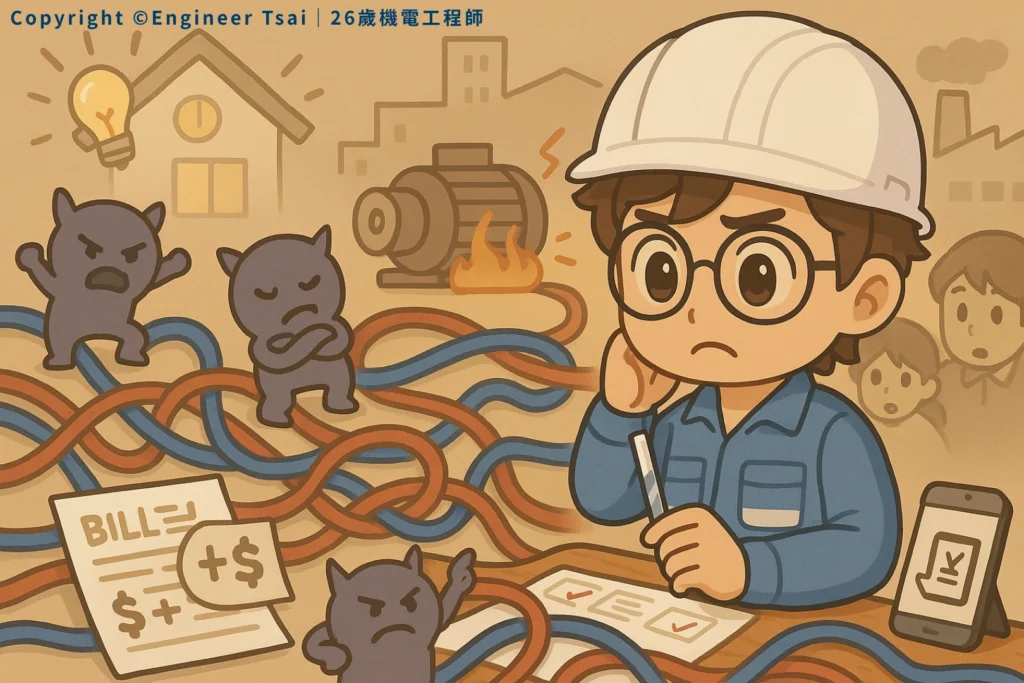
A lot of people assume power factor is only a “big factory problem”. But you’ll see symptoms in all kinds of places:
- Lights that flicker when a large AC unit or fridge kicks on
- On a job site, lights dipping when you start a big motor or saw
- In a building, after installing elevators or big pumps, tenants start saying “The lights feel unstable” or “Some equipment feels weird now”
Behind many of those complaints, you’ll often find too many inductive loads and not enough correction — in other words, poor power factor.
Typical culprits include:
- Induction motors and transformers
- HVAC compressors and circulation pumps
- Elevator motors and large fan motors
- Large LED lighting systems with certain types of drivers
- Older fluorescent lighting with magnetic ballasts
These are all classic inductive loads, and inductive loads tend to pull current out of phase with the voltage. That’s what drags your power factor down.
Chapter 4 – How to Improve Power Factor
If you’re on a typical residential rate, your utility usually doesn’t bill you directly for power factor, so the impact on your bill is limited.
But if you run a plant, manage a commercial building, or take care of a campus, power factor correction becomes a very real cost and reliability issue.
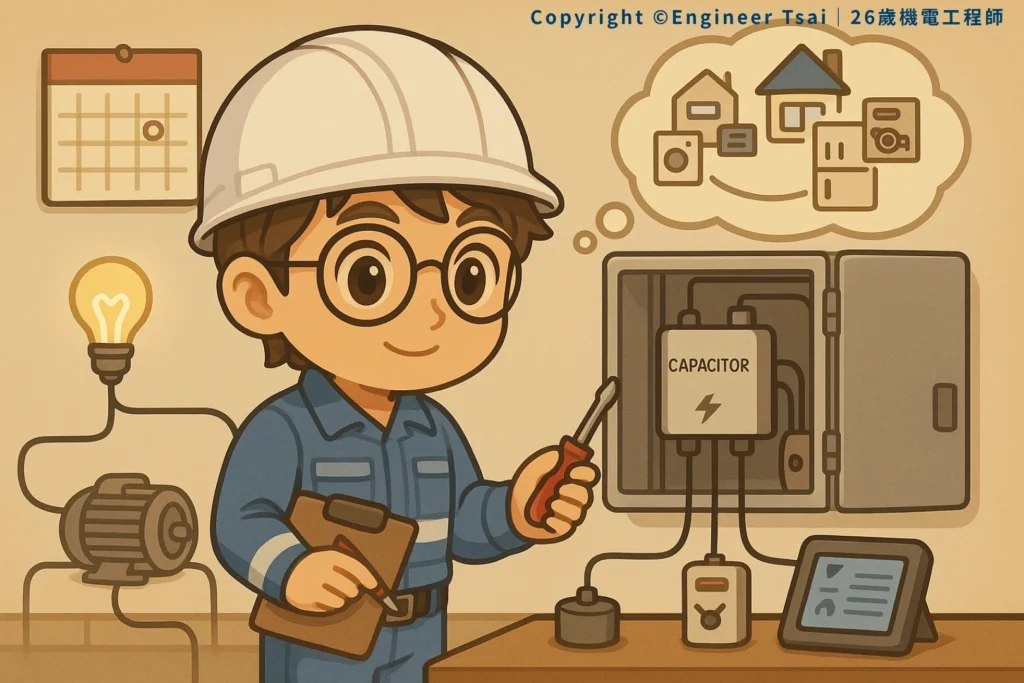
Method 1: Add Capacitor Banks (the classic correction method)
This is the most common solution you’ll see in plants and large buildings.
You install capacitor banks to supply reactive power locally, so the system doesn’t have to pull as much from the grid. Many facilities have an automatic power factor correction panel that turns capacitor stages on and off to keep the overall PF around 0.9–0.95 or better.
However, capacitors are not something you just throw in and hope. Poorly designed capacitor banks can cause over-correction, resonance, unwanted overvoltage, or the capacitors themselves overheating and failing.
That’s why serious projects are usually designed by someone familiar with power quality and harmonics, not just whoever can buy the cheapest capacitors.
Method 2: Use Variable Frequency Drives (VFDs)
When you add VFDs to pumps, fans, and compressors, you usually get more than just speed control and energy savings.
Modern VFDs can soft start motors (no huge inrush spike) and present a power factor that’s much closer to 1 on the AC side (depending on the design and filters used). That means smoother starts, less voltage dip, and better overall power factor for the facility.
Many plants improve power factor indirectly just by converting a few major constant-speed motors to VFD-driven variable-speed operation.
Method 3: Plan your loads and operating schedule
Not every fix requires new hardware. Sometimes you can reduce problems just by being smarter about when and where loads run:
- Avoid putting all your largest motors on the same feeder if you can help it.
- Stagger start times so you don’t start multiple large motors at exactly the same moment.
- Group loads in a way that makes power factor correction easier, instead of stacking all “problem loads” on one circuit.
Even simple operational changes can make your monitoring trends look better and reduce the size and cost of any capacitor banks you install later.
Conclusion – Power Factor Shows How Smart Your System Really Is
Saving energy isn’t always about using less. Often, it’s about using what you already buy more intelligently.
That’s what power factor measures: how much of the electrical “cup” you’re paying for is actually turning into useful work. So when someone asks “what is power factor”, this is the most honest answer: it tells you how smart or wasteful your electrical system really is.
Whether you’re a home DIYer starting to care about power quality, a field technician on call for late-night breakdowns, or the engineer responsible for an entire plant’s distribution system, the next time you look at a dashboard or utility report and see “PF” or “power factor”, don’t treat it as a random mysterious number.
It’s your system quietly asking: are most of us working hard here, or is half the crew just along for the ride?
📌 Further Reading
🔹 What Is an Electric Motor? From Electricity to Motion
Learn how motors turn electrical power into mechanical work — and why they’re often the main reason your power factor drops.
🔹 How Inductors Affect AC Circuits
A friendly look at inductive loads, phase angle, and how they relate to energy that “sloshes back and forth” instead of becoming useful work.
🔹 What Is a Variable Frequency Drive (VFD) and How Does It Control Motors?
Why VFDs save energy, improve power quality, and often help your power factor at the same time.
🌐 External resources if you want to go deeper
For a more formal definition of power factor, you can also check:
- Power factor – overview and formulas on Wikipedia
- U.S. Department of Energy – general resources on electrical efficiency and power quality
Power Factor FAQ
Q1: Do homeowners need to worry about power factor?
For most residential customers in the U.S., the short answer is: not really. Utilities usually bill you only for energy (kWh), not for power factor directly. However, if your home has a lot of large motors (for example, an elevator, big pumps, or a workshop full of machines), you might still see symptoms like lights dimming when large loads start or equipment running hotter than expected.
Q2: How can I tell if my power factor is good or bad?
The most straightforward way is to look at your metering and monitoring. Many facilities have a power meter at the main service that shows PF in real time. Larger plants may have a power monitoring system that trends power factor across multiple feeders. As a rule of thumb, PF around 0.95–1.0 is excellent, around 0.9 is usually acceptable, and sustained values well below 0.9 are worth investigating.
Q3: If my power factor is low, do I always need capacitor banks?
Capacitor banks are the classic tool for power factor correction, but they are not the only solution. Before ordering capacitors, check whether your feeders are very long, your equipment is old or lightly loaded, or your largest motors could be upgraded to variable-speed drives. Sometimes improving load distribution and equipment choice reduces the problem enough that a smaller, safer capacitor bank is enough.
Q4: Are there risks when adding power factor correction capacitors?
Yes. Poorly planned capacitor banks can cause over-correction, resonance with transformers and cables, unwanted overvoltage, or the capacitors themselves overheating and failing. These risks are higher in systems with lots of VFDs and rectifiers that generate harmonics. Serious projects should be based on a load study and harmonic analysis, with proper selection of capacitor size, switching steps, and protection.
Q5: I’m a new technician or engineer. How should I start learning about power factor?
If you’re new to AC power and still asking yourself “what is power factor”, a good roadmap is: 1) master the AC basics first (voltage, current, kW, kVAR, kVA); 2) study a few real utility bills and monitoring screenshots, and see how power factor changes during the day; 3) follow at least one real power factor correction project from before-and-after measurements to how the capacitor bank or VFDs are wired. After a few real systems, power factor stops looking like a scary formula and becomes a practical indicator of system health.
—
Have you ever run into a nasty power factor issue or helped fix one? Share your story in the comments — other techs and engineers can learn a lot from real-world war stories.
Read next in this topic
- What Is Electricity ? Everything You Need to Know
- Current & Voltage for DIY Enthusiasts : Unlock the Basics
- AC vs DC: What’s the Difference and Why It Matters (From Phone Charging to 120 V Home Power)
- Basic Parts of an Electric Circuit (Power Source, Wires, Loads)
- Conductor vs Insulator: How Your Home’s Wiring Keeps You from Getting Shocked
- Ohm’s Law Explained: V = IR for 120V Home Circuits
- What Is a Resistor? How It Works, Types, and How to Choose the Right One
- Series vs Parallel Circuits: Simple Guide for Home Wiring (With Formulas & Examples)
- How Electromagnetic Wave and Electricity Shape Modern Technology
- What Is Voltage? Simple Definition, Everyday Examples, and Safety Tips
- What Is a Battery? How It Works, Types, and Everyday Uses Explained
- What Is Ampere’s Law? A Visual Guide to How Current Creates Magnetic Fields
- What Does a Capacitor Do? Uses, Energy Storage, and Everyday Examples
- Types of Electrical Wire: How to Choose the Right One for Your Home
- How AC Power Is Converted to DC: What’s Really Inside Your Phone Charger?
- Electrical Energy Conversion: How Energy Transforms for Everyday Use
- Magnetic Field and Current: The Core Relationship Behind Motors, Generators, and Wireless Charging
- How Do Magnets Work? From Fridge Magnets to Maglev Trains
- What Is Inductance? Inductor Basics for Real-World Circuits
- What Is Impedance? A Plain-Language Guide to Resistance, Inductive Reactance, and Capacitive Reactance