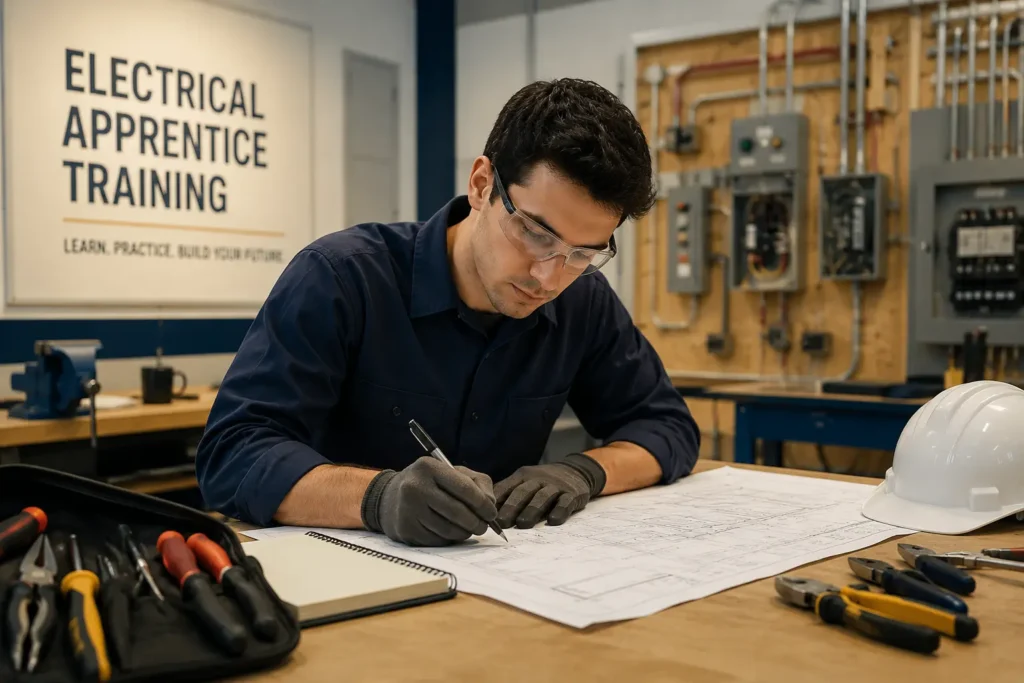
Quick answer: Most people become electricians in the United States by finishing high school or a GED, getting into a registered electrical apprenticeship, and working about four to five years under supervision while taking related classroom instruction. After that, most states or cities require a licensing exam before you can work as a journey-level electrician. There is no federal electrician license, so the exact hours and exam depend on where you work.
Changing careers into electrical work in the United States can feel needlessly confusing. IBEW, ABC, IEC, trade school, helper jobs, registered apprenticeship, and state licenses are related—but they are not the same step, and different organizations control different parts of the process.
Most people enter through a registered apprenticeship, a helper or laborer role that may later lead into apprenticeship, or technical or trade school before applying to a program or employer. There is no single nationwide electrician license path: rules vary by state, city, county, sponsor, and employer. The practical first move is to verify your local rules, compare paid training routes, and read each program’s written terms before spending money.
The U.S. Bureau of Labor Statistics Occupational Outlook Handbook states: “Most electricians learn through an apprenticeship, but some start out by attending a technical school.” (U.S. Bureau of Labor Statistics) Registered programs are listed on Apprenticeship.gov. (Apprenticeship.gov, U.S. Department of Labor)
Not ready to commit yet? Start with the free 0–12 month electrician career roadmap and use it as a low-risk first-year test plan.
How to Become an Electrician: 5 Steps at a Glance
| Step | What you do | Where to check |
|---|---|---|
| 1. Meet entry requirements | High school diploma or GED; many apprenticeship programs set a minimum age of 18 | Each sponsor’s application page |
| 2. Pick your route | Registered apprenticeship, electrical helper job, or trade school first | Apprenticeship.gov job finder |
| 3. Train on the job | Supervised field hours plus related classroom instruction, typically four to five years | BLS Occupational Outlook Handbook |
| 4. Get licensed | Pass the journey-level exam your state or city requires | Your state or city licensing agency |
| 5. Keep it current | Renew your license and complete continuing education where required | Your state or city licensing agency |
Table of Contents
How to Become an Electrician: 3 Main Paths
Three starting points show up consistently in official U.S. career information:
1. Registered Apprenticeship — Paid, supervised field work plus related classroom instruction, progressive wages, and a portable completion credential when the program requirements are met.
2. Electrical helper or laborer — Entry-level jobsite work under journey-level supervision. This is an employer classification, not the same as a registered apprentice. It can build experience toward a registered program, but promotion is not automatic.
3. Technical or trade school — Classroom or pre-apprenticeship training before you apply to a registered apprenticeship or employer-sponsored program.
Isaac Arnold applied for the IBEW Local 64 commercial apprenticeship in Youngstown, Ohio, straight out of high school and was not accepted because the program wanted applicants with field experience. He took a union low-voltage cable-pulling job, spent roughly a year learning tools and jobsite habits, and then entered the commercial apprenticeship. (Isaac Arnold / IBEW The Electrical Worker, October 2025) His path is one union-local example — not a national rule.
What Is a Registered Electrical Apprenticeship?
A Registered Apprenticeship is a specific legal status under federal or state registration. Federal standards in 29 CFR Part 29 (Electronic Code of Federal Regulations) require:
- An organized work process covering major occupational functions
- Related instruction (the federal standard recommends at least 144 hours per year)
- Progressive wage increases tied to skill development
- Supervision by qualified journey-level workers
- A recognized credential upon completion
Search Apprenticeship.gov (Apprenticeship.gov, U.S. Department of Labor) for programs near you. A listing means the program met registration standards — still verify directly with each sponsor: who runs it, eligibility, application windows, wage schedule, and what credential completion produces in your jurisdiction.
Related guide: Electrician Apprenticeship With No Experience.
Do You Need Trade School to Become an Electrician?
Technical school is a legitimate entry point for some people; it is not a universal prerequisite. BLS notes that some electricians start with technical school rather than going directly into apprenticeship. (U.S. Bureau of Labor Statistics) Some programs credit hours toward apprenticeship. California requires approved classroom hours for electrician trainees — a California-specific rule, not a national requirement. (California Department of Industrial Relations)
Cory McCray, a journeyman with IBEW Local 24 in Baltimore, advises asking whether a program connects you to real, paid work before you pay tuition. (Cory McCray / IBEW The Electrical Worker, February 2026) He describes a friend who paid for a for-profit school, accumulated debt, and was redirected toward the IBEW for placement — one Maryland union practitioner’s account, not a national survey.
Before paying tuition or deposits, confirm:
- Documented relationships with local apprenticeship programs or employers
- Whether credits transfer to the apprenticeship or licensing path you plan to pursue
- Whether the program is recognized by agencies relevant to your target licensing path
Before spending money on any program, it’s worth a free gut-check on the fundamentals first. Try Tsai Electro’s free Electrician Fundamentals: Learn, Practice & Mock Exam — a short lesson on Ohm’s Law and circuit basics, a hands-on calculator, and a 10-question mock exam with explanations and a pass/fail result. It won’t tell you which apprenticeship to pick, but if the fundamentals already click for you, that’s a real, free signal before you commit tuition or deposit money.
IBEW Union vs. Non-Union Electrical Apprenticeships
Electrical apprenticeships generally run through two structural models:
Labor-management partnership programs — typically IBEW joint apprenticeship training committees (JATCs), jointly run by the union and participating contractors, with organized classroom instruction and collectively bargained wage schedules.
Employer or trade-association programs — sponsored by individual contractors, ABC (Associated Builders and Contractors) chapters, IEC (Independent Electrical Contractors) chapters, or other registered sponsors without a collective bargaining agreement. Structure, placement reliability, and benefits vary.
The two practitioner accounts quoted in this article come from IBEW union pathways. They illustrate union-path application and learning — not every U.S. apprenticeship route. Non-union operational detail below uses official sponsor information only.
| Question | Union JATC | Non-union / ABC / IEC |
|---|---|---|
| Typical sponsor | IBEW-NECA labor-management partnership | Employer, ABC chapter, IEC chapter, or another registered sponsor |
| How work is obtained | Usually through local referral and participating contractors; verify local dispatch and placement rules | Often through a participating employer or sponsor; verify whether employment comes before or after enrollment |
| Who records OJT | The local sponsor records hours under its program rules | The employer or sponsor records hours under its program rules |
| How wages are set | Often follows a collectively bargained progression where applicable | Follows the sponsor’s written progression schedule; request it before accepting |
| Classroom delivery | Local JATC or affiliated training center | Chapter, employer, college, training trust, or another sponsor-approved provider |
| Tools, tuition, and fees | Depends on the local agreement and program | Depends on the employer, chapter, and sponsor; verify every cost in writing |
| Changing employers | Transfer and referral rules depend on the local program | OJT and classroom transfer depend on sponsor rules; confirm before moving |
| Completion result | Program credential; state or local licensing may still be separate | Program credential; state or local licensing may still be separate |
Neither route is automatically better for everyone. Compare specific written terms in your area.
How Non-Union Apprenticeships Commonly Work
In many open-shop or merit-shop settings, the sequence looks like this:
- Employment and sponsorship — A contractor or employer hires you as a helper or trainee, then sponsors your enrollment in a registered apprenticeship program. An ABC chapter, IEC chapter, or individual employer may serve as the program sponsor. Verify registration status with the U.S. Department of Labor or the applicable state agency.
- Classroom instruction and OJT records — Classroom instruction may be delivered by the chapter, a training trust, a community college, or a provider such as NCCER. Supervised field hours are logged under program rules. Ask who signs off on hours and how records transfer if you change employers.
- Wage progression and training costs — Registered programs tie raises to progression steps. Request the written wage scale before you accept — not a verbal summary. Clarify who pays for tuition, books, tools, exam fees, and association dues.
- Employer transfer, completion credential, and licensing — If you switch employers mid-program, ask whether OJT hours and classroom credits transfer under that sponsor’s rules. Completing a registered apprenticeship produces a program credential — not the same as a state or local electrician license. Licensing is a separate step governed by your work location.
ABC describes member-driven registered apprenticeship and craft training across chapters nationwide. (Associated Builders and Contractors) IEC describes employer-connected apprenticeship combining paid field learning and classroom instruction. (Independent Electrical Contractors) Apprenticeship.gov remains the federal directory for registered programs. (Apprenticeship.gov, U.S. Department of Labor)
Questions to ask any non-union sponsor before you commit:
- Is this program registered with the U.S. Department of Labor or a state apprenticeship agency?
- What is the first-step hourly wage and the full written progression schedule?
- Who documents OJT hours, and what happens if I change employers?
- What costs am I responsible for (tools, books, tuition, fees)?
- What credential does completion produce, and how does that relate to licensing in my city and state?
Related guide: Union vs Non-Union Electrician Apprenticeship.
How to Get an Electrician License: State and City Rules
There is no federal electrician license. States set licensing or certification rules; cities and counties may add separate local credentials.
Examples only — not a national directory. Verify requirements with the authority governing your exact work location.
| Jurisdiction (example only) | Credential structure | Authority to verify with | Key requirement |
|---|---|---|---|
| California (state) | Electrician trainee registration → state certification | California Department of Industrial Relations | Approved classroom enrollment and California-specific trainee rules |
| Texas (state) | Apprentice electrician license → journeyman electrician license | Texas Department of Licensing and Regulation | 8,000 hours of supervised experience for a journeyman application |
| New York State | Electrician listed as a registered apprenticeship trade | New York State Department of Labor | 60-month standard term shown in the official apprenticeship listing |
| New York City (local) | Master and Special Electrician licensing | NYC Department of Buildings | Separate local credential system from New York State apprenticeship listings |
(California Department of Industrial Relations; Texas Department of Licensing and Regulation; New York City Department of Buildings; New York State Department of Labor)
New York State and New York City are not interchangeable. Ohio and Maryland appear only as home states of quoted union practitioners, not as licensing examples in this table.
Related guides: Apply for the Texas Journeyman Exam at 7,000 Hours and From Journeyman to Master Electrician in Texas.
How Long Does It Take to Become an Electrician?
Federal standards do not set one national program length. Figures you may see — and what they mean:
- 144 hours per year of related instruction — Federal recommendation for registered programs (Electronic Code of Federal Regulations); a program floor, not a licensing rule
- 8,000 hours of supervised field work — Texas journeyman licensing threshold (Texas Department of Licensing and Regulation); state-specific
- 60-month apprenticeship — New York State registered-apprenticeship listing (New York State Department of Labor); jurisdiction-specific
- Four to five years — BLS broad description of typical apprenticeship completion (U.S. Bureau of Labor Statistics); observation, not a contract
Your timeline also depends on application waiting lists, testing, employer matching, and licensing steps after program completion. Application timelines may extend beyond one cycle when testing, ranking, employer matching, or limited openings are involved. Plan for a multi-year commitment before journey-level credential status in your jurisdiction — not a fixed calendar you can assume from any article.
Related guides: Electrician Apprenticeship Hours by State and Changing Electrical Employers in Texas Without Losing Your Hours.
Electrician Salary and Apprentice Pay: What the Numbers Mean
BLS Occupational Outlook Handbook — Electricians, SOC 47-2111 (May 2024): Median annual pay: $62,350 | Projected employment growth 2024–2034: 9% (faster than average) (U.S. Bureau of Labor Statistics)
That $62,350 median is not a first-year apprentice wage. It is the midpoint for all employed electricians nationally — from new apprentices to veterans. This article does not establish a verified national apprentice median.
BLS also reports that the lowest 10 percent earned less than $39,430, and the highest 10 percent earned more than $106,030 (U.S. Bureau of Labor Statistics). The lowest 10 percent figure describes the lower end of the full occupation distribution — experienced workers included. It is not an apprentice starting-wage benchmark. Do not use it to budget first-year apprentice pay.
In registered programs, apprentice wages are usually a percentage of the journey-level rate for that sponsor and area, rising at defined progression steps. Confirm your sponsor’s current scale in writing.
Before you accept an offer or enroll, request written answers on:
- First-step hourly wage (or starting percentage of journey rate)
- Full wage progression schedule and raise triggers
- When benefits begin (health, retirement, etc.)
- Tuition, books, tools, and exam fees — who pays
- Overtime, travel, and per-diem policies when relevant
- How progression is documented if you change employers
What Do Employers Look for in New Electrical Apprentices?
Technical skills matter from the first week. Work habits often matter just as much.
Isaac Arnold said he would rather admit he does not know how to wire a motor than risk damaging equipment. Cory McCray emphasizes showing up on time with a willingness to learn. The two practitioner accounts highlight several beginner habits that employers commonly value:
- Reliable attendance and punctuality
- Willingness to learn and follow instructions
- Asking before acting when unsure
- Safety awareness and honest communication about hazards
- Professional conduct on shared jobsites
Workers have the right to understandable safety training and to report hazards without retaliation. (Electronic Code of Federal Regulations; Occupational Safety and Health Administration; Occupational Safety and Health Administration)
Related guides: Jobsite Safety for Electrical Apprentices and NEC Article 210 Branch Circuits for Apprentices.
How to Apply for an Electrical Apprenticeship
This is an editorial research sequence: use it to plan your own steps and timing, then confirm each step with the program you apply to.
These stages do not mean you will begin work within four weeks. Testing, interviews, ranking lists, employer matching, and available openings can extend the process by several months or longer.
Stage 1 — Verify jurisdiction and eligibility
- Identify the state licensing agency for your work location
- Check whether your city or county adds local requirements
- Search Apprenticeship.gov for registered programs (Apprenticeship.gov, U.S. Department of Labor)
Stage 2 — Compare union, ABC, IEC, and employer-sponsored structures
- Shortlist at least two registered sponsors (JATC, ABC chapter, IEC chapter, or employer program)
- Compare written wage scales, classroom providers, and completion credentials
- Review ABC and IEC sponsor pages for chapter-specific requirements (Associated Builders and Contractors; Independent Electrical Contractors)
Stage 3 — Prepare documents, math, testing, and interview materials
- Gather commonly required ID, education records, and prior experience documentation
- Review each sponsor’s math requirements. Some programs use aptitude tests or require prior algebra coursework.
- Draft questions about progression, costs, and licensing outcomes
Stage 4 — Apply, follow up, and evaluate written terms
- Submit during open application windows; confirm receipt
- If waitlisted, stay in contact and document any skills programs credit
- Compare written offers: wage schedule, hours requirements, credential scope, and fees
Already comparing sponsors or waiting on responses? Use the free Apprenticeship Application Tracker to record each application, note unanswered questions, and compare written offers side by side.
For a broader sequence of beginner lessons and career routes, explore the Tsai Electro electrician learning path.
Before you apply: compare three real opportunities
Choose three opportunities in an area where you can actually work. Copy the employer or program’s answers into this worksheet. Mark anything missing as “not confirmed,” and ask the named contact before spending money or leaving your current job.
| What to record | Opportunity A | Opportunity B | Opportunity C |
|---|---|---|---|
| Employer or program, location, source URL and date checked | — | — | — |
| Application deadline, entry requirements and contact | — | — | — |
| Starting pay, pay period and stated hours | — | — | — |
| Class schedule, fees, tools and travel costs | — | — | — |
| Who provides training and records work experience? | — | — | — |
| Which local authority can confirm how this route fits your licensing goal? | — | — | — |
| Next question to ask and date to follow up | — | — | — |
For U.S. apprenticeship opportunities, start with Apprenticeship.gov’s career-seeker tools and apply through the employer or program sponsor. Keep job ads, training-provider information, and licensing requirements as separate sources, and confirm licensing fit with the relevant authority. For broader occupation-level pay and working conditions, use the BLS electrician profile; its occupation-wide pay figures are not an offer of apprentice starting pay.
Contact one program about one unanswered question. Keep the reply with your worksheet so your next decision is based on information you can verify.
Planning to work as an electrician in Texas?
Texas licenses electricians through TDLR, one step at a time from apprentice to master. See every step, the hours and the exams in one place.
See the Texas license ladder How to become an electrician in Texas Or try 70 free Texas Journeyman practice questions in rounds of 20, no sign-upRelated guide: Electrician Apprenticeship Interview Questions.
How to Become an Electrician: FAQ
Next step: In Texas? The Texas Electrical Apprenticeship Entry Kit turns these steps into a plan: 13 Texas programs checked on their own websites, a 7-day start plan, aptitude-test practice, interview prep and a Houston contractor call list. Start with the free 7-page Houston sample.
How fast can you become an electrician?
In most places, reaching journey-level status takes a registered apprenticeship of about four to five years. Trade school can help you get hired sooner, and some states credit part of that schooling, but field hours are still required. Texas, for example, requires 8,000 hours of supervised work for a journeyman license.
Is 25 too old to become an electrician?
No. Apprenticeship programs commonly set a minimum age of 18, not a maximum, and many people start after working other jobs. What matters more is passing the aptitude test, handling basic algebra, and being ready for physical work on job sites.
Is becoming an electrician hard?
It takes years, not months. You need algebra-level math for aptitude tests and licensing exams, you study the National Electrical Code, and the work can be physical, outdoors, or in tight spaces. Treat the apprenticeship like a full-time job and the classroom hours like school.
Do I need trade school before I can apply for an apprenticeship?
No. Trade school is not required before applying to many registered electrical apprenticeships. Some programs value prior construction experience or approved coursework, so check local eligibility before paying.
What is the difference between an apprentice, a journey-level electrician, and a master electrician?
An apprentice works under supervision in a structured training path. Journey-level and master credentials depend on the state or locality, so verify the titles and legal scope where you plan to work.
Is a union apprenticeship better than a non-union one?
Neither route is automatically better for everyone. Compare local written terms for employment, wage progression, classroom delivery, costs, benefits, and transfer rules.
How much will I earn as an apprentice?
There is no single national apprentice wage. Each sponsor sets a written progression schedule, and the BLS median of 62,350 dollars a year for all electricians (May 2024) is not apprentice pay.
What if my state rules differ from this article?
Electrician licensing rules can differ by state, city, and county. Find the official authority for your exact work location and verify requirements directly.
Sources and Limitations
Official sources cited in this article include the U.S. Bureau of Labor Statistics, Apprenticeship.gov, 29 CFR Part 29, the Electrical Training Alliance (IBEW-NECA), Independent Electrical Contractors, Associated Builders and Contractors, California DIR, Texas TDLR, New York State DOL, NYC Department of Buildings, and OSHA worker-safety materials. Two verified union practitioner accounts (Isaac Arnold, IBEW Local 64, Ohio; Cory McCray, IBEW Local 24, Maryland) illustrate union-path experiences only.
This article does not constitute legal, licensing, or career advice for any specific jurisdiction. Non-union paths are described using official structural information — not a verified non-union first-person account. Verify all requirements, wages, and program terms with the applicable sponsor and government authority in your work location.
About the author: Tsai Electro holds Taiwan’s national Class B Indoor Wiring Technician certificate and works as an MEP and site engineer on major builds. This guide relies on official U.S. sources and clearly identified U.S. practitioner accounts.