Table of Contents
Can 120 volts kill you? The answer is not just a voltage number
Can 120 volts kill you? Yes, under the wrong conditions. A U.S. household circuit can drive a dangerous current through the body when skin is wet or damaged, the current path crosses the chest, contact lasts long enough, or the person is connected to grounded metal, water, or another conductor.
That is why two people can touch sources with the same nominal voltage and experience very different outcomes. One person may feel a brief jolt. Another may be unable to let go, fall from a ladder, develop an abnormal heart rhythm, or die.
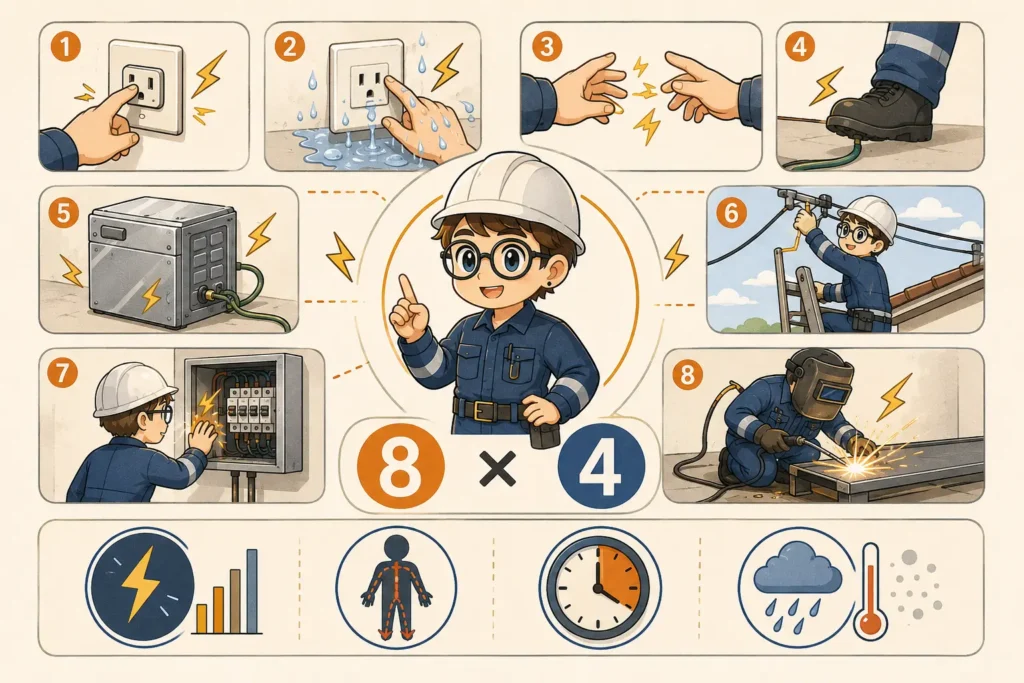
The video explains the four variables behind those outcomes. This article does something different: it applies the same framework to eight common situations involving 120V receptacles, wet work, body current paths, energized metal enclosures, work at height, 240V circuits, and a documented 88.3V AC welding fatality.
The key idea: Voltage matters because it helps drive current, but voltage alone cannot tell you how much current actually crossed the body, which organs were in the path, or how long the circuit remained complete.
▶️ Watch first: four factors that change electric-shock severity
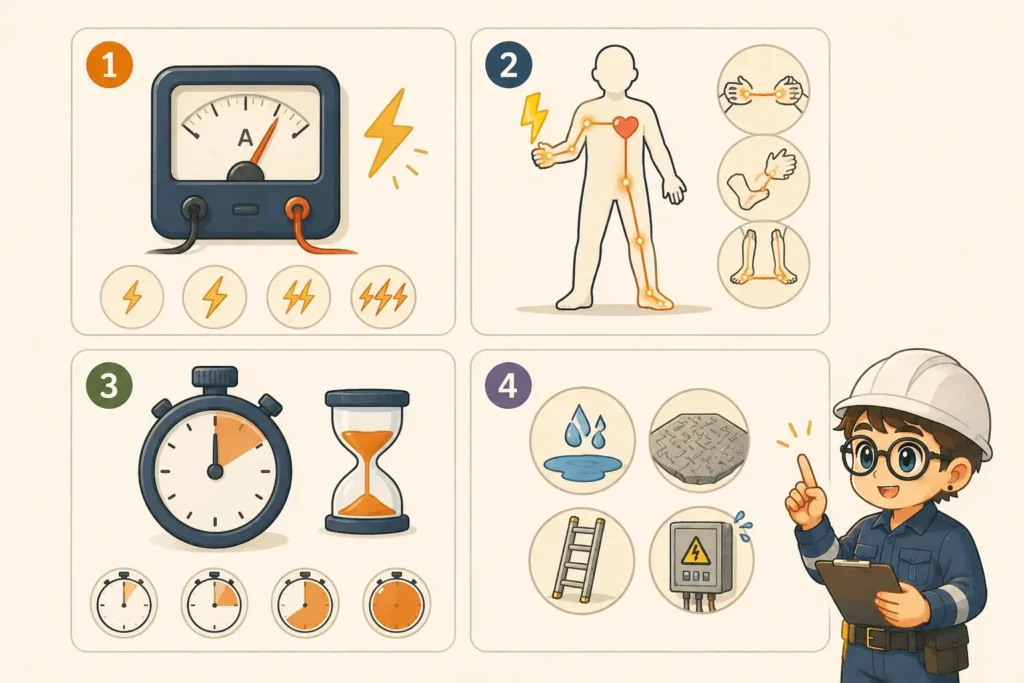
The video introduces a simple memory aid: how much current, which path, how long, and under what conditions. Watch it for the foundation, then use the repeated scenario tables below to practice applying those questions.
Electric shock vs. electrocution: a U.S. terminology note
In U.S. safety writing, electric shock describes electrical current passing through the body and causing a physiological effect. Electrocution is commonly used for a fatal electrical injury. This article uses “shock” for exposure in general and “fatality” or “electrocution” only when a death is documented.
That distinction matters for search intent. Someone asking what happens after a 120V shock may need medical information, while someone studying current paths may need electrical-safety information. This page separates the two instead of mixing medical triage with do-it-yourself electrical instructions.
How to use the four-factor electric-shock check
I use four short questions to organize established electrical-safety principles: how much, which path, how long, and under what conditions. This is an Engineer Tsai teaching framework, not the formal name of an OSHA, NIOSH, NFPA, or IEC standard.
| Question | What you are really asking | Common mistake |
|---|---|---|
| How much? | How much current actually passed through the body, based on source voltage and the total impedance of the contact path? | Treating the circuit-breaker rating as the current that went through the person |
| Which path? | Where did current enter, where could it leave, and did the chest lie between those points? | Looking only at the hand that touched the source |
| How long? | Was contact interrupted immediately, or did muscle contraction, gripping, a fall, or entanglement prolong it? | Assuming a person will always be able to pull away |
| Under what conditions? | Were the skin, gloves, floor, clothing, footwear, metal surfaces, and surroundings wet, damaged, or conductive? | Treating moisture and grounded metal as background details |
OSHA training materials summarize the same core idea: shock severity depends on the current path, the amount of current, and the time the body remains in the circuit, with voltage, moisture, and health as additional influences. OSHA also warns that low voltage does not mean low hazard.
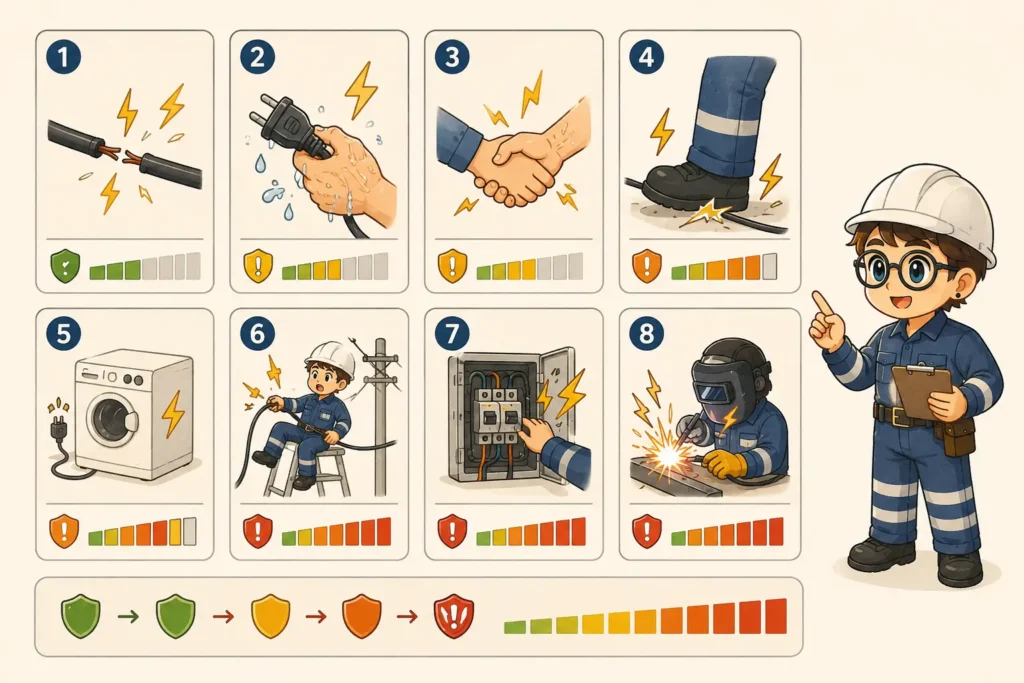
Eight electric-shock scenarios compared
| Scenario | Factor most likely to increase risk | Misleading assumption | Better conclusion |
|---|---|---|---|
| Brief 120V contact with dry hands | Contact pressure, damaged skin, a second contact point, and the return path | I survived it before, so 120V is harmless | The earlier event does not reproduce the next circuit |
| 120V with wet hands or wet ground | Lower contact impedance and a more conductive return path | The voltage did not change, so the risk did not change | The same voltage can drive more current through a lower-impedance path |
| Hand-to-hand | A major path may cross the chest | Only the hand that touched the source is affected | Both the entry and exit points matter |
| Hand-to-foot | The torso may lie between the hand and grounded surface | Work boots always isolate the worker | Footwear and the floor are only parts of the total path |
| Energized metal appliance case | Large-area contact plus grounded surroundings | The appliance still runs, so its case is safe | Normal operation does not prove the enclosure is deenergized |
| Shock at height | Loss of balance, startle response, and muscle contraction | A nonfatal current cannot cause a fatal accident | The secondary fall may be the life-threatening event |
| 240V contact | More voltage can drive more current through similar impedance | 240V causes exactly twice the injury of 120V | The risk is generally greater, but injury does not scale by a simple multiplier |
| 88.3V AC welding fatality | Bare skin, sweat, a chest-to-knee route, and conductive metal | Anything below 120V cannot be fatal | A lower voltage cannot cancel an especially dangerous path and environment |
Scenario 1 | Brief 120V contact with dry hands
This is the scenario most often distorted by personal stories. A person touches a 120V conductor, feels a sharp sting, pulls away, and concludes that standard household voltage cannot be deadly.
What the story leaves out is the circuit. The contact area may have been small. The skin may have been dry and intact. The second contact point may have had relatively high impedance. Contact may have ended before a sustained muscular response developed.
| How much? | Which path? | How long? | Under what conditions? |
|---|---|---|---|
| Dry skin can increase contact impedance, but cuts, pressure, sweat, and contact area can change it | A path still requires another point through the other hand, feet, metal, neutral, or ground | A quick withdrawal once does not prove voluntary release will always be possible | Dry hands and ordinary footwear are not rated insulating protection |
Assessment: A previous minor 120V shock proves only that the previous event did not produce an obvious severe outcome. It does not establish a safe voltage or a repeatable result.
Scenario 2 | 120V with wet hands, sweat, or wet ground
The source voltage may stay the same while the human circuit changes dramatically. Moisture can reduce contact impedance at the hand, improve the connection at the feet, and spread contact over a larger area.
OSHA documented a 2023 marine-construction accident in which workers were standing in water while using an electrical tool. A worker received a reported 110V shock while removing a stuck core drill; both workers fell into the sea from the platform, one was treated and released, and the other died from his injuries. The report does not isolate electrical current as the only cause of death, but it shows why water, tools, and secondary falls must be analyzed together.
| How much? | Which path? | How long? | Under what conditions? |
|---|---|---|---|
| Lower total impedance can allow more current at the same voltage | Hand-to-foot and enclosure-to-ground paths become easier to complete | Muscle contraction or a fall can extend or complicate exposure | Wet skin, standing water, sweat, conductive structures, and damaged cords can combine |
Assessment: Wet conditions do not merely make a shock “hurt more.” They can change the amount of current and make a return path much easier to complete.
Scenario 3 | Hand-to-hand current across the chest
A worker may focus on the hand near the energized conductor while the other hand rests on a panel, metal frame, conduit, ladder, machine enclosure, or another conductor.
Current does not travel as one perfectly drawn line inside the body. It distributes through available conductive tissues. But when the two external contact points are on opposite hands, the chest lies between them, placing the heart and breathing muscles near a major path.
| How much? | Which path? | How long? | Under what conditions? |
|---|---|---|---|
| A firm grip and larger contact area may reduce contact impedance | Opposite-hand contacts place the chest between entry and exit regions | AC muscle contraction may make release difficult | Metal equipment and confined spaces create additional contact opportunities |
Assessment: Always identify both ends of the body circuit. The energized contact is only half of the analysis.
Scenario 4 | Hand-to-foot current through the torso
A hand contacts an energized part while the feet connect the body to a conductive floor, damp soil, a steel structure, or grounded equipment. The current may pass through the torso before leaving through one or both feet.
Ordinary work boots should not be treated as guaranteed electrical insulation. Sole material, wear, contamination, water, pressure, and the surface beneath the worker all affect the path.
| How much? | Which path? | How long? | Under what conditions? |
|---|---|---|---|
| The source voltage and the impedance of the complete hand-to-floor path determine the current | A hand-to-foot route can place the chest within the conductive region | A fall or inability to release may prolong the event | Wet concrete, steel decks, soil, sweat, and damaged footwear can lower total impedance |
Assessment: Footwear and a dry-looking floor are only parts of the circuit. They are not a guarantee of isolation.
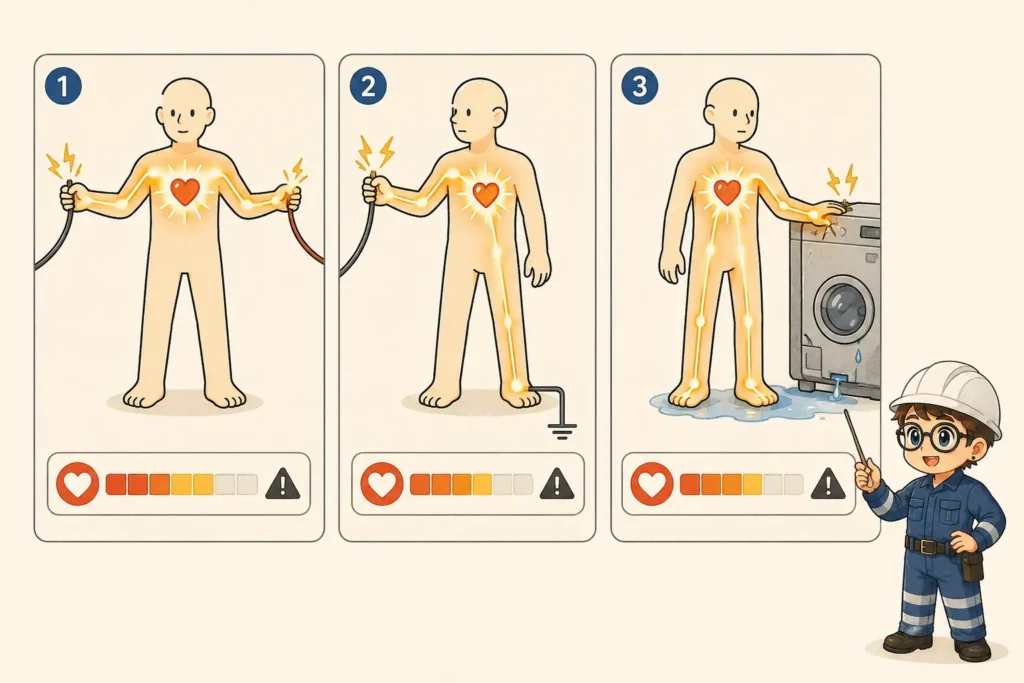
Scenario 5 | An energized metal appliance case
An appliance can continue to operate while a fault energizes a metal case or frame. Damaged insulation, a loose conductor, moisture, or an internal failure can place voltage on a surface that should not normally carry current.
If a person touches the enclosure while connected to the floor, plumbing, another appliance, or grounded metal, the body can become part of the fault-current path. Equipment grounding and GFCI protection are important layers, but neither makes touching a suspected energized enclosure acceptable.
| How much? | Which path? | How long? | Under what conditions? |
|---|---|---|---|
| Fault voltage, grounding, GFCI response, and body-path impedance all matter | Metal case to hand, then through the body to feet or another contact | A grip on a tool or handle can make release harder | Water, metal floors, missing grounding, damaged cords, and incorrect wiring raise concern |
Assessment: “The appliance still works” and “the metal case is deenergized” are separate questions.
Scenario 6 | A brief shock while working at height
Electrical injuries include more than burns and cardiac effects. NIOSH lists falls caused by electrical contact as one of the main electrical injury types.
On a ladder, lift, roof, scaffold, or elevated platform, even a short shock can produce a startle response, violent muscle movement, temporary loss of control, or loss of balance. The fatal mechanism may be the fall rather than the current inside the body.
| How much? | Which path? | How long? | Under what conditions? |
|---|---|---|---|
| A current below a fatal cardiac threshold may still produce involuntary movement | Even a more localized path can disrupt balance or grip | A fraction of a second may be enough to trigger a fall | Ladders, roofs, moving equipment, and overhead conductors multiply the consequences |
Assessment: The environment changes not only how current flows, but what happens immediately after contact.
Scenario 7 | Is 240V exactly twice as dangerous as 120V?
Under otherwise similar conditions, 240V can drive more current through the same impedance than 120V. But injuries are not calculated by multiplying the voltage ratio by two.
Skin impedance is not fixed. Contact can puncture or bypass the skin. Pressure and area change. The body path and exposure time change. That means 240V should generally be treated as more hazardous, while 120V must never be described as safe.
| How much? | Which path? | How long? | Under what conditions? |
|---|---|---|---|
| More voltage increases the ability to drive current through a given impedance | The two contact points still determine which body regions are involved | Inability to release can matter more than the voltage label alone | Wet conditions, metal, confined spaces, and line-to-line contact can increase risk |
Assessment: Do not ask which household voltage is safe to touch. Ask whether the task can place the body across a sustained potential difference.
Scenario 8 | How an 88.3V AC welding contact became fatal
A verified occupational fatality in Taiwan provides a rare documented example below nominal U.S. household voltage. In October 2023, a worker was collecting welding leads and an electrode holder after welding. The reported open-circuit AC voltage was 88.3V.
The official investigation reported that an energized metal part of the electrode holder contacted the worker’s bare left chest. His right outer knee was against a metal pipe on the equipment. The reconstructed route ran from the left chest through the heart region, toward the right knee, the metal pipe, and the welding return circuit.
The report did not document the actual current through the worker or the exact contact duration. Those values should remain unknown. The case does not prove that 88.3V always causes death. It proves that a voltage below 120V cannot be used by itself to rule out a fatal outcome.
| How much? | Which path? | How long? | Under what conditions? |
|---|---|---|---|
| Actual body current was not reported and should not be invented | Bare left chest → heart region → right knee → metal pipe → welding return circuit | Exact duration was not reported | Bare skin, sweat or moisture, conductive metal, and damaged holder insulation were documented factors |
The U.S. NIOSH arc-welding toolbox talk reinforces the same prevention logic: inspect welding leads, keep the body insulated from the work, avoid wet or damp conditions, use dry gloves, and do not touch the electrode or metal electrode-holder parts with bare skin or wet clothing.
Assessment: A lower voltage cannot cancel a chest-crossing route, exposed skin, moisture, and conductive metal acting together.
Five conclusions this comparison does not support
| Wrong conclusion | Why it fails | Better question |
|---|---|---|
| I was shocked by 120V before, so it is safe | The next contact path, skin condition, pressure, duration, and environment will not be identical | Where can current enter and leave this time? |
| Anything below 120V cannot be fatal | The documented 88.3V welding case disproves that assumption | Do moisture, bare skin, a chest path, and metal return exist? |
| I will always be able to let go | AC can cause involuntary muscle contraction and sustained gripping | Could the person grip, become trapped, or lose balance? |
| The appliance runs, so the case cannot be energized | Functional operation and enclosure insulation are different conditions | Has the enclosure been safely tested by a qualified person? |
| No burn means no injury | Electrical injury can affect the heart, nerves, muscles, and deeper tissue without an obvious surface wound | Are medical evaluation or emergency symptoms present? |
After an electric shock: when to get medical help
This section is not a diagnosis or a substitute for medical care. Mayo Clinic states that a person injured by contact with electricity should see a healthcare professional. Cleveland Clinic advises medical care after electric shock even when symptoms are not obvious, with the level of care depending on the exposure and injuries.
Call 911 for severe burns, loss of consciousness, confusion, seizure, trouble breathing, cardiac arrest, abnormal heart rhythm, severe muscle pain or contractions, or an ongoing high-voltage or power-line emergency. Burns, chest pain, palpitations, weakness, numbness, persistent pain, pregnancy, and injuries from a fall also require professional assessment.
Do not touch a person who is still connected to the electrical source. Turn off the source if it can be done safely, keep away from downed power lines, and follow emergency-dispatch instructions.
What future electricians should learn from the matrix
A future electrician does not become safe by memorizing one milliamp table. The more important skill is recognizing every point that can complete a circuit before work begins.
- Look beyond the energized conductor: identify the enclosure, floor, water, steel, conduit, ladder, tools, jewelry, and the worker’s posture.
- Trace both ends of the body path: ask where current can enter and where it can leave.
- Reject experience-based gambling: “I have done this before” is not a hazard analysis.
- Respect qualification boundaries: unqualified people should not work on energized parts.
- Prefer deenergization: control the energy source, prevent reenergization, and verify the condition using appropriate procedures and test equipment.
- Evaluate employers by safety culture: training, job briefings, GFCI use, lockout/tagout, PPE, supervision, and stop-work authority are career factors, not paperwork details.
For the career side of electrical work, continue with Types of Electrical Careers: 6 Paths Beyond Construction and the Electrician Learning Map.
FAQ about 120V, 240V, wet skin, and current paths
Q1: Can 120 volts kill you?
Yes. A nominal 120-volt household circuit can cause fatal injury when enough current passes through the body, especially when the path crosses the chest, contact lasts longer, or wet skin and grounded surroundings lower total impedance. A previous minor shock does not prove the next contact will be minor.
Q2: What happens if you get shocked by a 120V outlet?
The result can range from a brief painful jolt to muscle lockup, burns, a fall, an abnormal heart rhythm, or death. The outcome depends on the current through the body, the entry and exit points, contact time, skin condition, and surrounding conductive surfaces.
Q3: Is 240V exactly twice as dangerous as 120V?
No simple injury multiplier exists. Under otherwise similar conditions, 240V can drive more current through the same impedance and is generally more hazardous. But the actual injury is also shaped by current path, duration, contact area, skin condition, frequency, and the environment.
Q4: Does dry skin make 120V safe?
No. Dry, intact skin may provide more resistance than wet or damaged skin, but it is not rated electrical insulation. Pressure, cuts, sweat, contact area, footwear, the floor, and a second contact point can change the circuit without warning.
Q5: Why is a hand-to-hand shock especially concerning?
A hand-to-hand path can place the chest between the two contact points, so the heart and breathing muscles may lie near a major current path. Other paths can still cause burns, muscle lockup, falls, and serious injury, so none should be treated as safe.
Q6: Will a GFCI always prevent an electric shock?
No protective device can make intentional contact safe. A properly installed and functioning GFCI can interrupt certain ground-fault currents quickly, but it does not protect against every line-to-line or line-to-neutral contact, and protection depends on installation, maintenance, and the exact fault path.
Q7: Should I get medical care after an electric shock?
Medical authorities advise professional evaluation after electrical injury, especially for any burn, loss of consciousness, chest pain, palpitations, trouble breathing, confusion, seizure, persistent pain, weakness, numbness, pregnancy, high-voltage exposure, or a fall. Call 911 for severe symptoms or an ongoing electrical emergency.
Q8: Can I touch a wire or use the back of my hand to see whether it is live?
No. Never use your body as a voltage tester. Electrical work should be deenergized, locked or otherwise controlled against reenergization, and verified with appropriate test equipment by a qualified person following applicable procedures.
About the author and credential disclosure
Engineer Tsai holds Taiwan’s Level B Interior Wiring Technician certification and has field experience in building MEP construction. These qualifications support the electrical explanation and case analysis in this article, but they are not U.S. electrician licenses. U.S. electrical work must follow the laws, licensing rules, employer procedures, and adopted codes of the relevant state and locality.
Conclusion: ask whether the body can become part of the circuit
So, can 120 volts kill you? Yes. But a useful safety answer cannot stop at “yes” or at a chart of current thresholds.
Dry contact, wet contact, hand-to-hand, hand-to-foot, an energized appliance case, work at height, 240V, and an 88.3V welding fatality all show the same pattern: the outcome comes from the complete circuit and the conditions around it.
Before judging any electrical exposure, ask four questions: how much current, which path, how long, and under what conditions? If the body can become part of the circuit, the goal is not to predict whether a person can survive it. The goal is to prevent that path from existing.
Good electrical safety is not proving that your body can tolerate the circuit. It is keeping your body out of the circuit from the start.
🔹Move-in Pro: a 30-minute home electrical quick-scan checklist
If keeping your body out of the circuit is the real goal, the fastest first step is knowing which outlets, breakers, and GFCI/AFCI protection in your own home actually need a closer look. This printable checklist walks you through that scan room by room – it’s a self-check tool, not a substitute for a licensed inspection.
Further reading and watching
- YouTube: Why Electric Shock Is Dangerous — Four Factors That Change the Outcome
- What Is Electric Current?
- Voltage vs. Current
- What Is Electrical Grounding?
- Types of Electrical Careers: 6 Paths Beyond Construction
- Electrician Learning Map
Sources and safety notice
- OSHA: Electrical training material on shock severity, moisture, current path, and low-voltage hazards
- NIOSH: Electrical Safety — Safety and Health for Electrical Trades Student Manual
- NIOSH: Electrical Safety in the Workplace
- MIT Environment, Health & Safety: Electrical Safety and Current Paths Through the Body
- OSHA Accident Report: 110-Volt Shock During Wet Marine Construction Work, 2023
- NIOSH and CPWR: Arc Welding and Electrical Safety Toolbox Talk
- OSHA 29 CFR 1910.254: Arc Welding and Cutting
- Taiwan Occupational Safety and Health Administration: 88.3V AC Welding Fatality, reference 1121815641
- Cleveland Clinic: Electrical Shock — First Aid and Medical Care
- Mayo Clinic: Electrical Shock First Aid
Safety notice: This article is educational. It is not energized-work instruction, medical diagnosis, or permission to test a circuit with your body. Electrical work should be deenergized whenever required and performed by appropriately qualified people using applicable energy-control, verification, PPE, and work-practice requirements. For an active emergency or severe symptoms, call 911.